Showing posts with label Sarah Kay. Show all posts
Sarah Kay ✊ In 1985, at the height of the Cold War, British singer Sting wrote a protest song against mutual nuclear deterrence. 

Calling upon reason, which was scarce at the time, he pleaded to understand that no one is above another – that we all fear death, violence, that we all want the same thing for our children. We all, supposedly, do. We all, supposedly, work toward a society in which they would grow up free and happy.

The Belfast pogroms have tested that theory in two different ways. The non-issue of asylum has been fascinating the United Kingdom, and Ireland, in the most negative way possible. A population ranking under 2%, asylum-seekers have become targets of the most violent of acts, including burning people alive. The Belfast attacker was a 30 year old from Sudan. This was a call to review immigration and our role toward those under international protection. It’s in the name: asylum is not regulated domestically as much as it is the product of a post-war treaty that was meant to address the consequences of the 1936 Nüremberg laws – statelessnesss - and provide for the millions of displaced in Europe: refuge, the right to seek safety and protection.

The current genocide in Sudan should horrify us all. A consequence of the 1994 Rwanda genocide and the 2003 genocide in Darfur, Sudan is suffering unprecedented levels of conflict-related sexual violence. In 2024, Volker Türk, the High Commissioner for Human Rights, commented that:

(The RSF) have killed thousands, seemingly without remorse. They have manufactured a climate of sheer terror, forcing millions to flee. They have let the people who could not - or would not - escape, suffer, destroying medical services and blocking humanitarian aid. 

Ignoring that Sudanese people should indeed be under international protection is dehumanisation on a state scale.

But there are other genocides – in Palestine, in Congo, in Armenia – where the horror continues to unfold; sometimes live streamed into our phones, sometimes spoken about at the tail end of news reports. In 2025, the Office of the High Commissioner for Human Rights announced:

In other areas under M23 control in South Kivu, such as Minova, M23 has occupied schools and hospitals, forced IDPs out of camps and subjected the civilian population to forced conscription and forced labour. Additionally, DRC officials report that at least 165 women were raped by male inmates during the prison break by more than 4,000 inmates from Goma’s Muzenze prison on 27 January, as M23 began its assault on the town.

 As Sting then said, “there’s no such thing as a winnable war, it’s a lie we don’t believe anymore.”

But migration isn’t only about seeking asylum; it is the oldest, and most important, human behaviour. Since the beginning of human civilisation, we have migrated: to find food, to find land, to find water. We have migrated, even more importantly, to find shelter. Through this migration, Darwin’s theory of evolution brought us here, to the point where Jim Crow laws on segregation, a source of nostalgy in many European countries, can become a biological issue. Migration isn’t and will never be a crime, because we have all migrated one way or another in our lives: we studied abroad; we did a work away visa; we visited a friend and overstayed our welcome; we decided to check out a new city because Belfast felt too small. All of this is migration. Moving back with your parents in Dundalk because you couldn’t find a job in the city is a micro form of migration; you wouldn’t have it removed from you. Migration is not the issue; racism is. Only one category of people is allowed to migrate and doing so on the assumption that their chosen form of immigration is the only valid one. Ending immigration has never helped any public deficit or crumbling institutions, in fact, it’s been demonstrated time and time again that immigration has immense economic benefits.

As Sting said again, here’s no monopoly on common sense on either side of the political fence. We believe that those seeking asylum made a choice. We believe that migrants all inherently are bad faith actors in an otherwise open and thriving community. We deny the simple fact of genocide and the direct consequences of global exploitation leading to global inequality. We have no moral or ethical right to denounce what we would continue doing to ourselves: criminal exploitation. Paramilitary recruitment, drug trade, all of which show cruel child neglect in the name of scoring political points. Wouldn’t we want a different future for them, too?

⏩ Sarah Kay is an international human rights lawyer now described as “an unusual and extraordinary threat to the national security and foreign policy of the United States” . . . again.

Do We Love Our Children Too?

Sarah Kay ✊ Several months ago, my phone vibrated against the marble countertops of my kitchen, with several Signal notifications appearing on the lock screen. 

“Am I okay?” my friend and colleague MP texted. “Where should I go? Am I going to end up on a list?” I sighed, grabbed my phone and texted back, “you’re fine. I don’t think you need to go anywhere.” I hesitantly put the phone down, thinking I probably sounded overly dismissive, and texted again. “Plus if you were to be on a list, I’m sure you already are anyway. So keep on doing your thing!” Somehow, it didn’t reassure MP as much as it should have.

On Thursday, an oversensitive and emotional rich white man penned an irrational and disorganised Executive Order, the only actions he seems able to take, not being fully cognisant of what governance requires. The long text, penned without Microsoft Word’s grammatical assistance, is a monumental brick aimed at the glass windows of the International Criminal Court. A full 6,159km (I googled it) from the site of this Executive Order, issued by a country not a member of the governing treaty, the Court is not particularly impressed. It did not stop its work in 2020, and it will not in 2025. However, the language is much broader than the previous sanctions issued back then, which “only” targeted the General Prosecutor and the Office of the Tribunal Prosecutor (OTP).

This time, under the watchful eye of alleged war criminal and genocidaire Benyamin Netanyahu, Trump decided to declare the Court - that, again, the US is not even a part of - “illegitimate”. Seeing that this poor judgement call had little to no effect on a profession that does not recognise the legitimacy of Donald Trump, the only escalation possible was the use of force now targeting international law as a whole. Note that, at no point, in this Order, is Trump asserting the ICC did not have a legal basis to claim territorial jurisdiction over Palestine, or had no legal basis to issue arrest warrants against Netanyahu and former Defense Minister Gallant. It just spat out “legitimacy” as a supremely subjective concept. But of course, the eyebrows were raised over the “dangerous precedent” Trump claims the ICC attempts to set.

As usual, the far right is engulfed with rage over the most basic display of accountability. The precedent is one of possible oversight, and provided us with this Napoleon-esque decision-making: “The United States will impose tangible and significant consequences on those responsible for the ICC’s transgressions” (of what?) ranging from asset seizures to travel bans. Section I (ii) A-C clearly extends to any international lawyer, not a US resident, having participated in any of the investigations, evidence gathering missions, and analysis conducted by the ICC against Israel and against the United States (in case anyone forgot about the Afghanistan investigation). This Order targets not just a few, but hundreds of legal professionals and scholars. It places particular stress on those of us who have worked for, in, or around commissions of inquiry and reside all over the United States.

For the avoidance of doubt, let me make very clear that this will not impact the work of the Court; it never did. It will not affect the work of the General Prosecutor; it never did. It will never lead to a withdrawal of those arrest warrants; this won’t even be considered. In his rush to flex his non-existent muscles against what causes him a slight inconvenience, Trump forgot that not everyone is watching, or is interested in watching. Stating elsewhere in the document that “the United States remains committed to accountability and the peaceful cultivation (sic) of international order” is only worth the quality of the whitehouse dot gov website this was published in. “The ICC and parties to the Rome Statute must respect the decisions of the United States” is risible, “and not subject their personnel to the ICC’s jurisdiction” makes me wonder if the Attorney General has indeed even read the Order. Trump seems to confuse “sovereign prerogative” with “royal prerogative”, demonstrated by his unilateral dismantlement of a Republic he wants to turn into a nuclear wasteland.

From Thursday, we are all under a 60-day notice waiting on a decision regarding who will be directly named by the Treasury, and how section I will apply to our collective visas. For those residing within the United States, this may mean contingency plans, preservation of assets, international protection; this will inevitably result in a paralysis of legal action within the United States. It will deprive the country of its best and brightest, will dim the influence of the United States on the world stage, and continue to enshrine it as a threat to the global rule of law. Trump’s quest for absolute isolationism will sicken, starve, and endanger the country. If any of those preliminary statements about the ICC’s role, jurisdiction, and scope were true, nothing is stopping the US from joining the Rome Statute and taking part in the Assembly of State Parties (ASPs), saying what it needs to say where and when it matters. Alas, this would require some introspection, and probably some legal advice on the risks of accepting territorial jurisdiction.

It seems that, for an illegitimate body, the ICC is terrifying this administration. I, for one, am grateful that it is now acknowledged by Executive Order that our collective legal work, worldwide, has irritated a despot. It is the reason why people like MP and myself have become lawyers: to be witnesses of violence, but with the capacity to act against it. Thanks for the ammunition, Donald.

⏩ Sarah Kay is an international human rights lawyer now described as “an unusual and extraordinary threat to the national security and foreign policy of the United States” . . . again

Sanctioned

Sarah Kay ✊ The first thing I want to say is that I don’t even know where to start.


Somewhere near Bastille, off Boulevard Richard-Lenoir, is a small street without any pretension or, until then, historical significance. Mere walking minutes from the beating, pulsating heart of French identity, stand beige buildings, post-war architecture, with unadorned windows and empty balconies. The traffic of the boulevard is heard faintly during rush hour, but after shops close, it returns to an almost suburban quietness. The backstreets of the 11th district have a lot to share. Rue Nicolas-Appert, ten years ago, was temporarily renamed Rue de La Liberté d’Expression (Freedom of Expression Street).

I grew up with Charlie Hebdo. I grew up with Le Canard Enchaîné. I grew up with old school, sometimes crass, often biting, satirical press. From them I learned critical thought, and the stubborn refusal to yield to power, no matter how democratic. I learned that what happens in the hallowed halls of said power is not necessarily more important or more solemn than fundamental freedoms, including that of opinion, expression, and information. I learned that dissent can be funny; that pompous ceremony is hardly a celebration; and that we should all, if we believe in said freedoms, always remain vigilant. No matter how stable the nation, no matter how safeguarded the human rights, nothing, or no one, is ever safe.

The second thing I want to say is that my memories of ten years ago have no sound.

History came to Charlie Hebdo, and I have never stopped thinking Charb would have hated it. He hated it in 2011, when the firebombing of 2011 forced him under police protection. In 2012, someone called for Charb’s beheading online. In 2013, Al-Qaeda put Charb on its “most wanted” list. The constant reminder of violence and the presence of uniforms in a magazine’s editorial office ring odd, uncomfortable, because unnatural. Can the press truly be free under the watchful eye of its detractors and of the state? Some had then argued, cynically, that liberty has a price, but the cost is unaffordable. If this means leaving behind Charb, Cabu, Tignous, and others, it is unacceptable. This isn’t a contract through which any of us can willingly engage. It is not a debate. It is not a disagreement, it is not even a conflict. It is silence. Silence that has enveloped the district in diffused pain, almost ashamed of its gaping wound: the pens that were now lying on the floor of the magazine offices, covered in blood, next to those who had huddled under desks for the longest ten minutes of their existence.


We know the story. A tragic two-day manhunt resulting in a hostage crisis and the trial by bullet of the gunmen, two brothers who claimed to have killed in the name of Al-Qaeda in the Arabian Peninsula (AQAP) with weapons supplied from Belgium. France will then plunge into deep counter-terrorism waters, yet barely had 10 months’ reprieve before the next terror attack that would then change the country forever, and for the worse. In this interim, the legislation stopped solely relying on the 1905 principle of laïcité, a French exemption to the typical understanding of freedom of religion, which imposes state secularity. It created the criminalisation of what it called “apology for terrorism”, ie. its support or endorsement; it limited reporting on national security and defense matters; it demanded complete and total subjugation to a new order, in which prevention of radicalisation and extremism would exceed its constitutional ambitions to preserve speech and opinion at all costs. What Charlie fought for seems to have vanished with them, somewhere, indeed, between Bastille and République.

We should never forget them, and never forget that Charlie Hebdo’s refusal to bend the knee wasn’t reactionary, or disrespectful. It was foreshadowing what the world had become, and would continue to cement: a timid, non-confrontational analysis of world events. I often ponder what Charb would think of France today, under Le Pen’s spell, causing chaos in the Assemblée, unable to find its place in an increasingly polarised world. The silence is deafening.

A week after the shooting, on the 14th of January, Charlie Hebdo rose again in an act of defiance. The Prophet Muhammad is depicted on a green background, holding a pen, and shedding a tear. “Tout est pardonné”, “All is forgiven”, the front page read. It ran almost 8 million copies worldwide.

Pour Cabu, Elsa Cayat, Wolinski, Charb, Philippe Honoré, Bernard Maris, Mustapha Ourrad, and Tignous.

⏩ Sarah Kay is a human rights lawyer.

Catharsis

Sarah Kay ✊ once ran into Manuel Valls in a shopping centre in Evry-Courcouronnes in 2008. She’s been struggling ever since

2024 challenged democracy and modern institutional status quo like very few years did before. Some would show you the responsible planets for it, others would refer to the inevitable and cyclical nature of extremist politics. What France brings to the table is stereotypical but always gravity-defying political spectacle.

Unseen under the Fifth Republic, the vote of no-confidence (motion de censure) in the Michel Barnier government feels like a brick thrown at a window. It is not just a reflection on Barnier himself but very specifically of President Macron, delegitimised since his anticipated dissolution of the Assembly earlier this year, but seemingly delegitimising himself. This vote was a long time in the making, but it was clearly aimed at the President. Unfortunately, the Constitution only allows for the use of this parliamentary procedure to target the Prime Minister. And so Macron remains, a much hated figure that now clearly rang the death bells of the Fifth Republic.

The Centre-right struggled to emerge from this spring’s elections. Little to sell, with a lot of pre-existing baggage from Macron’s chaotic and controversial first mandate, they only took leadership out of principle. But familiarity brings contempt, and constant flirting with the demands of an empowered far right was never going to yield stability. One thing always leads to another, and unacceptable compromises reached their apex. The reactionary challenge to an indifferent government is one that will burn more than bad lawmaking. On the day of the vote, led by Le Pen’s formerly-known-as-the-National Front RN party and drafted by whatever is La France Insoumise (far-left pre-Potemkin? Nationalist socio-anarchism? Loud noises?) unions and collectives asked parties to vote against axing the government, insisting on the need for political stability for the purposes of negotiations and planned reforms. So, what now?

Well, France has made its constitutional bed and is very likely to keep Michel Barnier. Macron has already exhausted his get-out-of-this-government dissolution free card and would now have to wait two more years to announce parliamentary elections. As of Macron himself, he is extremely unlikely to go. Nevertheless, he persisted with his (ab)use of executive powers, such as the very Gaullist 49 (3), allowing for the President to force legislation through both Chambers. Austerity politics announced with very little mitigating measures as well as constant nods to Le Pen on immigration, borders and EU foreign support was never going to be the thriving pluralistic influence Macron begged for with his dissolution gamble. The truth is, there is no turning around that ship. Macron is headed for the iceberg but pretends he can outrun it.

Le Pen herself is in a predicament. Facing several counts of corruption and embezzlement, she could face 5 years’ imprisonment if found guilty in an ongoing trial. She could also be hit with an electoral ban, meaning she would not be allowed to run in the upcoming parliamentary elections. Her absence would be a breath of fresh air, but it is a medium term goal. As of today, France is heading toward the inevitable end of the road crash, a test of institutional resilience I am not sure it is quite ready for.

Growth is always uncomfortable, but the country does not know government suspensions the way we do here in Northern Ireland, and it might have to find a quick solution to this perennial problem of political legitimacy: do people get the government they deserve?

➽ Sarah Kay is a human rights lawyer.

Tout Est Chaos, À Côté

Sarah Kay 🔖 Erasure takes so, so many forms.


We talk of erasure when talking about censorship; silencing; oppression, suppression, and the annihilation in its absolute form, genocide. In an era of rampant state violence, from police brutality to wars of expansion, the chant remains the same: say their names. But how do we pass on this knowledge? Above all, what does bearing witness mean?

Erasure is an odd term. It can be active or passive. It doesn’t, in itself, indicate violence. If nothing else, it is about the passing of time. Remnants of past civilisations – Pompeii, Athens, Jerusalem, Homs, Bamiyan – those places were erased, but not for the same ggkreasons. The elements do not have criminal liability. Survivors are not carrying the same burden.

In Against Erasure, we catch a glimpse at life in Palestine before the 1948 Nakba. A Palestine that rises from the ashes of military destruction. We see multigenerational families tending to olive groves; we see patriarchs with long white beards reading to young grandchildren; we see women in colourful dresses, resting on a thick, rich rug, sharing tea and wisdom amongst themselves. We see lives, intertwined and interdependent, living peacefully, including the presence of other ethnicities: an Armenian family; a Bedouin tent; a group of Coptic monks. Musicians, artists – singers, oud players, trumpetists – adorn the pages of this book, full of life, full of history, heavy with millennia-old knowledge.

Erasure, in a genocidal context, is not simply about human extinction. It is about annihilation of culture, of tradition, but most importantly, of memory. We see the same dynamics at play on a lesser level but with the same intent elsewhere: book bans, historical revisionism, passive voice in news coverage. By erasing suffering, we erase victimhood. By erasing victimhood, we erase its cause. We erase culpability, and root causes. We then all become unwilling participants in the process of destruction.

Bearing witness is not about the reckless consumption of graphic horror on the daily basis. Bearing witness Is knowing what is in front of us – erasure – and refusing it. We say names, but we also know the faces. We talk about places, but we also know what they looked like before walls, checkpoints, and military patrols. Candlelit processions to mosques, parades, murals on the walls of schools and processions in Gaza, the times of the British mandate however must not be seen through positive nostalgia. It was colonisation still, and state control pouring out of every frame. But the aspiration for a different and better future was still there.

Against Erasure affirms that Palestinians have the right to exist; the right to live free from violence; the right to their language, their history, their culture and their land, a fertile one stretching from the river to the sea. Our duty is never to forget.

Teresa Aranguren and Sandra Barrilaro, 2024, Against Erasure: A Photographic Memory of Palestine Before the Nakba. Translated from the Spanish edition by Róisín Davis with Hugo Rayón Aranguren. Haymarket Books.ISBN-13: ‎978-1642599800.

⏩ Sarah Kay is a human rights lawyer.

Against Erasure

Sarah Kay 🔖 My memory is faint, and I hold onto it like a child with a blanket. I worry it might disappear.

I remember the feeling of warm sand under my feet, my shoes in my right hand. It was a pair of beaten up Dr Martens, the same boots I had worn since I was a kid that had followed me around the world, in all those places where human life is cheapened and reduced to survival.

The sun was setting, but the warmth remained. The gentle clapping of the waves somehow absorbed every sound around. There were families behind me, with children running, laughing, parents calling them home, as it would be time for dinner. All I could hear was the rush of the Mediterranean, a vast body of water that had calmly surrounded so many places I should be able to call home. Palestinians cannot call Haifa home. My feet have known Haifa, but so many indigenous to this place never have.

I have talked about home, not just the physical element, but the idea and ideal of home, with Mx Yaffa for years. I have approached Blood Orange with that knowledge of the extreme privilege I have held, being able to return to Belfast safely, on my own terms, on my own time, and without any obstacle. Home is not a privilege. Home is a right. Home is an entitlement. Colonialism, occupation, and genocide are weapons forged in the fire of controlling, destructive, and bloodthirsty power. Resistance to this absolute desire for annihilation has always floored me, like a flower blooming from beneath the concrete. A flower that smells like orange blossom.

In Blood Orange, Yaffa asserts, declares, cherishes, and opposes. It is an ode to the sense of self; to the knowledge of identity; to reverence to our ancestors; to claiming, and reclaiming, a language, an appropriation of the land, an understanding of the elements, and the acute pain of displacement. In “I Am”, perhaps its most powerful core, Yaffa fearlessly and powerfully declares,

I am not

A Palestine you

Can erase

I am

Indigenous sovereignty

You can't wipe out

I am

Palestine

Indigenously sovereign

A movement

A thought

A voice

I am inevitable

This inevitability is what has powered independence movements since the dawn of our belligerent humanity. We are told the arc of history always bends towards justice, but justice’s arm is not even-handed, to say the least. This inevitability transcends man-made structures, the pathetic fragility of the nation-state, the inherently unsustainable idea of supremacy. It is inevitable that Palestine will be free. It is inevitable that we, as a collective, will one day be free. Our lifetimes are just that; short, ephemeral, insignificant. The intimacy we feel towards our own idea of freedom and liberation is what endures. It is okay to feel small in the face of a grand revolution, and this is how Blood Orange made me feel: I was dwarfed by the luminous revelation of this inescapable future.

With the simple question, So / Where do / The motherless / Go? Yaffa forces us to face our idea of displacement. In a world full of foaming-at-the-mouth screams for blood and soil, have we forgotten about Palestinian, with no right of return? Have we forgotten about Armenians, chased from Turkey to the Caucasus? Have we forgotten that the celebration of a diaspora, regardless of its ethnic origins, is one always borne out of atrocities? In this same blog, I had talked before about the end of legal sovereignty, this idea that our norms could be the way out, a hopeful and inclusive vision for an utopic future. In this constant struggle between the advocate and the legal professional, between the prosecutor and the activist, I have found a narrow, dry and somewhat loveless place in which to stretch my legs.

Blood Orange challenges those narrow, occidental world views. It shatters those pre-conditioned ideologies by not just expecting, but demanding, a genuine, true way out. A way out for all the oppressed. No longer containing classifications of skin colours, no longer expecting compliance with half-baked democracies, seeing beyond all of this, all of this noise, this undignified fist fight for power. A utopia.

All that is left for us, the readers, is this:

Our blood filling

Trees and canyons

Turning the

Sea a blood orange

Like an eclipse that

Forgot to

Subside

May we see an end to this blood shed in the name of control, and may all see the waves in Haifa. May we all be freed from a seemingly unstoppable appetite for hate. As Stefan Zweig once wrote, may we all see a dawn to this long, cold night. Mx. Yaffa gave us one. Least we can do is listen.

Yaffa As, 2023, Blood Orange. Meraj Publishing. ISBN: 9798223130505. Buy from Rainy Day Books.

➽ Sarah Kay is a human rights lawyer.

Blood Orange

Sarah Kay ✊ Sometime near 60 BC, the Roman scholar and lawyer Marcus Tullius Cicero advised his friend Titus Annius Milo, accused of murdering a third person, resulting in a speech during which the now infamous phrase originated. 

Several times modified, the original idiom goes silent enim leges inter arma, which translates into, “in times of war, the law falls silent.” This was meant to explain his murder will go unnoticed, because larger issues kept the world occupied. And ever since, taken in much more gruesome contexts, the maxim is invoked to claim that atrocities are committed in the name of war. As John Kirby, the White House Press Secretary, noted on the 25th of October, “war is messy, war is gory, and civilians are gonna die.”

Since hearing those words, I have tried to sit with those words, and what those words mean for someone like me, whose job rests on the premise of being loud, extremely loud, in time of war. Sixteen centuries later, Hugo Grotius, residing in The Hague, worked against Cicero in De jure belli ac pacis, published for the first time in 1625 and intended as a gift to Louis XIII of France. This was not the first time “law” and “war” found themselves in the same sentence, but it cemented the belief that even one of the great plagues can’t silence those of us who regulate, determinate, and adjudicate.

I could continue to cover three more centuries of words in Latin then in English that would tell you about war, and the regulation of conduct of and in war. I could tell you about the League of Nations and I could tell you about court referrals. One thing I can not tell you is why the law is painfully silent on the day I am writing this, and the 28 days prior. In response to a horrific, mass scale terror attack committed by the terror group Hamas, the state of Israel has decided to continue - and promises, this time, to finish - its genocide of the Gaza Strip. I am mentioning another loaded word, this time not Latin, but Greek: genocide, the destruction of an entire population.

We have language for the unspeakable. We have collated seemingly opposite civilisations to create a common memory cataloguing horror. We have then drawn, designed and implemented the aforementioned laws and regulations that speak of those horrors with the reverence of those who remember, but the arrogance of those who think they can stop this from happening, by sheer will, not even commitment. I learned from the books, tediously. I nearly crushed under the weight of self-discipline, but the belief carried me.

I didn’t find law silent in time of war. I stood with a stained jacket on the Whiterock Road in Belfast. I tiptoed along abandoned railway lines in Kosovo, mere years later. I found those, blue helmets and blue jackets and blue pants and blue armbands, full of rage, full of despair. They weren’t silent. They were loud, but it wasn’t enough: genocide was louder. After Rwanda, East Timor, Myanmar, China, and the atrocities in Afghanistan, Yemen, Syria, and Libya, who is louder? Are we just building more and more bombs to drown the screams?

We are taught accountability at a very young age. We know actions have consequences. And yet millions are dying in Gaza due to a near absolute absence of consequences. Millions are already dead in the Democratic Republic of Congo, sacrificed at the altar of neocolonial policies that seem to escape the accountability that true universality requires. In 2017, Prof. Anthea Roberts wrote the critical yet controversial Is International Law International? - wondering if the Global North continues to exert judicial dominance over the South. But as we are witnessing yet another genocide, waged in the Occupied Palestinian Territories and on everyone’s social media account, we are now told to once again relegate human rights and humanitarian imperatives to secondary or tertiary concerns, as there is some eradicating, annihilating, and cleansing to do.

We are not silent, and we have never been. What we need is the political courage to support accountability, regardless of who the perpetrator is. What we need is to restore what was at the heart of regulating war in the first place: to limit the constant letting of civilian blood that has never fertilised any ground or bred any trees, of freedom or prosperity. What we need is the courage to end it, and the screaming will cease.

➽ Sarah Kay is a human rights lawyer.

Inter Arma Silent Leges?

Sarah Kay ✊ Yes, and there are ICC fact finders there now. 

Designated starvation and collective punishment is what characterises specifically the treatment in Gaza, in addition to the conditions of detention: it can cross the threshold into genocide.

It took 60 years to take it to the ICC. I don’t want to die before hostilities cease and I see the case. Palestinians deserve a state, deserve peace, deserve safety, and deserve self-determination. Most importantly, they are entitled to all of these things. Let me repeat. Entitled.

Israeli civilians and foreign nationals currently being detained, injured and killed are damage caused by Netanyahu’s lifelong commitment to eradicate the Palestinian cause and its survivors. His government has, just like Russia before it in the face of the Ukraine invasion, criminalised protest, imprisoned dissent, and ripped out the courts. Consolidating power, he triggers Hamas’ violence and traps his own citizens under their guns.
 
Hamas does not represent Palestine, but Palestine has no way to obtain representatives. Palestinians can’t go back home, they do not have a right of return. Palestinians can flee, but they’re already the largest refugee population in the world, making up a two digit percentage of the populations of both Lebanon and Jordan. Palestinians were in the largest Syrian refugee camp, Yarmouk, before the Syrian uprising. Yarmouk, since 2015, is the definition of hell on earth. I’ve been there. Hell. Hell you can’t comprehend. Hell I hope you never can.

Mandatory drafts, denial of access to civil rights for the non-Jews, refusal of mixed marriages, and forced religious education makes Israel an oppressive theocracy. I am urging everyone on the Palestinian cause to reach out to Jewish voices for peace and Israeli activists fighting against the occupation of the Palestinian Territories, which, I have to remind everyone, have borders fixed in 1967. Anything else is a crime of aggression. Israelis are scared because they have no say in how their government treats Palestinians; and how they will be made guilty.

Politics are too complex for war, and that has always been the case. The law is not silence in time of war, this idiom no longer exists and in fact, ignores just how old the regulation of conflict is. Politics are silent, because politics is about dialogue, debate, and discourse. War doesn’t just suspend those, it destroys them. You can only argue with the living; and those who made it back have lost the capacity to do so. Trauma, once inflicted on that scale, also defines the political silence of future generations, for whom opposition will be the only way to create identity and community.

There can be no peace without justice, and justice would demand that the current US budget of military assistance to the IDF - $3.9 billion as of 2019 - is suspended. Justice would mean treating Israel the way we would treat any other state that would commit such crimes, for so long. Justice would be granting Palestine statehood. But statehood demands three criteria. One of them is territorial definition.

And Palestine’s borders already exist. They were drawn. They’re drawn on the UN HQ walls, where every year, we have a reminder of how much we fucked up in handling the end of British colonialism of the area mixed with the aftermath of the Holocaust.
 
  • The Nakba compounding existing trauma.
  • A genocide to respond to a genocide.
  • A crime against humanity to balance a crime against humanity.
  • Programmed dehumanisation to face annihilation.

This conflict proves humanity at its worst. It illustrates how little we invest in the principles we claim to uphold because everything becomes an ideological fervor to end all the previous worships. Israel and Palestine, the most fertile and holy ground of our entire civilization, are now where such lofty ideas of development and morality die in abject circumstances.

We are all responsible for this conflict. And we are all responsible for calling an end to it and demand action. Without Islamophobia, without antisemitism. Because we must. Because the Palestinian cause is everyone’s cause. Its asks are everyone’s asks. Its resistance is everyone’s hope. Its endurance is everyone’s perseverance. And Israel’s fascism should be everyone’s anxiety. Because its self preservation at all costs is our isolation. Because its hunger for control is our submission. Because its manipulative foreign policy becomes our burden of arms trade.

It’s about and for all of us.

➽ Sarah Kay is a human rights lawyer.

Israel’s Fascism Should Be Everyone’s Anxiety

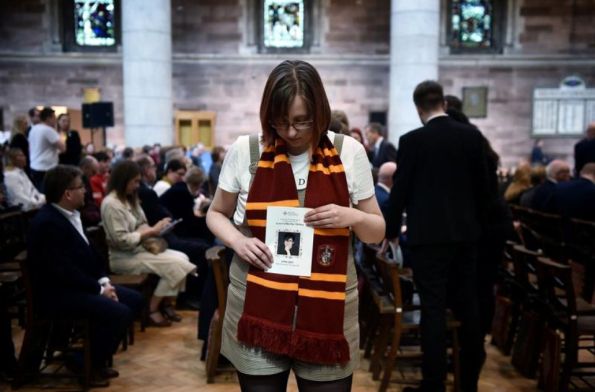
Sarah Kay remembers Lyra McKee on the first anniversary of her death in a piece that featured in Non Curat Lex.


In the middle of a pandemic, where everyone worldwide is counting their dead, pouring over curves, peaks, spikes, and dips, where every little dot is a human life drowned in the name of the god of statistics, it feels trite to extract one life, and make it important. What would be even more painful, and egregious, would be to turn this one life into a symbol of everything larger than them, bigger than the pain of their loved ones, and plant it as a monument to all those wishing to worship another god – politicisation, bigotry, peace – as opposed to the life itself.

It’s been one year since my friend Lyra McKee was gunned down in Derry. It’s been one year with a couple of people in custody, some outrage here and there, and fortunately, a compilation of all her unpublished work released by her publisher with the consent of her family. It’s been one year today, and it’s a year during which so much happened, that I couldn’t stop thinking, for a second: Lyra should have been there. Lyra would have been on the frontline with NHS workers, defending a welfare state that cares about all and not a few; she would have investigated governmental failures to protect; she would have reached out to us human rights defenders to see what could be done to ensure security and health, and what were our primary concerns for the post-pandemic world. She would have, would have, could have, she could have, all of this potential, wasted away.

This isn’t my grief. It is Northern Irish grief. It is this very form of anger mixed with the powerlessness in which paramilitary recruitment incubates 20 years after the peace process. It is the fury bubbling below the surface of our tired skins that a 29 year old would still be adding her name to the list of those who continued dying after our official statistics ended. She has become one of those she were writing about. Those young lives, all of whom mattered, all of whom had loved ones and futures and maybe an education, a vocation, a calling, all of those beating hearts that had not been defeated by the lack of prospects in our respective neighbourhoods, that could have helped radiate Northern Ireland not just in Ulster, but in Europe, and beyond. Lyra died because someone in the N-IRA went out that day and decided the right to life wasn’t their priority. Most importantly, Lyra died because she was doing her job, and the N-IRA would not stop terrorizing communities.

I don’t care about their apology, but I care about all those messages I have left on my phone. This isn’t a peculiar loss, either. Throughout the world, families, extended ones and close ones, have those empty chairs, those absences, those ghosts, their candles at their windows, because terrorism, conflict, insurgency, cartels, have robbed them of someone that was crucial to their stability. Lyra McKee was a journalist, and she stood up, wrote, researched, interviewed, probed and poked for all of those bodies, the nameless and the interred, the disappeared and the headlines, to figure out why they were not amongst us anymore. Her particular skill, what made her writing so specific and her voice so unique, was that she was capable of entirely removing herself from a story and give the front row seats to those voiceless citizens. She focused outside of the statistics. The new generation – hers, and the ones that came after – that continue to suffer the mental health deterioration due to the conflict, the unspoken suicides, the lost boys of paramilitary machismo, the forgotten girls of religious bigotry. The issue with Northern Ireland, you see, is that every cobblestone hides something underneath it. Every brick probably rings hollow. Not only did we need Lyra, we need more journalists like her. She had spoken with the support of PEN and Amnesty International on the importance of investigative journalism at a time when the political will on both sides was to forget and maybe, down the line, accept reluctant forgiveness. Amnesties were not Lyra’s beat. Lyra wanted accountability, and she wanted them for all.


I wrote about this before, but the way Lyra McKee and I met was because she had heard of me, a girl from the lanes, that had somehow made it out, and had tried to do something that would make the city proud. I don’t know if I had the chance, throughout all those years, to tell her that she was the one being the standard for what Northern Ireland can achieve. She was the role model. She was a powerful voice, a loving caretaker, and a passionate partner to the love of her life, Sara. I would send her photos of wherever my travels would take me, and she would make plans to be there some day. My losses and my frustrations were hers. My wins and my elation were hers, too. This is what friendship means. But there is a strange bond between a human rights lawyer and a journalist: it’s truth. Granted, the two professions butt head often enough that this may sound odd, but truth and justice are two fundamental values that could never be replaced. We talked about our dead, in the middle of the night, or over coffee; we talked about exile, displacement, about parallels between this war and others. She wrote so beautifully about how Northern Ireland could be so much more than what it is. Because it can. And I have to believe it will.

If we are about truth and justice, the very least we can all do is carrying on Lyra’s work. It’s to leave no stone unturned, to advocate for all victims of the conflict, to continue pushing for accountability, to force recognition and acknowledgement of every repeated pattern in current counter-terrorism operations, and to respect, honour, protect the freedom of the press. We have to commit to ensuring a brighter and positive future for everyone across Ulster, and to uphold their civil and human rights. LyraMcKee did not give up on Northern Ireland, and neither should we. This isn’t about the guilt of the diaspora. It’s about what we can do, right here, right now, to put an end to paramilitary recruitment, to demand more from those tasked with enforcing the peace process, to push for deeper integration of communities, take those walls down, and giving each and every grieving family what they were asking for all along. Truth. Justice. And the end of the staccato sound of a rifle ripping through a dark and moody night. No more of those. No more waiting for wailing sirens, no more being interrupted by the dull vibration of a distant explosion. No more.

She is not the first person I have lost to this particular war in which I grew up. I am, very much, this war. She is not the first person I have lost to a terror attack. She is not the first journalist to have been killed while performing their job. She is not the first friend whose loss is leaving an empty space where text messages and dinners at Home should be. The question “why” continues to resonate, loud, insistent, a power drill to the skull, every single time. How can someone die in Derry in 2019? How was someone with such a strong activist background absent from the celebrations of the legalisation of same-sex marriage and abortion? We will keep working, speaking, writing, publishing, advocating, and litigating until Northern Ireland sees a future at the end of this very bleak and much too long tunnel.

There are no lessons learned, because senseless death is senseless death. There is going forward. For Northern Ireland. For us all. For Sara. For journalists worldwide.

The mission has never mattered more.

➽ Sarah Kay is a human rights lawyer.

Northern Discombobulation

Sarah Kay answers 13 questions in a Booker's Dozen.


TPQ: What are you currently reading?

SK: I'm currently reading Les Travaux, the 8-volume work on the drafting of the ECHR, for a huge paper I'm writing. I hope to soon have some time to read Drive Your Plow Over the Bones of the Dead by Olga Tokarczuk, gifted to me by my friend and brilliant barrister Brenda.

TPQ: Best book you have ever read?

SK: The Ground Beneath Her Feet by Salman Rushdie. It's one of my favorite books of all time.

TPQ: A must-read before you die?

SK: I majored in classics in high school, so I think I did all the reading I needed to do, but maybe the must read before I die hasn't been written yet. I welcome suggestions.

TPQ: A preference for fact or fiction?

SK: I can't choose! I very rarely - and I mean it's happened once or twice during the last decade - fact because I want to keep reading about what I do and want to get better at it, but sometimes fiction provides the best escape.

TPQ: Favourite female author?

SK: I don't know if there is an author, male or female, whose books I would automatically buy if I knew they had one coming out. Marguerite Duras, probably.

TPQ: Favourite male author?

SK: I already cited Salman Rushdie, so I'm going to go with Philip K. Dick.


A Berlin Book Tower in memory of the Nazi book burning.

TPQ: First book you ever read?

SK: I literally don't have any idea. I remember I used to steal my older siblings' books, which was fine, because they didn't know I could read yet, so I could pretend it had nothing to do with me. But I don't remember. I might have also grabbed a book from my parents' library.

TPQ:
Favourite childhood author?

SK:
I was never into "child books", very early on. I would read a book if I wanted to read it. No one ever told me it was inappropriate or that I wouldn't understand. I have a lot of affection for The Giver by Lois Lowry, and for the values it holds.

TPQ: Any book you point blank refuse to read?

SK: Trump's books are a no-no.

TPQ: Any author you point blank refuse to read?

SK: Oh I also don't care about Sean Spicer's book. I heard John Yoo has one out as well? That's a shame.

TPQ: Pick a book to give to somebody so that they would more fully understand you.

SK: Circe by Madeline Miller. It was - again - gifted to me by a dear friend who understood that it would really help if I read something that wasn't law-related for once, and I was probably the last person on earth to read it since everyone around me was giving me rave reviews. Well, it didn't disappoint. I'm definitely a daughter of Circe.

TPQ: Last book you gave as a present?

SK:
I Am The Border, So I Am by @BorderIrish. I'm using it as stocking fillers this Christmas. Everyone needs to know. I think I also sent someone Ubik by Philip K. Dick.

TPQ:
Book you would most like to see turned into a movie?


SK: I'd rather they weren't. I think The Haunting of Hill House series was a masterpiece and really did the book justice. I'm also into The Man In The High Castle series, but they took liberties, so at first I was a little peeved. I don't know. I like books because they allow my imagination to form what it is and what it looks like; I don't want a vision to be imposed on me necessarily.

➽ Sarah Kay is a human rights lawyer.

Booker’s Dozen @ Sarah Kay


Sarah Kay shares her thoughts on a recently published book by The Irish Border.


The role that @BorderIrish played in educating the Twitterati, especially of the English and broader Commonwealth persuasion, about Northern Ireland and its invisible frontline proved invaluable. Its online participation in debates has elevated an anonymous social media figure to the political representation of values and safety that no one else had until then taken to heart. By photoshopping a picture of an elephant on an official Cabinet photo release during a Brexit negotiation, @BorderIrish let everyone understand that the Northern Irish population, if not represented at Chequers, or poorly, in Westminster, would at least have a bit of craic at the expense of the British government.

It worked.

The book that came from the success of the Twitter account includes most of the quips and sarcasm to which we had become accustomed, the Border, after all, being as Irish as possible, could never simply write down history in the first degree. It would take a specific sense of humour to appreciate the complete absurdity of Brexit, while the gravity and seriousness of its sheer neglect of Northern Ireland deserves nothing but scorn. @BorderIrish’s made-up characters – the rebellious, funny, informed best friend Jean, who lives in a border town, and Jim, the Leaver who never leaves, are part of a book that spans the three years since the referendum that upended a continent, and the end of this decade, nowhere closer to a resolution, but much deeper and entrenched into divisions.

But @BorderIrish is not just here to laugh at Jim’s expense and high-five Jean – well, touch her hand with its blades of grass – whenever a British civil servant comes back to London empty-handed. It is also there as a keeper and reminder of a history that belongs to my generation and those that came before mine, the legacy of the current and future Irish and Northern Irish generations. Keeping this in mind, and with memory sometimes a painful one, never truly erased by the speed of the Enterprise racing from Dublin to Belfast, the book keeps its promise never to let any reader forget exactly where it comes from and what it has seen. One passage in the book is particularly poignant: “you will do everything to forget about me, and I will make sure I am the one border you will never forget about.” If this sounds ominous, it’s because it is: incidents of violence in Northern Ireland have risen since 2016; emergence of new paramilitary groups have already claimed lives; and Brexit has already been declared a threat to the Good Friday Agreement, an international peace treaty.

The Border painstakingly explains it is both the Irish border in the UK and the British border in Ireland, although by the nature of the isle and its formerly temporary status, it is more of an Irish border. From the use of typical local slang to the references of the cities near or across its “squiggly bits”, @BorderIrish is a voice representing those who were never asked to opine on the consequences of Brexit on their lives; the cities that have sprung across the grassy fields and empty spots where customs posts once were; the people that walk, run, work, live, across a fault line they have learnt not to think about every day. It is no longer the threat it once was; it is a matter of change in currency, health systems, and governance – or lack thereof. But for border communities, there is no question to divide themselves in two, the strike of an axe across their recent lives and newfound aspirations, a Berlin Wall separating families over an accent, a religious affiliation, or an overwhelmingly present sense of patriotism.

I have crossed that border many times. I had long hated it, and had wished for nothing else than to see it disappear. @BorderIrish reconciled me with it through an amorphism; it is a border that loves some pastries, isn’t keen on dogs being walked near it, friendly with cows, and getting seriously inebriated when a lorry is losing a beer keg across it. It tries to make friends with Michel Barnier, and reaches out to other borders in order to figure out if it is truly that unique. Once sleepy and quiet, @BorderIrish finds itself at the heart of the biggest diplomatic and foreign policy issue of this European era, without the support or the understanding of involved parties. Norway, Sweden, Gibraltar, Mexico, and other contested lines in the sand, mountains, or sea are asked to weigh in with their own particular history and their own knowledge of conflict near or because of them; despite the pressing nature of sovereignty and border control in this golden age of cheap populism, @BorderIrish finds itself in a unique position of being both invisible and impossible to miss, non-existent and over present in negotiations, a political symbol that refuses to be politicized, and a commitment to peace without a representative in Stormont to speak on its behalf. This is perhaps the most Northern Irish thing that I have ever come to witness in a very long time: how to disappear without stopping to exist. That is one existential question of a region that never fully grappled its history if I’ve seen one.

Of course, it is hard not to speculate on @BorderIrish’s author identity. The book plays with the great names of literature, trying to translate the post modernism of Twitter’s character limits into what Shakespeare, James Joyce, Samuel Beckett or W.B. Yeats would have said. The exercises exist in the book, so salient and precise that one can only accept that our border is nothing short of exceptionally erudite. This is perhaps thanks to decades of not having to do anything else but let the grass grow and watch cities erupt, as opposed to hearing the clacking sound of rifles or inhaling the smoke of burning buildings. It pays tribute to what the country has done best, its most prideful exports, its characters and its humour, its resilience and resistance, but at no point does it ever underestimate the constant fear that Brexit has placed in the minds and hearts of those who know @BorderIrish exists. In short sentences and carefully chosen words, it speaks of the violence it once saw, the lives that are no longer present to speak in Brussels, of the balaclava-hidden faces that have traipsed along the long fence. If one does wonder what Twitter would look like if De Valera and Michael Collins had access to it in 1919, it surely can’t beat the ignorant statements put forward by several DeXEU ministers or Home Office civil servants with regards to what is now a Northern Irish Question.

And so the book ends. The reader laughed, cried, felt something pinch at its heartstrings and depending on its age, traveled back in time in the darkest recesses of its mind, when @BorderIrish was menacing, not protective. And protective it definitely is. The Twitter account as well as the book make it clear that they exist because no one else otherwise would; because the silence over the Irish scar has been deafening, and will not be swallowed if placed into the Irish sea. Northern Ireland will soon enter its third year without a local government; it is just as shaken by the looming British General Election as one can expect; but we should never forget a past that is still our present for the sake of political convenience. We can laugh about it; we can be cynical about it; we can decide we will keep our head high in the midst of all the feudalism remarks that appear in the right wing press, but one thing is for sure, is that we should and shall not be forgotten. And in that, @BorderIrish is doing a grandiose public service.

@BorderIrish, 2019, I Am the Border, So I Am. Publisher: HarperCollins ISBN-13: 978-0008356996

⏭ Sarah Kay is a human rights lawyer, Follow her on Twitter: https://twitter.com/K_interarma

All You Had To Do Was Stay


Sarah Kay with a piece on a lighthouse at Newry.

One of the many professional hazards that come with the practice of law is the lack of time dedicated to reading anything not related to legal commentary, let alone fiction, or, God forbid, linked to a hobby. It was with that sense of transgression that I exited Daunt Books in London last month with a curious opus under my arm, Tom Nancollas' lyrical, poetic and unique Seashaken Houses. Little did I know, I would still find what a national security lawyer in the Brexit era would need in it.

Seashaken Houses relates to off-shore lighthouses scattering the coasts of Britain and Ireland, and tells the stories - from the early days of engineering in the late 1790s to solar panelled lanterns of today - with reverence, respect, and complete abandon. Growing up in Ireland, lighthouses are not just a permanent fixture of the landscape, they also let us know we are home. My fascination with lighthouses pre-dates my identification of a memory in time, so that book was a treat. I noticed it had a chapter on Haulbowline, a lighthouse in Carlingford Lough, near Newry.

Haulbowline means a lot to me for several reasons, to the point that those who know me know the lighthouse tattooed inside my left arm is not just a symbol overly present in traditional tattooing, but a realistic, perfect rendition of Haulbowline. It is one of many signs that mark the border, this fault line that has been so indelicately treated and considered since the 2016 Brexit referendum. And as Boris Johnson planned to displace the controversial and simmering fault line into the Irish Sea, I thought of Haulbowline.

Haulbowline is the light that flashes once every ten seconds in the darkness where Irish and Northern Irish waters meet, at the mouth of the lough, a formerly haunted - or so it was said to be - granite stone tower standing 111 feet tall and fully automated, powered by solar panels in a country that knows little of sunshine, off the border town of Newry. The Twitter account that has kept both the republic and Ulster sane during those last three years of being evoked as a problem - reminiscent of a painful Irish Question - @BorderIrish, just released a book, that should be by my door in a few days. The Border, given a voice, a personality, friends and foes, speaks of history, of bloodshed, and of the freedom contained in "freedom of movement". This Border, invisible, crossed every half hour or so by The Enterprise railway, but very real, also exists in the sea. It is no less difficult and no less wrought with history because it is in the water, changing and moving, ebbing and flowing, as opposed to drilled into terrestrial grounds.

The piece I mentioned above contains this paragraph, noting later that the EU 27 continue to rule out any form of border checks between the Republic and Ulster:

hauliers taking goods across the sea would have to let inspectors check their lorries to ensure their loads comply with EU rules. They may also have to fill out customs declarations, if Northern Ireland ends up staying in the European customs regime while Great Britain draws up its own rules.
The Government says these checks may take place at factories and warehouses, rather than at ports, to avoid delays at key infrastructure points.

Said points would be Holyhead, Liverpool, Belfast and Larne, not mentioning Greenore, more disaffected than operating, from which one would wait for a high tide to reach Haulbowline. It would not be the first time that the seas around the terrestrial border would have seen strife. Tom Nancollas, Welsh by origin, familiarized himself - to the extent he could and would - with the conflict and found in Kew's National Archives that, if he hadn't noticed bullet impacts in Haulbowline, it may be because he didn't specifically look for them.

At the beginning of the Troubles, starting under Operation Banner in the summer of 1969, the seas were also patrolled under Operation Interknit, during which Royal Navy ships would patrol contested seas and would be granted power to stop and board any vessel they considered to be suspicious. He found declassified notes from the Ministry of Defense from that era - he does not specify a date, but context places it between 1972 and 1973 - stating:

Carlingford Lough has long been a traditional route for smuggling livestock, food and dutiable goods from the Republic into Northern Ireland. Since the start of the present IRA campaign in 1969, a number of intelligence reports have suggested that this route has been used for smuggling arms, ammunition and explosives into Northern Ireland, and that the option to use this route again is always under consideration by the Provisional IRA.

The events that transpired in June 1974 when a small and private yacht numbered 183L led to the demands placed by the sailor - who saw himself boarded by the Royal Navy and threatened with further action - to exactly denote where Irish waters ended and where Northern ones, under British jurisdiction, started; it had always been accepted that south of the Lough would be southern waters, and Haulbowline marking the partition. Nancollas notes, "I began to see the lough itself as a kind of swollen borderline, its waters a shadowy no man's sea in which only force prevails." It is difficult, as one pauses after this period, to understand the possibility of customs checks in the Irish Sea as no less than a poor man's understanding of border politics, believing that an element would be better equipped to keep violence at bay than another. It was certainly not the history of the Carlingford Lough in 1974, and would not be in 2020.

Haulbowline itself was boarded by the Royal Navy. Automated in 1967, the tower had no keepers, only maintenance operators employed by Irish Lights. No one resided in there permanently, as generators had replaced manual lights, which it appears would have made the tower an even more suspicious location. A lighthouse, defined by Nancollas and likely others as being one of the earliest constructions in human history to be motivated by altruism, avoiding needless and untimely deaths in constant shipwrecks, was suddenly politicized, turned into an instrument of insurrection, an unmoving element of conflict, one that truly pre-dated its construction, but betrayed by its location.

We can deduct this from communications between the Ministry of Defense and Irish Lights, the latter alleging forced entry that had damaged the lighthouse, specifically the lantern, the very purpose of its existence, and that the captain of one of the Navy boats patrolling the border in the sea, HMS Vigilant (the other being HMS Alert, to keep in tune), had been forceful and disrespectful with Haulbowline's attendant when asking for the keys. As with the recollection of events with the private yacht, the story from the MoD's perspective and the Irish attendant differed widely.

The communication ends on a conciliatory note, saying the Commander of HMS Vigilant would "make his peace" with Mr Cunningham, then the lighthouse attendant, whatever that could mean.

Knowing the very presence of a granite tower standing at the entrance of the lough to prevent shipwrecks and aid navigation had become an instrument of war in the hands of the MoD, I struggle to think of how a border in the Irish Sea could be any less controversial and alleviate any concerns repeated ad nauseam by Northern Irish residents over the end of the Customs Union. It has certainly not been helpful to have a border in the sea at the times of the Troubles, and it would not be long until Haulbowline - its residential floors empty, its lantern mechanical, its interiors covered in flaking paint - turned again into a symbol that no one truly wants to resurrect.

⏭ Sarah Kay is a human rights lawyer, Follow her on Twitter: https://twitter.com/K_interarma

Haulbowline


Sarah Kay observes the need to reanimate a desire for peace

In the one week since we have lost the incredible soul that was Lyra McKee, I was given the opportunity to express my incredible sadness and budding anger to different outlets, starting with RTE on the day and, this week, before the funeral, to BBC Radio 4, for their obituary programme The Last Word.

It still feels surreal to discuss an obituary when it comes to someone so young and so full of life, but I am grateful nonetheless to share some of my fondest memories of one of the most incredible humans I’ve met, the presenter offered me the most impossible riddle to ever, well, present to someone from Ulster.

I’m giving you this the way I’ve given it to Belfast-born writer Robert McLiam Wilson: “with the Prime Minister and the Taoiseach present, do you think this will be a moment of change for the situation in Northern Ireland?” The issue is that Lyra herself would have had the best response to that question.

Because my generation is screwed; we have been robbed of hope a long time ago. We’ve had Clinton, then Haass, and we allowed ourselves to believe in the luxury that a modicum of stability could be achieved; now we’re cynical, soulless. Northern Ireland holds many records, but one that has yet to be matched is the longest democracy not to have a sitting government in peacetime. Peace talks collapse; power-sharing talks are halted. The situation Sinn Fein and the DUP place the region is one of hostage to sentiments that have not fully translated to a generation that has not come of age around the RUC.

The Ceasefire Babies, as Lyra called them, enjoyed their European membership, their freedom of movement, EU Charter-given rights and few would dare question the importance of the Good Friday Agreement. As of the date of writing, the 1998 Belfast Agreement can buy alcohol, but not yet rent a car. It can vote, enroll in the military, and pass its driving licence. This is by no means a test of legal endurance. By the scale of international treaties, the Good Friday Agreement is in its infancy.

An old folk song popular in France, for some reason, claims that “an orange tree” - the symbol of peace – “would never grow on Irish soil”. Everyone but authorities in charge had been well aware of the terrifying fragility of our peace-building organisations, of the funding for the survival of integrated communities. Few wrote about this like Lyra did.

Lyra loved her generation. She spoke of her elders with reverence, never invalidating their experiences for the simple reason it did not happen to her specifically. She discussed trauma with a sensitivity I have yet to see in those sitting in Stormont. She wrote about inherited violence with the complexity of a much more mature mind, and she had at some point desired to complete a degree in international peace in order to have a deeper understanding of the mechanisms and power at play in Northern Ireland. She didn't need to: she had access to those who had no one left to talk to, who had been discarded, left by the wayside, alone with their thoughts, fears and nightmares somewhere north of Divis Street and east of Malborough Street.

Lyra was a child of Belfast and knew its infrastructure did not always include a two-story high Urban Outfitters in the city centre. The mental health toll of the conflict continued well after the Belfast Agreement and still claims lives. What too many had forgotten is that the same old violence we knew, reckless and immature paramilitary violence, could claim lives in 2019.

Do I believe this is a watershed moment? I want to. I don’t want this life - or any life, but this one was close to my heart - lost in vain. But we are facing a British government swallowed up in the Brexit-shaped black hole it manufactured and our peace process has fallen into the void.

Before Lyra's murder, Derry had been engulfed in escalating riots for months. Always a hotbed of the conflict, bearing the scarlet letter of the Troubles for hosting the Bloody Sunday, Derry had less to account for than Belfast. Sectarianism was just as evident from a bird's eye view, its history painted on tall walls around a museum dedicated to the Irish civil rights movement. For many, “parade season” is just a time of the year to see if the grass is greener on the European continent, go see relatives in the Republic, or simply hold tight inside their homes.

Outside of Ulster, the attention is very few and far-between. Theresa May's alliance with the DUP last year, in a pathetic bid to keep her hold onto premiership, introduced the party to the rest of the United Kingdom. Until then, a very large portion of the British political commentariat had simply obliterated the situation in Northern Ireland, including one cause that was very close to Lyra's heart: access to same-sex marriage. To borrow the words from the brilliant Grainne Teggart of Amnesty International, the North is “a place apart”.

Lyra could not marry her girlfriend, Sara Cummings, despite being recognized in Great Britain and the Republic of Ireland. Women still do not have access to abortion, despite the recent legalisation in the Republic and the long standing legislation in Great Britain. Lyra would have kept European membership to ensure that her rights would be preserved; Northern Ireland had long learnt the lesson that nothing could be done if it wasn't done by itself. Let it be known that the DUP is the only party that refused to vote in favour of the Good Friday Agreement, yet its leader, First Minister Arlene Foster, has attended Lyra's funeral.

Brexit has given us “the GFA is not sacrosanct”, according to the same Arlene Foster, and we have new young people recruited by not so new paramilitaries. I’ve seen more willingness to act toward unity, inclusion, integration, and peace-building today during the funeral than I have in my entire life. Today, the news broke that the funeral had reunited the controlling authorities – Simon Coveney, Ireland's Foreign Minister; Karen Bradley, Secretary of State for Northern Ireland; Therea May, Prime Minister – propelling forward a new round of power-sharing talks, halted, like a suspended breath, since the death of Martin McGuinness.

This speaks to who Lyra was as a person, but also to the power of Northern Irish people to act for themselves. Because we are by ourselves. No one else is paying attention. Lyra McKee aimed to change that, to bring forward stories beyond the confines of our borders.

That her funeral brought those who denied her sexual orientation and her rights as a woman can't be denounced anymore. If her death can reanimate a desire for peace, that had been long abandoned or considered achieved (!), then it must be preserved, cherished, and nourished, just like the lives of the Ceasefire Babies. They deserve it, and so do we.

Sarah Kay is a human rights lawyer

Cherishing The Children Of The Ceasefire