Showing posts with label Belfast race riots. Show all posts
Tommy McKearney ☭ The recent rioting and pogrom in Belfast was met with the trite, facile interpretations and responses we have grown all too used to hearing.


Proffered explanations ranged from attributing the violence to trouble-stirring social media postings, to loyalist paramilitary intervention, to lax border controls accommodating freeloading, dangerous foreigners (invariably dark-skinned).

The responses that followed were as predictable as they were anodyne. Every political party in the Assembly condemned the disturbances, although unionism qualified its criticism. At the same time, the other political parties made little effort to analyse the root causes apart from the safe option of rejecting racism and violent protests.

Missing from all this was a properly penetrating analysis as to what caused the disturbances to reach the intensity they did or, more significant still, what are the possible consequences of what happened.

Let’s not forget that, in the days preceding the Belfast pogrom, there were several racially motivated incidents. A disused premises on Belfast’s Shankill Road, being converted for use as a grocery shop by an Indian businessman, was burned out in an arson attack. In Mid-Ulster, Moygashel loyalists continuously displayed an anti-Muslim poster, deemed illegal by the PSNI. While in County Down, the DUP’s Carla Lockhart MP was joined by several elected representatives from the Ulster Unionist Party and the TUV to take part in a gathering hurling abuse at people demonstrating against the Zionist genocide in Gaza.

Against this background and in spite of some reporting, the June pogroms were clearly not spontaneous. There can be little doubt that the rioting was organised and led by loyalist groupings. Moreover, contingency planning to take advantage of any opportunity must have been in place for some time prior to the brutal attack on Stephen Ogilvie. The fact that, within hours of the knife attack, lists of names and addresses of migrants were distributed to hordes of young men dressed and ready to wreak havoc indicates the degree of preparation.

Lending a measure of spurious legitimacy and encouragement to those involved in perpetrating the pogrom was political unionism. In a well-practised routine, unionist politicians spoke from both sides of the mouth. Following their ritual condemnation of violence, they began pointing at supposed lax immigration control at Dublin airport and an open border resulting from the Common Travel Area.

Making sure there would be no mistaking the underlying racist message coupled with demands for a fortified border, Jim Allister’s TUV produced a hideous cartoon. The offensive piece was illustrated by a bus, apparently loaded with dark-skinned people including women wearing hijabs, all displaying banners proclaiming access to: free housing, free money, free healthcare and free benefits.

Whether consciously designed to do so is difficult to say, but by underlining the supposed economic objective of the so-called migrant invasion, the message resonated with many in working-class unionist areas. Globalisation has now resulted in the deindustrialisation of what once was a source of relatively well-paid employment for a majority of working-class unionists. Currently, the scene is one of unemployment and hardship, exacerbated by criminals exploiting the misery with drug dealing and extortion. All of which contributes to fuelling anger leading to the inexcusable victimisation of migrants living in predominantly loyalist areas.

There is, of course, a long and cruel history of such loyalist offensives in the North, until more recently directed against inhabitants of Catholic districts, especially in Belfast. To a certain extent, this bitter experience of previous persecution goes a certain way to explaining the very obvious absence of anti-migrant violence in republican working-class districts. In fairness too, it has to be said that Sinn Féin activists on the ground have used their influence to prevent anything similar developing in areas where they have a presence.

Nevertheless, there is no room for complacency or self-congratulatory applause. While the relative peace in non-unionist areas of the six counties is to be welcomed, there is disturbing evidence that elsewhere across Ireland, the ugly face of anti-migrant racism is all too prevalent. For three years running, 2023–25, Dublin was the setting for violent far-right racist rioting.

Last month witnessed several hundred demonstrating outside the Dáil against the EU Migration and Asylum Pact. Many protestors carried tricolour flags, others were shouting the lie that ‘Ireland is full’ and several repeated the loaded slogan, ‘Tiocfaidh ár lá’.

More alarming still was an event in Belfast, staged in August 2024, when far-right elements from the Republic joined loyalist thugs in an anti-migrant demonstration. An event made truly remarkable by the flying of both the tricolour and the union jack together, fronted by a banner reading, “Coolock says No”.

While both reactionary loyalist elements and their southern Irish counterparts remain, for the time being at least, on the periphery of mainstream society, there is cause for concern. Loyalism, while not abandoning religious sectarianism, is adopting a distinctly racist position. Coupled with a developing racist far-right presence in the Republic, there is the basis for a dangerous and potentially powerful fascist movement emerging across the island.

For centuries the empire used religious sectarianism to divide Ireland’s poor and working class and thereby facilitate its controlling stake in the country. Should a referendum, in decades to come, result in reunification rendering sectarianism ineffective, might a dark hand promote fascist-supervised racism to fill the place vacated by religious antagonism? Imperialism has for long maintained itself by practising a strategy of divide, conquer and rule.

We have a proud history in Ireland of resistance to oppression, but it is essential that we don’t let our guard drop. As Rosa Luxemburg told us, it’s socialism in a workers’ republic or barbarism under racist fascism.

Tommy McKearney is a left wing and trade union activist.
He is author of The Provisional IRA: From Insurrection to Parliament.
Follow on Twitter @Tommymckearney

Sectarianism And Racism 🪶 A Poisonous Cocktail

Aaron Edwards ★ Writing in Aide Memoire.

There have been conflicting reports about the involvement of loyalist paramilitaries in the recent riots in Northern Ireland - but what is the truth of the matter?

Following a knife attack on a man in the Kinnaird Avenue area of north Belfast on 8th June, in which the PSNI charged another man with attempted murder, serious rioting broke out across Northern Ireland.

The Irish News initially reported on Wednesday 10th June that loyalists were involved in the trouble.

A day later the Belfast Telegraph carried a front page headline indicating loyalist paramilitaries denied orchestrating riots but would not help stop the violence.

On 12th June The Guardian suggested loyalists were likely sitting on the fence about the unfolding mayhem and had ostensibly adopted a ‘neutral’ stance.

By the end of the week, on 14th June, the Belfast Telegraph’s Northern Ireland Editor Sam McBride was writing about his first-hand encounter with loyalist paramilitaries while covering the riots.
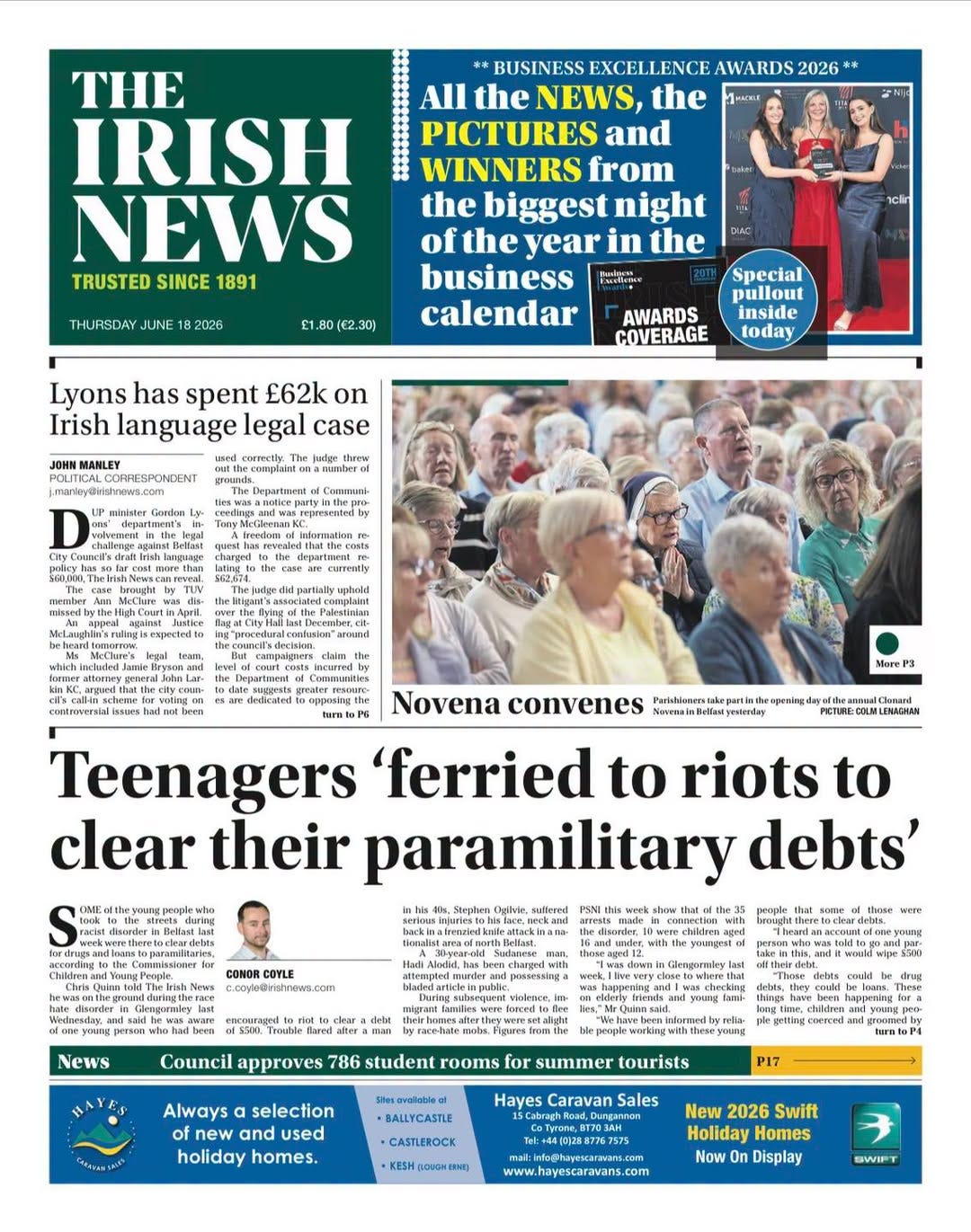
A few days later on 18th June the Irish News featured an interview with the Commissioner for Children and Young people, Chris Quinn, who said he was aware of young people being bussed in to trouble spots to clear drug debts.

The next day the Irish News editorial went a step further and laid the blame for the riots squarely at the door of loyalists, stating ‘no serious observer could ever in doubt that the recent racist rioting was organised by loyalist paramilitary figures’.

The Writing is on the Wall

With conflicting reports on the involvement of paramilitary groups, where does the truth actually lie?

It is important to be honest at the outset: Loyalist paramilitaries have been deeply involved in rioting and race hate incidents in the past. Therefore, it is reasonable to assume, as the old saying goes, there really is “no smoke without fire”.

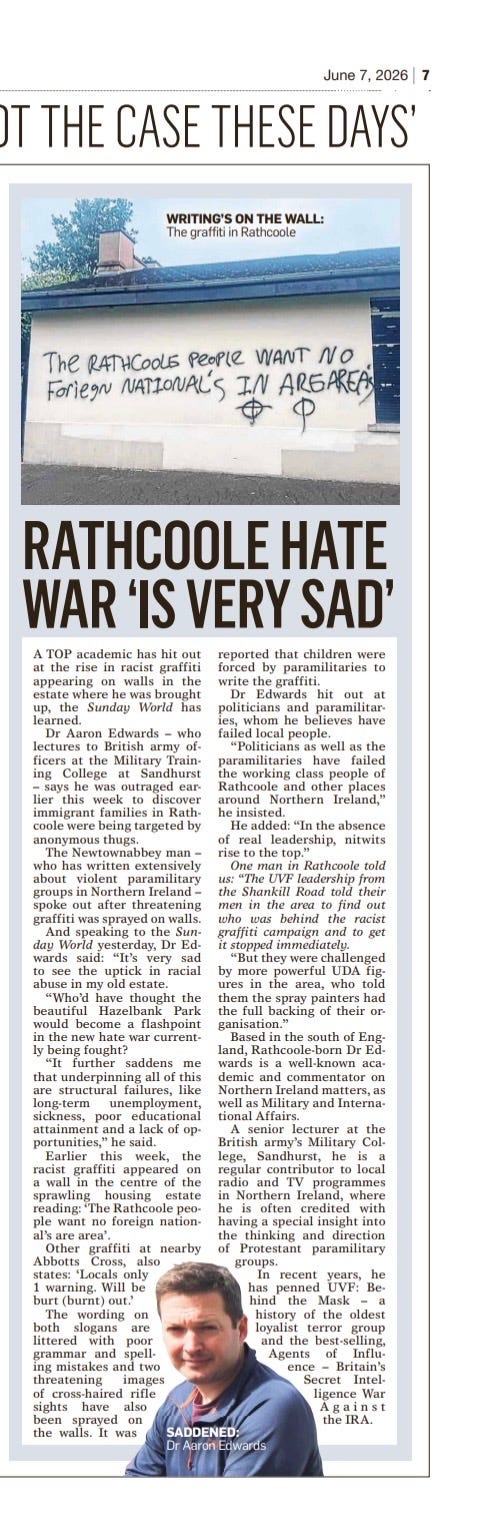
In fact as recently as the week before this gruesome knife attack, the Sunday World newspaper carried my comments on racist graffiti that had appeared in and around the Rathcoole estate. It had been reported that local paramilitaries had forced children to spray the writing on the walls.

The graffiti did not appear out of nowhere.

It followed off the back of non-violent protests staged by concerned local residents regarding an incident involving a group of Yemeni migrants dancing on ceremonial daggers in Hazelbank Park, a short distance from the estate.

Hazelbank has become something of a flashpoint in recent years, particularly as new immigrant communities take advantage of the outdoor amenities.

Inevitably these protests have drawn the attention of some paramilitaries, with one tabloid newspaper suggesting the South East Antrim UDA had been involved in an arson attack on a vehicle belonging to a Nigerian man in Rathcoole.

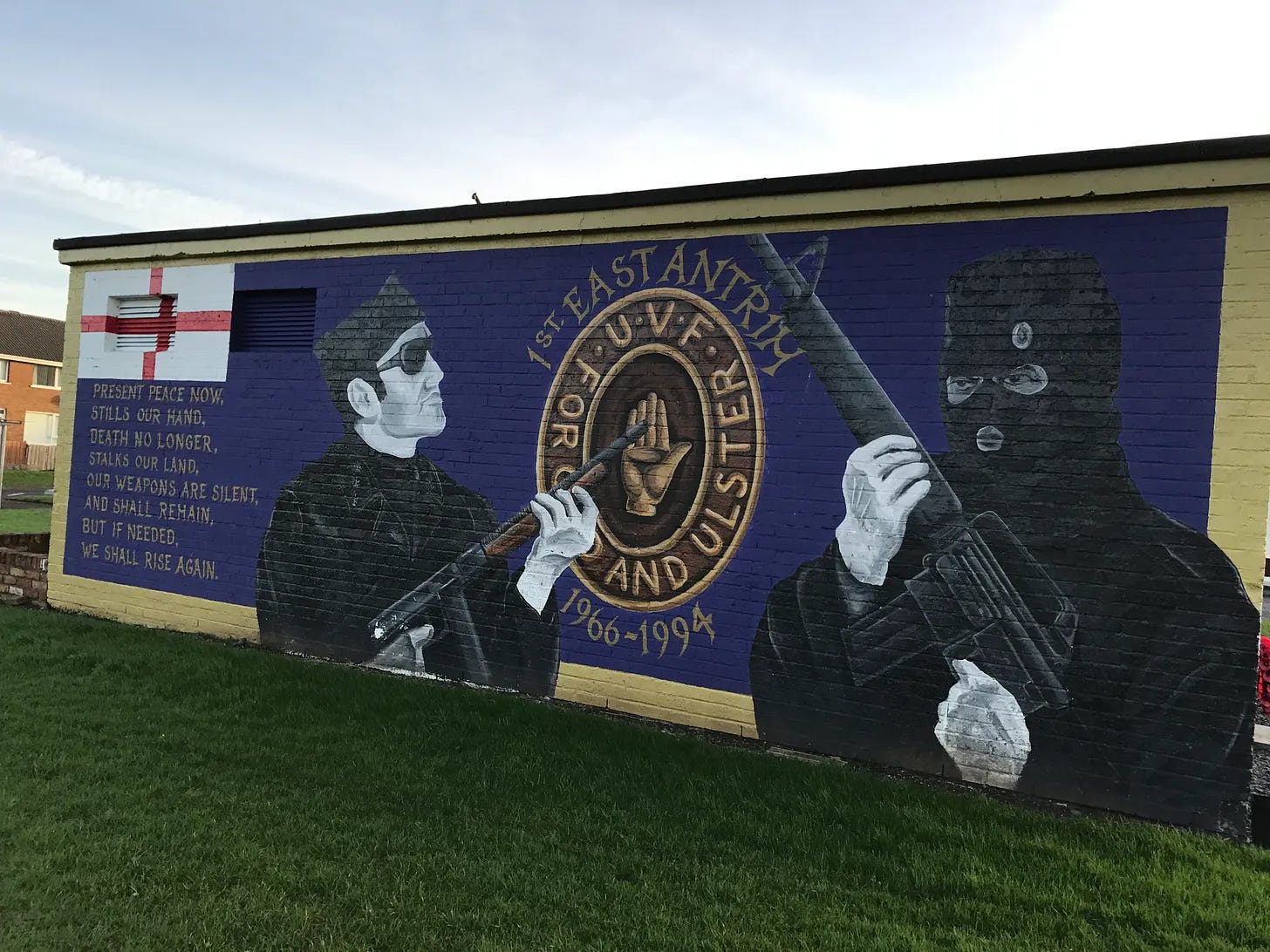
I have since learned that a local UVF figure is suspected of being behind the spray can graffiti and, potentially, in actively sending young people onto the streets.

Not much happens in the working class estates of Newtownabbey without paramilitaries being
aware of the situation. The question is are they directly involved in the violence we saw in early June?

Most readers would probably ask at this point - why does it matter which organisation is involved? Surely the key point is they are involved.

My answer would be that it matters because knowing what kind of malign influence animates such acts, even at a localised level, can aid in preventing or pre-empting them in future.

Influence vs Involvement

How then can we understand the role of paramilitaries in race hate incidents?

I think the first point to make is that we can assume some degree of loyalist paramilitary influence, if not involvement, in the recent riots.

This may seem to fly in the face of the PSNI’s briefing on 11th June that there was ‘no evidence’ of ‘paramilitary coordination’ in the violence.

Whether individual paramilitaries were physically present on the ground directing trouble or simply ‘monitoring’ the situation from a step removed is a moot point, for they are part of the fabric of marginalised and deprived communities.

They know everything that goes on and they have real influence in deciding the direction of travel when feet are on the street in large numbers.

At this point it is important to step back for a moment and look at the wider dynamic at play within paramilitary groups.

Both the UVF and UDA leadership structures have become ossified in recent years as they have made moves to leave the stage.

In practice, what that means in places like Rathcoole is that mid-level ‘commanders’ have much more autonomy to respond to issues like racial tensions. It also means if an intolerant figure is in charge of the UVF locally - and there have been many shifts in leadership over the past few years - then they may well be complicit. And the Shankill-based Brigade Staff would be none the wiser.

However, that is not the same as saying there is a single mastermind sitting behind the scenes pulling the strings of those predominantly younger people engaged in the trouble.

Whether paramilitaries were involved is a moot point for it is generally agreed the causes and course of the
riots in Belfast and elsewhere is not indicative of one overarching ‘puppet master’ pulling the strings.

As tempting though it may be to assert that paramilitary involvement explains the causes of the violence, it is important to place these riots in a wider perspective. One in which direct involvement is distinguished from active influence and/or passive influence in a broader strategic context.

Let me explain what I mean in a little more detail.

When asked for comment by the Irish News on 10th June, I mapped out a number of theories regarding paramilitary involvement and/or influence in this fast developing situation:

One theory is that, given several loyalist paramilitary leaderships have been in negotiations regarding paramilitary disbandment, it’s unlikely loyalist groups sanctioned the horrific scenes we witnessed on the streets last night.
It might be argued the tight leash governments and international donors have exerted on paramilitary groups makes it unlikely their membership were directed to become involved.
Another theory - a rather cynical one - is that paramilitary structures have not gone away because they have no intent to do so. By stepping back some of these groups are essentially saying to the authorities: “we can be useful in managing racial conflict.” By doing nothing they are trying to make themselves relevant. And that’s morally repugnant and dangerous.
It means, as the past two years of race based rioting has proven, some people in positions of authority actually buy into this vision of what some experts like Dr Sean Brennan have called ‘paramilitary peacekeeping’.

There was, of course, a third theory (mentioned above), in terms of the internal dynamics between central command structures and local leadership.

Nevertheless, you will hopefully see the point I am trying to make.

In all three scenarios, paramilitaries - and how the state, society and people all interact with them - can switch between passive influence, active influence and direct involvement, particularly when it comes to violence.

Curiously, as the trouble spread, there were even calls for paramilitaries to shift into direct involvement mode to ‘put the genie’ of race-based violence back in its bottle.

This is a tempting lever to reach for, as I have argued on many occasions before. There is even evidence to suggest it was used effectively when loyalist youths clashed with the PSNI in 2021.

In the context of the recent riots, I argued it might well stop one form of (race-based) violence but we risk embedding these groups further into a well-trodden pattern of (sectarian) violence.

What I should add is this approach continues to be favoured within policy and statutory communities.

Shifting Ground

Whether loyalist paramilitaries played a coordinated role or not, the ground beneath them is shifting.

More and more young people have proven themselves determined and coordinated when it comes to putting feet on the street, with or without paramilitary influence or direct involvement.

For close analysts of the security situation, these changes are not unexpected.

Indeed, it could be argued the past three summers of racially motivated rioting, signals two possible futures.

On the one hand, paramilitary groups will act to capitalise on the disaffection and go on a recruitment drive, particularly amongst those young people impacted by the criminal justice system.

On the other hand, new (malign) social movements may well emerge from the violence we witnessed earlier this month.

While some see paramilitaries as benevolent arbiters of social good - in old fashioned terms as ‘defenders’, others will see them as malevolent forces injurious to the greater good.

No matter what way you characterise them, they show no signs of going away anytime soon.

Rioting, whatever its cause, only makes them more relevant and places an onus on those charged with eradicating them from our midst to understand the changing character of the risks they pose to community safety.

Aaron Edwards is the author of critically acclaimed books, UVF: Behind the Mask and Agents of Influence: Britain’s Secret Intelligence War Against the IRA. His next book, Enemies Within, on the use of secret agents inside the UDA/UFF, will be published by Merrion Press in 2026.

No Smoke Without Fire?

Muiris Ó Súilleabháin ✍ The race riots of recent weeks, and the responses they produced, revealed something uncomfortable about the North. 

Despite decades of peacebuilding, racism remains embedded in our society. So too does sectarianism. The two are often treated as separate problems. They are not. Increasingly they feed one another.

I write as an Irish republican, not as a northern nationalist. One of the most damaging developments in recent years has been the tendency to treat racism as a problem that belongs exclusively to the Protestant, Unionist and Loyalist community. When racist incidents occur in loyalist districts, entire communities are condemned. When similar hostility emerges elsewhere, particularly within nationalist areas or across the south, they are explained away as isolated incidents, a product of deprivation, or an unfortunate exception.

Neither approach survives serious examination.

If one community can be judged collectively by the actions of its worst elements, then every community can. The logic is identical. The result is absurd. Neither the PUL nor the CNR population is a single political or cultural bloc. Both contain decent people, prejudiced people and people who simply wish to get on with their lives. Racism does not recognise constitutional preferences. It is carefully constructed and crosses every boundary that we know.

By turning racism into another front in the constitutional argument, the political class and the community gatekeepers have managed to sectarianise a human rights issue. The result is predictable. Communities retreat into defensiveness. Politicians score cheap points. Nothing changes.

The language employed in these debates exposes the contradiction. Terms such as “hun”, “planter” and “knuckledragger” are frequently deployed by Republicans under the banner of anti-racism. They are sectarian slurs. Their purpose is not to challenge prejudice but to reinforce it. They reduce complex communities to caricatures and then they congratulate themselves for doing so.

When Irish Republicans use sectarian slurs to condemn racial prejudice, they are not fighting intolerance, they are simply engaging in a different form of it. Weaponising anti-racism to score points against a traditional constitutional rival strips Republicanism of any moral authority it may hold.

Sectarianism and racism share the same intellectual foundation. Both begin by reducing individuals to a category. Both rely on inherited assumptions. Both permit collective guilt. The target changes. The method does not.

Nowhere is the reality of prejudice within the broader Irish population more starkly exposed than in the treatment of Irish Travellers. This is why the treatment of Irish Travellers matters. Travellers experience levels of discrimination that would provoke outrage if directed at any other group. They are refused access to businesses, excluded from opportunities and treated with suspicion based on surname, identity and background. Their health and social outcomes remain among the worst in Western Europe.

Yet this reality rarely features in conversations about racism within Irish society. Shared religion, shared geography and shared history have not protected Travellers from discrimination and racism. The lesson is obvious. Racism and exclusion are not confined to one tradition. They emerge wherever societies decide that some people matter less than others.

The institutional response in the North has been no more impressive.

The Executive’s record on racial equality is defined less by achievement than by inertia. The Racial Equality Strategy for 2015–2025 was widely criticised throughout its lifespan. During the same period race-hate incidents and crimes continued to rise. The most recent figures recorded by the PSNI are the highest since records began.

Faced with this reality, the Executive led by Sinn Fein has produced another framework. In March 2026, First Minister for All, Michelle O’Neill launched a public consultation on a new draft Race Relations Framework. Critics from across civil society responded with unusual consistency. Amnesty International described it as unfit for purpose. Others called for its withdrawal and redrafting. The criticism centred on a simple point. The framework treated racism as a problem of community relations and integration rather than a problem of structural inequality and discrimination.

Without targets, funding, timelines or accountability, strategy becomes performative. The draft strategy creates the appearance of action and change while avoiding its substance.

Alongside political failure sits another problem. Over the past three decades a substantial industry has developed around conflict management and community relations: the peace industry. Much valuable work has been undertaken by some within the community and voluntary sector, but the funding environment has also produced perverse incentives.

For years organisations relied upon large-scale peace funding. As those resources diminished, new funding priorities emerged. Anti-racism became one of them. The danger is not that racism receives attention. It should. The danger is that racism replaces sectarianism as a funding opportunity.

When organisations depend upon demonstrating crisis in order to secure resources, crisis acquires value. The problem is no longer solved. It is managed. This year, community organisations that once argued there was no racism in Republican areas in Belfast for example were to the fore in claiming funding allocated by the British Home Office to tackle anti-migrant sentiment.

Good relations funding is now allocated to the established gatekeepers, often to the detriment of the emerging support and advocacy groups established by the new migrant communities themselves.

Cultural awareness workshops, diversity seminars and performative events do nothing to address racism or sectarianism. They serve a dual purpose for both community gatekeepers and the political and social elites. It is highly cost-effective theatre. It is significantly cheaper for the Stormont Executive to throw a minor grant to a local community group for an "anti-racism workshop" than it is to build social housing.

Workshops, awareness sessions and symbolic events have their place. They may improve understanding. They may challenge ignorance. What they cannot do is substitute for aspiration, education, healthcare and economic opportunity.

The consequence of this approach is visible in working-class communities across the North. Areas experiencing poor housing, weak services and limited opportunity become vulnerable to resentment and manipulation. Far-right activists exploit those conditions. Migrants become convenient targets. The underlying causes remain untouched. There were no riots on the Malone Road.

When disorder follows, entire communities are denounced as backward or racist. This approach absolves government of responsibility. It transforms political failure into a cultural defect.

The North will not address racism through moral grandstanding. It will not address it through sectarian score-settling. It will not address it through endless declarations of concern.

It will address it only when we are prepared to apply the same standards to ourselves that we apply to others. True anti-racism requires looking inward with an unblinking, critical eye, regardless of the flags flying at the end of the street

That requires several things.

First, collective guilt must be rejected. Individuals should be held accountable for their actions. Communities should not.

Second, racial equality policy must move beyond rhetoric. Strategies require measurable objectives, funding and enforcement.

Third, public funding should be linked to demonstrable outcomes rather than the perpetual management of social problems.

Finally, inequality must be addressed directly. Housing, healthcare, education and economic opportunity are not distractions from anti-racism. They are part of it.

The recent riots did not create these problems. They exposed them.

The choice now is whether we continue to explain racism through the comforting language of tribal politics, or whether we recognise it for what it is: a societal failure shared across communities, institutions and governments alike.

⏩Muiris Ó Súilleabháin was a member of the Republican Movement until he retired in 2006 after 20 years of service. Fiche bhliain ag fás.

After The Riots

Lynx By Ten To The Power Of Two Thousand And Four

Dr John Coulter ✍ There was a lot of well-worded rhetoric of condemnation of the race riots which erupted in parts of the Province following an alleged stabbing incident in north Belfast.

But the vast majority of these carefully drafted press statements seemed to avoid the crucial ‘elephant in the room’ - what will be a workable, long-term solution to the illegal immigration crisis sweeping the UK?

This month’s riots were a mirror image of the race riots which engulfed my home town of Ballymena last year, where - as in the recent situation - a water cannon was deployed by police.

Whilst rightly condemning the mindless violence, the PSNI Chief Constable did make mention of the peaceful protests which had also taken place in areas such as Coleraine, but were vastly overshadowed by the rioting elsewhere.

Th trigger for the current racial unrest is the belief that illegal migrants and asylum seekers are sneaking into the UK via the open border with the republic.

The underlying problem is that when violence takes centre stage, all migrants are tarred with the same brush. Racial rioters do not take notice of the many folk from the ethnic communities who, since 1945, have integrated successfully into Ulster society.

Rioters do not distinguish between genuine legal migrants who are making a positive contribution to the economic life of the UK - especially those who work in the NHS - and the illegal ‘benefits brigade’ who see the UK’s benefit system as an easy ticket to manipulate.

Then there’s the asylum seekers who have genuine reasons, too, for being in the UK because of religious or political persecution in their home lands, such as Christians who have fled Nigeria or the Middle East.

Analysing the causes of the riots recently in my commentating on GB News TV, I emphasised the point that for a long-term solution to the immigration crisis to work, it required radical political surgery, not a sticky plaster.

For Northern Ireland, the problem - ironically since partition - has been the existence of the common travel area between the six counties of Northern Ireland and the 26 counties of Southern Ireland. A generation of folk in Northern Ireland still remember how the south was used as a springboard for the genocide and ethnic cleansing of the border pro-Union community by republican terrorists during the Troubles.

If any flow or even a trickle of illegal migrants coming from Southern Ireland into the UK is to be halted, then manned border posts and check points must be introduced.

That sounds like a very radical option, but there’s a perception that many politicians, community groups and places of worship are afraid to address the immigration ‘elephant in the room’ for fear of the current woke snowflake society branding them as racist, fascist, Nazi or Far Right.

However, given the recent riots - and the fact that next May voters in Northern Ireland will go to the polls in local council and Stormont Assembly elections, political parties will have to seriously address the immigration issue.

However, the real immigration issue is in mainland Britain where the so-called small boat crisis is perceived to be out of control, hence the recent surge in support for the Right-wing Reform UK party with some opinion polls predicting leader Nigel Farage MP could be a future holder of the keys to 10 Downing Street.

The root cause of the UK’s seeming inability to get control of the small boat crisis, which has seen tens of thousands of illegal migrants cross the English Channel to Britain, has been the UK’s lack of an iron wall of ships across that particular sea border.

If ever that point was being rammed home, it was the recent resignation of the Labour Defence Secretary John Healey who cited that military spending ‘fell well short’ of what was needed.

Put bluntly, the Royal Navy simply does not have the ships to create that iron wall across the English Channel which would force the small boat armada to turn back - and we are still not in the teeth of the summer months when the weather in the channel is expected to be better, thus encouraging more migrants to risk the crossing.

Even if a budget was magically approved to build more ships and train more sailors, that development will not become a reality within the next few months.

Put bluntly again, the real problem is the inability of the French authorities to stop the armada of small boats leaving French shores in the first place. If the French security forces were doing their jobs competently and effectively, none of the illegal migrant boats would leave the beaches.

Mind you, the inability of French authorities to control their own borders comes as no surprise. They could not do this in the Great War and they could not do it in the Second World War, so why should we in the UK be so surprised that France cannot hold sway over its own beaches!

Even if the French could gain control of their beaches, what about the tens of thousands of illegal migrants who have already arrived in the UK and have been housed in hotels before being moved into the community? What is radically required in an isolated holding centre along the lines of the American Camp X Ray, which existed in Cuba’s Guantanamo Bay.

Such a detention camp would be policed by the intelligence community so that every migrant or asylum seeker would be vetted to ascertain if they were genuinely fleeing persecution, or had the view - ‘we’re on our way to benefits Britain!’

The genuine migrants seeking political or religious asylum could be integrated into the community while the illegals would be deported to their countries of origin. But no one leaves the UK’s Camp X Ray until their identity is confirmed.

Integration must be the key to migrants and asylum seekers remaining in the UK. In this respect, the Christian Churches have a major role to playing in educating migrants in Western Christian values.

Last year, I attended a Presbyterian missionary rally at which a woman spoke passionately about how her church was assisting such integration in Northern Ireland. However, she emphasised one of the main difficulties they faced was these new comers’ views on women. To migrants - legal and illegal - from some cultures, women are viewed as second class citizens or sexual play things.

Likewise, many migrants arrive in the UK with little more possessions than the clothes they are wearing. Given that migrants have been housed in hotels where they get regular meals and clothing, the perception has been fuelled that UK authorities take the view - migrants before locals.

This perception has fuelled an anger and fear in some communities that migrants are being given preferential treatment especially as many local families are struggling with a cost of living crisis, having to rely on food banks, or even deciding if they can either heat their homes or cook a meal - the so-called ‘heat or eat’ dilemma.

One fact is certain in Northern Ireland. The current political parties will have to radically address the immigration ‘elephant in the room’ before next May’s elections, otherwise the door will be opened electorally for the real Far Right parties to enter the political arena with their hard line solutions.

Time is not on the side of the current local government and Assembly establishment parties if they want to avoid another repetition of this month’s horrible rioting.

Follow Dr John Coulter on Twitter @JohnAHCoulter
John is a Director for Belfast’s Christian radio station, Sunshine 1049 FM. 

Time To Tackle Immigration ‘Elephant’ Head On

Zeteo UK ★ Written by Owen Jones.

An attempted beheading in the street. Yet no incendiary front pages followed. No politicians issued statements inciting fury. There were no riots, no pogroms.

This was a terror-related attack by a white neo-Nazi, Alina Burns, against a Kurdish barber last year. Similarly, when two teenagers stabbed to death a random British Asian father as he delivered groceries to his mother in Wales, Nigel Farage did not demand “pure, cold rage.” When a white British man raped a Sikh woman, believing her to be Muslim, the Daily Telegraph did not ask if the UK had “descended into anarchy.”

And when a white man stabbed a Saudi student to death in Cambridge, GB News didn’t host a segment headlined, ‘British people are fed up!’ Indeed, there’s no evidence it covered this hideous murder at all.

Belfast burned this week. The direct culprits were racist thugs who set fire to homes they believed migrants lived in. Families with little children had to be rescued from the flames. Businesses and cars were burned. Vehicles were stopped so the mobs could search for migrants. We have a word for this: it is a pogrom.

None of this can be divorced from Northern Ireland’s own history. In the summer of 1969, loyalist thugs burned one in 20 Catholics out of their homes in Belfast – the biggest act of ethnic cleansing in Western Europe since World War II. Perhaps some of their grandchildren continued this hateful tradition.

Continue @ Zeteo UK.

But there is another context for this pogrom. For years, British media and political elites have portrayed Britain as descending into violent mayhem because of immigration.

That’s all based on a lie. There has unquestionably been a huge increase in immigration over the last two decades, and it has made Britain far more diverse than it was. Yet by any measure you pick, violence in Britain has plummeted over that same period. Overall surveyed crime is about a third of what it was in 2002. The murder rate in England and Wales is nearly half what it was in 2003. In London – the UK’s most diverse city – it is at its lowest ever recorded level. Hospital admissions caused by assault, knife assault, bodily force, blunt objects and firearms have all fallen sharply.

Detailed research by the Oxford Migrant Observatory finds no significant relationship between immigrants and crimes. Foreign nationals are underrepresented when it comes to violent offences and robbery.

The Belfast Riots Are An Anti-Migrant Pogrom 🪶 And The British Media Has Serious Questions To Answer

Wired ★ Written by David Gilbert.

A White Supremacist Youth Group Helped Orchestrate the Belfast Riots After Elon Musk and Tommy Robinson stoked anger over a horrific knife attack in Belfast, a youth group linked to a global neo-Nazi movement quietly orchestrated anti-immigrant riots. 

Within an hour after a horrific knife attack took place in Belfast on Monday night, far-right UK activist Tommy Robinson had shared a video of the incident on X, a post that racked up 6 million views.

Within hours Elon Musk, the owner of the platform, weighed in, agreeing with a post calling for “consequences” for politicians.

By Tuesday morning, supercharged by X, the video was everywhere, and groups on Facebook were organizing protests across Northern Ireland and the UK. Far-right figures in the US and UK continued to pour fuel on the fire online, framing the incident as part of a broader antiwhite agenda being perpetrated in Western countries.

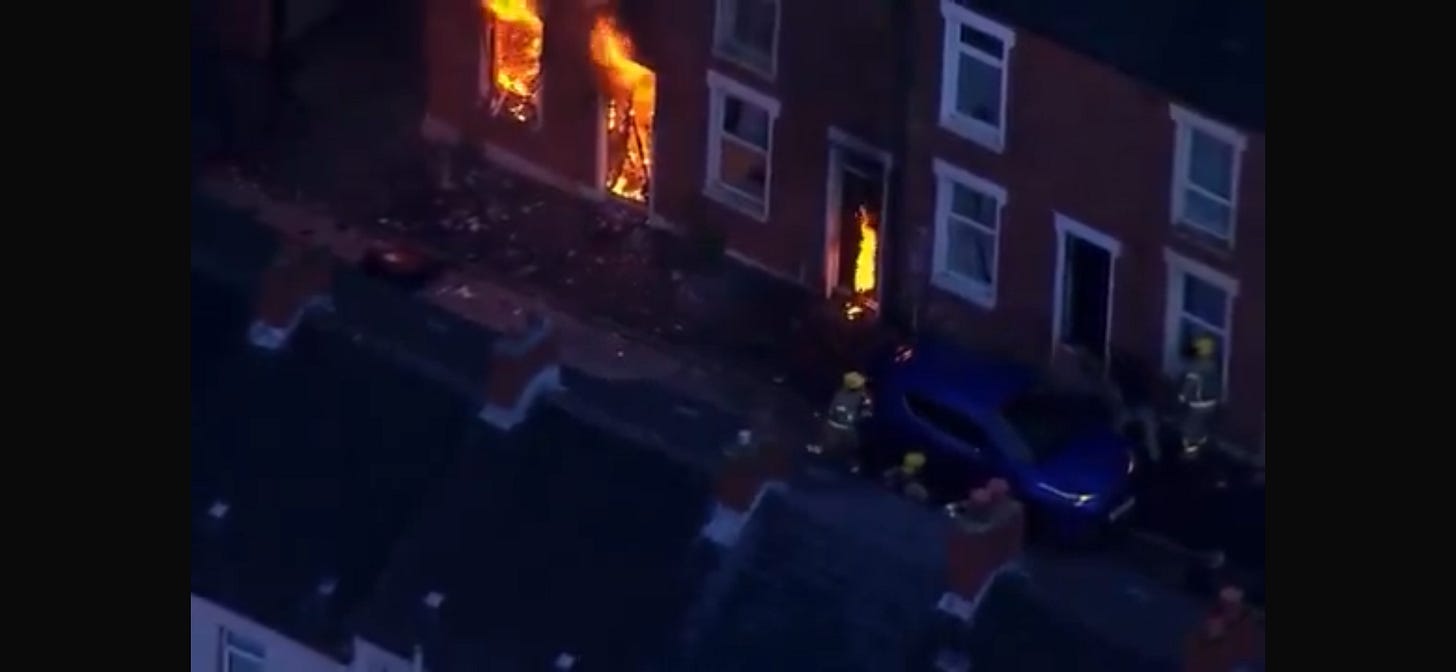
By Tuesday evening, violent protests had broken out in Belfast, with masked rioters setting fire to vehicles, kicking in the doors of homes they believed housed immigrants, and setting those homes on fire.

Politicians were quick to criticize Musk and Robinson, who did not reply to requests for comment . . . 

Continue @ Wired.

A White Supremacist Youth Group Helped Orchestrate The Belfast Riots

Tadhg Hickey 📺 with a satirical takedown of the racist riots in Belfast.  

Recommended by Brendan Keane.

Tel Aviv Tommy & Belfast Race Riots