


There have been conflicting reports about the involvement of loyalist paramilitaries in the recent riots in Northern Ireland - but what is the truth of the matter?
Following a knife attack on a man in the Kinnaird Avenue area of north Belfast on 8th June, in which the PSNI charged another man with attempted murder, serious rioting broke out across Northern Ireland.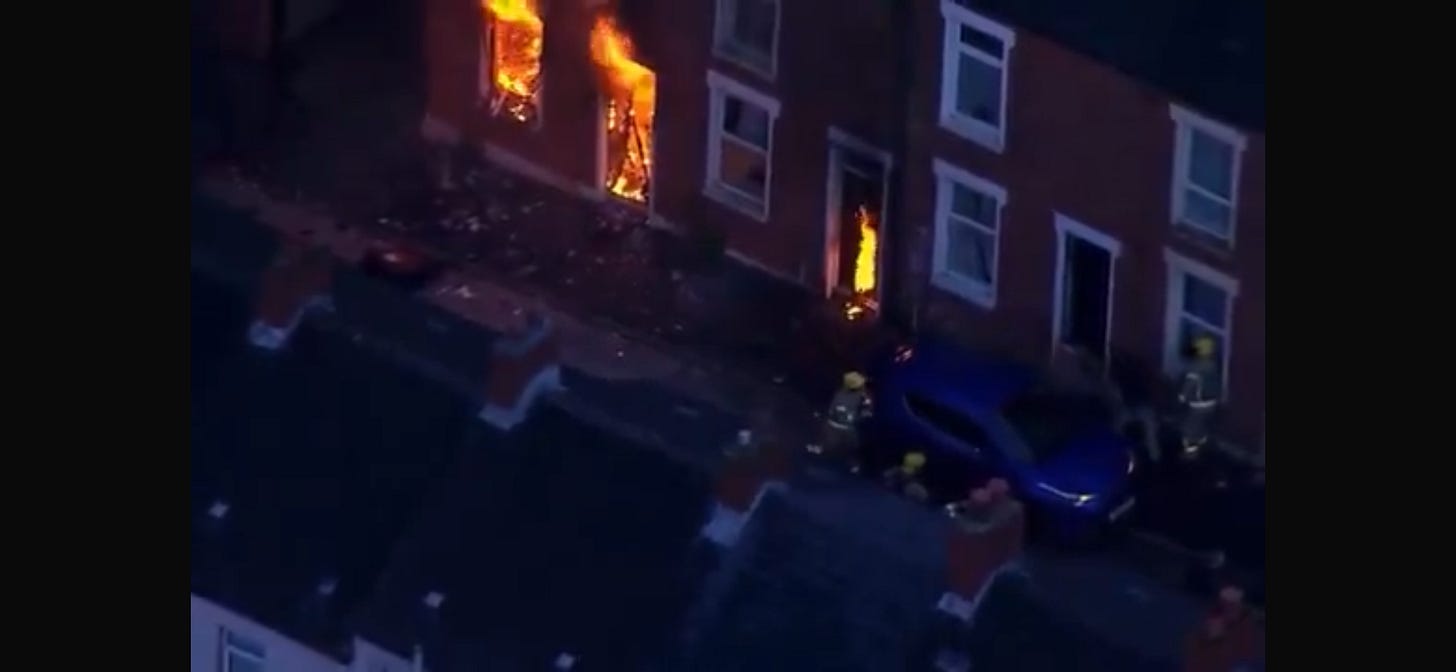
The Irish News initially reported on Wednesday 10th June that loyalists were involved in the trouble.
A day later the Belfast Telegraph carried a front page headline indicating loyalist paramilitaries denied orchestrating riots but would not help stop the violence.
On 12th June The Guardian suggested loyalists were likely sitting on the fence about the unfolding mayhem and had ostensibly adopted a ‘neutral’ stance.
By the end of the week, on 14th June, the Belfast Telegraph’s Northern Ireland Editor Sam McBride was writing about his first-hand encounter with loyalist paramilitaries while covering the riots.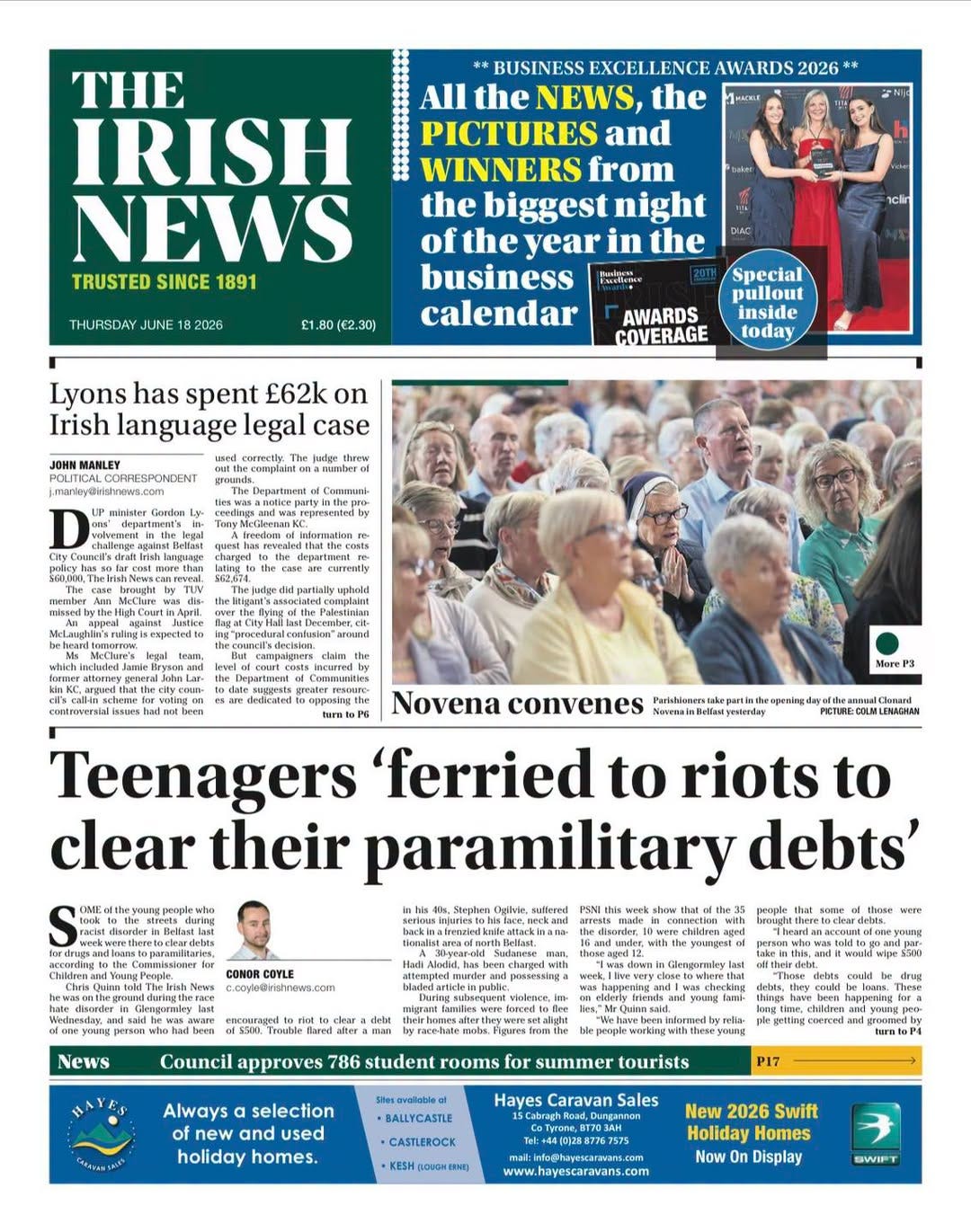 A few days later on 18th June the Irish News featured an interview with the Commissioner for Children and Young people, Chris Quinn, who said he was aware of young people being bussed in to trouble spots to clear drug debts.
The next day the Irish News editorial went a step further and laid the blame for the riots squarely at the door of loyalists, stating ‘no serious observer could ever in doubt that the recent racist rioting was organised by loyalist paramilitary figures’.
The Writing is on the Wall
With conflicting reports on the involvement of paramilitary groups, where does the truth actually lie?
It is important to be honest at the outset: Loyalist paramilitaries have been deeply involved in rioting and race hate incidents in the past. Therefore, it is reasonable to assume, as the old saying goes, there really is “no smoke without fire”.
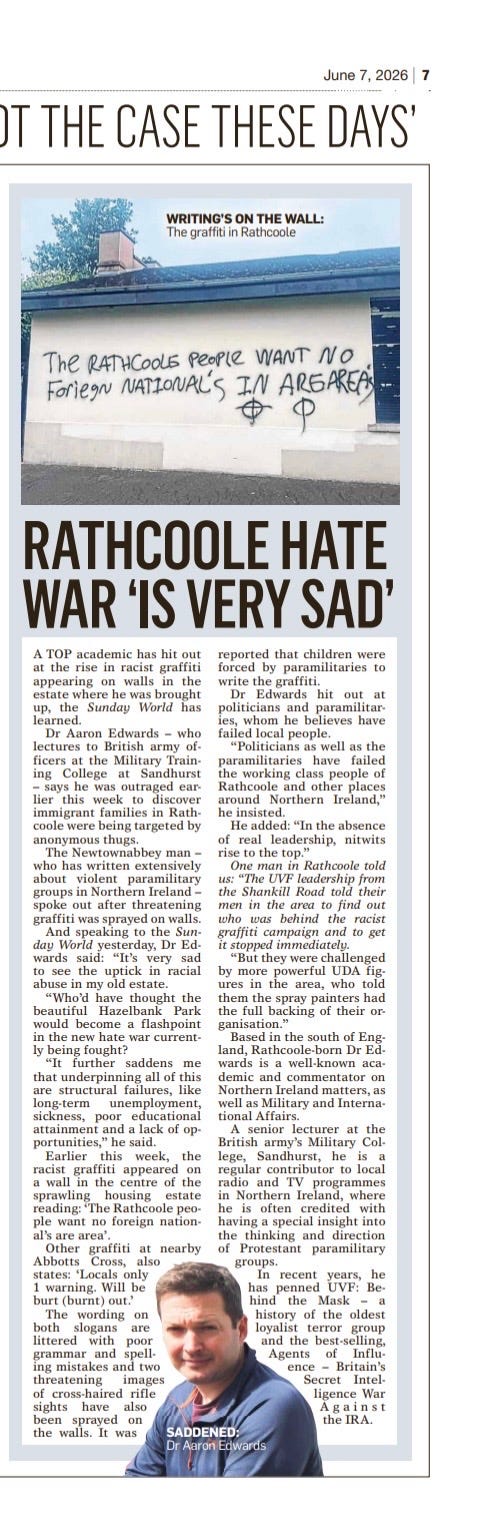
In fact as recently as the week before this gruesome knife attack, the Sunday World newspaper carried my comments on racist graffiti that had appeared in and around the Rathcoole estate. It had been reported that local paramilitaries had forced children to spray the writing on the walls.
Following a knife attack on a man in the Kinnaird Avenue area of north Belfast on 8th June, in which the PSNI charged another man with attempted murder, serious rioting broke out across Northern Ireland.
The Irish News initially reported on Wednesday 10th June that loyalists were involved in the trouble.
A day later the Belfast Telegraph carried a front page headline indicating loyalist paramilitaries denied orchestrating riots but would not help stop the violence.
On 12th June The Guardian suggested loyalists were likely sitting on the fence about the unfolding mayhem and had ostensibly adopted a ‘neutral’ stance.
By the end of the week, on 14th June, the Belfast Telegraph’s Northern Ireland Editor Sam McBride was writing about his first-hand encounter with loyalist paramilitaries while covering the riots.
The next day the Irish News editorial went a step further and laid the blame for the riots squarely at the door of loyalists, stating ‘no serious observer could ever in doubt that the recent racist rioting was organised by loyalist paramilitary figures’.
The Writing is on the Wall
With conflicting reports on the involvement of paramilitary groups, where does the truth actually lie?
It is important to be honest at the outset: Loyalist paramilitaries have been deeply involved in rioting and race hate incidents in the past. Therefore, it is reasonable to assume, as the old saying goes, there really is “no smoke without fire”.
In fact as recently as the week before this gruesome knife attack, the Sunday World newspaper carried my comments on racist graffiti that had appeared in and around the Rathcoole estate. It had been reported that local paramilitaries had forced children to spray the writing on the walls.
It followed off the back of non-violent protests staged by concerned local residents regarding an incident involving a group of Yemeni migrants dancing on ceremonial daggers in Hazelbank Park, a short distance from the estate.
Hazelbank has become something of a flashpoint in recent years, particularly as new immigrant communities take advantage of the outdoor amenities.
Inevitably these protests have drawn the attention of some paramilitaries, with one tabloid newspaper suggesting the South East Antrim UDA had been involved in an arson attack on a vehicle belonging to a Nigerian man in Rathcoole.
I have since learned that a local UVF figure is suspected of being behind the spray can graffiti and, potentially, in actively sending young people onto the streets.
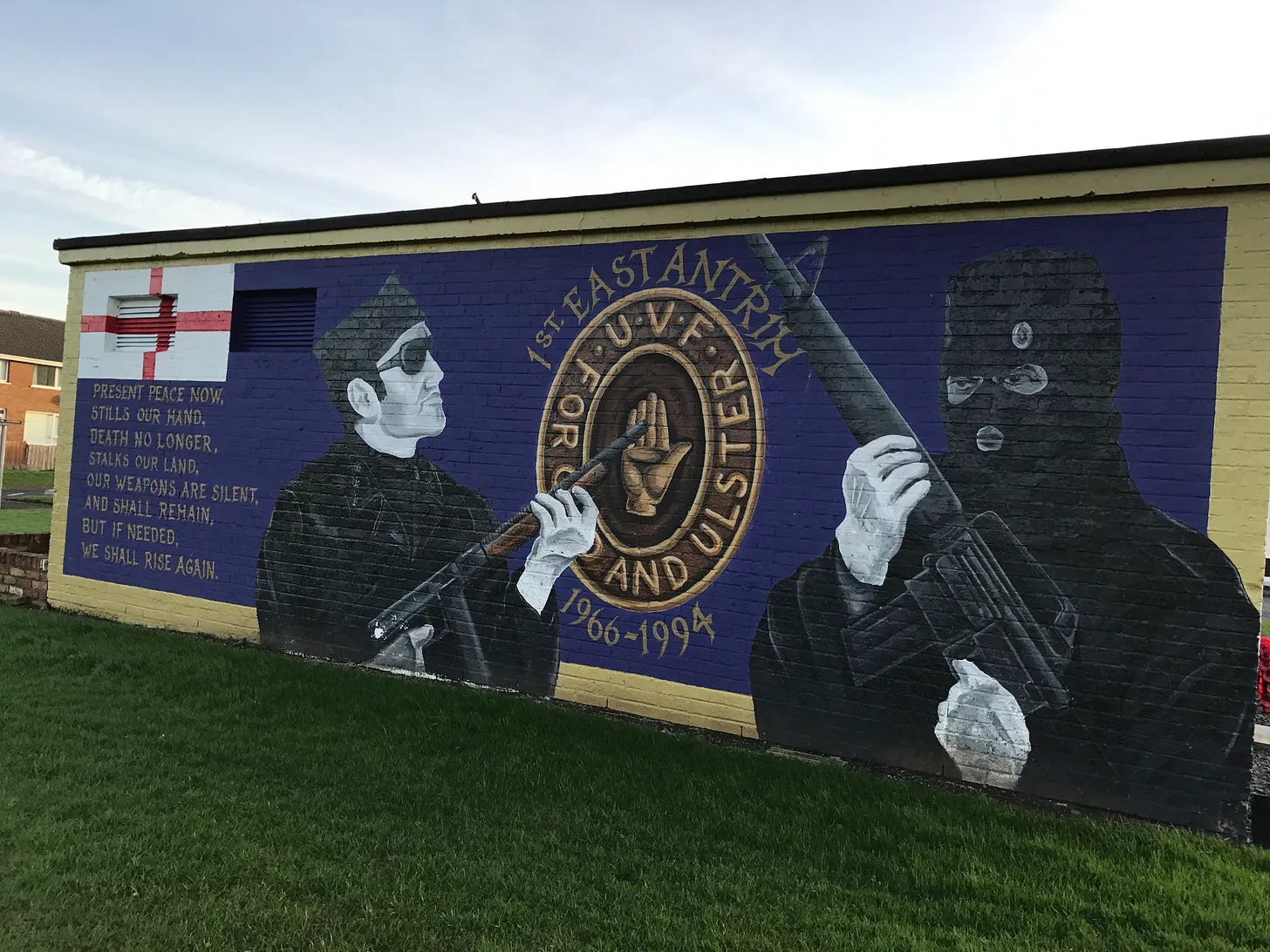 |
| Not much happens in the working class estates of Newtownabbey without paramilitaries being aware of the situation. The question is are they directly involved in the violence we saw in early June? |
Most readers would probably ask at this point - why does it matter which organisation is involved? Surely the key point is they are involved.
My answer would be that it matters because knowing what kind of malign influence animates such acts, even at a localised level, can aid in preventing or pre-empting them in future.
Influence vs Involvement
How then can we understand the role of paramilitaries in race hate incidents?
I think the first point to make is that we can assume some degree of loyalist paramilitary influence, if not involvement, in the recent riots.
This may seem to fly in the face of the PSNI’s briefing on 11th June that there was ‘no evidence’ of ‘paramilitary coordination’ in the violence.
Whether individual paramilitaries were physically present on the ground directing trouble or simply ‘monitoring’ the situation from a step removed is a moot point, for they are part of the fabric of marginalised and deprived communities.
They know everything that goes on and they have real influence in deciding the direction of travel when feet are on the street in large numbers.
At this point it is important to step back for a moment and look at the wider dynamic at play within paramilitary groups.
Both the UVF and UDA leadership structures have become ossified in recent years as they have made moves to leave the stage.
In practice, what that means in places like Rathcoole is that mid-level ‘commanders’ have much more autonomy to respond to issues like racial tensions. It also means if an intolerant figure is in charge of the UVF locally - and there have been many shifts in leadership over the past few years - then they may well be complicit. And the Shankill-based Brigade Staff would be none the wiser.
However, that is not the same as saying there is a single mastermind sitting behind the scenes pulling the strings of those predominantly younger people engaged in the trouble.
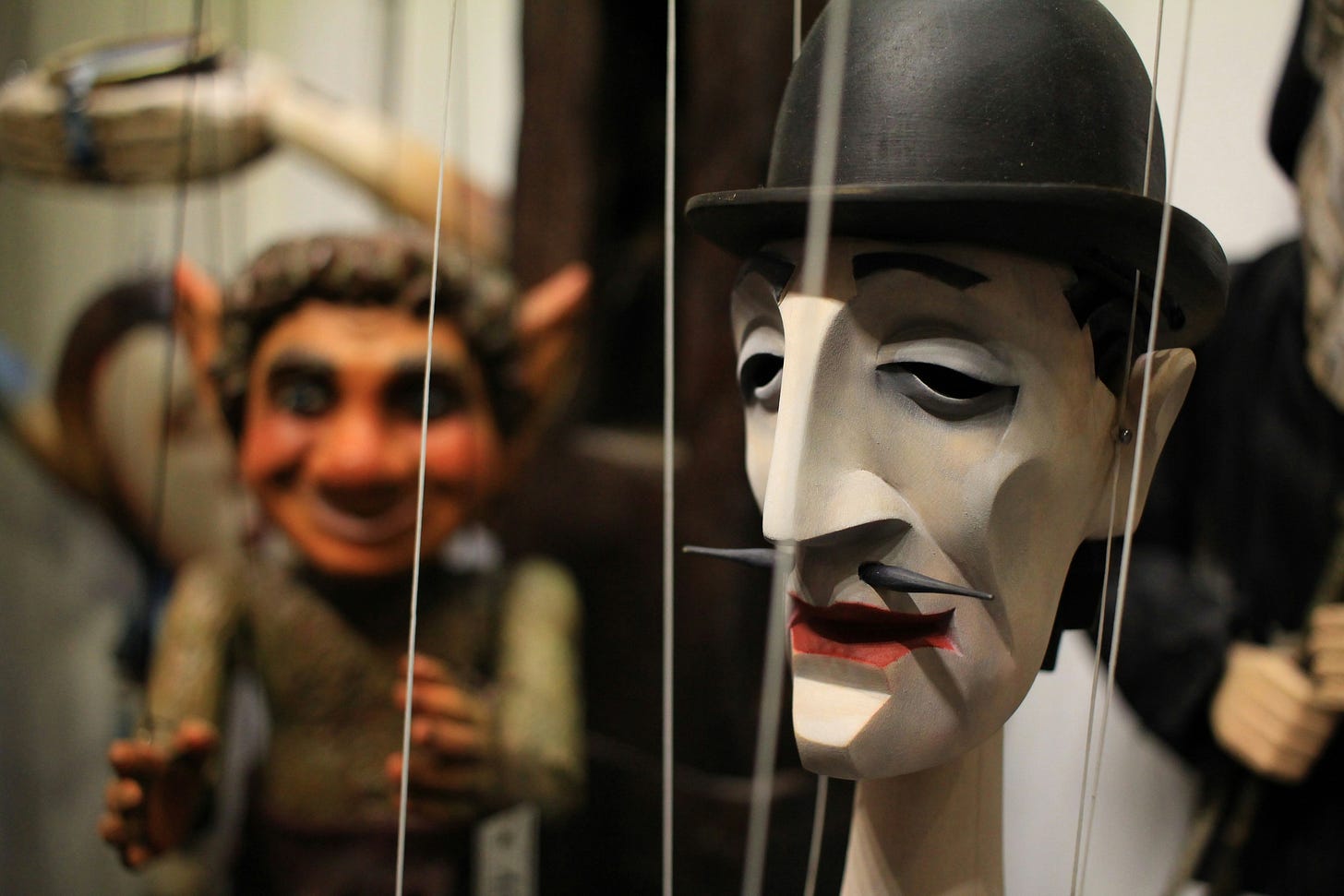 |
| Whether paramilitaries were involved is a moot point for it is generally agreed the causes and course of the riots in Belfast and elsewhere is not indicative of one overarching ‘puppet master’ pulling the strings. |
As tempting though it may be to assert that paramilitary involvement explains the causes of the violence, it is important to place these riots in a wider perspective. One in which direct involvement is distinguished from active influence and/or passive influence in a broader strategic context.
Let me explain what I mean in a little more detail.
When asked for comment by the Irish News on 10th June, I mapped out a number of theories regarding paramilitary involvement and/or influence in this fast developing situation:
One theory is that, given several loyalist paramilitary leaderships have been in negotiations regarding paramilitary disbandment, it’s unlikely loyalist groups sanctioned the horrific scenes we witnessed on the streets last night.
It might be argued the tight leash governments and international donors have exerted on paramilitary groups makes it unlikely their membership were directed to become involved.
Another theory - a rather cynical one - is that paramilitary structures have not gone away because they have no intent to do so. By stepping back some of these groups are essentially saying to the authorities: “we can be useful in managing racial conflict.” By doing nothing they are trying to make themselves relevant. And that’s morally repugnant and dangerous.
It means, as the past two years of race based rioting has proven, some people in positions of authority actually buy into this vision of what some experts like Dr Sean Brennan have called ‘paramilitary peacekeeping’.
There was, of course, a third theory (mentioned above), in terms of the internal dynamics between central command structures and local leadership.
Nevertheless, you will hopefully see the point I am trying to make.
In all three scenarios, paramilitaries - and how the state, society and people all interact with them - can switch between passive influence, active influence and direct involvement, particularly when it comes to violence.
Curiously, as the trouble spread, there were even calls for paramilitaries to shift into direct involvement mode to ‘put the genie’ of race-based violence back in its bottle.
This is a tempting lever to reach for, as I have argued on many occasions before. There is even evidence to suggest it was used effectively when loyalist youths clashed with the PSNI in 2021.
In the context of the recent riots, I argued it might well stop one form of (race-based) violence but we risk embedding these groups further into a well-trodden pattern of (sectarian) violence.
What I should add is this approach continues to be favoured within policy and statutory communities.
Shifting Ground
Whether loyalist paramilitaries played a coordinated role or not, the ground beneath them is shifting.
More and more young people have proven themselves determined and coordinated when it comes to putting feet on the street, with or without paramilitary influence or direct involvement.
For close analysts of the security situation, these changes are not unexpected.
Indeed, it could be argued the past three summers of racially motivated rioting, signals two possible futures.
On the one hand, paramilitary groups will act to capitalise on the disaffection and go on a recruitment drive, particularly amongst those young people impacted by the criminal justice system.
On the other hand, new (malign) social movements may well emerge from the violence we witnessed earlier this month.
While some see paramilitaries as benevolent arbiters of social good - in old fashioned terms as ‘defenders’, others will see them as malevolent forces injurious to the greater good.
No matter what way you characterise them, they show no signs of going away anytime soon.
Rioting, whatever its cause, only makes them more relevant and places an onus on those charged with eradicating them from our midst to understand the changing character of the risks they pose to community safety.
 |
| Aaron Edwards is the author of critically acclaimed books, UVF: Behind the Mask and Agents of Influence: Britain’s Secret Intelligence War Against the IRA. His next book, Enemies Within, on the use of secret agents inside the UDA/UFF, will be published by Merrion Press in 2026. |


Or the people in these areas have become utterly sick of the demographic change and subsequent inability of the local families to get housing or jobs never mind doctors appointments and hence are asking what fucking use are the 'Paramilitaries' who espouse a semblance of authority over the community. The community has watched for decades whilst so called Loyalists grew fat on the drug teat, the elders of which are now in their dotage, and are now asking exactly what do you 'do'?
ReplyDeleteThe odd 'local level' commander probably has a spark of wit that hears this and decided to do the absolute pathetic level of utter pish with graffiti. As ridiculous and as woeful as this is, it is still a practical event however stupid, redundant and misguided it was it is many orders of magnitude beyond what the main "Unionist" parties do....and that is fuck all, save criticize those communities where this happens. Typically for mainstream unionism it never misses a chance to kick an own goal.
Far easier than provide leadership to the PUL communities I suppose. For utter shame.
Why and how do proscribed organisations continue to exist in 2026? That said I’m pretty sure I know the answer. Same thugs and knuckledraggers different “enemy” The perpetual victimhood that exists within the north’s loyalist communities. If it’s not the Catholics it’s the Muslims or the Hindus or …. 🙄
ReplyDelete