Showing posts with label UK General Election 2024. Show all posts
People And Nature ☭ On 4 July, the climate-trashing Tory government will be replaced, as good as certainly by Keir Starmer’s “changed” Labour Party.
Simon Pirani
18-June-2024

For all its talk of “green prosperity”, Labour plans to work closely with the corporations that profit from North Sea oil and gas and from generating electricity – and who intend to produce, and use, fossil fuels for as long as they can.
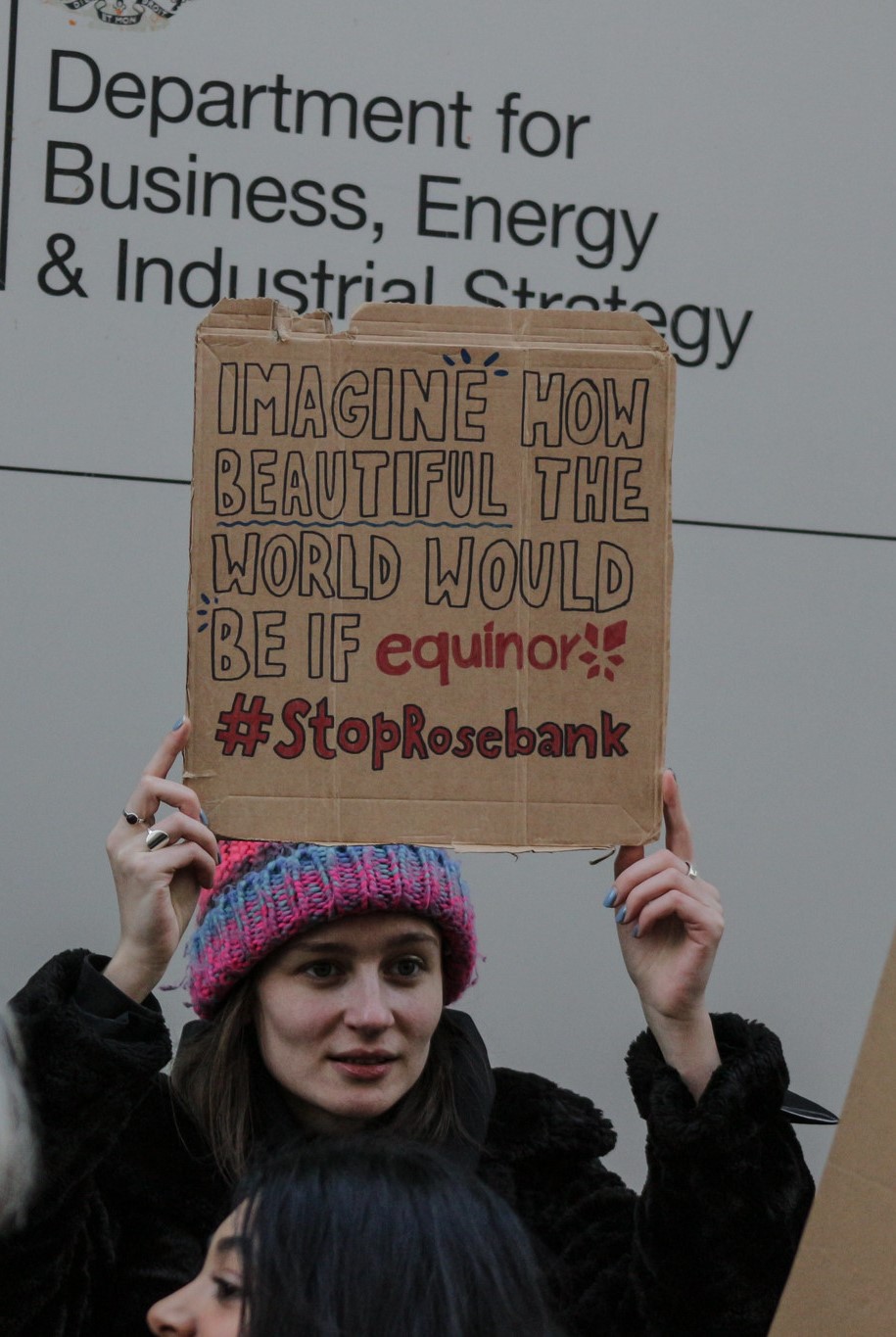
A protest at government offices against the Rosebank oil
field project, January 2023. Photo by Steve Eason

Labour’s plans for cutting greenhouse gas emissions from homes and cars are hopelessly timid, because of its conviction that private business does it best.

Under Labour, we will in my view make progress against social injustice and climate change only insofar as social movements and the labour movement:

(i) confront and confound the government, and

(ii) show that action on climate change, far from costing ordinary people money as the extreme right claim, is 100% compatible with combating social inequalities.

In this article I try to identify the likely battlegrounds between our movements and a Starmer-led Labour government:

Fossil fuel production and the path away from it (part 1); electricity generation at national (part 2) and local (part 3) levels; avoiding false technofixes (part 4); and changing the way energy is used in homes and transport (part 5). Part 6 is about bringing these separate, but connected, issues together.

1. Transition away from fossil fuel production on the North Sea

The election-time slanging match about the North Sea’s future has featured politicians’ and union leaders’ cynicism at its worst. In opposition to this, our movement needs serious conversation about how to fight for working people’s livelihoods and run down oil and gas production simultaneously.

The political war of words has focused on Labour’s commitment not to issue new licences to explore for oil and gas in the North Sea.

The Scottish National Party, which fears losing parliamentary seats to Labour, has lashed out with a claim – shown by BBC Verify to be false – that this would cost “100,000 jobs”. This is “a clear about-face” from the SNP, which last year “committed to a built-in bias against granting new licences”, the Politico web site reported.

“Exaggeration and misinformation helps no-one”, given the urgent need for “a clear-eyed conversation about how to ensure that Scottish workers benefit from the transition away from oil and gas”, Tessa Khan of the climate advocacy group Uplift said.

But exaggeration and misinformation is exactly what leaders of the Unite union, which represents many North Sea workers, contributed. They withheld support for Labour’s manifesto, because of its North Sea policy (as well as for much better reasons, such as its employment policies) and endorsed SNP leader John Swinney’s nonsense.

Unite leader Sharon Graham suggests that a ban on oil and gas licences is the main threat to North Sea jobs. That is not true. It usually takes more than ten years from licence issue for a field to start production, so there is only a very indirect connection. In recent years oil corporations’ decisions to slim down their North Sea operations has posed a far more immediate threat.

If Labour reverses its ban on new licences, the only beneficiaries will be those corporations – while the planetary disaster threatened by climate change would come one step closer, as the heads of the UN and International Energy Agency have pointed out. Indeed there is a powerful case for scrapping the already-granted licence for the giant Rosebank field.

Unite says it wants to “see the money and the plan” for the transition away from oil and gas. But as its leaders well know, plans already exist.

The Sea Change report, published five years ago, showed how the North Sea workforce could expand, with investment in wind power and other renewables. The oil companies and Tory government have other ideas, set out in the North Sea Transition Deal – which proposes spending £15 billion on their pet technofixes, carbon capture and hydrogen. (See also part 4 below.)

The Green New Deal Rising group disrupted an event sponsored by oil industry
lobbyists at the Labour party conference in October last year. Photo by Jess Hurd

Unite, along with other unions, accepts these false solutions, and calls for investment in hydrogen and carbon capture, as well as wind power.

At a recent gathering of trade unionists concerned with climate policy, Pete Cannell of the campaign group Scot E3 argued that, given the dominance of this technofix narrative, “it’s legitimate to ask whether ‘just transition’ is any longer the right framing”.

Perhaps we should be talking about “rupture, rather than transition”, he said, to make gains for social justice and tackling climate change. This starts with uniting oil workers and Scottish working-class communities more broadly. This is the conversation we urgently need.

2. Public ownership in the electricity system

Labour will set up a “publicly-owned clean power company”, GB Energy, paid for by a windfall tax on oil and gas producers. But GB Energy will own few, if any, electricity generation assets and will focus on partnerships with private capital. Labour also plans to leave the electricity transmission and distribution grids in private hands, and to leave largely unchanged the neoliberal electricity market rules that allowed corporations to reap billions by impoverishing households in the 2022 “energy crisis”.

Labour intends to capitalise GB Energy with £8.3 billion over the next five years: £3.3 billion for a potentially useful Local Power Plan (see part 3 below), and £5 billion to “co-invest in new technologies” including floating offshore wind and hydrogen, and “scale and accelerate mature technologies” including wind, solar and nuclear.

Labour’s loud claim that GB Energy will “lower [electricity] bills because renewables are cheaper than gas” is not credible. This would require, at least, an investment far greater than £5 billion, allied to a root-and-branch overhaul of electricity markets.

More likely, GB Energy will, at best, fund new technologies that financial markets prefer not to risk their own money on – or even follow in the footsteps of Tony Blair’s disastrous Private Finance Initiative, with which corporations milked billions from the NHS. The Guardian, apparently briefed by Keir Starmer’s team, reported that GB Energy will probably start with “investments alongside established private sector companies”, including the chronically over-budget Hinkley Point, Sizewell C and Wylfa nuclear projects.

The Greens and others slammed Starmer, when he finally clarified on 31 May that GB Energy will essentially be an investment vehicle. But a trenchant critique had already been published last year: Unite’s Unplugging Energy Profiteers report, which warned that “unless combined with a public purchasing monopoly, or significant market reform intervention, [GB Energy] will have no impact on distorted pricing in the wholesale market”, and “by concentrating very limited resources on de-risking experimental forms of generation, GB Energy will use public resources to underwrite and further increase future potential profits for the private sector”.

Unite, and the Trades Union Congress, call for public ownership to be extended not only in electricity generation, but also in the supply business and in transmission and distribution networks. Labour made similar calls in 2019, but has now ditched them.

Underinvestment in these networks is a scandal as damaging as the water companies’ rip-off: tens of billions of pounds’ worth of network upgrades are needed to facilitate renewable generation and close the gap on missed climate targets.

The National Grid’s Nechells electricity substation near Birmingham

Already, there are 10+year queues for renewables to be connected to the grid; house-builders are fitting climate-trashing gas boilers because they can not access electricity for heat pumps; battery storage lies unused because companies’ computer systems are out of date … all while distribution networks paid out £3.6 billion in dividends to shareholders in 2017-21.

The system is in such a state that even Rishi Sunak’s dysfunctional government took regulatory powers away from National Grid and put them in the Future System Operator. Nick Winser, the electricity network commissioner, warned the government that unchanged, the system would leave “clean, cheap domestic energy generation standing idle, potentially for years”. “Very few new transmission circuits have been built in the last 30 years”, he said: unless jolted, companies could take up to 14 years to build them.

To make the electricity network fit for the transition away from fossil fuels, wider public ownership is crucial. Our movement needs to work out how to coordinate the fight for it.

3. Community energy and decentralised renewables

Labour promises to spend £3.3 billion on a Local Power Plan, under which GB Energy will “partner with energy companies, local authorities and cooperatives to develop up to 8GW of cheaper, cleaner power by 2030”. Up to 20,000 renewable projects will return “a proportion” of their profits back to communities. But “the detail on these plans is sparse”, the New Statesman reported – and so it is surely up to community organisations and the labour movement to discuss effective ways this money could be spent.

Until now, central government has been a wrecking ball for community energy. In 2015, it changed planning rules, effectively blocking onshore wind projects. In 2019, it scrapped the feed-in tariff paid for electricity supplied to the grid from small-scale renewables. And for years – as decentralised renewables technology leaped forward internationally – it ignored calls to overhaul market rules. Small renewables projects were locked out of the grid by the need for a £1 million + licence, and other obstructions.

The Green New Deal all-party parliamentary group last year called for the regulatory system to be turned upside down, to end its bias in favour of the “big five” generators. It proposed a “European style ‘right of local supply’”; changes to rules on planning and public procurement; mandatory transparency of grid data; and other measures.

Such changes would make it possible to replicate the success of Energy Local in Bethesda, north Wales, which supplies locally-produced hydro power to households at below-grid prices. In April, the Common Wealth think tank proposed a “public-commons partnership” as the institutional form under which local authorities could develop such projects.

All this will take a fight, though. Otherwise, electricity corporates will spread their tentacles into decentralised renewables, as they are doing in the US and Australia.

Furthermore, we need to overcome the official labour movement’s residual reluctance to support community energy projects. The TUC’s recent renewables policy paper, which lists offshore wind, wave, nuclear and “zero carbon hydrogen” (?) as energy technologies – but not decentralised wind and solar – is, unfortunately, indicative.

Decentralised renewables, developed with cooperative, community and local authority forms of ownership and governance, can help to break corporate control of electricity provision, and open the way to democratise and decommodify it.

4. Opposing false technological solutions

False technofixes, including hydrogen and carbon capture, use and storage (CCUS) feature prominently in Labour’s election manifesto – the outcome of lobbying by the oil industry, for which they comprise a survival strategy. Nuclear power – expensive, dangerous, and beloved of the military – is there too, grabbing funds from proven, socially useful technologies such as home insulation, public transport and decentralised renewable power.

While the case against nuclear has been made, and the false logic of CCUS exposed, over decades, the drive for hydrogen is more recent: it is the oil companies’ alternative to electricity-centred decarbonisation. Energy systems researchers argue that, while hydrogen may be needed in future e.g. for steelmaking or energy storage, it will never be suitable for home heating, and hardly ever for transport.
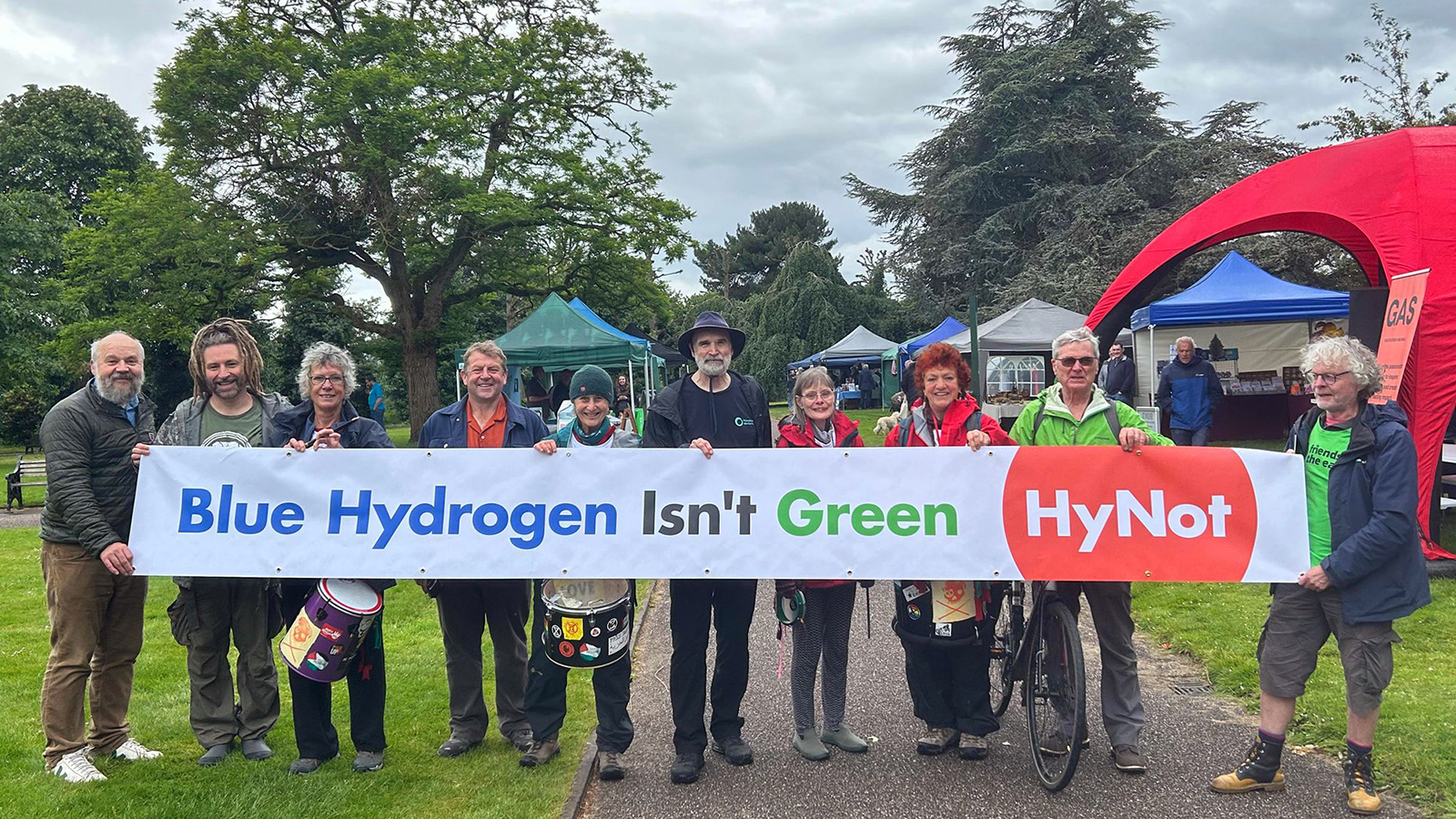
 
Demonstration by HyNot, which opposes hydrogen for home heating, at
the Green Expo UK in Cheshire, last week. Photo from 
HyNot twitter feed

The Tory government has invested heavily in hydrogen, and the 2023 Energy Act provided a framework for its commercial development. But attempts to bribe communities into testing it out for home heating have hit setbacks. A planned test at Whitby, Merseyside, was cancelled last year after vigorous opposition by local residents and the HyNot campaign group. This year a second planned test at Redcar, Yorkshire, and a third one in Fife, Scotland, were both postponed.

Catherine Green Watson of HyNot said: 

These postponements are great progress for our campaign. But on Merseyside we still have strong local political support for hydrogen in industry, which should not be the priority. Instead, we need to concentrate on upgrading the electricity grid.

We need a discussion in the labour movement and social movements about the social role of these technologies. We could work towards unity around the principle that they should not receive state funding that could go to quicker, more effective decarbonisation paths.

5. Energy use in our homes and transport

Labour has scaled back its promises to invest in its Warm Homes Plan that will fund grants and low-interest loans for insulating homes and replacing gas boilers with heat pumps. Shadow energy secretary Ed Miliband last year talked about “up to £6 billion a year”; by the time Labour’s manifesto was published last week, this had shrunk to “an additional £6.6 billion over the course of the next parliament” (that is, over five years). Talk of upgrading 19 million homes had stopped; now it’s 5 million.

Labour has stuck with commitments to take railways back into public ownership, and to support municipal ownership and franchising of bus services. But it is also promising to “forge ahead with new roads”, and keep the transport system centred on private cars, at a time when researchers argue that this cuts dangerously across tackling climate change.

If Labour sticks to this course, determined by its neoliberal fiscal rules and by corporate lobbying, then key opportunities to cut UK carbon emissions, while improving people’s lives, will be missed. Researchers have been screaming for years that insulation and heat pumps, and superceding the car-centred transport system with better, cheaper public transport, are desperately needed to decarbonise homes and transport, the two largest sources of greenhouse gas emissions.

Battles on effective energy conservation in homes, transport and throughout the economy are part of the war to limit climate change.

Labour’s commitments are too timid to reverse the disasters caused by Tory policies. In the decade from 2012, annual completions of home insulation upgrades fell by nine tenths. The measures announced by government last year would take 190 years to improve the energy efficiency of the UK housing stock and 300 years to hit the government’s own targets for reducing fuel poverty, National Energy Action stated.

As for roads, the government could cancel the £10 billion Lower Thames Crossing scheme, final approval of which has been delayed until October, and apply to all future projects the principle adopted by the Welsh government – that they can only go ahead if compatible with climate policy.

Labour may not only fail to deal with these gigantic sources of carbon emissions, but actually open up new ones. A grim example is Labour’s threat to overrule communities who question tech corporations who want to build fuel-guzzling data centres – which will help trash climate targets, to the benefit of those corporations alone.

6. Bringing the issues together

The stakes are high. Every new assessment by climate scientists underlines the conclusion reached by leading British researchers four years ago: that the UK’s decarbonisation targets are half as stringent as they need to be, to make a fair contribution to tackling global heating. The government’s own climate change committee says non-power sectors of the economy need to decarbonise four times faster than they are doing.

Tackling climate change, while reversing the effects of 14 years of neoliberal austerity policies, will not be easy. Indeed, Labour does not intend to: both decarbonisation and social policy will be subordinated to their fiscal rules.

The labour movement and social movements need to challenge and push back Labour’s pro-fossil-fuel, pro-austerity approach.

We need to unite our forces and find the pressure points – be it saying “no”, to the Lower Thames Crossing project and similar, or finding openings for collective action, e.g. in the Local Power and Warm Homes plans.

To act effectively on climate, we need to keep in mind the necessity of holistic solutions, and reject illusory technofixes and greenwash narratives that claim to reduce emissions with one hand, and pour them into the atmosphere with the other. SP, 18 June 2024.

🔥Thanks to the Ecologist, where this article also appeared.

🔥“Market forces” will never prevent climate disaster. A review of The Price is Wrong by Brett Christophers (April 2024)

🔥Wind, water, solar and socialism – a People & Nature long read (September 2023)

☭ People & Nature is now on mastodon, as well as twitter, whatsapp and telegram. Please follow! Or email peoplenature@protonmail.com, and we’ll add you to our circulation list (2-4 messages per month).

Post-Election Battlegrounds For Climate And Social Justice

Ten links to a diverse range of opinion that might be of interest to TPQ readers. They are selected not to invite agreement but curiosity. Readers can submit links to pieces they find thought provoking.


Lynx By Ten To The Power Of One Thousand One Hundred And Twenty Six

Dr John Coulter ✍ In spite of the jolly atmosphere in the House of Commons last week as most of the newly-elected MPs took their seats on the green benches at Westminster for the first time, back home in Northern Ireland, the Christian churches should hold their own post mortem on the election results.

With Sinn Fein and the SDLP holding their respective seats fuelling talk of the mythical border poll, and the DUP losing seats sparking yet more gossip about Unionist unity, the Christian churches also need to ask themselves some serious questions about their relevance under a Labour regime in the UK.

There is a real need now for those churches to set aside petty theological differences about who the Biblical Antichrist is, should women wear hats to church, which form of baptism is correct, and how often should the sacrament of communion be held.

In many Northern Ireland constituencies, the voter turnout was well below 60 per cent. The churches need to ask - how many Christians stayed at home? Put bluntly, if the churches want to have their voices heard in a Labour-dominated Parliament, they need to champion the cause of Australian-style compulsory voting.

Within some sections of Christian theology, there is a viewpoint among evangelicals and fundamentalists that when a person becomes a born again Christian according to the Biblical doctrine of salvation, they should adopt a ‘come ye out from amongst them’ attitude to the world - and this includes not voting.

However, Christians cannot adopt a hypocritical Biblical Pharisee attitude and moan about the advances of the secular society or the liberal views of elected representatives if they have not bothered to vote in the first place.

While there may not be council, Assembly or Westminster elections in Northern Ireland for a few years, this gives the churches time to organise their flocks into an effective lobby group with a common agenda - getting compulsory voting as part of UK citizenship.

Could you imagine how the political landscape of Northern Ireland would be radically changed if we had a 96 per cent turnout of voters in each of the 18 constituencies?

Of course, the main hurdle in achieving this common agenda among the churches is that Christians love to argue among themselves. Theological liberals find it hard to agree with theological evangelicals; broad-minded ecumenists would differ from hardline fundamentalists. In practical terms, Christian unity in Northern Ireland has become as big a myth as Unionist unity.

Practically, what the churches need to do as a starting point is to copy the tactics of the Southern Baptist churches in the United States in the Sixties during the civil rights era for Afro-Americans - they got their congregations registered as voters.

For a start, if every person who calls themselves a Christian in Northern Ireland, of whatever theological standpoint or denomination, got themselves on the electoral roll and pledged to vote at the next election, what impact would that have on those who were elected?

A Churches Voter Forum needs to be established with the sole purpose of getting all Christians registered to vote. Surely that can be achieved without anyone compromising their theological beliefs?

The next step would be the most challenging - establishing an agenda of core beliefs which the Churches Voter Forum could put to wanna-be candidates and parties. Unfortunately, this is where the theological differences and petty squabbles between the Christian denominations would kick in.

However, there is one part of Scripture which the vast majority of all Christians agree upon - the role of Christ’s Sermon on the Mount, also known as the Beatitudes; the ‘blessed are …’ passages of the New Testament.

Surely no Christian could disagree with these specific teachings of Christ? This being the case, could a future Churches Voter Forum get candidates and parties to sign up to this agenda? Put bluntly, Christian voters would be asked by their denominations to plump for any candidates who sign up to the Beatitudes Agenda.

Currently, as a result of this month’s General Election there is a perception that the real political battle in Northern Ireland is for middle ground politics. This also fuels the false perception that middle ground also applies to theology - that it is only liberal Christians who are interested in, or will influence, the electoral process.

Other false perceptions have existed - and still do! During the Paisley senior era, the Free Presbyterian Church he founded in 1951 was viewed as the DUP at prayer, just as in 2024 some pentecostal churches have been unjustly branded as the TUV at prayer.

There is the false perception that theological evangelicals and fundamentalists are being increasingly sidelined in what is viewed as the forward march of secularism and pluralism in Northern Ireland, especially among young and first time voters.

Like Unionism and nationalism, the Christian churches will have some serious thinking to do as they ponder the implications of the election results.

For the churches, the key question will be bluntly simple - how do we become a relevant voice which is listened to in a secular society? The sooner the churches get their act together in voter mobilisation, the better placed they will be for the next poll.

The bitter medicine which the churches may have to swallow is that if they bury their heads in the pews, the significance of the so-called ‘church vote’ will become increasingly irrelevant and voiceless in future elections.

Christ Himself took positive action against the money changers in the Temple; the time has come for churches to practically follow His example and organise the flocks.
 
Follow Dr John Coulter on Twitter @JohnAHCoulter
Listen to commentator Dr John Coulter’s programme, Call In Coulter, every Saturday morning around 10.15 am on Belfast’s Christian radio station, Sunshine 1049 FM. Listen online.

Churches Need To Lobby For Compulsory Voting

Muiris Ó Súilleabháin ✍ It could be argued, with some merit, that the British parliamentary election of 2024, finally saw Big House Nationalism overtake Big House Unionism as the dominant political force in the north of Ireland.

That Big House Nationalism as now exemplified by New Sinn Féin presented the electorate with a party manifesto, painfully devoid of substance or policy. Treating their electorate with such disdain, was an indicator that the election was to be fought along tribal lines. A calculated risk was taken by the new kitchen cabinet, that the vote for us or you will get them policy was the one that would resonate best with those who bothered to vote in an election with the lowest recorded turnout.

A few weeks previous, the election in the 26 had been a disaster for Southern Sinn Féin. Mary Lou, Pearse and Eoin saw their populist political posturing and smugness overwhelmingly rejected by the vast majority of the electorate. Decimation was only prevented, and the southern leadership saved (for now) by the vote transfers of Aontu, the far right, and various socialist parties.

FF/FG and the media, surgically dissected the policies of SSF, as not costed, not worked out, remarkably centrist and similar to FF/FG policy. FF/FG also publicly highlighted the abysmal failure of NSF in the north to make any substantial progress on the issues they claimed that they alone could solve in the south.

NSF will have been delighted that their political opponents and the media chose to make this election a sectarian head count. Pat Cullen was harassed about her views on historical IRA actions rather than facing scrutiny about the glaring contradictions of her standing for a party that actively cut nurses pay and refused health workers a pay rise when they held the Stormont Ministries responsible i.e. Health (O’Neill) and Finance (O’Muilleoir).

NSF will be actually aware, privately, that their recent “success” (managing to retain the same number of seats and the same percentage of votes) was a byproduct of Unionist disunity rather than the “seismic shift” towards reunification that some dubious commentators are portraying.

With a refreshed mandate not to be the DUP, Northern Sinn Féin, have promised (again) that they will “continue” to put the rights of workers and families to the fore front as they govern the north of Ireland. The northern leadership of Michelle, Conor and John have already recommitted to ask the British Exchequer (nicely) for more money for public service reform and payrises in the north.

Michelle and Mary Lou have also asked for a not inconsiderable bung on the side to allow the First Minister to deliver what her party`s Finance & Economy Ministers could not deliver, a new football pitch in West Belfast.

I live in hope for the day when the media and voters will begin to challenge NSF on actual delivery and outcomes rather than buying into the busted flush of border poll mania. A forensic examination of what they have achieved in the north since they entered Government 26 years ago could provide the baseline for a credible challenge to their hegemony.

There is now an entire generation in the north who have not lived under Westminster direct rule, and for most people Unionist misrule is a historical memory. Conditions in the north are now directly comparable, in relative terms, to the conditions that gave birth to the civil rights movement of the 1960s.

20% of the population are leaving school with literacy levels that are not considered functional.

In figures that dwarf the South in per capita terms, 55,000 people presented as homeless, including a shocking 4,500 children in 23/24.

Absolute child poverty rates in West Belfast remain the highest in the UK and at 21% are comparable to post invasion Iraq.

27% of the northern population are economically inactive which is primarily linked to disability and illness surpassing unemployment rates in both Gaza and Sudan.

The differential in life expectancy between the richest and the poorest in the north has grown to a striking 14 years and the number of people reporting poor or bad health has risen by 50% since the 2011 census.

Waiting lists for cancer treatments have increased to the extent that international targets, (that will save your life) are not being met.

83,000 people are dependent upon foodbanks, and the opening of new foodbanks are viewed as nothing more than good photo opportunities for progressive Ministers.

This is a snapshot of life in the north in 2024. It demonstrates how the people of the North are being failed, not by the “Brits” or Big House Unionism but by the parties that have led the north for the last 26 years. This includes the progressive party of change NSF, which has held executive powers in all the ministries responsible, but has singularly failed to bring about any progressive change in 26 years.

A deeper delve, beyond this snapshot of post GFA NI, would clearly show that he peace dividend has bypassed most working-class communities across the north. Inequalities remain clustered in the same areas (primarily in Belfast and Derry) as they were in 1969. The issues remain the same.

Big House Nationalism has failed us all, while heavy on rhetoric, New Sinn Féin have failed to address in any meaningful way the systemic and endemic inequalities that still pervade across our society: Meet the new boss same as the old boss.

Mountains of “peace money” from the states and the EU, which should have been used to address these critical issues effectively, was squandered on vanity projects whose sole purpose was to keep certain republicans on board the peace train.

NSF Ministers in the north continue to copiously fund community and voluntary organisations who make no or minimal impact upon their communities and provide nothing but an employability programme for the loyal soldiers of a long-forgotten war and their extended families.

Public money was sacrificed to “solidify” the “peace process” and this obscenity continues in 2024, thirty years after the first sos. NSF, funded indirectly by the British, maintain a frightening level of coercive control over their communities preventing a radical alternative emerging in the north. Community groups and the ubiquitous community workers serve the “movement” in much the same way as the “Committees for the Defence of the Revolution” serve the Cuban establishment.

When I raised these matters with the NSF canvasser at my door recently, I was blandly told that a vote for NSF was a vote for change. As the NSF canvas teams left in their top of the range cars, I pondered that change should have and could have started 26 years ago. I see no appetite or capacity within NSF to change anything.

Why would they change or want to change the status quo when the “movement” and its activists are the sole beneficiaries of the “peace process gravy train.”

This is a subject that I hope to explore in greater detail in my next article.

The hysteria that NSF and their proxies have created about a border poll and the questionable significance of a football pitch in West Belfast are deflections. Distractions designed to keep the troops busy and happy and to fool the base into believing the myth of movement towards the republic.

A border poll which has been on the statute books for 50+ years, will not bring The Republic. In the remote chance that the British call one, there is an even more distant probability that it will be successful. The recent election results north and south are the clearest indicators in some time that it is not on the agenda of either Government. Why would it be, when the great and the good of “Irelands Future” as embodied by Brian Feeney couldn’t even fill a medium sized concert venue in Belfast despite a national mobilisation by New SF.

Starmer came north in the first few days of his term to underpin that the British approach will be consistent under his tutelage. The bipartisan approach to the north that has existed in the UK since 1922 will continue. With a majority of 174 and at least three terms in his sights, Starmer has no need (or appetite) to appease the 7 abstentionist MPs from NSF. The notion that they (NSF) could “pile the pressure” on the UK establishment to accede to a polite request for a border poll is as preposterous as it sounds.

Likewise, building a new football pitch in West Belfast won’t eradicate the endemic child poverty in that area. “Families and workers” (© NSF) will still be dependent upon foodbanks and the number of children requiring free school meals will continue to increase.

How anyone could argue that Albania versus Georgia in Andytown will generate prosperity for Belfast is beyond slapstick. It will, for a few days, increase the profits for pubs, clubs, hotels and taxis etc in the vicinity of Casement, (cui bono? ). If it happens, it will be sold to us as a victory for NSF (over Unionism) and presented as a triumph for the progressive politics and change that we were promised.

I have no doubt the Wolf Tones will sell out the opening concert and that the “peoples” paper and Feile will instruct us all that the building of Casement is a vicarious victory for the bold IRA. Danny and Gerry might even get a stand named after them.

Children will still be hungry families and workers will continue to struggle and the poor will still be the poor.

⏩Muiris Ó Súilleabháin was a member of the Republican Movement until he retired in 2006 after 20 years of service. Fiche bhliain ag fás.

Big House Nationalism

Sean Bresnahan ✒ The outcome of Thursday’s vote in the Six Counties further demonstrates the changed demography in that colonial gerrymander. 
And yet, despite outward appearances, the ‘gut’ feeling engendered by the result can only be one of disillusionment.


It surely disheartens to see the nationalist vote finally outstripping its unionist counterpart only for it to be steered down the path being taken by the new Sinn Féin. For the ‘agreed’ Ireland of O’Neill and McDonald — stooges, of course, for Kearney and his ilk — will be a pale imitation of the Ireland for which so many fought across the years, too many of whom paid the supreme sacrifice.

It saddens to think that their vote in many ways results from their being linked to that struggle of the past. And yet they are wasting it — on orders from their ‘betters’ no doubt — to make sure that the objects of that struggle are disabled. Opportunism and sycophancy are motivators for some; for others a darker causality lies hidden.

Who knows what will be the final detail of it all but, suffice to say, this compromised arrangement will be laced with every manner of concession — concession that ultimately serves to protect and give endurance to Britain’s continued involvement in our country.

New Sinn Féin’s vote could easily be put to a much better use but alas. The Brit, as ever, has done his work well. What a waste of such massive potential, of political capital that could have been used to build a genuine Republican base seeking genuine Republican outcomes. That is what ultimately lies at the heart of Thursday’s result.

Sean Bresnahan is an independent Republican from Co. Tyrone who 
blogs @ Claidheamh Soluis. Follow Sean Bresnahan on Twitter @bres79

Massive Political Capital Wasted

Robert Emmet 1916 Society Lisnaskea  ðŸ¤¡ with a view on bourgeois parliamentary elections and non-politics.

Ahhhh, so here we go again.

Just a couple of days to go until the people of Fermanagh & South Tyrone are yet again to take to the polls to see which particular representative is to repress us on behalf of their imperialist masters. 

Hearing through the grapevine that there are only two messages on the doorsteps, could we guess what they are? 

Knock! knock!! 

Good evening, we're just out doing a bit of canvassing. 

Yes, i'm registered to vote. 

OK, great stuff, don't forget to vote for us as you don't want to see a Fenian take the seat. An IRA sympathiser!! 

Yes, OK, but when you're here, what about the state of the healthcare system? 

Yes, when we get elected, we will sort everything out. 

Thanks folks you always have my vote! (Silently thinking) even tho i'm still living in poverty. Anyways I don't care as long as Ulster remains British and our wee country Norn Iron remains a sectarian cesspit ... Orange poverty is better than green poverty! 

Knock! knock!!

Good evening, yes, it's us again. We know we have your vote, but don't forget to turn out on Thursday as you don't want to see a daughter of Harry West elected. This is the seat of Bobby Sands. 

OK, but your party has held that seat numerous times, but what have you done with it? Ehhhh  

Look at our rural towns! Doctors surgeries closing, towns like here in Lisnaskea, who had 3 banks now have no bank. The roads are horrendous, yet road tax increases every year.... 

Emmmm, that is the Tories' fault. 

Ok, but you implement Tory policies and have for decades been endorsing neo liberal Thatcherite austerity. 

We don't really know what you mean as we're just canvassers. But all that will be sorted in the new agreed Ireland. Ye know the one we're discussing on podiums with civic nationalism?! 

Ahhh, OK, you have my vote. Just a thought! 

What if people actually voted according to their class interests and we had politicians who managed the country on behalf of the people who live in it instead of managing it on behalf of the exploiter vulture class?

Are the above paragraphs what James Connolly meant when he stated ruling by fooling is a great English art with great Irish fools to practice on? Time For An Alternative To The Failed Representative Democracy Style Of Top Down Politics!!

Orrrrrrrr, we can always keep doing the same old thing and getting the same old outcomes. If so, don't complain about not being able to see a doctor, not being able to get a house, the cost of fuel, house rent, vehicle insurance, wages, etc..... Remember, it's you, the people who vote these clowns into government  

So don't say you didn't know!

Knock Knock

Caoimhin O’Muraile ☭ The character assassination on the former British Labour Party Leader, Jeremy Corbyn continues unabated. 

It is not the Conservative and Unionist Party who lead these assaults on the man who almost became British Prime Minister but the Parliamentary Labour Party (PLP)t. The present Labour leader, Kier Starmer, has expelled his former boss from the PLP in a most disgraceful fashion. Starmer was once a supporter of Corbyn – or he at least pretended to be – until he, Corbyn, lost the 2019 General Election by a huge margin. Starmer saw his long-awaited chance of replacing Jeremy Corbyn, despite him falsely and pretentiously supporting the man previously against the sharks of the PLP. Starmer has accused the former leader of being anti-Semitic, which he certainly is not, and under the false guise of cleansing the party of all allegations regarding anti-Semitism expelled Corbyn who now stands in his constituency of Islington as an Independent. The Labour PLP did not want Corbyn as their leader in the first place but lost out to the huge support he had, and still has, among the party membership as a whole. 

Jeremy Corbyn was elected as leader by a huge majority but the PLP were not satisfied with that, they wanted a re-run, which they got and lost by an even greater margin. They totally ignored the majority and party democracy until they got their own way after the 2019 election. If such actions had occurred in any other party Labour would have been shouting about democracy from the roof tops. When they do it in their own camp not an utterance within the PLP of discontent! They continue while often laughing at the humiliation heaped on the party under Corbyn’s leadership at the 2019 General Election, a defeat brought about in no small way by their own actions, to assassinate Corbyn’s character. They purposely attacked their party leader in public, an assault led by Margaret Hodge and other right-wingers within the PLP. Amid these attacks, constantly referencing 2019, they never mention the 2017 General Election when Jeremy Corbyn proved very popular and reduced Prime Minister, Theresa May’s, working majority from 17 to 4, forcing May’s resignation as she wept at what amounted in many ways to a defeat for the Tory Party.

Prior to the 2017 and after attempts to dislodge Corbyn as their leader many Labour MPs, including Stephen Kinnock the son of former leader, Neil Kinnock, were laughing at the thought of Corbyn becoming Prime Minister. He was not alone as the general opinion among the PLP was along the lines of; let’s get this farce out of the way and after we have been hammered, we can elect a new leader. Unfortunately for these treacherous bastards the hoped for and expected drubbing did not come. Corbyn proved very popular among the electorate, particularly the younger voters and Labour received 40% of the vote, their highest since 2001, only 2% behind the Conservative and Unionist Party. The Tory’s could only form a minority government having just lost their ‘working majority’ and May resigned. She was replaced by Boris ‘the clown’ Johnson who staggered on until 2019. This gave the Labour PLP ample time to really get the knives out for the man who almost became the Labour Prime Minister which would have meant many of these so-called MPs would have been deselected by their constituency parties. After the 2017 election the same Stephen Kinnock was filmed almost in tears at how well his hated socialist leader had done! The backstabbing of Jeremy Corbyn by the PLP made the attack on Julius Caesar led by Marcus Junius Brutus (44 BC) look like a walk in the park.

On Sunday 23rd June 2024 the Labour Shadow Education Secretary, Bridget Philipson was interviewed on Sunday with Laura Kuenssberg and was asked about the 2019 election. She replied to this part of a question with a flip back to Corbyn’s leadership. She blamed “poor leadership” for the 2019 defeat and a “poor leader, Jeremy Corbyn”. Not once did she mention the result of the 2017 election which painted a very different picture of the then Labour leader. Since that peak year the knives came out in ‘Brutus’ fashion for Jeremy Corbyn. The accusations of anti-Semitism grew simply because he, like many other politicians rightly so, criticised the Israeli Government policies towards the Palestinians. These attacks on Tel Aviv were no different to similar attacks on the Russian Leader, Vladamir Putin, in Moscow. The difference was, and is, allegations of anti-Semitism could not be fired at Putin’s accuser’s but can be at those of Benjamin Netanyahu! These allegations against Corbyn by the PLP were backed up and even magnified by the media – no surprise there – and began to stick in the eyes of many. It must be pointed out that many Jewish people and organisations stood up for Corbyn and themselves criticised the Israeli Government actions against the Palestinians. Not a word was mentioned either by the Labour PLP or the media about this Jewish support for the now former party leader. 

Corbyn resigned after the 2019 election, the man who had come so close only two years previous and, even though he lost the 2017 General Election led the party into that ill-fated 2019 contest staying on as leader because 2017 bad been so close. Corbyn never stood a chance, his own PLP made damn sure there would be no repeat of 2017 even if it meant another five years in opposition.

On 4th July there will be a General Election in the UK. Jeremy Corbyn, now expelled from the PLP, will run in Islington as an Independent candidate. I for one hope he wins the seat. The present Labour leader, Keir Starmer, looks likely to become the next Prime Minister. This means instead of the official Conservative Party being in office another version with a small c will become the government. Keir Starmer will be Prime Minister unless the polls are all wrong by a country mile but look at the opposition! Rishi Sunak, the incumbent PM, has all but thrown the towel in after his, albeit short disastrous term of office in Number 10. The neo-fascist Nigel Farage is heading the Reform UK party and hopes to become the official party of opposition. If Starmer, fraudulent as he may be, cannot beat such opposition he should return to being a barrister. There will be no PLP knives out for Starmer as he continues to turn the Labour Party into a cheap version of the Conservative and Unionist Party. Keir Starmer, the man who wears a red overcoat to hide his Royal Blue jacket underneath! 

As for the Labour rank and file, particularly Momentum who were in most cases Corbynistas, what about them? What about internal democracy inside the British Labour Party betrayed along with Jeremy Corbyn? Well, these things happen is the feeling I get as the party rarely mentions its best electoral result under Jeremy Corbyn in 2017 since the days of Tony (Tory) Blair. The best percentage of the vote result since 2001 and not a word of credit by the traitors. We should not expect any! Imagine back in 2017 if the PLP had used as much energy supporting their leader instead of trying to trip him up at every opportunity what the outcome of that election might have been? Instead Corbyn and Momentum along with a few left-wing MPs fought the election not only against the Tories but against their own PLP. A fucking disgrace of the highest magnitude!

Caoimhin O’Muraile is Independent Socialist Republican and Marxist.

‘Brutus’ Attacks On Corbyn Continue