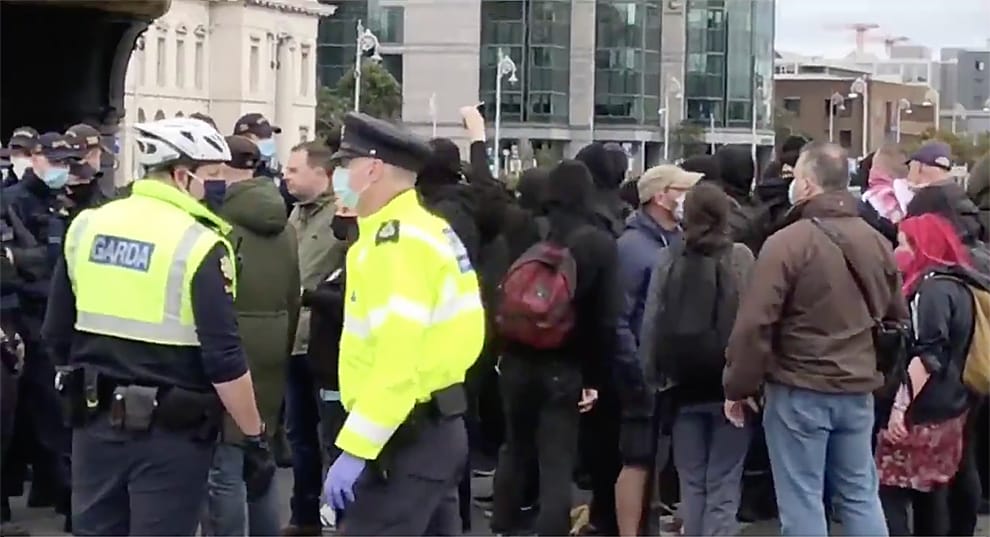
Showing posts with label Saoradh. Show all posts
Christy Walsh ✍ When I was told that Saoradh had sent solidarity greeting to Hamas for their crimes against humanity I had to check it out.

Sure enough they Salute Hamas and its "Operation Al-Aqsa Storm" of genocide to kill as many Jews as they could. I was disgusted. Today, 12th October, Saoradh has not self-reflected and withdrew its support for Hamas. There is no justification to support Islamism and its crimes against humanity. And no self-respecting Republican would ever support Islamism’s acts of depravity and pure evil. It appears Dissidents are becoming more radicalised in their thinking that genocide, war crimes and crimes against humanity are legitimate means. This radicalisation has never been part of Republican psychic.

I recalled that after the 9/11 atrocities I could not believe there were Republicans/dissidents gleeful about those attacks. They thought so little of the Irish communities in the US that have stood in solidarity with Republicans throughout the Conflict. When I explained that Islamism hates the world and if you are not Muslim, or the type of Muslim they like, then they would as easily kill you unless maybe you converted. One dissident responded “Haven’t we oppressed and tortured Muslims, we deserve it.” I reminded him of Irish history, we had been the oppressed and never the oppressor. The defence was but we are part of the West, we deserve it. Scary thinking. Years later I encountered someone else who defended ISIS’ right to carry out genocide and acts of sheer barbarity and cruelty. Dissident radicalised thinking is a matter of concern.

So Saoradh have praised Hamas, loved their war crimes and crimes against humanity. Another frequent contributor to The Pensive Quill once wrote how when dissidents secure a United Ireland – they would then sort out the Unionists and other enemies. I called him out for it – I assume I am ‘other enemy’ because I didn’t agree with him. These people don’t actually get that war crimes, genocide and crimes against humanity should never be carried out by anyone, even by those you like. I realize that if Saoradh and violent dissidents had the manpower and weaponry they might do the same if they aren’t repulsed by it. It comes down to opportunity and they don’t have it. The IRA would never even have thought of doing these things – killing babies and gang raping civilians, abducting little children and other sick and horrific acts of cruelty. Saoradh and the Left’s sympathies for Islamism is deranged and detached from decency and human dignity.

I am concerned about both Israeli and Palestinian civilians. Hamas attacks have always been designed, not for the insignificant damage they inflict, but the disproportionate response they draw from the Israelis. Their latest attacks are consistent with that strategy. They have effectively wrapped a suicide belt around the Gaza Strip in expectation of the Israelis blitzing it and that would draw other Muslims to attack Jews. In essence they are sacrificing Gaza in hope the Jews would be wiped off the face of the planet – they stated as much – to end the occupier’s existence on earth - or something like that. That is pure desire for genocide not freedom fighting. 

The Palestinian leadership in the West Bank have said they don’t want any part of Hamas crimes against humanity. It’s a shame Saoradh hadn’t got the same decency and compassion. I would not want to live in Saoradh’s radicalised idea of a United Ireland. It besmirches the ideals and aspirations of generations of Irish Republicanism.

⏩ Christy Walsh was stitched up by the British Ministry of Defence in a no jury trial and spent many years in prison as a result.

Saoradh Salute To Crimes Against Humanity

Anthony McIntyre
tells Suzanne Breen that in his view Saoradh is as big a threat to state as St Vincent de Paul.

 
McIntyre says there is little support for dissident group or its political wing in wake of MI5 sting.

An ex-IRA prisoner has said that the New IRA's political wing, Saoradh, "poses as big a threat to the British state as St Vincent de Paul".

Anthony McIntyre said there was little support for either republican organisation in their own community in the wake of revelations that the dissidents had been infiltrated by alleged MI5 agent Dennis McFadden.

Ten people, including two women and a Palestinian doctor, are facing a range of terror charges following the sting.

Mr McIntyre said that the New IRA was viewed as “a pale imitation” of the Provisionals.

“People see it as an irritant,” he said. 

It is not a serious IRA fighting a determined guerilla war against the state. It is known for its incompetence and ineffectiveness.  It has inflicted no casualties on the state since 2016. Last year it killed journalist Lyra McKee when it opened fire recklessly during a riot in the Creggan, and it came close to wiping out a group of young people when it exploded a bomb on a street outside a courthouse in Derry.

Mr McIntyre served 18 years in jail for the murder of a UVF man in 1976. He is a long-term critic of Sinn Fein’s political direction but opposes continuing any armed campaign.

He added:

Apart from the risk it poses to civilians primarily within its own community, the New IRA does nothing more than make a bit of noise and give the state the opportunity to continue using repressive legislation and curbing people’s civil rights.

Mr McIntyre challenged Saoradh’s claim that last month’s MI5 operation was an attempt to crush the party.

“Few will give any credence to the charge that this is a state attempt to close Saoradh down or wipe them out,” he said. “My feeling would be that Saoradh poses as much a threat to the British state as St Vincent de Paul do — which is none.”

Mr McIntyre claimed he had not seen the party “use its energy on serious and substantive” issues.

What I have seen is Saoradh join others and follow a few groups around Belfast city centre, and shout at them on the street on Saturday afternoons. It’s actually embarrassing. It makes republicans look as bad as those that they claim they are challenging.

Scotsman Dennis McFadden has been named in court as being the alleged MI5 agent involved in the New IRA sting. It has been claimed that he organised safe houses for the paramilitary group which were bugged by the intelligence services.

Mr McIntyre said:

Spying is called the second oldest profession precisely because it is not a new phenomenon. Many agents and informers penetrated the ranks of the Provisional IRA. And the IRA itself has used informers in the past. The late prison officer, John Hanna, spied on his colleagues for the IRA. So when republicans howl about spies it is only because of whose ox has been gored. If a player in any game gives the opposition a penalty kick, their adversary would be a fool not to take it.

Hanna was a senior prison officer in the H-Blocks. In 1990 he was sentenced to life imprisonment in Maghaberry jail for helping the IRA murder his colleague, Brian Armour, two years earlier.

Hanna had been involved in plans to stage a large-scale prison breakout.

He had also given information on other colleagues during an affair with a female IRA intelligence officer. He died of cancer in 1992, aged 45.

⏩Follow on Twitter @AnthonyMcIntyre

Of Spies And Men

Anthony McIntyre
senses a general republican indifference to recent arrests of prominent Saoradh members. 

The arrests of a number of Saoradh activists alleged by British police to be senior figures in the New IRA, as it is frequently described, has prompted a flurry of media commentary and speculation. For the news hounds it is a big story. With the New IRA not doing very much, what is supposedly being done to the New IRA makes the headlines.

Some of Saoradh’s republican rivals are said to be gloating. Those of us who have spent considerable time behind bars avoid that, even if we have little fraternal feeling for Saoradh. There are enough imbibing the sweet juices of Schadenfreude, without ex-prisoners sticking their straw in as well. While gloating has a presence, it seems indifference is the foremost sentiment circulating within republican circles. 

I don’t much follow the internal machinations of that fractious world, tending to see its incessant bickering, backbiting and jockeying for pole position much as Kissinger did when observing the politics of the university scene: they are “vicious precisely because the stakes are so small.”

Consequently, I didn’t feel in much of a position to comment when a couple of journalists contacted me, more or less restricting myself to saying that I had next to no interest in Saoradh or the New IRA and that my understanding of either was rudimentary. My curiosity was so stifled that when the arrests were first announced I had no great desire to find out who had been gripped. My response was the same as it would have been had news broken that a lot of clergyman had been arrested, accused of blocking a motorway in opposition to abortion or same sex marriage. The story might be interesting in itself but wondering who might be caught up in it all was absent. So, no point in feigning to journalists an interest that does not exist for the purpose of waxing learned. These things only grab my focus if the arrested are personal friends of mine, as on previous occasions they have been.

What concentrated my mind was the issue of agent involvement. I didn’t know Denis McFadden, but the informed speculation was that he had been a friend of a friend, since deceased. Not just a friend but a great friend. I didn’t see it as a reflection on the late Tony Catney, but that more than anything else drew me to the story.

The British police, back in the day when there was a serious IRA fighting a determined guerrilla war against the state, made use of informers as a counter-insurgency tactic. They invariably brought with them controversy and at one point seriously damaged the reputation of the Northern judiciary as it summersaulted from guilty to not guilty verdicts in the era of the supergrass. Probably the Beaks' worst judicial hour in a clatter of bad ones to choose from. 

Informers are invariably the most unreliable of witnesses. All too often they have with handler approval been up to their necks in the very activity the state likes to claim they have been instrumental in curbing – think Stakeknife and Mark Haddock. Self-serving accomplices, informers have every reason to cover their tracks with the scent of others. The state attempt to tart them up as having undergone some ethical conversion is simply shining a turd.

A species despised the world over because of what debased motives are attributed to them, the image of Gypo Nolan’s monetary reward being disdainfully pushed across a table to him at the end of a stick in the movie The Informer is indicative of even the handler attitude towards the type. The damning line from Louis Borge’s poem The Spy, I betrayed those who believed me their friend, perhaps captures better than most the reason they are held in such low esteem. Perhaps as a result of an evolutionary biological trait towards cooperation for purposes of survival, the stench of betrayal instinctively causes the nostrils to flare in revulsion towards the alien presence. 

For all of that, as reviled as informers are, virtually every agency across the board from states to guerrillas use them. The commodity is secrecy and the marketplace for that particular piece of hardware is densely populated by buyers and sellers. The very term industrial espionage shows its more widespread application.  Spying is not called the second oldest profession because it is a relatively new phenomenon. The IRA too made use of informers in the past – the late prison officer, John Hanna, for example. So when republicans howl about them it is only because of whose ox has been gored. If a player in any game gives the opposition a penalty kick, their adversary would be a fool not to take it.

Colleagues and friends of the arrested will exhibit a sense of entitlement, demanding that all republicans stand shoulder to shoulder with those behind bars. Outside of lip service that is unlikely to happen. Few will give any credence to the charge that it is a state attempt to close Saoradh down, feeling that Saoradh pose as much threat to the state as St Vincent de Paul. If they don't say it openly they seem willing to state privately that the arrests are the inevitable outcome, not of radical politics but of traditional militarism.  Most, while feeling aggrieved that MI5 and informers still figure on the landscape - courtesy of the parliamentarization of the Provisionals - will probably leave the arrested to their fate, feeling that energy is better invested elsewhere rather than in pushing the Sisyphean stone uphill only to have it roll back down again ad infinitum. 

Heroes on horseback, to cite Marx, rarely change society and seem unfailingly willing to place their faith in those ready to change horse.

⏩Follow on Twitter @AnthonyMcIntyre

Second Oldest Profession

Alex McCrory
➤ reflects on the ongoing use of the informer by the British state security apparatus.  

He crept in like a thief in the night.
Stealthily, he stalked his prey.
The characteristic smile.
Extended hand of friendship.
He moved quietly amongst the duped.
The gullible who welcomed him with open arms.
But something didn't quite gel. 
Was it his flaky personality?
A square peg in a round hole.
Where did he come from?
To where has he gone? 
Vanished into thin air.
His legacy.
Broken hearts and broken homes.

Gypo Nolan, a dim-witted Dubliner played by Victor McLaglen, is thrown out of the IRA for failing to execute a British solider. He harbours a dream to escape to America with his prostitute girlfriend Katie, but he has no money to buy the boat tickets. A solution presents itself in the form of personal betrayal of his close friend and comrade, Frankie, who is on the run from the Tans. Desperate to see his family after weeks of dodging the enemy, the fugitive plans to return home to see his mother and sister Mary. He is taking a massive risk.

Gypo gets wind of this and decides to squeal on his mate for a reward of £20, a princely sum for the time. As the result, Frankie is killed in a shootout at his mother's house while trying to escape. Gypo starts drinking heavily and spending money freely about town. This is noticed by the local volunteers who begin to suspect him of being a tout. Mary tells the IRA that Gypo was the last person her brother spoke with that day. All the evidence points in one direction. 

The IRA finds Gypo drunk in a local pub and arrests him. Although he denies setting up his friend, the court marshal finds him guilty and sentences him to death. But the condemned man manages to escape through a hole in the ceiling and runs straight to Katie's house to profess his love. She pleads for his life but the IRA commander refuses to intercede on her behalf. IRA men hurriedly go to Katie's house and shoot Gypo dead. 

The Informer is a story of betrayal, greed, love and retribution. These are some of the ingredients that turn a comrade into a Judas Iscariot. Whether it be for money, revenge or self-preservation, the tout relinquishes all bonds of friendship and brotherhood. This he must do in order to effectively serve his master.

In the first instance, informing is usually a panicked response to some type of leverage or threat exerted by interrogators or spooks. Few set out to be stoolies, on the contrary, most are pressurised and cajoled by authority into cooperating. The price is far too high for it to be a voluntary decision. However, a brutal death on a lonely country road has failed to deter some from accepting their thirty pieces of sliver. The certainty of a long prison sentence can override the possibility of discovery. For some it is a chance worth taking in certain circumstances. 

What prompted this post is the recent exposure of Denis McFadden as a British agent. What is his story? We will probably never know the answer.


 Informers become adept at telling lies and covering their tracks. It is part of the tradecraft. There are no obvious tell-tale signs to alert us to their presence. In some cases there may be grounds for suspicion, but it usually comes later in the day. An awful lot of damage already be done by the time someone comes under suspicion. The many unanswered questions around McFadden has excited speculation and theories which is understandable, but there is little hard evidence to support them at this time. We may come to learn more as the story unravels. But, from the standpoint of his handlers, it is a job well done.

McFadden was personable, affable, generous, helpful, resourceful, likeable and friendly. These traits did not point him out as an informer rather than being just a nice guy. 20/20 vision makes the fool a wise man after the fact. How much of the above was simply a part of his legend; a clever construction designed to ingratiate and mislead. Again, we may never know the answer.

Today, ten republicans are in jail on the most serious of charges. Families and relationships have been turned upside down in the space of a week. The immediate future looks bleak for all concerned. A man who was embraced as a friend, welcomed with open arms, has left a trail of devastation in his wake. This is the hallmark of The Informer.


Alec McCrory 
is a former blanketman.

The Informer

Matt Treacy ➤ If reports are to be credited, British intelligence appears to have successfully moved against one of the aspirant IRAs – namely those claimed to be in the New IRA and those in the left-wing grouping, Saoradh. 


The scuttlebutt is that MI5 recruited a leading member of the organisation in question who embarrassingly it would seem managed to obtain not only audio but video recordings of meetings of its leadership. It would appear that the recordings are to supply one of the key elements in charges against those arrested over the past number of days. Seven of those have so far been charged.


he alleged “supergrass” has been named on several social media forums along with his photograph. It would seem that he was a former member of Sinn Féin and was one of those who worked on their internet sites and media. He was involved with the party in Antrim from the early 2000s and when complaints were made about him, people were told that he not only represented SF, but the “whole republican movement.” Indeed.

He was also involved for a time as secretary with a group called Justice Watch which styled itself as a human rights NGO. He also apparently owned a takeaway and a bar in Belfast while involved with Saoradh. Which tells its own story.

A number of things are worth pondering in relation to all of this, not least for those persuaded that a revival of armed struggle might be a good thing. Firstly, it proves once again how easy it is for the intelligence services to infiltrate and manipulate secret organisations.

Without dabbling in the more extreme conspiracy theories regarding the demise of the Provos, it is clear that the IRA was penetrated at all levels and that this played a probably not inconsiderable part in its surrender, disarmament and disbandment. Which you might think would motivate others in questioning the point of attempting to create a retro Provos.

Whatever the intelligence and counter-insurgency aspects of the demise of the IRA, the decision to end the armed campaign was the correct one. It had long since ceased to be a plausible path towards a British withdrawal and the ongoing deaths, imprisonments and collateral damage were pretty much for nothing by the early 1990s.

So calling it off was the correct move. The politics of what followed are a different matter. Certainly, few republicans who supported the ceasefires could have envisaged that Sinn Féin would follow the military capitulation with the acceptance of Partition, and a role in administering the British controlled part of Ireland.

Along with that in short order came the abandonment of any pretence to be a movement standing for the sovereign independence of Ireland. Or having a plausible strategy to bring that about. The acceptance of the EU’s control over vast areas of Irish life is one consequence. The other is the headlong embrace of the mindless liberalism that will if successful make any project for national sovereignty meaningless, even in the unlikely event of it being formally ratified at some stage in the future.

So there is certainly an intellectual and historical argument against the direction which the republican movement in the main has taken over the past 25 years. There is none for reviving a failed armed campaign, which in any event is counter-productive when it does splutter into occasional life. More pointless deaths and more men and women doing jail time when they might be devoting their energies to something more productive.

The politics behind all of this are pathetic. I have seen leading members discussing Maoism. Apart from that nonsense, there is the usual left republican obsession with the past. Connolly for Dummies based on de-contextualised quotes from something written over a century ago. As though any of this has the slightest relevance to Ireland today. Like the Bourbons, they have forgotten nothing, and learned nothing.

It is surely ironic too that one of the political manifestations of the group in question, Saoradh, has been to turn out in support of Irish government ministers to clamp down on free-speech. They joined with the usual Pollyanna NGOs, professional lefties and antifa soccer casuals in support of Charlie Flanagan’s proposed “hate” legislation in a demonstration against free speech at the Dáil.

Of course, once their presence was highlighted, the Care Bears were appalled given Saoradh’s investigation by the PSNI following the killing of Lyra McKee in April 2019. Now the same state on whose side Saoradh is standing “objectively” (Marxists love that word) is doing its best to destroy them. That’s the thanks you get for “confronting the far right” it would seem.

It’s curious to see Saoradh joining with Antifa to try to attack people taking part in anti-lockdown rallies or demonstrations. Surely those demonstrators are ‘anti-establishment’? Does that make Saoradh ‘stooges of the state’, or some such phrase they would use to describe others? Or is this more of the M15 directing operations? Who knows.

Anyone familiar with the Dublin Fenians in the 1880s and 1890s will see some echoes in the current predicament of conspiratorial armed republicanism. As the land reforms and seeming success of the Irish Party at Westminister in advancing Home Rule took hold, some in the Irish Republican Brotherhood were reduced to squabbling factions, led by the nose through Special Branch into bombing schemes and occasionally murdering one another over money and allegations of informing.

Meanwhile the coming revolution was being shaped by those who in a period of political becalment were working through the cultural organisations to re-assert a national consciousness that was under threat of extinction.

The more far-sighted among the Fenians eschewed the plotting in dingy bars for the practical work within the GAA, the Gaelic League, national minded newspapers, and economic co-operation. It was this which laid the basis for what freedoms were won after 1916.

We arguably face a similar period now, as the forces inimical to our culture and sovereignty as a people have the upper hand. Those who think it can all be solved by kindergarden ultra leftism allied to an intermittent “armed struggle” are clearly part of the problem, not the solution.


Matt Treacy has published a number of books including histories of the Republican Movement and of the Communist Party of Ireland.
He is currently working on a number of other books; His latest one is a novel entitled Houses of Pain. It is based on real events in the Dublin underworld. Houses of Pain is published by MTP and is currently available online as paperback and kindle while book shops remain closed.

Why Are Saoradh Joining With Antifa To Attack Anti-Lockdown Rallies?

Dieter Reinisch
spoke with Saoradh after the arrests of party activists earlier this week in a Joint PSNI-Garda operation. Sine the interview a number of people have been charged by the PSNI. This is what the party told Dieter Reinisch.

On Friday morning, a tenth member of the radical Irish republican party Saoradh was arrested in Glasgow and the car of an activist seized by the PSNI in East Tyrone. I spoke to a party representative from Dublin about the ongoing Operation Arbacia, house searches and arrests of Saoradh members. Here is what he told me.

On Tuesday, August 18, the Northern Irish PSNI, assisted by An Garda Síochána in the southern 26 Counties, the Republic of Ireland, arrested nine leading members of the radical Irish republican party Saoradh (Liberation). The arrests were made while several houses of Saoradh members were searched in Derry, East Tyrone, and North Armagh.

In the South, Gardaí searched the homes of six republicans in Dublin, Cork, Kerry and Laois. Most of those singled out for house searches and arrests were former republican prisoners. All nine members, seven men and two women, aged between 26 and 50, are still questioned at Musgrave Serious Crime Suite in Belfast. There were no arrests made by An Garda Síochána.

BBC Northern Ireland reported that the MI5 directs the Operation Arbacia. In a statement on Friday, the PSNI informed that the operation is “ongoing”. On Thursday, all four Saoradh offices in Derry, Newry, Belfast, and Dungannon were searched. On Friday morning in Scotland, a tenth Saoradh member was arrested following a search of his family home in Glasgow.

All ten are held under the British Terrorism Act and remain in custody. The authorities were granted an additional 72 hours to question the nine people held in Belfast by Judge Pat Lynch QC. This extension will end at 2 pm on Saturday.

This major cross-border operation against the republican party Saoradh is one of the most significant operations against republican activists in many years. Over several months the security service increasingly turned their attention on Saoradh activists, particularly in Derry and Strabane. The use of house searches and arrests in Scotland and both parts of Ireland suggests that this operation is aimed at breaking Saoradh.

The operation primarily focuses on leadership figures of the lawful political party in the Northern jurisdiction. At the same time, a spokeswoman for An Garda Síochána said that “there were no plans to make arrests [in the Republic of Ireland]”. Security service statements emphasise that the operation is directed against the activities of the so-called “New IRA”, or “the IRA”. Arresting these political activists under the Terrorism Act in an operation supposedly target the New IRA is intended to establish clear evidence of overlapping membership of the lawful party Saoradh and the proscribed paramilitary organisation IRA. If the security service succeeds in making this link, it will serve as a pretext to proscribe Saoradh.

In a statement, PRO Paddy Gallagher from Derry stressed that Saoradh is a lawful political party: 

Since the formation of Saoradh, the British and Free State governments have used an array of draconian measures to suppress the party. By targeting party members, their families and supporters, the oppressor has sought to bully the party out of existence. The MI5-led operation which has witnessed the detainment of several members throughout Derry, Tyrone, Armagh and further raids in Dublin, Cork and Kerry is another example of targeted attacks in a futile attempt to stop the growth of our party.

Alex McCrory, a prominent republican activist and former prisoners from Belfast, said:

Such a level of cross-border coordination and cooperation is unprecedented in recent years. Undoubtedly, it is made eminently more possible by the appointment of Drew Harris as the Top Cop in the twenty-six counties. Harris may have donned a Free State uniform, but he is a British cop at heart. In this instance, he would have bent over backwards to assist his former employer.

Saoradh has issued two statements since the start of the operation on Tuesday, and Belfast member Dee Fennell appeared on UTV during the PSNI search of the Belfast office.

While media attention has focused mainly on the developments in Northern Ireland, I spoke to a representative of Saoradh in Dublin about the situation south of the border. The activist is an influential member of the party but wants to remain anonymous: “If my name appears in the media today, my house is on the list for a raid tomorrow morning.”

In Dublin, the houses of two party activists were searched:

The operation was an attack on former prisoners. Only former prisoners were singled out, but nothing was found. This is plain harassment of prisoners that is going on for years.

Funds for republican prisoners held in the high-security prisons Maghaberry and Portlaoise are raised through the Irish Republican Prisoners’ Dependents’ Association (IRPWA). There are about 30 prisoners looked after by the IRPWA in Portlaoise. “One prisoner who was recently released from Portlaoise lost his job because of the constant harassment from the Gardaí Special Branch.”

He was particularly outraged about the way the searches were conducted:

The armed Emergency Response Unit conducted the searches. This Saoradh member has a partner with severe back problems. Because of that she was up and looked out of the window and saw the whole street and the front yard filled with armed Gardaí of the Emergency Response Unit. They placed big flashlights outside the house. She immediately knew what was going on.

Over the past years, I had several meetings with the Saoradh members whose house was searched in Crumlin; some of these meetings had to be postponed due to the health issues and hospital appointments of his partner.

Despite these severe health issues, they assaulted her and forced her on the ground. That was at 5 in the morning. Because of the noise, the neighbours came out on the street. All they are doing with these raids is harming the community. Some of the neighbours immediately objected to the raids and protested.

I asked him why he thinks that Saoradh was targeted this week:

They want to damage the standing of our activists in the communities. They are worried that Saoradh is successful in community work, so they want to alienate Saoradh within the communities.

In the months before the outbreak of the Pandemic, Saoradh increasingly turned their attention on social issues, such as the Island-wide housing crisis. Over the last couple of weeks, Saoradh was active in confronting right-wingers in Belfast and Dublin, teaming up with other Socialists and Irish Antifa activists.

Journalist John Mooney recently quoted a Garda source in the Times, saying that republicans are:

attracting young people on a variety of political issues including globalisation and anti-capitalism. The people who are joining are not just traditional republicans but more left-wing activists. 

“But there is also another reason, why this operation has begun”, the Saoradh representative said:

It is a PR exercise by the police that they can say they are targeting ‘the dissidents’. We are amid a pandemic that is about to lead to a recession, and this is their way to show to the politicians: ‘We need more money.’

He then turns his attention to another topic regularly highlighted by Saoradh – Ireland as a global tax haven for multinational companies: 

We had the massive financial crisis in 2008. Bankers and property developers were throwing taxpayers money out of the window; corruption and criminality were ongoing for years. How many banks have been raided? How many houses of the top bank managers have been raided? How many have been convicted for their criminal actions that led to the current social crisis? None, absolutely none.

I want to move on to the next question, but he insists:

This was a long-planned, well-coordinated operation. You would need hundreds of personnel for such a big operation. We are regularly told by the government that there are no resources to tackle anti-social behaviour and drugs. Still, they can find more than one hundred Gardaí to smash in the doors of political activists at 5 in the morning.

Saoradh was officially formed in Newry in autumn 2016. The aim was to build an Ireland-wide radical republican alternative to the Good Friday Agreement and Sinn Féin. Some of the leading members are experienced republicans who were active in the Provisional IRA and Sinn Féin during the conflict in Northern Ireland. They were joined by a young generation of republicans, overwhelmingly from urban working-class areas, effected by youth unemployment and social issues, who see no perspective in the current political settlement.

Earlier that year, some of those who later formed Saoradh organised a march in commemoration of the centenary of the 1916-rising. Up to 4.000 people marched behind 50 women and men in paramilitary-like uniforms through rural Coalisland in County Tyrone. The main speaker of the event was former republican prisoner Davy Jordan who later became the first chairperson of the party. Jordan has since been succeeded by Dublin-man Brian Kenna but remains in the national leadership of Saoradh.

The Pandemic forced Saoradh to cancel their parades in 2020, but at Easter 2019, still up to 1.000 people marched at their national Easter commemoration outside the GPO in Dublin.

So how will the recent house searches and arrests impact the work of Saoradh, I ask: 

I believe that these raids will not affect Dublin. It will make our members more determined. Yes, these times are worrying, it is always worrying when the state comes down so heavy on a political grouping, but this will make us more determined to get our message out.

He continues: 

Raids are done for two reasons: One, is to alienate our activists in communities. When people see heavy raids like that, they go: ‘Oh my God, what have they done? They must be up to something for them to do something like that.’ So, the first reason is to alienate us within our own communities. The second reason is to put people off joining us. When people hear about raids like that, it puts some people off from joining us.

He then talks about the consequences in the North:

Obviously, the arrests in the 6 Counties are a lot more worrying because people are still in custody and the security service may bring in trumped-up charges. This will mean that they will be taken out of circulation politically from anywhere between now and two years. That is worrying.

Although this is a more sober and, probably, more honest assessment, it echoes what Paddy Gallagher from Derry said: “The more Saoradh resists, the more pressure is applied. Likewise, the more pressure that is applied, the more Saoradh will resist.”

However, with the arrest of ten leading members of Saoradh, the threat of charges is still hanging over the party. If some of their national leadership members are charged under the Terrorism Act, only time will tell if and how Saoradh can recover from such a blow. 

Dieter Reinisch is a Historian of contemporary Irish history at the National University of Ireland in Galway, and an Adjunct Professor in International Relations at Webster University. 


Operation Arbacia Clamps Down On Saoradh

Saoradh pours scorn on PSNI and Sinn Fein claims that the nationalist party is under threat from armed republicans.

For over two decades now the use of phantom threats by Sinn Féin to distract and deflect from policy changes, the abandonment of ideological principle and political mistakes and miscalculations has become a tried and tested tactic. Likewise, they have often been used in the run up to elections in order to garner sympathy, galvanise their membership and/or distract from unfulfilled promises from previous campaigns. The past few days have seen the phantom threat utilised yet again. There are several reasons for this.

Firstly, there is an onus on Sinn Féin to further distance themselves from their revolutionary past. Ironically this pressure emanates from parties that Sinn Féin now seek to emulate, those that the party has spent months and years begging for a seat at the establishment table. What better way to do so than by pretending to be at risk of attack from those upholding the revolutionary tradition that they have abandoned?

Secondly, several Sinn Féin members have made it known to Saoradh that both Michelle O’Neill and Gerry Kelly have faced internal criticism over their recent Crown Force recruitment attempts. This was voiced at their “Cuige” meeting at the weekend in Belfast, and also behind closed doors at what the party terms “Republican family meetings”. What better way to pull these members back into line than by suggesting they are somehow empowering those who seek to attack their own leadership?

Read more @ Saoradh.

Phantom Threats

Anthony McIntyre muses on the stifled world of republicanism and former republicanism.

A couple of recent events have helped to open a lid on the often-closed world of both current republicanism and its predecessor in the days when it could plausibly claim to have a republican pedigree.  

When John O’Dowd announced his challenge to Michelle O’Neill for the deputy leader spot within Sinn Fein it was followed by a period of silence, despite his optimism about the upcoming party and island wide debate. Most thought he was having a laugh as he certainly was not for real. Debate in Sinn Fein is like a Catholic in the Orange Order. Those on the outside looking in were told brusquely to move along, nothing to see here. O’Dowd was effectively muzzled. In any event, the debate: 

never happened. There were no hustings, no TV studio head-to-heads, and the initial social media discussion between Sinn Fein members after O’Dowd’s declaration was shut down swiftly. 

If O'Dowd was going to win the contest he first had to be able to make his pitch, but the party seemed intent on not allowing that to happen. The appointed one was to remain in place. O’Neill, conversely, merely had to sit silent and the status quo would remain undisturbed, the feathers of the peacock unruffled by the audacious posturing from the pretender to her throne.

The event itself was like a papal conclave. While professing little interest, neither I nor the keen observers were offered a glimpse. Anyone interested enough - I was not included in their number - had to wait on the white smoke which first announced the winner but held back on displaying the score card. The day prior to the vote some wit posted on twitter congratulating O’Neill on her victory the following day. As for O'Dowd he ended up "banished to political Siberia"

A seasoned journalist later rang me to suggest the result was close otherwise they would have announced it. I didn’t concur. Tight or not, the party wears a mask in order to prevent peering from without.  And it seems Saoradh -  perhaps more honest about wearing masks  - having picked up the republican baton dropped by Sinn Fein, is as opposed to scrutiny as its erstwhile comrades

The authoritarian need to dictate and impose its writ appears to be part of the republican DNA. Saoradh showed that it means to carry on in the republican tradition of authoritarian imposition when it refused an invite to the author Marisa McGlinchey to its ard fheis. McGlinchey was angry whereas I would have seen it as a cause to celebrate. The reason given was a pretty lame one: she had written a piece for the Sunday World.

The late journalist Marty O’Hagan, almost certainly killed by protected agents within the LVF, worked for the paper but never refrained from calling it the Sunday Worst. The paper has never been kind to Saoradh and it doesn't take a genius to work out that truth will never be allowed to stand in the way of a sleazy story where the rule of thumb seems to be fuck news, fake news will do. 

Still, that is no reason for depriving McGlinchey of a presence at the type of event where she seeks to ply her academic trade. Dictating to people for whom they will or will not write is the match that eventually burns books.  McGlinchey has arguably done more than any other writer in recent years to allow what passes for republicanism today to explain itself in its own words. Her engaging book Unfinished Business was considered so subversive of demonisation and marginalisation of those republicans regarded as dissidents it was banned for a while from Maghaberry Jail, which in these somewhat more enlightened times is on a par with a bread and water diet. Saoradh's attitude towards McGlinchey is indistinguishable from that of prison management at Maghaberry. 

First they came for the book, then they came for the writer. 

White Smoke