Showing posts with label Public transport. Show all posts
Anthony McIntyre  Despite the wealth in this society the waiting lists continue to grow whether for hospitals, houses, driving tests, ad infinitum.

The most recent to join the queue have been the dead, waiting for autopsies to be performed. Our rulers have now resorted to bringing in specialists from the UK to ascertain how people died. Perhaps those pathologists, while they are here, might have a look at the walking dead running Transport For Ireland in Dublin City.

This came home to me yesterday morning as I stood along with a friend wating on a bus at Summerhill. The 73 which seems to be the only bus that services Summerhill right out to Marino is supposed to come every ten to twelve minutes. That's what is spoofed on the website. We needed it yesterday to get close to our next stop for the 40D that would take us out to our destination, Cappagh Hospital, for a 1000 appointment. The 40D from Parnell Street can take up to forty minutes to make that journey, so we needed to make its 0900 service, which would get us to Cappagh with twenty minutes to spare. My friend has difficulty walking and is on a stick, so I accompany him on hospital visits. We both have Free Travel passes so the return journey to Cappagh Hospital, if the bus operator is up to the task, should not cost us a cent.

We arrived at the Summerhill stop close to 0830 which would give us plenty of time to make our connecting bus. An hour later we were still there. Five 73s went past on the outward journey but not a single citybound one.

Not one driver from the outbound 73s stopped to inform us of a problem. I guess it it not their responsibility otherwise they would have to tell everybody along the route. When a citybound one did arrive it was full and drove past us, the driver glancing our way indifferently. He could probably do little else. Taking time to explain the situation to irate would-be-passengers might have made those on his bus, already well behind schedule, just as irate about the inordinate delays. At the very least the service could have sent an inspector around those stops where electronic information boards are absent. But that is the type of thought the brain dead are not inclined to have.

People of different colours and nationalities congregated, frustrated and complaining about the total unreliability of the 73. Yesterday was not just a one off. They needed to get to work, so some started walking into town realising that they would pass plenty of 73s on their way, as the vehicles went in the opposite direction.

Growing anxious, we began trying to flag a taxi from about 0900 but had no luck. Eventually I suggested to my friend that he should either ring a cab or the hospital telling it we would need to cancel. He opted for a taxi. It arrived inside two minutes, the private sector succeeding where the public had failed miserably. The last time we headed out to the hospital in terrible weather it cost my friend almost thirty yoyos. This time the journey was much quicker and cost him twenty. A sizeable chunk out of a disability income.

People like my friend wait long enough to be seen by hospital consultants. Their quality of life depends on them making their appointments. Those appointments in turn depend on the public transport system being fit for purpose in deprived areas. I don't imagine there were too many delays yesterday in Dalkey. Many there probably have the financial means to go private in health matters as well, meaning they wait for neither buses nor treatment. All fine for the wealthy and healthy. Ballybough (the poor town), well, it doesn't seem to figure high in the priorities of the people running our public transport service. An impoverished working class community, it can be treated with disdain by officialdom. The wealthy can expect not only a larger slice of the cake but also the cream on top. The most disadvantaged, they get the crusts, and stale ones at that.

Follow on Bluesky.

73 🚌 The Busless Route

People And Nature ☭ Campaigners are calling on transport secretary Louise Haigh to scrap the Lower Thames Crossing (LTC) – a monstrous £10+ billion, 22-kilometre six-lane motorway tunnel – and put the money into public transport.

25-July-2024

Haigh has to decide whether to approve the Development Consent Order (DCO) for the LTC by 4 October. But the ruling could come even sooner: Rachel Reeves, the Chancellor, asked Haigh to prioritise it.

A protest against the LTC project, in Grays in 2016.
Photo from the 
Echo News web site

The crossing is the largest road construction project in the National Highways portfolio. It would reinforce the car- and road-centred approach to transport policy taken by the Tories, and undermine already-failing attempts to cut greenhouse gas emissions from the transport sector.

Campaigners say the £10+ billion could instead be ploughed into desperately needed improvements to public transport, the most effective route to decarbonisation.

The argument rolled out in support of the LTC, that it would reduce hold-ups at the nearby Dartford Crossing, is flawed – because more roads always produce more traffic.

Chris Todd of the Transport Action Network said: “The LTC offers Labour a huge opportunity to reclaim £10 billion that, with this project, would at best offer only five years’ relief from congestion at Dartford.

That money could be used by the government for improvements in public transport that people everywhere are crying out for.

Leigh Hughes of the Thames Crossing Action Group, which since 2016 has been coordinating local efforts to block the LTC, said: “The project will never fulfil its stated objectives. The Dartford Crossing will still be overcapacity. Mile per mile, this will cost more than HS2.

There will be no access for buses or cycles. The plans on the table are for a ‘smart motorway’, with no hard shoulder, by stealth. And here locally [in south Essex] we will be in a toxic triangle, with pollution from the A13, the A127 and the new approach road.

National Highways themselves estimate the LTC will add 6 million tonnes of carbon dioxide emissions, at a time when these should be going down. This is not the legacy we want to leave to our children and grandchildren.

Hughes called on people, wherever they are in the UK, to lobby MPs, calling for cancellation.

Senior Labour politicians have not commented on the LTC since the election – but there are signs that they might justify it as part of their drive to “rebuild Britain” by mobilising private infrastructure finance.

⏺ In her keynote speech on 9 July, Rachel Reeves said she would ask transport secretary Haigh to “prioritise decisions on infrastructure projects that have been sitting unresolved for far too long”. The decision on the LTC is by far the biggest of these.

⏺ Just before the election, a Labour party spokesman pointed to the LTC as an example of the Tories’ “broken approach to infrastructure”. They said delays were “unsustainable” – but made no comment on the worth of the project itself.

⏺ Straight after Reeves’s speech, Labour MP Torsten Bell also cited the long-delayed LTC as an example of costly and ineffective planning. “If we want net zero to happen, and to happen without higher costs, then things are going to have to be built. Things that not everyone loves.” He, too, failed to comment on whether the project is actually needed. Johann Beckford of the Green Alliance responded: “A resolution [to indecision on the LTC] is needed quickly. But the decision should be to scrap the project, at least in its current form.”

⏺ Former Siemens UK boss Juergen Maier, who wrote an unpublished review of transport policy for Labour, also railed against construction delays and called for “a long-term plan to build ambitious, economically transformative transport infrastructure, linked to a proper industrial strategy”. He did not distinguish between public transport and road projects.

The proposed route of the LTC. From National Highways web site


Juergen Maier, Torsten Bell and Louise Haigh’s office were approached for comment, but did not respond.

⏺ Labour launched a broader review of infrastructure policy, including transport, energy and digital connectivity, in January. Maier is joined on the panel for that review by senior executives from Arup, Mace and Skanska – all firms that make tens of millions of pounds each year for their shareholders by delivering big construction projects.

Behind this policy offensive lies Labour’s plan to “get BlackRock [the world’s biggest investment firm] to rebuild Britain”, which will result in further privatisation of infrastructure.

Economist Daniela Gabor has warned

The choice here is not merely between public and private financing of public goods, but whether British citizens should tolerate the government handing out public subsidies for privatised infrastructure.

Within days of the election, Labour showed that it is ready to overrule local opposition to infrastructure projects, by promising to review decisions blocking the construction of two data centres. The energy, water and material cost of such centres are giving tech researchers nightmares.

The climate damage done by road-building must be considered, along with the way that it reinforces social inequalities, transport researchers say.

The Transport for Quality of Life group has warned that, to meet climate targets, total car mileage needs to go down by at least 20%, and possibly by 50%, by 2030 – but there is no legal requirement on the government or other authorities to reduce the volume of traffic.

The group’s research shows that current government investment plans, including LTC construction, will by 2032 push greenhouse gas emissions from the UK’s strategic road network up by 20 million tonnes per year of carbon dioxide equivalent – while, to meet climate targets, they need to go down by 167 million tonnes per year.

Even the government’s own Climate Change Committee – which climate campaigners say puts far too much faith in electric vehicles to reduce transport sector emissions – is warning that transport decarbonisation is disastrously slow.

The committee’s review of climate policy progress, published last week, said that since 2008 transport sector emissions reduction had gone less than two-thirds as far as it had projected. Improvements “had been largely offset by the increasing size of new vehicles.”

The review also criticised “the inconsistency of the [government’s] revised roads policy statement with emissions objectives” and the diversion of HS2 cash to road building.

The LTC comes hard on the heels of the Silvertown Tunnel, a new Thames crossing a few kilometres upstream due to open next year – which was pushed through by the Labour mayor of London despite fierce local opposition on climate, air pollution and social inequality grounds.

Victoria Rance of the Stop the Silvertown Tunnel coalition said:

I can not believe that yet another 1970s-style road project is being seriously considered, given the climate and clean air crises we face. Surely the new government will honour its promises to take the climate emergency seriously, and stop the LTC. We need a transport policy that, first and foremost, cuts car traffic.

The Greater London Authority is currently conducting a consultation on the proposed fees for drivers crossing the Thames via the Silvertown tunnel and the Blackwall Tunnel that runs alongside it. Campaigners continue to call for the Mayor to consider using the new tunnel for public transport and non-motor traffic, instead of cars and lorries.

There are two visions of transport policy. The first, centred on road expansion on the dubious pretext that it supports economic growth – and embracing flawed, emissions-heavy projects such as the LTC – will deepen the climate crisis and exacerbate social inequalities.

The second, championed by campaign groups including the Transport Action Network, the Better Buses campaign, Get Glasgow Moving and Fare Free London, envisages investment in public transport as a socially-owned and controlled public service, a shift away from private cars and rapid decarbonisation. SP, 25 July 2024.

⏺  Please voice your opposition to the LTC. Suggestions from the Thames Crossing Action Group here.

 People & Nature is now on mastodon, as well as twitterwhatsapp and telegram. Please follow! Or email peoplenature@protonmail.com, and we’ll add you to our circulation list (2-4 messages per month).

Invest In Public Transport, Not The Lower Thames Crossing

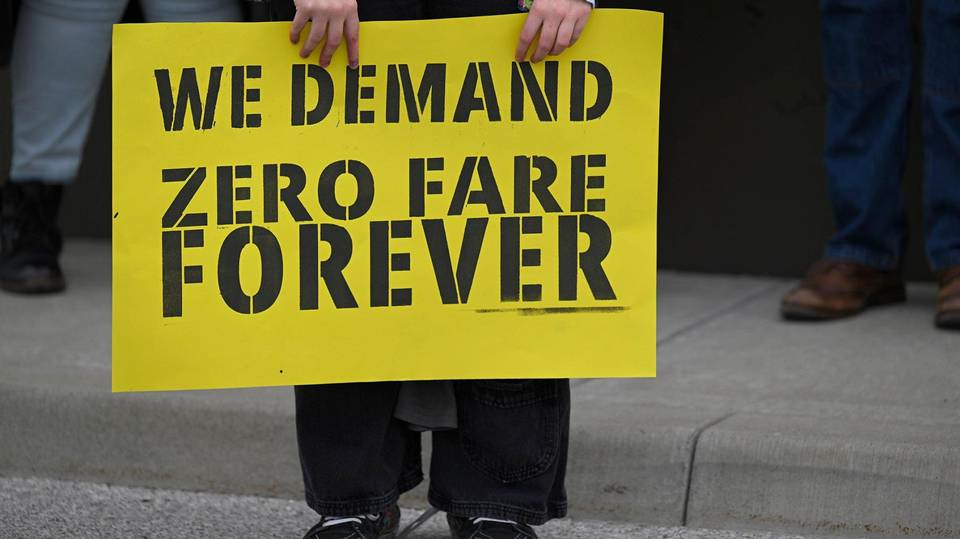
People And Nature Free public transport “opens the city to all” and should be “provided as a public service, just like health, education and public parks”, a new Campaign Briefing from Fare Free London says.


Abolishing fares for public transport in London is “one of the drastic, demonstrative actions needed to tackle climate change globally and air pollution locally”.

Fare Free London, set up at a meeting of community, trade union and environmentalist activists last month, is calling on the city’s Mayor to adopt the policy, and commission research on how to implement.

Celebration of the introduction of free public transport in Montpellier, France, December 2023.
With thanks to the Mayor’s office at Montpellier

It urges national government to support the fare-free approach around the country, and change local government finance rules so that it can be paid for.

The Campaign Briefing, supported by Fare Free London, the Greener Jobs Alliance, the Stop the Silvertown Tunnel coalition and Tipping Point, argues:

Free public transport supports social justice. A system based on public transport and active travel (walking, cycling and so on) supports Londoners’ physical and mental health.
Free public transport, introduced as part of an integrated transport policy, would help rapidly to cut the number of private cars, vans and HGVs on the roads – and so cut greenhouse gas emissions, and the air pollution that kills thousands of Londoners each year.
London is falling behind its own weak climate targets, and even further behind targets worked out by climate scientists. The transport sector has made the least progress in cutting fossil fuel use over the last twenty years. Free public transport would start to reverse this dangerous trend.
Free public transport cuts across the dangerous populist rhetoric that tackling climate change costs ordinary people money. It shows that the opposite is true: measures to deal with climate change and air pollution can also make life better.

The briefing, written by Simon Pirani, cites the largely positive experience of mid-sized cities that have adopted a zero-fares approach, including Luxembourg, Tallinn (Estonia), Dunkerque and Montpellier (France), and Albuquerque and Kansas City (USA). “London can be the first big global city to follow their example.”

London has its own experience to build on: in the 1980s, a sharp reduction in fares bumped up public transport use and reduced car journeys, before Margaret Thatcher’s Conservative government stepped in and took control of the capital’s transport away from the Greater London Council.

On climate policy, the briefing shows that London’s transport sector is missing even the Mayor’s own targets – and these lag far behind targets based on climate science.

In 2022 Mayor Sadiq Khan declared that London should aim for “net zero” by 2030, rather than 2050. A report he commissioned from Element Energy on how to achieve this stressed that, in transport, it “can not be achieved by technology alone”. Reducing demand for travel in high-carbon modes – mainly, private cars – is crucial.

The Mayor then opted for an “accelerated green” approach that would cut the number of vehicle-kilometres driven in the city by 27%, by 2030. Even if that is achieved, transport sector emissions would be 30% higher than needed, Fare Free London’s briefing points out.

It adds that “in the two years since these new targets were announced, City Hall has not noticeably shifted from its emphasis on electrification as the main means to decarbonise transport”.

The briefing points to research from a team at Imperial College, that presents scenarios in which there are 43-81% fewer vehicle kilometres driven by 2027 as the only credible ones for meeting science-based emissions reduction targets.

Electrification of vehicles just can not happen fast enough; cutting traffic is the priority, the Imperial team says. This dovetails with other transport research advocating an avoid-shift-improve approach (avoid car journeys where possible, shift to public transport and active travel, improve the carbon intensity of remaining journeys).

To achieve emissions reductions, free public transport needs to be part of an integrated transport policy, the Fare Free London briefing states. This includes:

🔥 Substantial investment in public transport and active travel, a return to principles of public service provision, and support for a properly-rewarded, secure workforce;

🔥 A review of road projects, similar to that undertaken by the Welsh government, with a view to suspending those not compatible with climate policy;

🔥Policies to encourage active travel (walking, cycling etc);

🔥An end to subsidies for car drivers at the public’s expense, and consideration of a London-wide road-user charging scheme, and parking charge reform, to discourage unneeded trips by car.

“Road pricing is tried and tested”, the report points out. It has been in place in Singapore since 1999, to reduce congestion.

As a social justice measure, to support low-income households, free public transport always works. To achieve progress on climate and air pollution too, it needs to be integrated with other transport policies.

Here Fare Free London builds on the approach advocated by Transport for Quality of Life, whose recent briefing, A Radical Transport Response, stated:

Rapid action to reduce car use will only be fair, and command public consent, if it takes place in parallel with big changes to our transport system, to give people decent, clean and affordable ways of travelling to work, education and services, by foot, bike or low-carbon public transport.

A section of the Fare Free London Briefing on how to fund free public transport shows that London is more heavily reliant on fare income than other major world cities.

The London transport system’s revenue from fares, around £4 billion per year, is 70% of the total (excluding temporary government grants), compared to 26% in Paris, 36% in Hong Kong and 38% in New York.

Alternative options covered by Fare Free London’s briefing include:

□ Road user charging, which can be levied by the Mayor, and an improved system of parking fees, which requires cooperation between borough councils;

□ Land value capture, already used by Transport for London to finance the recently completed Elizabeth Line, with the Community Infrastructure Levy of £600 million and enhanced business rates income of £4.1 billion. The Centre for Cities estimates that TfL could raise more than ten times as much with similar measures;

🔥A payroll tax similar to the one in Paris, which covers more than half the cost of the Paris public transport system. A charge of 0.6% of London’s gross wage bill would raise £1 billion per year; it would require parliamentary legislation to introduce.

The report also covers measures that could be adopted by national government, to fund free public transport in London and nationally, including:

🔥 Ending the freezing and cutting of fuel duty, which has cost the Treasury £80 billion in 2010-23, according to the Office for Budget Responsibility;

🔥 Cancelling road building projects that do not conform to climate policy objectives and diverting the money to public transport;

🔥A consistent approach to taxing wealth, including e.g. a wealth tax, reversal of Capital Gains Tax reductions and the application of National Insurance to the wealth of landlords and speculators;

🔥 A clampdown on corporate tax evasion as long advocated by the Tax Justice Network.

Fare Free London does not prescribe any means of funding free public transport, but rather points to the wide range of options, given the will to implement it.

Free public transport has “become a synonym of freedom”, the editor of a local transport magazine in Dunkerque, where fares have been abolished, wrote. In a largely working-class city, “people of limited means say they have rediscovered transport.”

Here is a way to voice our aspiration for cities that put people, their health and their lives, first – a way to bring together our struggles for climate justice and social justice. 20 March 2024.

🔥Fare Free London’s campaign briefing is downloadable from the Transport Action Network site. Fare Free London is on the web and at info@farefreelondon.org.

🔥 Thanks to the Ecologist, where this article first appeared.

⏩ People & Nature is now on mastodon, as well as twitterwhatsapp and telegram. Please follow! Or email peoplenature@protonmail.com, and we’ll add you to our circulation list (2-4 messages per month).

Zero Fares ☀ A Way To Act On Climate And Social Justice

People And Nature “Free public transport opens the city to all”, says Fare Free London, a campaign set up on 10 February at the Waterloo Action Centre.
1-March-2024

Free public transport “is provided as a public service, just like health, education and public parks, and is supported by public investment.

“It is central to a vision of London as a city where people, their health and the lives they live, come first”.

After the meeting, I did a podcast with Future Transport London, a long-standing campaign group. It’s here – please click and listen!

Photo by Tammy Ljungblad, Kansas City Star.

Fare Free London is following an international trend. The photo is from Kansas City in the US, which has had zero bus fares for four years – and where campaigners want to make this highly successful scheme permanent.

Asked on the podcast about the objectives of the proposal for free public transport, I said there are two:

First, to make the system more socially equitable. London is more socially un-equal than any other part of the UK. A higher proportion of households is in poverty, 25%, than any other region except North East England.
Second, to take drastic, demonstrative action on greenhouse gas emissions and air pollution.

On greenhouse gases, the mayor’s strategy is focused on electrifying vehicles. This can not produce results fast enough, as has been shown in detail by research published last year by a team based at Imperial College.

A substantial reduction in traffic is needed. That’s also good for tackling air pollution and improving other health outcomes.

In answer to a question about what other policies are needed, I said that experience shows that providing free public transport, on its own, does not necessarily lead to big cuts in road traffic.

It needs to be combined with (i) substantial investment to improve the system, (ii) measures to provide more road space for other users (pedestrians, people on bikes and so on) and not just for cars, and (iii) ending policies that subsidise cars and road-building at the public’s expense. SP, 1 March 2024.

🔴The Fare Free London campaign is getting up and running. Supporters will be demonstrating on Thursday 7 March, at 9.30am, at City Hall, Kamal Chunchie Way, London E16 1ZE, at the plenary meeting on the London Assembly. There is information about the 10 February meeting on the web site of the Stop the Silvertown Tunnel coalition. If you want to get involved, email stopsilvertown[at]gmail.com.

🔴 About the photo. Members of Sunrise Movement in Kansas City lobbied a meeting of the Board of Commissioners (the local government body in charge of transport) on 20 December. The Board was considering a proposal to end the city’s highly successful zero-fares policy, which has applied to buses for the last four years. The decision was postponed, further discussed in January … and the fight continues. 

⏩ People & Nature is now on mastodon, as well as twitterwhatsapp and telegram. Please follow! Or email peoplenature@protonmail.com, and we’ll add you to our circulation list (2-4 messages per month).

‘Free Public Transport Opens The City To All’

People And NatureReposted, with thanks, from the Stop the Silvertown Tunnel coalition web site. Also on Labour Hub.

6-December-2023

We have discussed this proposal in the Stop the Silvertown Tunnel coalition, and now invite organisations, groups and individuals to join us in this initiative. We hope to have a get-together on this early in 2024. To indicate interest, please write to stopsilvertowntn[at]gmail.com.

Aim

Free public transport can help tackle climate change globally, and air pollution locally, while supporting households struggling with the cost-of-living crisis. Transport should be provided as a service, just as health, education and public parks are.

The Stop the Silvertown Tunnel coalition on a trade union
march to keep rail ticket offices open, in September


On climate, London is falling behind its own weak targets, and even further behind targets worked out by climate scientists. The transport sector is the city’s second largest source of greenhouse gas emissions, after the built environment, and the sector that has made the least progress in cutting fossil fuel use over the last twenty years.

Drastic, demonstrative action is needed. Free public transport, implemented together with improvements to services, investment in active travel and ending subsidies to car drivers and the haulage industry, can help rapidly to cut the number of vehicles on the road. We need to make public transport Londoners’ first choice for getting around: make it enjoyable. This is the best way to reduce emissions.

Cutting down road traffic is also the best way to tackle air pollution that kills thousands of Londoners each year.

Free public transport is a social justice measure. It supports households on the lowest income, who are the least likely to have a car. By becoming the first big city in the world to provide free public transport, London could show the way to take action that addresses both climate change and social inequality.

How is it done?

The effect of free public transport, in terms of reducing carbon emissions and air pollution, is strongest if adopted together with other transport policies, including:

🚌 Embracing the principle that transport is a public service, not a commodity sold for profit; expanding services further, starting by reversing cuts in bus services, and investing heavily in support for active travel.

🚌 Community support for a stable workforce with fair pay and conditions, and union organisation. Such a workforce is the key to a good service, as the unions’ recent success in ditching plans to close rail ticket offices shows.

🚌 Reversing several decades of policy support and subsidies for motor traffic, at the public’s expense, from national and local government. This could include smart road charging (currently under discussion at GLA); smart emissions-based parking charges, coordinated across London; repurposing the Silvertown Tunnel; and expansion of school streets and other measures to reclaim street space for communities.

🚌 In London’s case, free public transport policies would be most effective if allied with progress towards cheap or free train travel in the south east, provided by publicly owned companies.

London can learn from, and build on, a wealth of existing experience in offering free public transport, currently in Luxemburg and Tallinn (capital of Estonia), and at different times in the last 30 years in numerous cities in France, Germany and the US. London has already moved in the right direction, by providing free transport for over-60s and under-18s: extending these existing schemes would present few practical problems.

London and national policy

We favour free public transport not only in London, but nationally, and will work together with those outside London campaigning on this issue.

National government policy has undermined public transport and active travel for many years, by supporting road traffic with subsidies and undermining rail and bus services in line with privatisation dogma. At the same time, Conservative politicians seek to divide voters by claiming that London has an outsize share of national resources. We reject this divisive politics.

National government has used negotiations with the mayor’s office to try to force a heavier burden on passengers (by increasing fares and limiting benefits) and staff (by constraining pay increases and undermining pension conditions).

To achieve free public transport in London means a change in national government policy. We call on the Mayor to join us in advocating such a change.

How would it be paid for?

Revenue from fares comprises about half of Transport for London’s income (£4.3 billion of £8.6 billion (forecast) in 2022-23). TfL also receives revenue from business rates retention, other operating income e.g. the congestion charge, and grants from central government.

The transport networks in most of the world’s big cities already rely on fares for a much lower proportion of their revenue than TfL does. TfL recognises this, and its policy is to reduce the proportion of revenue from fares. We agree with this, but believe the reduction should be much more ambitious, with a target close to zero.

Alternative sources of income could include:

🚌 Revenue raised by local government, e.g. a payroll tax (used in Paris), land value capture (e.g. Community Infrastructure Levy used to fund the Elizabeth Line); other ways of raising revenue from commercial and luxury property; reformed road use charging (see above).

🚌 Revenue raised by central government, e.g. increased fuel duty to restore the value lost by 13 years during which it has been frozen, which would be sufficient to fund free public transport in London and far beyond. Central government could also e.g. follow the Welsh government and declare a moratorium on road building, and divert funds to public transport. GLA policy is to reduce reliance on central government funding, but given the likelihood of a change of government, this approach can be reviewed.

It would not be the function of a community-based campaign to prescribe how free public transport could be funded: the above simply indicates that there is a range of options.

Campaign methods

To win support from a wide range of community groups; transport workers’ unions; researchers of climate, air pollution and transport policy; politicians and local government, in order to lobby the Mayor and the GLA. This may be able to build on the unity of purpose that we have achieved in the Stop the Silvertown Tunnel coalition.

⏩ People & Nature is now on mastodon, as well as twitterwhatsapp and telegram. Please follow! Or email peoplenature@protonmail.com, and we’ll add you to our circulation list (2-4 messages per month).

Proposal To Campaign For Free Public Transport In London

Anthony McIntyre  It can be a frustrating experience for commuters when dealing with the bussing end of public transport. 

Yesterday before a Dail committee, public transport bosses appeared to give a performance account in the face of blistering criticism around the inefficiencies in their operation.

Last week commuter coalitions from Cork, Galway and Dublin all wrote to the Transport Committee voicing concerns that the public transport system was now at "crisis point."

For over a year, public transport users have been faced with long delays, cancelled services, and ‘ghost buses’ and, sadly, the situation is not showing any signs of improving.
The problem is particularly acute on low-frequency routes where just one cancelled service may result in wait times of over an hour. We believe that this level of poor service is eroding trust in the public transport system and jeopardising the Government’s goals to increase public transport usage.


Dublin Bus in particular seems to be on a year round Halloween schedule with the ghost bus service that never arrives, but merely appears on real time apps and electronic signs at the stops. ‘Bus passengers regularly describe waiting for buses that don’t show up’ and they complain about the inability of Dublin Bus to provide notice of cancellations, opting instead to leave people stranded because there is no last bus home.

The problem is more widespread than Galway, Cork and Dublin. So frequent has the no show been right across the board on public transport that wags would take to quipping that all you need to do to go to a fancy dress party as Bus Eireann is not turn up.

In Drogheda the local town service is underperforming as well. Having left the cinema yesterday afternoon, upon watching Wings Of Desire along with my wife, I felt we were going to need wings to get home. We stood with others at the bus stop in West Street. Eager to compete with the other ghost buses, it proceeded to show that it would not show.

The traffic was light so there was no apparent reason for the delay. I have noticed it increasingly over the past few weeks despite no appreciably larger footfall in town nor chaotic roads. Yesterday afternoon, the bus to Moneymore was a mere five minutes late but the Ballsgrove one had still failed to materialise twenty minutes after its scheduled arrival. Normally both arrive together, often, within touching distance of each other. My wife, not as used to the phenomenon as I am, said in exasperation, it is not coming.

Eventually, gloomily, we headed off to get a taxi as did others, departing the rank thirty minutes after our bus was due to arrive. Glancing from our cab down West Street as we passed, there was still no sign of town service 173.  It makes no sense to lower bus fares to help assist with the cost of living crisis only for buses not to turn up or be so chronically late that using them is not worth the effort. Had I been travelling alone the taxi fare would have been 600% greater than the bus fare on Leap. It ended up half that level when my wife's additional bus far is taken into account. 

Having to use taxis in lieu is not an isolated phenomenon:

This happens constantly for me and I’ve been late to work multiple times cause of it . . .  I’ve found myself paying for taxis to work almost everyday now because the TFI transport system is just genuinely awful.

Individual drivers are not to blame as they struggle to fulfill their schedule and are normally quite pleasant and helpful although often strained. To boot, many, particularly in Dublin, fear assault, The system that is in place is simply not fit for purpose. Dublin Bus currently employs 2,800 drivers but has 150 vacancies it needs filled. Despite active recruitment the Acting Chief Executive said that “even with this number of new drivers, we are not keeping pace with the rate of network expansion...”

The Transport Minister, given his concerns about climate change, needs to get off his bike and explain just how people can be persuaded into public transport and away from the use of cars as a climate protection measure. Wrap the Green flag around me boys is not fixing this one. 

 ⏩ Follow on Twitter @AnthonyMcIntyre

Free Transport On No Bus