Showing posts with label Germany. Show all posts
Gearóid Ó Loingsigh ☭ writing in Socialist Democracy.

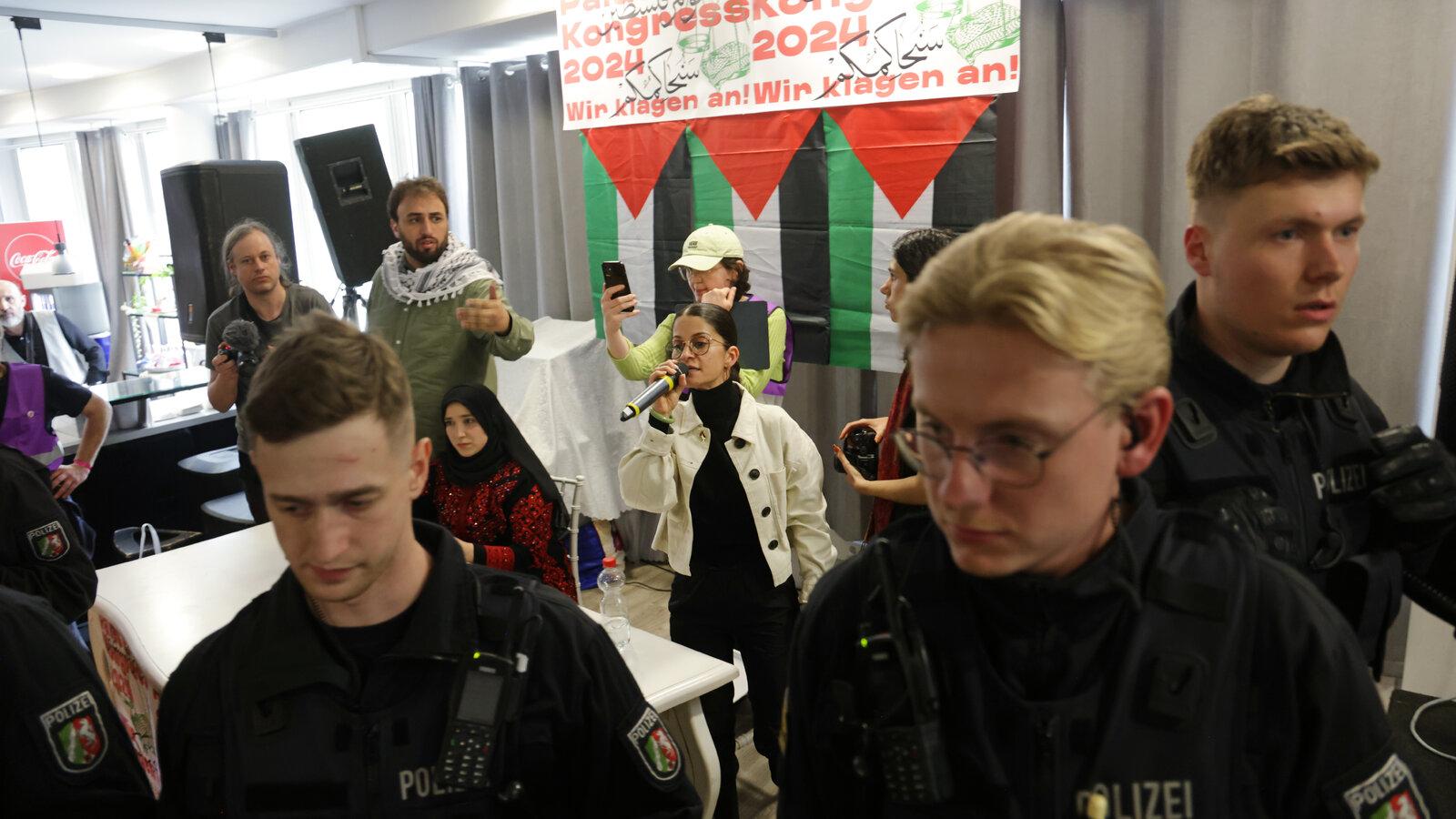
German police shut Pro-Palestinian conference

There is no doubt that the ghost of Joseph McCarthy wanders the earth through many a hallowed university hall, newspaper editorial room, police headquarters around the world and of course the cabinets of many western governments.

Censorship when it raises its ugly head, does so in a similar fashion to its past incarnations, though with new twists and turns that perhaps take us by surprise. However, it should come as no surprise to see that voices on Palestine are being shut down, though the recent German police assault on an international conference in Berlin was a major escalation in government attempts to criminalise those critical of the genocidal regime that holds sway in Tel Aviv and the white supremacist philosophy that is Zionism.(1)

Various issues are thrown into the mix. Palestine and Palestinian demands are presented as hate speech by governments and right-wing media, but so too is any defence of women’s spaces, though in this latter case the right-wing governments find some support from sectors of the Left who think that when they argue for censorship and the suppression of freedom of speech that somehow it will never be applied to them.

The German police stormed the three-day event as the first speaker was addressing it. They claimed they did so to prevent antisemitic statements being made i.e. not only are we in McCarthyite land of criminalising certain ideas by labelling them as antisemitic but we are in the land of Minority Report(2) where thought crimes can be punished in advance, before they have been committed. This is not that far removed at all from the Irish Hate Speech Bill that some on the Left have given support to, as the Police may inspect computers and phones and you may be charged with possession of material that may be used to commit hate speech. It was laughable and ironic that one of the photos of the police intervention of the Berlin event was the arrest of a young Jewish man, wearing a Kippa, who was there in solidarity with Palestinians. Following the event a number of Jews were charged with antisemitism.

Not only that but some of the speakers were banned from entering the country, amongst them Dr Ghassan Abu-Sittah who was an eyewitness to what was happening in Gaza and is also the Rector of the University of Glasgow. The former Greek politician Yanis Varoufakis was also banned from entering Germany and both were warned that they could not participate even by Zoom from another jurisdiction, an unlawful extension of German jurisdiction and a suspension of the free movement of European citizens within the EU.

This is part of a wider criminalisation of protest and the criminalisation of thought. Though some on the Left in Ireland such as People Before Profit T.Ds like Paul Murphy who support hate speech legislation believed in the benevolence of capitalist leaders when restricting commentary on women’s rights would never be extended to them, it has and for obvious reasons. Most right-wing governments, particularly those that claim some liberal kudos on certain social issues have taken advantage of the defeat of workers, critical thinking and any opposition at all to capitalism to advance right-wing hate speech legislation and restrictions on academic freedom, including the dismissal of staff, limitations on the right to voice opinions that go against government policy and in the process have garnered the support of many liberal currents and of course major NGOs who depend on government largesse to finance themselves.

The German event is not an isolated incident. Over the years various lecturers in the US have been suspended or not had their contracts renewed for speaking out about Palestine. Zionists were the original cancel culture specialists who managed to turn spoilt students whining into action, getting staff sacked and silencing other students. Recently, a professor of 30 years standing at Hobart and William Smith Colleges in the US was suspended over a contribution made to a blog. In their suspension of the employee the president stated that “I find her comments repugnant, condemn them unequivocally, and want to make clear that these are her personal views and not those of our institution,”(3) 

 It was liberals, the wokerati and even some Marxists who pushed for employers to take action against employees for their personal views and activities outside of the workplace and now it has come back to bite some of them, though not all, as many liberals and wokerati in the US are Zionists. Some of those who had been targeted were vile racists who shouted “Jews will not replace us” as they marched with torches. But you fight Fascism, you don’t give employers control over employees’ lives, ever. As Trotsky once quipped, if you can’t convince a Fascist, acquaint their head with the pavement. He didn’t say give your boss and the state more control over you and beseech them to act in your interests. A few days prior to that, Columbia University had suspended six students for allegedly participating in a panel discussion on Palestine.(4) And in a further sign that jackboots are once again goosestepping through Germany, the University of Cologne rescinded a job offer to Nancy Fraser, a Jewish American professor of philosophy, over her condemnation of killings in Gaza.(5)

They will not stop at that and it is not limited to issues such as genocide, but even local domestic politics. In April 2023, a French journalist Ernest Moret was arrested by British anti-terrorist police due to his involvement in protests in France against the Macron government’s pension proposals. He refused to give the police access to pass codes for his electronic devices and was charged with obstruction.(6) There are other precedents for this, one of them being the arrest of David Miranda, Glen Greenwald’s now deceased partner, in Britain when returning from a meeting with another journalist who had also worked on the files released by Edward Snowden.(7) The courts later upheld his detention to be lawful. Police held him and demanded access to his electronic devices. Then there is the jailing and punishing of Julian Assange. The charges against Assange were dressed up in various disguises. The first of them was the now discredited rape charges in Sweden which were dropped and also espionage charges when the real reason for jailing Assange is that he, as a journalist, exposed US war crimes in Iraq. The message is clear, censorship is the order of the day as is the hounding of journalists who hold unpopular views and expose the crimes of the state. Assange did not receive the support he should have, due to the trumped-up rape charges, with many on the Left, like the cowards they are running for cover. Even today, when the rape charges have been exposed for the lies they were and have been dropped there are those who refuse to speak out on his behalf for this very reason.

There is no world in which right wing governments suppress freedom of speech, academic freedom, freedom of assembly and criminalise broad opinions that they label as hate speech and don’t target the Left. It has never happened and never will. When they stood aside on Assange, they prepared the way for the assault on the Berlin Conference. When they harassed and tried to silence women defending women’s spaces they prepared the ground for the assault. When they advocated and supported right-wing governments’ attempts at introducing hate speech legislation they paved the way for the criminalisation of solidarity with Palestine. When the Hate Speech Bill comes back before the Irish parliament, they should take note and do the correct thing and oppose it, unequivocally.

Leftists who advocated employers taking control of employees lives and opinions, those that demanded that JK Rowling and others like her be hounded from the public sphere and that what they termed hate speech, in reality thought crimes, should be punished in law have aided and abetted right-wing governments in getting us to where we are now, which is that it is now very easy to criminalise pro-Palestinian voices. All you have to say is Hate Speech! Meanwhile Rushi Sunak in Britain is pushing ahead with a very broad and loose definition of extremism which will see almost everyone who does not support Sunak or Starmer in the dock.

Notes

(1) See interview with Yanis Varoufakis.

(2) Minority Report is a Tom Cruise film in which three mutants can see the future and predict who will commit crimes and they are arrested, charged and sentenced in advance before the crime is committed. In the film the system unravels.

(3) WXXI News (16/04/2024) Hobart and William Smith Colleges professor suspended for comments on Israel-Hamas war. Noelle E.C. Evans. 

(4) WSWS (09/04/2024) Columbia University suspends and evicts pro-Palestinian students. Tim Avery. 

(5) The Guardian (10/04/2024) German university rescinds Jewish American’s job offer over pro-Palestinian letter. Kate Connolly. 

(6) The Guardian (18/04/2023) French publisher arrested in London on terrorism charge. Matthew Weaver. 

(7) The Guardian (19/08/2013) Glenn Greenwald’s partner detained at Heathrow airport for nine hours.

⏩ Gearóid Ó Loingsigh is a political and human rights activist with extensive experience in Latin America.

A New Wave Of Censorship And Repression

People and Nature ☭ Markus Wissen and Ulrich Brand write that Lützerath will remain.[1] 

16-May-2023
Even if the coal is eventually extracted, the name of the place will continue to be a powerful symbol of the courage and ingenuity of people who resist both a powerful corporation and the power of the state.

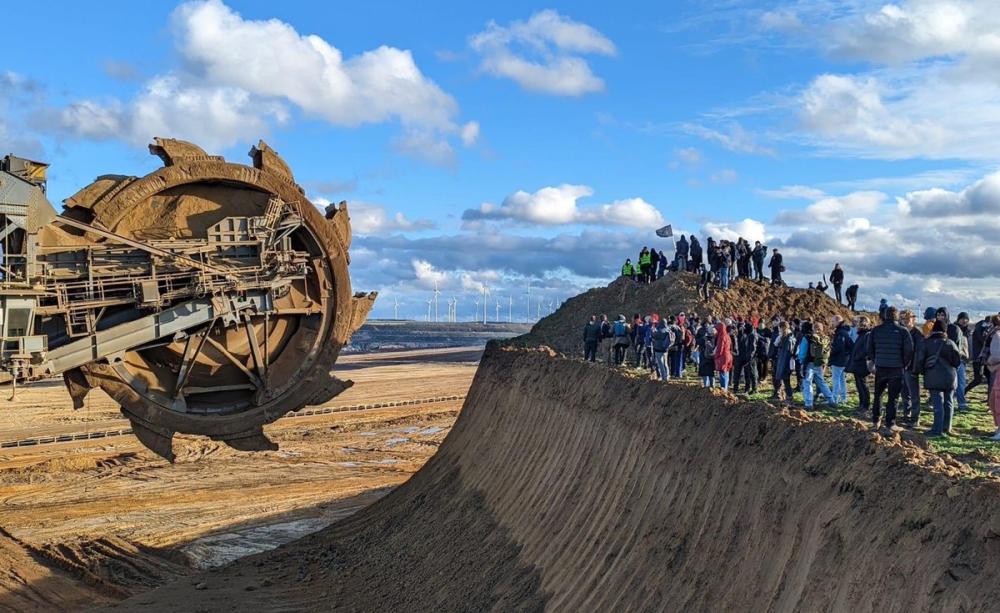
Demonstrators versus mining machinery, Lutzerath, 2022
Lützerath is also a symbol of a policy that fails to recognise the signs of the times: the phasing-out of coal and the transition to a mode of production in which the good life for all, rather than the defence of powerful particular interests, is the central point of reference.

Responsible for the failed policy is the so-called “traffic light” coalition between the Social Democrats (SPD, red), the Liberals (FDP, yellow), and the Greens, which has been governing Germany since the end of 2021. Together with the government of North Rhine-Westphalia, formed by the Christian Democrats and the Greens, they made a deal with the German energy company RWE.

The latter would be allowed to destroy Lützerath, situated in the Rhenish brown coalfield, in order to extract the lignite stored underneath the village. In exchange, the company would abandon its plan to destroy five further villages in the region and commit to phasing out coal by 2030, i.e., eight years earlier than envisioned in the so-called “coal compromise” concluded between the German state, the federal states, and the energy companies in 2020.

Until the very last moment, a broad coalition of movements – ranging from Fridays for Future, Extinction Rebellion, the Last Generation, and “Ende Gelände” to a local protest alliance, church groups, the Left party, and the Greens’ youth organisation – tried to prevent the destruction of Lützerath. Climate activists squatted in the houses left behind after the original owners were dispossessed and relocated. With enormous creative energy, they constructed a protest infrastructure and trained people in civil disobedience.

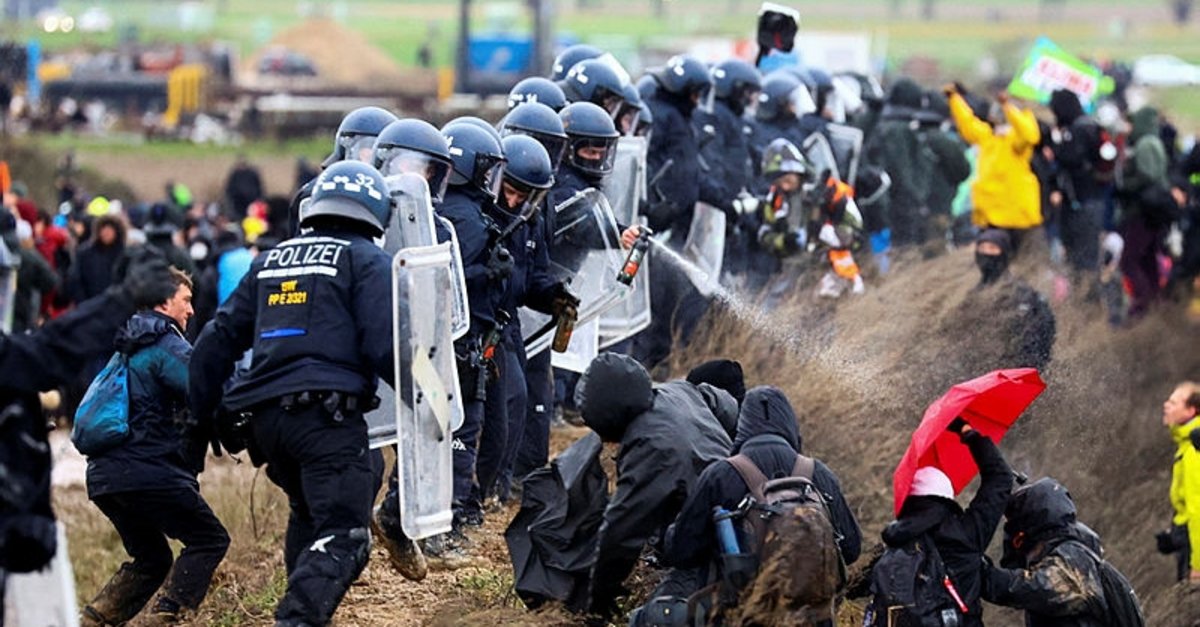
Many protesters held out in a camp near the village, wintry weather notwithstanding. Finally, on 14 January, a rainy and stormy winter day, around 35,000 people gathered for a large demonstration on the muddy fields around Lützerath that featured an address by Greta Thunberg. On this day, the police violence escalated, leaving many people injured.

The Greens, in particular, must acknowledge the legitimate indignation of the protesters: no sooner did they become a governing party at federal level for the second time since 1998 than they recommenced making policy against the very movements from which they themselves had emerged.

The first time, the peace movement led the turn against the Greens after their then-leader Joseph Fischer, the foreign minister of the red-green government, supported German participation in NATO’s war in Kosovo. Today, the Greens are disappointing the climate movement, to the strength of which they owe their recent electoral successes.

Green “sense of reality”

Certainly, no one expected the Greens’ participation in government to bring about a social-ecological revolution. After all, the Greens are part of a coalition in which the anti-environmental FDP has considerable power. Moreover, there is no question that state policy follows a logic different from the actions of social movements. The state is not an instrument that can simply be put at the service of fundamental social change. Rather, the possibilities of state policy are systematically constrained by the prevailing social relations. These relations are, so to speak, inscribed in the state apparatus: they shape the thinking of its personnel and determine which problems can be discussed at all and in what form.

The “march through the institutions” envisaged by the 1968-ers resulted in the march of the institutions through the protagonists of the movement.

This was the Greens’ experience of their first participation in federal government between 1998 and 2005: faster than they would have liked, and mostly without realising it, the Green leaders internalised the institutional restrictions and misunderstood this as an arrival on the hard ground of reality. In fact, it was only the reality of the ruling class, which they had previously criticised and now wanted to help shape.

The failure of today’s leading Greens is that they have not reflected on this experience. Instead, they ran blindly and unprepared into a situation in which they would eventually have to give a quasi-“free pass” to one of the world’s biggest polluters as part of a climate policy compromise.

RWE will probably be rubbing its hands with glee at such green realism for some time to come. Even as the climate crisis escalates, the company will be allowed to mine and burn another 280 million tonnes of lignite. In 2030, it will be able to let go of the hot air and scorched earth – and rest assured that by then, the increased prices for certificates from the European emissions trading scheme will have made coal-fired power generation unprofitable anyway.

On top of this, the company gets to destroy an important infrastructure of the climate justice movement, which would have caused it a lot of trouble in the years to come. The squatted Lützerath was a place where people came together for action trainings, workshops and festivals.

Now, it could be argued that the government preceding the current “traffic light” coalition – led by the Christian Democrats with the Social Democrats as a junior partner – systematically slowed down the energy transition and thus created the constraints with which the current government is now confronted. Furthermore, without the Greens in government, the situation would arguably be even worse, since this party pursues the most ecological agenda of the three coalition partners.

Finally, one could contend that the current government is not to blame for the rise in gas prices following the Russian attack on Ukraine and the subsequent revival of coal for the purpose of “energy security”.

That is true, but it misses the point. First, the simple fact is that the mining of coal under Lützerath is not necessary to energy security and network stability. This is the conclusion drawn by several expert reports.[2] Second, it is not necessarily desirable to secure sufficient supply to meet the existing purposes.

Why social movements are needed

Even if the coal were needed to meet the existing demand for electricity, it would be ecologically obvious to question this demand before emitting even more CO₂ to meet it. Do we need electricity for car factories to produce huge quantities of ever-larger vehicles, which, once released from their factories, either consume huge quantities of electricity or convert the fossil fuels themselves into carbon dioxide? Do we need energy with which the chemical industry produces mountains of plastic packaging that is, after a single use, incinerated or exported abroad? This is security of supply for a mode of production and living that is already plunging countless people into existential insecurity.

It would be much more sensible – and, in view of the growing and worsening crises, it is urgent – to pause and ask what things are socially necessary and can be produced in a way that does not further heat up the earth and destroy the livelihoods of people in this country and elsewhere, both now and in the future: a sustainable mobility system, a well-developed health system that is accessible to all, energy-efficient and affordable housing, and an education system that compensates for differences of origin instead of reproducing them.

Of course, there is plenty of money for this. Society is richer than it has ever been. Those who can afford to spend hundreds of billions of euros on the Bundeswehr (the German federal armed forces), or bailing out the banks, also have the resources to make society fit for the future.

Why should we continue to waste resources and human creativity on developing new financial instruments, designing SUVs, and optimising weapons systems? Why not instead put the social effort, the practical and collective intelligence of workers, the creativity of engineers at the service of a good life for all?

Such questions can hardly be discussed in parliaments and ministries. This should come as no surprise, since they go to the heart of the capitalist mode of production: the possibility of using private ownership of the means of production to the detriment of the general public as long as profits, growth, and tax revenues result.

This is couched in terms of “competitiveness”, with reference to jobs or the argument that “the Chinese” are the problem when it comes to addressing climate change and that Europe has already done its part. But these are smoke bombs that only serve to obscure the real problem.

This is why we need radical social movements like the climate justice movement that has been fighting in Lützerath and elsewhere. They shake up apparent certainties; they make visible concerns that are not, or not sufficiently, represented in the state apparatus; and they reveal apparently natural realities for what they really are: the coagulated results of earlier social conflicts, often in the form of the generalisation of powerful particular interests.

Understanding the hard realities that the Greens now take for granted as historical – that is, as shaped by powerful interests – and refusing to accept the logic of constraints means revealing the often-buried possibility of change and making clear that everything could be different. This is what makes radical social movements so dangerous to the ruling class and explains the repression they face. But it is also what makes them so important, because they shift the horizon of what can be thought and said. They open up a space of possibility that is systematically closed to state policy under capitalism alone.

Transformative strategies

In order to secure what has been achieved and to make successes effective, however, stakes have to be driven in somewhere. Changes need to be enshrined in law, secured against regression, and designed to withstand foreseeable attacks.

This is a difficulty that has led to the failure of many progressive movements. They create a spirit of optimism, point to possible alternatives, shift public debates, and have a politicising effect on younger generations. But without tangible social changes, such as an end to the burning of fossil fuels, a ban on industrialised meat production or an ambitious dismantling of the car system, there is a risk of frustration.

Another danger is that while movements may initially fight against repression and prevailing opinion, in the medium and long term they risk being co-opted. Repression can strengthen movements by raising awareness of their concerns, notwithstanding the danger to life and limb. By contrast, co-optation often means the creeping end.

The police assault on Lutzerath demonstrators, January 2023
Like their economic base, capitalism, liberal democracies thrive on change. They reproduce themselves by constantly reinventing themselves. Social movements are seismographs of a need for action, but this can also be captured politically and not infrequently translated into new business opportunities. The result is what Antonio Gramsci called “passive revolution”: the stabilisation of existing conditions through their change, steered by the dominant interest groups.

Again, this is not a law of nature, but a tendency inscribed in the functioning of liberal-democratic capitalist societies. The first step is to be aware of it. After that, it is important to deal with this tendency in a critical and reflective way. This applies both to radical social movements and to progressive actors in the state apparatus. Both face the challenge of developing transformative strategies and supporting each other in the process.

In contrast to modernising-affirmative strategies, transformative strategies are characterised by resisting co-optation and making successes visible. They design concrete reforms in such a way as to make fundamental changes apparent and, ideally, set in motion dynamics that are beyond the control of those in power.

Emancipatory state and party-political actors who are genuinely concerned with far-reaching transformations should be aware of the tension in which they necessarily operate, namely doing politics within and at the same time against the institutions of the capitalist state.

Emancipatory politics can move successfully in this contradiction, if it also sees itself as an institutional sounding board for social movements. Governments and parties committed to fundamental change must not only represent movements, but also contribute to the empowerment of them. This is the only way to create a dynamic that goes beyond the structural limits of the capitalist state and makes it possible to secure the gains for which the movements have fought.

The Greens have failed to do this. They are, as it were, operating on a half-hearted basis: they draw strength (in the form of votes) from the self-empowerment of the climate justice movement, but they give nothing back to the movement, leaving it in the mud of Lützerath to face state repression, which – to complete the symbolism of the struggles – is orchestrated by a Green police chief.

While the movement has emerged at least symbolically victorious so far, the Greens, as Mona Jaeger speculated in the Frankfurter Allgemeine Zeitung on 15 January, could experience their “Hartz IV moment” – the core of the neoliberal social and labour-market changes in Germany – with the eviction of Lützerath. Just as the Social Democrats squandered years of credibility in social and labour-market policy with its workfare turn and the introduction of the Social Code II in 2005 (of which Hartz IV was a part), the Greens are about to squander the last vestige of credit that the climate justice movement might have granted them.

In the firm belief that they are standing on the hard ground of reality, they are making a veritable belly flop on a muddy field in the Rhineland.

What will happen in and after Lützerath?

There are many examples that show that transformative politics is possible – and how it can be done. A current example in Germany is “Expropriate Deutsche Wohnen” (DWE), a housing movement that initiated a successful referendum to expropriate Deutsche Wohnen and other large real estate companies in Berlin. Doing so could contribute to improving the housing conditions of many people.

At the same time, it would concretely challenge a structural principle of capitalist society, namely the private disposal of basic infrastructure. The latter, in this case housing, would be removed from the logic of profit and its use value strengthened.

A similar approach could be taken with other types of infrastructure. Socialisation is also being discussed in the energy sector; and in the water sector, formerly privatised companies have been returned to municipalities in many places.

In all these cases, the initiative came from extra-parliamentary movements, which in turn benefitted from their interactions – never free of conflict – with left-wing actors in the state apparatus. In the case of DWE, it is unclear whether this link will hold. Much will depend on the work of an expert commission that was set up by the Senate after the successful referendum, in order to review the legal viability of an expropriation.[3]

What can be learned from this for Lützerath, and how can significant changes still be initiated?

A moratorium on the further extraction of coal would be an important first step, similar to the one suggested by more than 700 scientists on 11 January. Their idea was to stop the destruction of Lützerath and “to provide an opportunity for a transparent dialogue process with all stakeholders to develop sustainable ways of transforming society and time to review the underlying decision-making premises”.

A moratorium would not be transformative per se, but it could be filled in a transformative sense if the “how much” and “for what” questions facing social (energy) production were discussed.

The climate crisis and the war on Ukraine make clear that we must fundamentally change our deeply unsustainable ways of producing and using energy. This implies a dismantling of motorised individual transport and industrial agriculture, but also a rethinking of the supposed “silver bullet” of digitalisation, which is becoming ever more energy-intensive.

These questions are also posed directly or indirectly in “Lützerath” – and they require a sustainable answer that expresses solidarity with the rest of the globe. 16 May 2023.

➤ Republished here, with thanks, from the Illiberal Studies Program website.

Related stuff on People & Nature

➤ Straight talk about climate: ‘profound’ social-economic change is needed, by Simon Pirani

➤ Climate adaptation: more sea walls will not be enough, by Ulrich Brand, Barbara Fried, Rhonda Koch, Hannah Schurian, and Markus Wissen

➤ A review of The Imperial Mode of Living by Ulrich Brand and Markus Wissen

[1] This is a translated and extended version of our article “Lützerath als Fanal. Warum wir transformative Strategien im Kampf gegen die Klimakrise brauchen”, published in Blätter für deutsche und internationale Politik 2/2023. In English it was first published by the Illiberalism Studies Program. We wish to thank Eszter Kovats for her helpful comments.

[2] See, for example, the report by the FossilExit Research Group at the University of Flensburg (2022), Das Rheinische Braunkohlerevier. Aktuelle Zahlen, Daten und Fakten zur Energiewende, and Aurora Energy Research (2022), Auswirkungen eines adjustierten Kohleausstiegs auf die Emissionen im deutschen Stromsektor

[3] Politically, the prospects of expropriation have deteriorated since the repetition of the elections to the Berlin House of Representatives. Instead of the former red-red-green coalition between the Social Democrats, the Left, and the Greens, a black-red alliance between the Christian Democrats and the Social Democrats is going to govern Berlin. The Christian Democrats have fought the expropriation from the beginning, as has the right wing of the Social Democrats, led by the city’s former mayor, Franziska Giffey.

⏩ People & Nature is now on mastodon, as well as twitter, whatsapp and telegram. Please follow!

Lützerath ☀ Transformative Politics Versus Green Realism

The Immoral Minority ➠ Donald Trump has emerged as an inspirational leader in Germany. For the far right fringe that is.


Just before hundreds of far-right activists recently tried to storm the German Parliament, one of their leaders revved up the crowd by conjuring President Trump.

“Trump is in Berlin!” the woman shouted from a small stage, as if to dedicate the imminent charge to him.

She was so convincing that several groups of far-right activists later showed up at the American Embassy and demanded an audience with Mr. Trump. “We know he’s in there!” they insisted.

Mr. Trump was neither in the embassy nor in Germany that day — and yet there he was. His face was emblazoned on banners, T-shirts and even on Germany’s pre-1918 imperial flag, popular with neo-Nazis in the crowd of 50,000 who had come to protest Germany’s pandemic restrictions. His name was invoked by many with messianic zeal.

It was only the latest evidence that Trump is emerging as a kind of cult figure in Germany’s increasingly varied far-right scene. 

Continue reading @ The Immoral Minority.

Führer & Saviour

From the UNCHR a report on what immigrant Syrian children have brought to a German village. 

In 2015, a group of Syrian refugee children saved a famous German school from disaster and breathed new life into a shrinking village. Nearly two years later, they’ve become an indispensable part of community life.

“It was no life there in Syria, we were all so scared all of the time. I just wanted peace, nothing else,” says Syrian refugee Halima Taha, 30, who fled the war at home four years ago with her husband and three children. Arriving in Germany, they volunteered to move to Golzow, a tiny village on the German-Polish border.

At the time, Halima had no idea what her family’s arrival meant to the villagers. Back then, the village’s shrinking population was bad news for Golzow’s primary school, known by film fans the world over as the setting for ‘The Children of Golzow’, an epic 42-hour documentary filmed over five decades.

Yet the school’s fame wasn’t enough to save it from the effects of a creeping decline. Over the space of eight years, Golzow’s population shrank by 12 per cent, to just 835 people. Then, in March 2015, the unthinkable happened. For the first time since it opened in 1961, the school failed to make up the pupil numbers required for a reception class.

Continue reading @ the UNCHR.

Syrian Refugees Breathe New Life Into Shrinking German Village