

Showing posts with label Fírinne McIntyre. Show all posts
Showing posts with label Fírinne McIntyre. Show all posts


Fírinne McIntyre ✒ writing in Being Human.

"Your hair has been destroyed, to prevent you from contacting your ship."
Yorgos Lanthimos’ Bugonia is a story that could have turned audiences away. The CEO of a powerful medical company is kidnapped by two conspiracy theorists who believe she is an alien sent to destroy Earth.
The concepts behind its most considerable plot points could leave an audience groaning, shaking their heads as they leave the cinema muttering. If I were to explain the story arc to the layman, I would expect no reply other than, ‘Aw, c’mon. Really?’.
Bugonia could have missed its mark, but it was flawlessly executed. Execution is crucial, and Lanthimos has crafted a clean guillotine. The film borrows its plot from the South Korean film Save The Planet! (2003), and I wonder if I might find its execution as successful under another director.
A noteworthy piece of pre-release hype for Bugonia, including a bald-only preview screening, was that Emma Stone had shaved her iconic red hair, and sported a stubbly scalp for Lanthimos’ newest film - a sharp contrast to the remarkably black and ostentatiously long hair she wore in Poor Things. While the trailer revealed this bald-headed Emma, none of this prepares the viewer for the real-time hair-shaving scene.
Up close on 35mm film, I realised that Stone, a woman subjected to the beauty standards of 2025, had no prior idea what her scalp looks like. Watching felt like intruding. Stone’s performance in this film was beyond words, and without traversing too far into the land of spoilers, I found certain moments hard to watch.
Don, played by Aidan Delbis in his breakout role, was a real example of empathy and of the echo chamber - a character perfectly placed between innocence under manipulation and total complicity. Another hit from the guillotine of perfect execution.
To conclude, if you have seen Bugonia, please Google the children’s show Boohbah. It was the first thing I thought of upon leaving the cinema.
Yorgos Lanthimos’ Bugonia is a story that could have turned audiences away. The CEO of a powerful medical company is kidnapped by two conspiracy theorists who believe she is an alien sent to destroy Earth.
The concepts behind its most considerable plot points could leave an audience groaning, shaking their heads as they leave the cinema muttering. If I were to explain the story arc to the layman, I would expect no reply other than, ‘Aw, c’mon. Really?’.
Bugonia could have missed its mark, but it was flawlessly executed. Execution is crucial, and Lanthimos has crafted a clean guillotine. The film borrows its plot from the South Korean film Save The Planet! (2003), and I wonder if I might find its execution as successful under another director.
A noteworthy piece of pre-release hype for Bugonia, including a bald-only preview screening, was that Emma Stone had shaved her iconic red hair, and sported a stubbly scalp for Lanthimos’ newest film - a sharp contrast to the remarkably black and ostentatiously long hair she wore in Poor Things. While the trailer revealed this bald-headed Emma, none of this prepares the viewer for the real-time hair-shaving scene.
Up close on 35mm film, I realised that Stone, a woman subjected to the beauty standards of 2025, had no prior idea what her scalp looks like. Watching felt like intruding. Stone’s performance in this film was beyond words, and without traversing too far into the land of spoilers, I found certain moments hard to watch.
Don, played by Aidan Delbis in his breakout role, was a real example of empathy and of the echo chamber - a character perfectly placed between innocence under manipulation and total complicity. Another hit from the guillotine of perfect execution.
To conclude, if you have seen Bugonia, please Google the children’s show Boohbah. It was the first thing I thought of upon leaving the cinema.
 |
| Fírinne McIntyre of synth-pop duo “mischa and the bear” |


 |
| Alfie Gallagher |
Alfie, a chara,
I held my father’s hand as he shed a tear above your grave as the ornate box carrying the vessel that once held you was lowered into the earth.
I did not know you the way my father did, but I have seen how he loves you, and my love for you extends from that.
I watched your family welcome the world into their home to bid you farewell on your final journey. I watched your sister’s heart escape from her mouth in a cry of grief, and watched your mother find comfort in the many faces of those who loved you. I watched as they caressed her face with remnants of that love which will exist for as long as all who knew you shall live.
I got to know you so intimately in two long days through stories and memories shared over whiskey drank in your whiskey-sipping-chair in your childhood home, and can only wish that it had, and regret that it had not, happened before you were gone.
There is so much that can be said, and it brings a further sense of finality to stop speaking, but all things, good or bad, we know come to an end.
 | |
|


Emerging Irish act are making waves with gritty electro sound
Dark, gritty, angsty pop with paranoid androids and great electro hooks. Welcome to the world of Mischa and The Bear.
And no, the Drogheda duo’s name has nothing to do with the old kids’ cartoon Masha and The Bear.
“No, everyone asks that, it’s actually from our middle names,” says Bear (AKA Fírinne McIntyre).
Danny’s middle name is Mischa and my middle name is Berneen. My parents have always called me Bear at home, so it kind of just seemed obvious. I didn’t realise the cartoon was so popular. We’ll have to put in our bio that we’re not affiliated!
Mischa is Danny Rooney, formerly of the band Modern Love, and together the pair have been working on music for the past year.
“It just kind of happened naturally. I’m constantly producing music and Fírinne would jump in at times when I’m working on something, ‘Oh I’ve a suggestion, you should do this…’” says Mischa.
It just spawned from there. We wrote loads of stuff and there were some angsty-er tracks, stuff that I’d never really done before.
Continue @ Irish Mirror.
Fírinne McIntyre ✒ writing in Being Human.
 |
| ✶✶✶✶ |
“Certainty is the great enemy of unity. Certainty is the deadly enemy of tolerance." - Dir. Edward Berger
On the eve of my father’s 68th birthday, my family and partner sat down to watch Conclave. A film about the Catholic, or moreso, political process of electing a new pope.
Coming from a very atheist and very political background, my viewing of this film was initially hindered by two things: firstly, a notable lack of understanding of the Catholic hierarchy and the subsequent need to pause the film at multiple intervals, much to my father’s annoyance, to inquire as to who was who and what was up with the little hats they were wearing; secondly, I have a natural aversion to politics, like any child of political parents might, having had little interest or tolerance for political discussion for most of my youth. All of this is to say that Conclave was a film I would not have expected myself to enjoy, particularly in that it was also 2 hours long and I am a regular slave to the 6 inch screen.
The film was brilliant. Once it had been explained to me that I couldn’t refer to all of the priests as Popes because there was, in fact, only one Pope (and kind of the point of the film), it had a story that never quite faltered or failed to be interesting at every point. Sometimes a great film can fall a little flat when introducing its emotional arc, where a fine balance exists between emotion and pure cheese. But no fromage in Conclave, even where disasters strike at moments too obvious to be anything other than a sign from God. I saw myself and my father agreeing with the Catholics for perhaps the first time in our lives as they spoke of ‘certainty being the enemy of tolerance’.
I am the modern atheist who praises Conclave to high heavens. If there is one thing I am certain of, it is that Conclave is worth the watch, but it certainly requires one’s full attention.
|
| Fírinne McIntyre of synth-pop duo “mischa and the bear” . |
BabyStep Magazine 🎸 Hailing from Dublin and emerging from the glow of their bedroom studio, this duo makes a bold first impression with their debut single “Deny” — a brooding, cinematic slice of synth-pop that lands with precision and pulse.

 |
| Mischa And The Bear |
Crafted by producer/bassist Mischa (Danny Rooney formerly of modernlove.) and first-time vocalist Bear (Fírinne McIntyre), “Deny” is a darkly hypnotic exploration of obsession, control, and the chaos bubbling beneath the surface. Think industrial textures, distorted beats, and a haunting intensity that lingers long after the last note fades.
Ahead of the track’s release on April 25th, we caught up with the pair to dig into the sounds, stories, and strange magic behind “Deny.”
Q: “Deny” is such a powerful debut—can you talk us through how the track came together and what inspired its dark, cinematic energy?
Bear: We were actually messing around with the bassline on another track when Mischa tried a different bass, and immediately it sounded like it was entirely its own thing and not the song we were working on at all. So we opened a new session, and I sang the first melody that came to my mind, and it just stuck - the “Oh”s, the “I”s and the “Can’t deny, deny” hook.
Ahead of the track’s release on April 25th, we caught up with the pair to dig into the sounds, stories, and strange magic behind “Deny.”
Q: “Deny” is such a powerful debut—can you talk us through how the track came together and what inspired its dark, cinematic energy?
Bear: We were actually messing around with the bassline on another track when Mischa tried a different bass, and immediately it sounded like it was entirely its own thing and not the song we were working on at all. So we opened a new session, and I sang the first melody that came to my mind, and it just stuck - the “Oh”s, the “I”s and the “Can’t deny, deny” hook.
Continue @ BabyStep Magazine.

Fírinne McIntyre ✒ writing in Being Human.
Spoiler alert
Rating: 5/10
Plot summary: FBI Agent Lee Harker plays cat and mouse with Longlegs as she hunts for the man behind murder.
 |
| Longlegs: Directed by O. Perkins. |
“Half-psychic is better than not psychic at all.” - Blair Underwood as FBI Agent Carter
Barren, snowy landscapes, cool-toned colour palette, with all the vibes of an underground Indie horror, and almost the feel of a foreign movie, Longlegs begins strong. The trailer helped set it up this way, along with intense praise for its fear-level gathered on TikTok.
Harker and her partner are on the hunt for a criminal, whose location she psychically ‘senses’. I had to catch my breath at the first taste of shock horror when her partner was ambushed. As Harker scours the outside of her gorgeous cabin in the woods for an intruder, we see through Harker’s eyes a glimpse of Longlegs skulking through her home.
Portrayed perfectly, the tension was absolutely eerie, and satisfying for the horror-lover.
Alas, the second half of Longlegs felt like more of a goofy Boo than a Bone-chilling horror.
Keeping its fear-worthy momentum until the movie reached its halfway point, it then lost its magic. Nicolas Cage, while I understand the intention behind his character’s design, did not scare me. I’ll admit, his scene with a girl in a store creeped me out, but there was something a little too clownish about him, and not in the Stephen King sense.
“But your work's over. It's done. And you're gonna be in here for the rest of your life,” Harker says to Longlegs in a standard interrogation room in the all-too-typical fashion of cheap, cheesy horrors.
Harker unintentionally comes across as a petty child playing cop, and as Longlegs begins to praise Satan, the film reveals itself to be a bit of a clichéd letdown. The sense of pettiness in Harker and the Devil being behind Botoxed Cage’s serial killer motives just felt . . . tacky. By the end, there were multiple scenes where I could not help but stifle giggles - and I‘d honestly been clinging to my seat for the entire first half. What could have been the perfect twist at the end didn’t hit above the goofiness.
Fantastically introduced but ultimately anticlimactic, I would rate Longlegs a 5 out of 10.
Half-horror is better than no horror at all.
Fantastically introduced but ultimately anticlimactic, I would rate Longlegs a 5 out of 10.
Half-horror is better than no horror at all.
|
| Fírinne McIntyre is a fluent Irish speaker and has recently completed her Masters in Translation Studies. |


It led to a sudden dislike of Led Zeppelin's Rain Song because of its lyrics: Upon us all, upon us all a little rain must fall.
Even though I had a short umbrella in my bag, I knew it would prove useless against the wind that propelled the rain in my direction. So, in the bag it remained. This rain is a foreign product, all part of the Great Replacement that wants to replace dry Irish rain with invasive wet foreign stuff.
While it had poured out of the real skies earlier, not the imaginary heavens, the rain had stopped when I left the house to walk to the train station, listening to podcasts about fascism as I go. By the time I reached that destination, I was saturated from the waist down. Three schedules in various parts of Dublin deterred me from turning back and drying off. A fool and his folly are not easily parted despite the advice from my son that it would lash much of the day. Pelted by precipitation was my fate.
When I got to Dublin I met my daughter for our weekly Cappuccino. Her mood was even more grumpy than mine, the apple not having fallen far from the tree.

She had been frustrated by a few things including a failure of the internet at her place, exasperated by her feeling hangry. I offered her lunch but she opted for breakfast. And so the problems of finding eggs benedict began. I can't think of eggs benedict without at the same time having the joke from prison leap into my mind:
What did the two pregnant nuns say to the Mother Superior?
'Sister Benedictus.'
The first cafe we called to was so loud with rock music that we simply vacated our seats and went off in search of another. We found a quieter spot on the same street, took our seats only to discover that breakfast ended at 1130, but we could have a lunch menu. I wasn't for eating so it didn't much matter to me but I could see my daughter's face darken. Back out in the rain, not coming down so forcefully but still annoying, I told my daughter three strikes and we are out, that I had no intention of traipsing around Dublin in the rain just to find 'eggs fuckin benedict.'
In the last chance saloon she settled for dinner as eggs benedict went off the menu 'about twenty minutes ago.' Can Dublin be so dietary challenged that it is impossible to find eggs benedict after 1130? Somebody might blame those who scripted the 1916 Proclamation for that. How Pearse and Connolly didn't figure out what the real needs of the country were baffle me. They clearly lacked foresight. Instead of wasting time on human rights-speak and NGO-talk, promising to cherish all the children of the nation equally and all that, they should have focussed on eggs benedict.
The giveaway is to be located in the names of the seven signatories to the Proclamation: Tom, Thomas, James, Joseph, Pádraig, Sean and Eamonn but no Benny. Which I suppose might not be a bad thing given how it would be claimed by the Benny Hill-types who in their pariah parade strut their supposed patriotism on the streets of the capital, screaming 'nigger' at black workers who for some reason are to be excluded from the humanity proclaimed by the seven signatories and denied citizenship of this society.
A theme that eventually led to a discussion over lunch. My daughter is resolutely opposed to racism and was infuriated by remarks from Simon Harris which she felt blamed immigrants and refugees for the housing crisis. This, she said forcefully between bites of food, is a crisis brought on by a government of landlords looking after their cronies in the landlord business. When I replied that I didn't think it was a government of landlords, she quickly pulled the figures out from the phone. I responded that personal instinct is not what drives government policies but structural properties, that the class background of those who staff government is not the determining factor, and that no matter what party is in government, no more houses will be built. I was waxing Poulantzas while she was opting for a Miliband perspective. She then lashed out at the way black revellers were treated by An Garda during Culture Night events at Tola Vintage, in sharp contrast to how those racially abusing black workers at Coolock were treated by the force.
So, that is what we get when government claims its focus is on providing homes rather than eggs benedict. No sense of priority. And if things continue as they are eggs benedict will soon be served up without the yoke, wrong sort of colour for the racists.
 |
| ⏩Follow on Twitter @AnthonyMcIntyre. |

Fírinne McIntyre ✒ writing in Being Human.
This may not be so unusual, as atheism is far more common among those my age in Ireland these days than it ever was before. According to our Central Statistics Office, 15.6% of twenty year olds in 2016 indicated no religion, a figure doubled from 2011. However, the figure for those aged 5 in 2006 may be expectedly lower.
Exempt from religion classes from primary school on and baptised by a rebel priest – Des Wilson – I found myself feeling slightly outcast amongst my peers at school from a young age. I remember reciting prayer as Gaeilge in front of the bathroom mirror, not for fear of God but for fear of Santa knowing that I did not complete my homework. I readily believed in the jolly gift-bringer and his reindeers, but the idea of an all-knowing Man in the Sky deciding to send us to Hell for being gay or burn us alive in war-torn countries for having been born in the wrong place was not an idea as easily embraced.
My father, a writer among other things, was fond of bedtime stories, ranging from Captain Fírinne saving the day to many of his own theories about our grand universe. What stuck with me was his belief that none of us can remember where we were before birth, so why should it be any different upon death? He prefaced and followed every theory with the adamant advice to choose my own path when it came to religion – whether I wanted to be Christian or Muslim or a Giant-Flying-Spaghetti-Monsterist, he would support me.
Exempt from religion classes from primary school on and baptised by a rebel priest – Des Wilson – I found myself feeling slightly outcast amongst my peers at school from a young age. I remember reciting prayer as Gaeilge in front of the bathroom mirror, not for fear of God but for fear of Santa knowing that I did not complete my homework. I readily believed in the jolly gift-bringer and his reindeers, but the idea of an all-knowing Man in the Sky deciding to send us to Hell for being gay or burn us alive in war-torn countries for having been born in the wrong place was not an idea as easily embraced.
My father, a writer among other things, was fond of bedtime stories, ranging from Captain Fírinne saving the day to many of his own theories about our grand universe. What stuck with me was his belief that none of us can remember where we were before birth, so why should it be any different upon death? He prefaced and followed every theory with the adamant advice to choose my own path when it came to religion – whether I wanted to be Christian or Muslim or a Giant-Flying-Spaghetti-Monsterist, he would support me.
I proudly proclaimed myself an atheist like my father. And so, I was exempt from religion at school and refrained from making my Communion at age 8 like all the other children. I could not refrain, however, from jealousy over the money they would receive on the day, and so my father brought me to HMV. I came out with a pink Nintendo DS and 3 games of my choice, a much better deal than that of my peers.
At age 10, he brought me to the World Atheist Convention in Dublin. Richard Dawkins was one of the guest speakers. We stayed back after the conference because I wanted to meet my first celebrity. My father still proudly tells his friends that I met Richard Dawkins at 10 years old, and told him that I thought if God existed, he must be “a fat man in the sky eating donuts while children die below him”. I’m hopeful that Dawkins found it funny and appreciated it, as he willingly signed my napkin before leaving.
That same year, I watched a documentary with my father that had a lasting impact: ‘Terry Pratchett: Choosing to Die’. It was heavy material for a 10-year-old, but opened my eyes further to what I still believe to be the reality of the world we live in – without death there is no life. And it is not a “sin”, just as abortion is not a sin, to offer the end of life choice to those who need it.
I did find myself struggling with the stark finality of death after watching that documentary, as my belief in the oblivion awaiting us began to shake me to my core. I was brought to my GP at the time, who recommended prayer, suggesting that if I believed in the afterlife I might cope better with my intense fear of dying. I promptly responded that I highly doubted that there is a heaven for bugs, so why should it be any different for humans? He didn’t mention it again.
There may be much comfort for those who believe that there is no end, but in admiring my dad’s comfort in his own belief in death, and respectful of there being “no life without death”, I find myself having gained the same comfort in my adult years. I am no longer afraid – and I think I prefer the idea of oblivion after death to an eternal inferno, anyway.
At age 10, he brought me to the World Atheist Convention in Dublin. Richard Dawkins was one of the guest speakers. We stayed back after the conference because I wanted to meet my first celebrity. My father still proudly tells his friends that I met Richard Dawkins at 10 years old, and told him that I thought if God existed, he must be “a fat man in the sky eating donuts while children die below him”. I’m hopeful that Dawkins found it funny and appreciated it, as he willingly signed my napkin before leaving.
That same year, I watched a documentary with my father that had a lasting impact: ‘Terry Pratchett: Choosing to Die’. It was heavy material for a 10-year-old, but opened my eyes further to what I still believe to be the reality of the world we live in – without death there is no life. And it is not a “sin”, just as abortion is not a sin, to offer the end of life choice to those who need it.
I did find myself struggling with the stark finality of death after watching that documentary, as my belief in the oblivion awaiting us began to shake me to my core. I was brought to my GP at the time, who recommended prayer, suggesting that if I believed in the afterlife I might cope better with my intense fear of dying. I promptly responded that I highly doubted that there is a heaven for bugs, so why should it be any different for humans? He didn’t mention it again.
There may be much comfort for those who believe that there is no end, but in admiring my dad’s comfort in his own belief in death, and respectful of there being “no life without death”, I find myself having gained the same comfort in my adult years. I am no longer afraid – and I think I prefer the idea of oblivion after death to an eternal inferno, anyway.
|
| Fírinne McIntyre is a Fluent Irish speaker in the process of completing her Masters in Translation Studies. |


 |
| The Graduate |
My wife might have been tearful too but she was up in the balcony as space was limited and allocated to two family members on the ground floor of the Exam Hall where the degrees were awarded. She nominated my son to accompany me. I rarely get tearful so it required something extra special to bring it on.
There is a lot of pomp and ceremonious ritual serving as the backdrop to these occasions. I tend to have an arms length relationship with pomp, but it does beef up the ambience and adds gravitas to the achievement. The sonorous tones of Latin play a not unsubstantial part in proceedings and while I studied it at school, all but a few words have evaporated from memory.

From her earliest years I had no doubt that my daughter would succeed in whatever she chose to turn her hand to. She could problem-solve at a level above her years from around two and had a determination that abhorred failure. A fluent Irish speaker, having been tutored from Bunscoil up under the wonderful tutelage of the late Diarmuid O Tuama in Belfast, she was destined to master the Irish language. As it worked out she studied both it and French at Trinity. As I was never much of a culture vulture, the medium through which she was educated was never a priority for me. So long as she got a good education I was happy. I'm a convenience creature, preferring the world had one language and one currency. My wife who doesn't speak any Irish was the driving force there, wanting both her children brought up with the ability to speak the language fluently. Even today if we have a conversation in Irish in the house or on the phone my wife's face lights up.
Not that I had much influence over what my daughter sought to do, nor did I seek any. I take the view that if our children reach adulthood thinking entirely differently from the ideas we as their parents had, that is a barometer of success and independence. I think the only tree this particular apple did not fall far from was the atheist one. She has no interest in religion, once commenting to somebody who had advised her to pray that it would be futile: we are nothing more than highly complex bugs, and bugs don't pray. It was an answer much to my physicalist liking although I prefer the Brian Green phrase that we are nothing more than bags of particles. Bags or bugs, there is certainly nothing supernatural going on.
My own university studies took me down the road of politics. In this my daughter and I take completely different paths She has zero interest in politics. She is very much her own person, who doubles up in chefery when not studying. Now doing a Masters in Translation, she is on her way to the fair and I am on the way back. The tree of life just keeps on growing while shedding its human leaves to make way for others. As I depart she arrives.
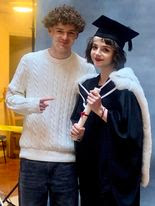
After a long day at Trinity we eventually settled in my wife's favourite French restaurant. It was fitting on the day that was in it with my daughter having graduated in French. When there I am not culinary promiscuous, venturing no further than the delicious mussels that are served up. It was not without its funny moments - each time the waiters approached the table my daughter addressed them in French but none of them spoke the language. The food had more authenticity than the service, but nobody was complaining. Not that it matters what the staff speak or do not speak: the language of cuisine is not that prone to error.
My daughter and I have complementary but not matching daddy bear and baby bear tattoos. They symbolise the one path we have treaded and the different paths our lives have taken. As life should be. Our children will always fly off and as parents we hope the flight is safe and the destination they pick, reached.
Mortarboards off to my Bear - one proud father.
|
| ⏩Follow on Twitter @AnthonyMcIntyre. |

I want to travel. I want to go to China and eat a dumpling. I want to walk through a Japanese garden, and I want to feel the snow of Alaskan ground. I want to feel the heat of an African safari, to eat Belgian chocolate in Brussels and fresh croissants in Paris, to see where terrible things happened in Germany and where great things happened too. But most of all, I want to travel.
Travel back in time, to places I’ve already been, to revisit the Californian suburban bungalow where my mom grew up, where I spent most of my summers, and where my grandpa died. I want to travel back to when I was sitting in an armchair as an earthquake passed beneath my feet; “Don’t worry,” Grandpa had told me, “it happens all the time.” I want to go back to later that night when my grandfather asked me to always express love and care for his wife, my grandma, for he knew his time was running short. I want to live within my memories of them, of their home, and I want to make more.
We used to go for three weeks at a time, once a year or every second year, over Easter or just after school had finished for the summer. The flight was long, 10 hours, and I was never much good at sleeping on loud and trembling airborne containers. But I never really minded, for I’d never felt at any other time that absolute happiness, that floating surreal sort of feeling, that was to be felt upon stepping off of the plane into the blaze of heat at LAX International Airport, and to see the faces of my grandma and grandpa in the flesh – not through Skype, not Facebook, not in the photos of the albums my grandma would print for me at the end of every trip. There is something magical about that feeling, and I don’t doubt that I will feel it again.
When I reflect on my Californian days, I see them as almost dreamlike, through the eyes of a child – as they were recorded in my head. And it was dreamlike; what other Irish kid got to spend 3 weeks under the American sun, being spoiled with love and candy and valuable life experiences as I was? Trips to Disneyland, to San Francisco and San Diego, to the Hollywood Hills to see the (in)famous sign up close; my grandparents, my only set, wanted to give me everything. I was their “first favourite grandchild”, as my grandpa would fondly tell me (with three others to follow in the shapes of my 2 cousins and younger brother).
My grandpa had served in the army in his youth, and had a good sense of what was right and what was wrong, and he dedicated some time to instilling his values into me (mostly for the sake of my mother, so that her daughter wouldn’t be quite as unbearably cheeky upon returning home to Ireland).
My grandmother cultivated in me her love for music and art, and creativity. Everything I’ve been taught and gifted by them, I still hold dearly to my heart. Everything that happened within the walls of that one-storey house, all the love and laughter and tears, I feel it all when I stand barefoot on sun heated pavement, or when I smell the sweet-scented dust of my grandma’s knitting room in a place unexpected, or when I drink a carton of chocolate milk that tastes just like the Hershey’s brand I would share with my grandpa in his kitchen years ago.
It really does feel like I’ve been to two different worlds: the dreamworld of California, and my Irish reality. It used to be that the second I stepped in through the doors of my own home in Louth, the image of their faces would vanish from my mind almost instantly, like it was just a dream, and I would be reduced to tears in my frustration of trying to hold on, and recollect. And now, I do visit California in my dreams, and I hold those dreams just as dear to my heart as I do my memories.
The last time I ever visited California (in reality) was when I was 14 years old. We stayed from mid-July to mid-August, and my grandpa’s health was declining rapidly; the chemotherapy made him weak, but his heart never once wavered from its love for my mother, brother and I. He likely knew it was the last time that he would see his Irish grandchildren. I wouldn’t let myself believe it – and he didn’t want me to either, telling me that we would see each other again. He died the next spring.
My mother attended the funeral and cared for him in his last month as I was preparing to sit my Junior Certificate Examinations. She read out a poem at his service, in both his honour and mine, as requested by me. I chose ‘Nothing Gold Can Stay’ by Robert Frost, as I knew in my heart that my grandpa was gold and everybody else knew it too, and that he himself knew he couldn’t stay, being the gold that he was.
And so, our gold did not stay, my grandma moved to Arizona to where her son lives in the mountains (where my grandpa would have loved to live could the strength of his lungs withstand the high elevation) and our trips to California ceased to exist.
Nothing gold can stay – but as the poem implies, it can be renewed. Our trips to California have renewed themselves into trips to Arizona now, where the old feeling is similar, but different. My grandpa has gone, but all that he has taught me has stayed in my heart. He lives in California still, a place in my soul that I visit from time to time when I crave to travel. I carry it with me always, and I know someday that I will return. It is a part of who I am.
California has shaped me and taught me what it means to recognize true gold when it is present. Not only did it allow me to know my grandparents, but it introduced me to my mom, who she used to be, not the American woman living in Ireland but an American woman at home. I have many stories of hers told by old friends now in their 50s and 60s, reflecting on the times of their youth in the 80s and 90s of California.
I feel that California allowed me to experience something much bigger and grander than my own life, to meet a whole new type of person (and believe me, the American stranger is very different to the typical ‘howaya?’ stranger of Ireland). And, it allowed me to learn so much more about things I was certain I already knew.
So, I want to travel. And I will. I’ll go to China, to Japan, to Alaska, Africa, Belgium, France, and Germany, and everywhere else on this planet that calls to me. And after all that, I will travel to the west coast of the USA, and I’ll step onto hot pavement in my bare feet, and I’ll smell roses tended to by somebody else’s grandma, and I’ll sip a new type of chocolate milk because maybe at that time Hershey’s won’t make it anymore. And it will be different – it won’t be the same ‘gold’ as I saw through my younger-self’s eyes, but I think, that in a flood of memories rushing back to me, real and unreal, in the surreality of it all, I will feel at home.

Guest writer Fírinne McIntyre with her first piece for TPQ. It is a short homework story.
So I'd always wanted a dog. First, I'd wanted a little husky puppy. Then a golden retriever pup. But my dad hated the mess they made, so as always, the answer was an elaborately described 'no'. Actually, it hadn't always been an elaborately described no - that developed after the begging I'd done, but anyways.
So you'd imagine the sense of surreality I'd felt walking down the street to my house that Friday, coming in the door to find a dog's lead on the table, dog bowls on the floor, a dog bed in the sun room. I'd asked my mam if we were babysitting a dog, because I didn't want to seem straightforward about it, as I'd be embarrassed if it turned out the dog wasn't going to be ours. Mam laughed. "No..."
"So we're getting a dog?" I pressed hopefully. "Yes. Only if your behavior's good," she replied casually. Usually, this only happens in movies, but I literally cried tears and tears and tears of happiness. So I bombed her with catapulting questions, all about the unknown creature we were letting into our home. She gave nothing away. I told her I was going outside, to my friends.
As I walked up that road, I imagined what it would be like to wake up in the morning to a wet, pink tongue, licking me all over. When my friends came outside, I told them all about my new dog. "Oh, no way!" Ruth exclaimed in awe. "You're so lucky!"
"Yeah... Maybe it and Patch could be friends," Ana said. I smiled, and we ran back to mine, checking if my surprise package had arrived yet. "Fírinne, she won't be here until your dad gets home. He'll be bringing her here," Mam told me. I sighed, and told my friends. We went back to their estate, and played for a couple hours. We made up names and a song for the chosen name, Bloom.
At around seven o clock, when we checked again, Dad still wasn't home. So we sat in my playroom and waited. The sound of a car pulling up caught my attention. I looked out the window, and saw my dad's friend Tom's Jeep's doors opening, and my dad stepping out with a cardboard box advertising popcorn on it. I ran to the front door, and said, "Dad, are we getting popcorn to celebrate the new dog?"
"Eh, Fírinne, could you climb up the money tree and grab us a fifty?" he said sarcastically. I felt my face growing hot. I ran up to him, and looked in that brightly coloured box. The weirdest fluffy black and white thing about the size of a fist was lying in the corner on a tattered old pink bathrobe. I gasped, and lifted it out. It yawned and unfurled itself. I smiled with glee. The little thing opened its eyes, and looked right at me. I held it up, and examined it. "It's a boy!" I exclaimed. "No, she's a girl." I looked again. "Oh...." I blushed. "Her name is Bloom," I told Dad. "Balloon? What sort of a name is that?" he joked. I sighed and laughed.

Ruth and Ana came outside, and played with Bloom. She stumbled around the grass with us, licking us, and sniffing us. My parents smiled, and joined in, petting her back, and calling her over, to train her to her name. Later that night, more of my friends that Ana and Ruth told about Bloom came over to pet her. I felt so popular that day. So for a few weeks, Bloom made me popular. Well, Cleo, as we called her after three days of everybody calling her 'Balloon'.
That quickly wore off as soon as she grew bigger and wasn't the tiny little fluff ball that could fit under a 4 inch shelf. But I'll never forget the night I met one of my best friends.

So I'd always wanted a dog. First, I'd wanted a little husky puppy. Then a golden retriever pup. But my dad hated the mess they made, so as always, the answer was an elaborately described 'no'. Actually, it hadn't always been an elaborately described no - that developed after the begging I'd done, but anyways.
So you'd imagine the sense of surreality I'd felt walking down the street to my house that Friday, coming in the door to find a dog's lead on the table, dog bowls on the floor, a dog bed in the sun room. I'd asked my mam if we were babysitting a dog, because I didn't want to seem straightforward about it, as I'd be embarrassed if it turned out the dog wasn't going to be ours. Mam laughed. "No..."
"So we're getting a dog?" I pressed hopefully. "Yes. Only if your behavior's good," she replied casually. Usually, this only happens in movies, but I literally cried tears and tears and tears of happiness. So I bombed her with catapulting questions, all about the unknown creature we were letting into our home. She gave nothing away. I told her I was going outside, to my friends.
As I walked up that road, I imagined what it would be like to wake up in the morning to a wet, pink tongue, licking me all over. When my friends came outside, I told them all about my new dog. "Oh, no way!" Ruth exclaimed in awe. "You're so lucky!"
"Yeah... Maybe it and Patch could be friends," Ana said. I smiled, and we ran back to mine, checking if my surprise package had arrived yet. "Fírinne, she won't be here until your dad gets home. He'll be bringing her here," Mam told me. I sighed, and told my friends. We went back to their estate, and played for a couple hours. We made up names and a song for the chosen name, Bloom.
At around seven o clock, when we checked again, Dad still wasn't home. So we sat in my playroom and waited. The sound of a car pulling up caught my attention. I looked out the window, and saw my dad's friend Tom's Jeep's doors opening, and my dad stepping out with a cardboard box advertising popcorn on it. I ran to the front door, and said, "Dad, are we getting popcorn to celebrate the new dog?"
"Eh, Fírinne, could you climb up the money tree and grab us a fifty?" he said sarcastically. I felt my face growing hot. I ran up to him, and looked in that brightly coloured box. The weirdest fluffy black and white thing about the size of a fist was lying in the corner on a tattered old pink bathrobe. I gasped, and lifted it out. It yawned and unfurled itself. I smiled with glee. The little thing opened its eyes, and looked right at me. I held it up, and examined it. "It's a boy!" I exclaimed. "No, she's a girl." I looked again. "Oh...." I blushed. "Her name is Bloom," I told Dad. "Balloon? What sort of a name is that?" he joked. I sighed and laughed.
Ruth and Ana came outside, and played with Bloom. She stumbled around the grass with us, licking us, and sniffing us. My parents smiled, and joined in, petting her back, and calling her over, to train her to her name. Later that night, more of my friends that Ana and Ruth told about Bloom came over to pet her. I felt so popular that day. So for a few weeks, Bloom made me popular. Well, Cleo, as we called her after three days of everybody calling her 'Balloon'.

Subscribe to:
Posts (Atom)


