Showing posts with label 2022 Stormont Elections. Show all posts
Dr John Coulter ✒ No Stormont Speaker, no Northern Ireland Assembly, does not necessarily sound the death knell for the Protocol. TPQ Monday contentious political commentator analyses the latest brinkmanship between the DUP, the Tories and the European Union.
 
Who will be the big beneficiary from the current game of political hard ball being acted out between the DUP, the Tories and the European Union? At some point, one of them will blink in this very high stakes political poker game.

It took decades of hard negotiating to get the 1998 Good Friday Agreement; it could only take a matter of days for brinkmanship to bring devolution to its knees.

Perhaps a more poignant question is - who is using whom in this political poker match? Is the DUP using ‘no Assembly’ to force the Tories into triggering Article 16 or bringing forward legislation to scrap the Protocol entirely?

Are the Tories using the DUP’s threats to the Assembly - and ultimately the peace process - to force the European Union into a major climbdown on the Protocol?

Is the European Union digging in its heels on the Protocol as a way of punishing the UK for leaving the EU and firing a warning shot across the bows of existing EU member states of the consequences of considering leaving?

Is the Irish government kicking off because it wants to use the Protocol to trigger a major debate on Irish Unity in a bid to spike Sinn Fein’s guns before the apologist party for the republican movement also becomes the largest party in the Dail?

And given the Sinn Fein mandate at Stormont, does it want the force the DUP into a climbdown on the power-sharing Executive so that it can get into government in the Northern Ireland Assembly simply to prove to Southern voters that it can be a responsible party of government in Leinster House?

In short, this is the political equivalent of the nail-biting poker game in the James Bond blockbuster, Casino Royale. The problem is, as with that famous movie, there has to be a big loser and there equally has to be a big winner.

Even if the Tories blink first and tell both the DUP and EU that it will bring forward legislation to effectively politically castrate the Protocol, how long will that process take?

If the DUP digs in its heels and pledges ‘government only when the Protocol is totally gone’, then at what point does the British Government pull the plug on Stormont as it did in 1972 and impose Direct Rule from Westminster?

Perhaps such a scenario would enable the DUP to collapse the Assembly completely and not share power with Sinn Fein. In such a scenario, the DUP should campaign for the Northern Ireland Office to be staffed by Northern Ireland MPs and not MPs from mainland Britain.

This would favour both the DUP and SDLP as Sinn Fein still refuses to abandon its 1905 founding principle of abstentionism from the House of Commons. However, in the past Sinn Fein has voted to overturn that outdated abstentionist policy regarding both the Dail and Stormont.

What happens in the event of Direct Rule from Westminster with an NIO staffed by Northern Ireland MPs, Sinn Fein decides to do another political U-turn and ditches abstentionism towards the House of Commons? Or would that be a bitter pill too much for traditional republicans to swallow?

Then again, if the Scottish and Welsh nationalist MPs and pro-republican MPs in the British Labour Party can take their seats at Westminster, why not Sinn Fein?

Of course, that is all based on the assumption London and Dublin will respond to any totally collapse of Stormont with Direct Rule from Westminster and not some form of joint authority involving both Dublin and London as equal partners with the NIO staffed by mainland Britain MPs and Leinster House TDs - a scenario where Northern Ireland could see Sinn Fein TDs from constituencies in the Republic directly running affairs in Northern Ireland.

It was the 1985 Anglo-Irish Agreement which saw the Irish Republic have its first real meaningful say in the running of Northern Ireland since partition in the 1920s. While Unionism and Loyalism tramped the streets of Northern Ireland with their Ulster Says No and Ulster Still Says No campaigns, the Republic poked its nose even deeper into Northern Ireland’s affairs using the Maryfield Secretariat outside Belfast.

If the Stormont Assembly was to finally be mothballed, could Unionism have to cope with an even harder version of the Anglo-Irish Agreement and the cloud of joint authority hanging over it?

And in the background, what will the loyalist hard men make of a Stormont collapse, especially if the Protocol remains in place albeit in a less influential format? At what point, even, does the DUP blink and decide to enter the Executive, elect a Speaker, and even nominate for deputy First Minister.

Is the DUP holding out for an autumn election to Stormont where it can redress the two MLA advantage which Sinn Fein has over the DUP. Or even, could Unionism get back to a situation whereby the post of First Minister is decided - as with the Good Friday Agreement - by the largest designation, not the largest party?

The key question remains - who holds the ace cards in this high stakes political poker game?

Follow Dr John Coulter on Twitter @JohnAHCoulter
Listen to commentator Dr John Coulter’s programme, Call In Coulter, every Saturday morning around 10.15 am on Belfast’s Christian radio station, Sunshine 1049 FM. Listen online. 

Playing ‘Hard Ball’ With Stormont To Bash EU Is Dicey Game!

Ian Major  ✒ As a Unionist, I can affirm that the sole reason for not running the Assembly is the Protocol.

It may seem unimportant to those unconcerned with the Union, but it is crucial to Unionists. It would be a hole below the waterline for the Union, if allowed to stand. 

The DUP, at least several of the leadership, might have been willing to adopt the UUP position on it, running the Assembly and hoping Boris would rescue them. But they knew that would finish the DUP.

A lot could be said about the DUP's messing that led to the Protocol, but the ordinary Unionist has given them the chance to redeem themselves on it. If they weaken, they will not be forgiven. 

I can see how Nationalists might think the real reason is a refusal to play second fiddle to SF now that SF is due 1st Minister. And the refusal of all Unionist parties to affirm they would accept a Deputy role supports that. But only the Agreement rejectionists think like that - TUV, with maybe a few DUP old guard. 

The Unionist parties should have had the honesty to affirm their willingness to take the Deputy role, if SF had the largest number of seats. They would always have done so, however reluctantly. 

The only proviso is that the Agreement was working properly. It has been, albeit with hiccups like the RHI scandal. But the Protocol ended that. It is a direct tampering with the Union, without Unionist consent. If it stands, the Assembly will fall. This is not a Unionist ploy. 

Who knows where this could end? Boris could refuse to budge and threaten Direct Rule with a strong Irish dimension. Even Joint Authority. It won't change hearts. Much better to remove the constitutional problem and get back to working together, even if it is with a SF First Minister.

⏭Ian Major grew up a heathen Protestant, was converted at 17. He lives out his Evangelical faith as a Baptist. 

It's The Protocol, Stupid

Matt Treacy ✒ The results of the Northern Ireland Assembly elections have been heralded as historic and possibly signalling a radical change in the constitutional position of the six counties as a part of the United Kingdom.


There is no doubt but that the results represented a triumph for Sinn Féin whose ability to run elections efficiently was no better illustrated than the manner in which they not only managed to get their vote out – after a minor panic in the last hour or two when turnout appeared to be well down on 2017 – but how they efficiently divided constituencies and resources to maximise their seat haul.

One particularly impressive example of this was in Newry/Armagh where Conor Murphy and Cathal Boylan were only separated by four votes on the first count. Similar vote management led to the same outcomes in Fermanagh/South Tyrone, West Tyrone, Mid Ulster and North Belfast. Of course they were assisted in that by the sheer bumbling ramshackle nature of the SDLP which is to electoral “machine” what an abacus is to a laptop.

The SDLP, like Sinn Féin’s electoral rivals in the south, – particularly Fianna Fáil who did the SDLP no favours whatsoever by love-bombing it – have effectively surrendered a significant part of what used to be their demographic constituency. Part of that has been to attempt to outWoke the Shinners on everything from transgenderism to abortion and immigration. This, however, has only succeeded in pushing away some of their more conservative voters.

The fact that Sinn Féin emerged as the biggest party – although it is not the first time they got the largest share of votes which they did in the 2009 European elections – and will get to nominate Michelle O’Neill as First Minister became the headline for most of the election commentary.

Mary Lou heralded this as an historic milestone and claimed that Northern Ireland was established to ensure that a Catholic nationalist – though she didn’t use the C word obviously – could not become prime minister and that there would be a perpetual unionist majority.

Yes, no doubt that was a consideration but the chief motivation that underlay the ethnic and electoral basis for the northern state was that it would most likely never voluntarily vote to join the rest of Ireland after the country was partitioned under the 1921 Treaty.

There was never anything specifically to exclude the possibility of Catholic nationalists becoming the biggest party in Stormont. Later amendments to the legal framework governing Northern Ireland’s position within the United Kingdom as contained in the 1973 Sunningdale Agreement and the 1985 Anglo-Irish Agreement specifically allowed for the possibility that if there was ever a majority within the six counties in favour of national unification then the British state would not act to prevent that, and indeed would facilitate a poll if such a scenario seemed possible.

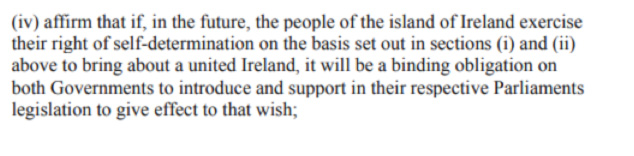
That condition was carried over into the 1998 Good Friday Agreement. The key section on ‘Constitutional Issues’ reiterates previous commitments to legislate for any democratically expressed desire by a majority to leave the United Kingdom. While Section 1 (iv) reads as though this might be something decided on an all-Ireland basis, subsection(ii) effectively retains the “unionist veto” by qualifying any such decision by the requirement that there would have to be the consent of “a majority of the people of Northern Ireland with regard to its status.”


A poll itself can only be held when it appears to the Northern Ireland Secretary that “a majority of those voting would express a wish that Northern Ireland should cease to be a part of the United Kingdom and form part of a united Ireland.” The bald fact of the matter is that there is no such evidence from any election held since 1998 that there are grounds to believe that a majority of those voting in a border poll would be likely to vote for a united Ireland.


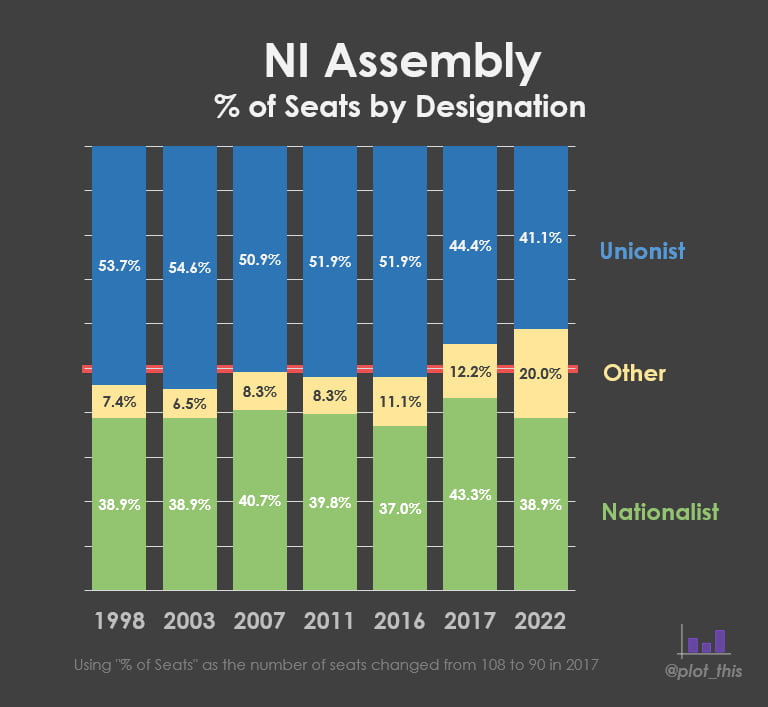
All of the electoral outcomes over the past quarter of a century prove that whatever about the internal shifts within the two designated nationalist and unionist political camps that support for parties openly favouring a united Ireland has barely changed at all over those 24 years. Indeed as this graphs show, the % of MLAs designated as “nationalist” is exactly the same as it was in 1998.

What has changed of course is that Sinn Féin is by far the dominant nationalist party. It has reduced the SDLP to a marginal force which last week was squeezed on the one hand by Sinn Féin, and to a lesser extent by Aontú among Catholic republicans opposed to abortion; and on the other by the Alliance Party which has eaten into the Catholic middle class vote.

A similar process has taken place on the unionist side where the Ulster Unionist party has had its vote further reduced by the DUP and Traditional Unionist Voice and has also lost votes and seats to Alliance.

The Alliance vote is most interesting as that party does not identify within the Assembly as either nationalist or unionist, and on the face of it there is little to predict how its voters or those of the much reduced Green Party might vote in a border poll. However, the electoral evidence would suggest that Alliance voters are more likely to be Protestant and therefore unionists with a small “u” and to a lesser extent middle class Catholics who were never enthusiasts for a united Ireland.

The notion then that Sinn Féin becoming the largest party in the Assembly – with exactly the same number of seats as before and with a vote increase of just 1% – is somehow a precursor or even a guarantor that the north is moving quickly towards unity is simply not true. Sinn Féin may or may not, depending on what the DUP decides to do, elect the First Minister. That in itself makes no difference to the provisions of the Good Friday Agreement with regards to the holding of a border poll.

It is also possible of course that there will be no agreement on the next Executive and that the Assembly remains suspended. With overall control of the six counties reverting back in the devolved ministries to the British Government. This, incidentally, suited Sinn Féin and the SDLP when abortion was introduced by default during the previous suspension – one of the few “north is next” promises Sinn Féin have actually managed to follow through on.

It is absurd in any event that any democratic election should lead automatically to a perpetual ethnically based coalition of parties who obviously hate each other but who have gotten on reasonably well in “power” on the same basis as coalition parties do everywhere else: looking after themselves and their clients.

That may not be sufficient to cobble together a deal this time. Who knows? That will hurt Sinn Féin less than it will the DUP as it will be able to claim – with some justification – that like Viscount Brookeborough – they don’t really like having Fenians about the place. Certainly not at the top of the table.

That will provide Sinn Féin with continued credibility in the north, but more importantly sustain the momentum as they focus on their real prize. Which is not a united Ireland but a place in government in the Republic.

Matt Treacy has published a number of books including histories of 
the Republican Movement and of the Communist Party of Ireland. 


Stormont Election Does Not Make Border Poll Much More Likely ✑ Under Good Friday Agreement Provisions

Caoimhin O’Muraile ☭ Love them or loath them it is unarguable that the political march of Sinn Fein under the all-female leadership of Mary Lou McDonald and Michele O’Neil appears to be unstoppable.

In the twenty-six counties the party leads the opposition in Dail Eireann, while in the six counties they have just won twenty-seven seats in the “Legislative Assembly” at Stormont. For the first time since partition over 100 years ago Sinn Fein are the largest party in the six counties, forty one years to the day, May 5th since the death of IRA hunger striker Bobby Sands. 

Sinn Fein are the largest party in an establishment they once swore to bring down. Back in 1972 the IRA campaign was a leading factor in achieving just this as the British enforced Direct Rule from London, putting the Unionist controlled Stormont into retirement. 

This is a complete metamorphosis in Sinn Fein’s political direction, as from the start of the war in the six counties the party refused to recognise either the Dail, Stormont or, indeed, Westminster. This changed to a certain extent in 1986 when at their Ard Fheis of that year they voted to enter, if elected, the Dail. A split occurred with a number of delegates dedicated to the orthodox republican tradition formed Republican Sinn Fein, an organisation still active today. History repeated itself here as in 1969/70 the Provisional Republican movement split from the “Officials” over the same argument, entering the Dail. 

If we take history as the only factor RSF have a valid point, entering or recognising the Dail is an antithesis to orthodox republican ideology. However, history is not the only factor and times change but nevertheless this was/is considered a betrayal of the republican ethos by RSF, perhaps in much the same way as Sinn Fein in 1926 considered the formation of Fianna Fail and de Valera’s decision to enter the Dail at that time as a betrayal, and again with the “Official Republican Movement” in 1969/70.

Since 1986 Sinn Fein (Provisional) have continued down the reformist road, which has its origins in the 1981 republican hunger strikes (seven IRA and three INLA POWs died on hunger strike in Long Kesh). As this progression, or digression - depending on your point of view - continued, Sinn Fein have become unrecognisable as the organisation which gave political support for the IRAs military campaign. This transformation culminated in 1998 with the signing of the Good Friday Agreement. This agreement perhaps from an Alliance Party or SDLP viewpoint was not bad, but it was/is not what republicans had been fighting for - it fell well short of the republican goal. Gone has any mention of the thirty-two-county socialist republic, gone has any support for armed struggle, gone has the Armalite and Ballot Box policy which was born out of the hunger strikes and gone has any reference to socialism. 

As a socialist and republican myself I never took the socialism of Sinn Fein as a serious manifestation of the ideology. There was no mention of nationalisation of the banks, workers' democratic control of the means of production distribution and exchange or a planned economy, all tenets of socialism. In fact, the British Labour Party had a greater commitment to socialism under the now abolished Clause IV than did Sinn Fein. Not only has any mention of socialism gone, so too has much of the rhetoric about Irish unification. Or perhaps this is a little unfair - let us say that commitment appears somewhat diluted compared with thirty years ago. Similar to the British Labour Party under Tony Blair, who betrayed the concept of socialism, abolishing the sacred Clause IV of the party’s constitution. Sinn Fein have similarly shifted ground hugely in order to gain electoral support, irrespective of republican principles.

Of course, Sinn Fein would deny any betrayal of republicanism and would, with possible justification, or possibly not, claim these are new strategies towards the same goal, a United Ireland. This is, of course, very much what Fianna Fail would have us believe is one of their aims, and the band played believe it if you like! However, that said, it is undeniable that the party for the first time since partition in 1921 are at its most popular. If they win the next twenty-six- county elections and become the Government in Dublin Sinn Fein can claim to be in power across the 32 counties, albeit in two different institutions with the six counties still under control from Westminster. Sinn Fein will, in effect, be an arm of the British administration!!

It must be said - and again, love or loath Sinn Fein - that the days of a “Protestant Parliament for a Protestant people” as James Craig once boasted have long gone. The question is at what price to the republican ethos? How long before the same Sinn Fein take their seats in the British Parliament? Never I can hear, but that would have been said prior to 1986 when entering the Dail in Dublin was an antithesis to republican doctrine dating back to the Second Dail of August 1921 to June 1922. At that time any future Dail would not be recognised until such time as an all-Ireland election could be held without any British interference. This, of course has not yet happened so once again RSF would claim this republican mantle.

Sinn Fein are now talking about a border poll on unification between five and ten years from now. Is this another dilution of policy? What happened to unification now? That is up to the individual to decide but I would suggest watch closely, and what kind of united Ireland will we have? A decent health service down here in the twenty-six-counties would be a start which would encourage those from a unionist tradition in the North who would argue, justly to a point, that they benefit from the NHS. Sinn Fein have pledged themselves to a single tiered nationalised health service if they are elected to government in the Dail. Time will tell on this one I just hope they do deliver, if elected, and not ditch this policy like so many others they have kicked into touch or, at best, parked.

All the above briefly discussed aside it is undeniable that the leadership of Mary Lou McDonald, President of the party, and Michele O’Neil have brought the party along as far as elections go. Perhaps this should be seen as encouraging for women in politics in Ireland and is indeed a credit for women’s advancement generally. I’m sure the suffragettes would be proud of the pair of them. In this context there has been a revolution in Sinn Fein for women’s political leadership (please nobody mention or compare Thatcher to this female revolution) and perhaps the other parties should take a leaf out of this book.

Sinn Fein are now a microcosm of their former selves as far as ideology and republicanism goes. On the other hand, they have evolved electorally into a political giant who look like in the near future controlling Dail Eireann in Dublin and the Legislative assembly at Stormont, despite that administration being answerable to Westminster on all important issues and have no real power outside local issues. Whether they will deliver on their promises remains to be seen though their recent track record has been anything but encouraging in this area. 

It is my hope, though without illusions, that should Sinn Fein become the government in the twenty-six-counties we at least get a health service fit for purpose in the twenty first century. This subject, that of health, is perhaps the last remaining credible unionist argument against a united Ireland. The delivery of services in the HSE is still well behind the NHS, despite that organisation slowly being undermined and privatised by various British Governments. It is still miles ahead of the HSE in the twenty-six-counties.

Caoimhin O’Muraile is Independent 
Socialist Republican and Marxist

The Political Ascendancy Of Sinn Fein

Dixie Elliot ✒Now that the weekend of much-ado-about-nothing is over lets look at reality.

Given the Unionist stance on not sharing power in the Stormont executive with a Sinn Féin First Minister we were expecting a huge surge in the Sinn Féin vote.

It didn't happen. They remain on 27 seats and their overall vote only increased 1.1% from the 2017 Assembly elections and was in fact down 0.4% from the 2019 Westminster election.

Not only that, the claim that Sinn Féin is the first Nationalist party to top the polls in the assembly elections is wrong. The SDLP did that in 1998 and lost out to the position of First Minister because the UUP got more seats on that occasion.

This time the Unionist vote was split and Sinn Féin got to have the position of First Minister because of this.

However, if they want the First Minister position then they have to give in to Unionist demands over the one thing tearing Unionism apart, the Protocol, or it's no executive.

They can't do that because the power to do so is between the Tories and the EU.

If the Brits try to change the Protocol then Unionism is still getting its own way and nothing has changed and the claim that Unionist domination is at an end is meaningless.

Also, now that they are the largest party in the executive means that Sinn Féin has to deliver on the promises it made on the run up to the election. There is no hiding behind Carson's statue in that regard.

As for Derry, the Sinn Féin vote was down 3.8% while the SDLP vote was down 0.9% meaning that the people in the city are increasingly growing tired of hearing the same promises which disappear like the clouds in Cloud-Cuckoo-Land after the elections . . . 

Thomas Dixie Elliot is a Derry artist and a former H Block Blanketman.
Follow Dixie Elliot on Twitter @IsMise_Dixie

No Big Deal

Alex McCrory ✒ with some observations on the outcome of the North's Stormont Assembly election.

Sinn Fein achieved an historical victory at the polls yesterday. I say this even though I did not vote myself. Being a keen student of Irish history, I recognise the significance of their triumph whilst also being conscious of its obvious limitations when viewed in the context of the Good Friday Agreement.

Yesterday's result is not a flash in the pan. On the contrary, it is the beginning of a new political order in the six-counties. Sinn Fein will consolidate it's position, leaving the SDLP adrift in a sea of uncertainty.

Really, it is difficult to see where the party of John Hume, hailed as the great peacemaker, goes from here. Perhaps a closer relationship with one of the southern parties, as suggested by some analysts, would anchor them in an all-island context. Quite clearly, it is past its sell by date as the party of northern nationalists. Sinn Fein has effectively stolen it's political attire and left it naked.

As for the DUP, it is hoist on it's own petard. By elevating the Protocol to a principle, it committed an act of political suicide, which was compounded by the refusal to accept a potential Sinn Fein first minister. Such undisguised arrogance infuriated nationalists and drove them into the arms of Sinn Fein. Whoever came up with this cunning electoral strategy needs shot at dawn.

What we are looking at is a lengthy period of Sinn Fein dominance in a British assembly. A party that once had 'Smash Stormont' as a primary political demand, now seeks to manifest it's position by restoring devolution. Of course, they will say it's not the same Stormont. 

Blah, blah, blah.

Alec McCrory 
is a former blanketman.

Sinn Fein Dominance In A British Assembly

Dr John Coulter ✒ Looks like Sinn Fein’s ‘Lipstick and Ballot Paper’ strategy has worked with the republican movement now the biggest party in the Assembly. But does that mean Unionists will agree to forming an Executive? TPQ Monday contentious political commentator poses some awkward questions.

Securing its 27 Assembly seats means that Sinn Fein’s returns to Stormont today as the largest party, two ahead of the DUP, suggesting that the republican movement can nominate Mid Ulster MLA Michelle O’Neill as First Minister.

So the reality is sinking in for Unionism; it is still a minority ideology in Parliament Buildings - 53 Non Unionist and 37 Unionist (a majority of 16 for those designating as Non Unionist).

Even if we go by existing specific designations - Unionist, Nationalist and Other, the 90-strong chamber now looks like 17 Others (Alliance), with the Non-Unionist Front of Sinn Fein (27), the SDLP (8) and People Before Profit (1) on 36, with Unionism on 37 (DUP 25, UUP 9, TUV 1, and Independent Unionists 2).

Another bitter pill for Unionism to swallow in the aftermath of the state of Northern Ireland celebrating its centenary is the prospect of having a republican First Minister whose party doesn’t even use the term ‘Northern Ireland.’

I’d love to be a fly on the wall when the Provisional IRA’s ruling Army Council digests the Stormont results. Yes, the Army Council will be pleased Sinn Fein has now become ‘top dog’ in the Assembly chamber.

Gone are the days when - publicly - Sinn Fein was the apologist face for the IRA’s murder and mayhem campaign of terrorism. The strategy of ‘an Armalite in one hand and a ballot paper in the other’ to ‘lipstick in one hand and a ballot paper in the other.’

The only positive a Unionist can take from a Sinn Fein victory is the number of women it has got elected to Stormont. The bottom line is - will there actually be a working power-sharing Executive at Stormont by the end of this week?

Sinn Fein has no difficulty nominating a First Minister, but does the DUP - or any other Unionist party - have the courage to nominate for deputy First Minister? The reality is, DUP boss Sir Jeffrey Donaldson does not enjoy the clout from Downing Street to crush the Northern Ireland Protocol.

Therefore, he cannot afford to nominate for deputy First Minister unless he gets major concessions on the Protocol from Boris Johnson in the forthcoming Queen’s Speech.

The other reality is that Sinn Fein needs Stormont more than Unionism. Sinn Fein needs a working, power-sharing Executive to firmly convince voters in the Republic that in the next Dail General Election, Sinn Fein should become a senior partner in a coalition government in Leinster House.

Sinn Fein does not have a good record as a responsible government coalition partner. In the 1918 Westminster General Election, when Sinn Fein won 70 of Ireland’s 105 Commons seats when the island was entirely under British rule, the party - formed in 1905; ironically the same year as the Ulster Unionist Council - did not take its Commons seats and negotiate a 32-county democratic socialist republic.

Instead, Sinn Fein - under its banner of Ourselves Alone - formed its own parliament (Dail Eireann) and then sparked a bloody War of Independence with the British in 1919.

Indeed, when Sinn Fein did secure an Anglo-Irish Treaty in 1920, rather than use the new Free State as a springboard to negotiate an all-island political solution, republicans started a equally bloody civil war between pro and anti-Treaty factions which saw more IRA members executed by Free Staters than were killed by the British during the so-called ‘Tan War’.

Until the IRA and INLA hunger strikes of 1981, Sinn Fein was an open apologist for the IRA terror campaign and a rallying point to commemorate the failed 1916 Dublin Easter Rising.

After the last Dail General Election, bitter rivals Fine Gael and Fianna Fáil formed an historic pact to keep Sinn Fein out of coalition government.

Ironically, Sinn Fein needs the Stormont Executive to work to combat the effects of the pandemic, get rid of the pothole plague across Northern Ireland roads, bring jobs, build the health service, combat the increasing costs of living, the poverty crisis and get rid of the ‘heat or eat’.

Solve these bread and butter issues and the Leinster House establishment may well feel that Sinn Fein has the maturity and responsibility to become an effective Dail government partner.

Indeed, the DUP has put its cards firmly on the table post election - its the Protocol, or the Stormont Executive, but not both.

Sinn Fein, in the meantime, will push to severe the established joint role of First and deputy First Ministers at Stormont. There will be no more ‘Chuckle Brothers’ routine as witnessed under the watch of the late Rev Ian Paisley and the late Martin McGuinness.

As exists in the Dail, the posts of Taoiseach (Prime Minister) and Tanaiste (deputy Prime Minister) are separate offices. To give more clout to Sinn Fein’s Dail thrust, it may push to scrap the joint status of Stormont’s First and deputy First Minister replacing it with two separate portfolios.

That could be the political trade-off if the designation ruling, set up under the 1998 Good Friday Agreement, but changed at the St Andrews Agreement in 2006 from Unionist and Nationalist to largest party, was restored to largest designation - Unionist, Nationalist and Other equally.

If Stormont cannot be restored and the Assembly is again mothballed as in 1972, with Direct Rule coming back, then the Northern Ireland Office could be staffed by Northern Ireland Westminster MPs rather than MPs from the mainland parties - a dilemma for Sinn Fein as it still operates its abstentionist policy towards taking Commons seats.

Even if Sinn Fein’s Stormont victory fires the starting gun on a campaign for a border poll on Irish Unity, who pays for unification should Unionists lose such a poll?

Will the new-look republic foot the bill for all those from Nationalist constituencies in Northern Ireland currently enjoying the lucrative UK benefits system and free NHS care? Will the European Union bankroll the new-look Republic as there will be no British Government millions to bail out any collapse in the Celtic Tiger economy as the UK did in the past?

More fundamentally, what is the point of Sinn Fein in any future united Ireland?

Follow Dr John Coulter on Twitter @JohnAHCoulter
Listen to commentator Dr John Coulter’s programme, Call In Coulter, every Saturday morning around 10.15 am on Belfast’s Christian radio station, Sunshine 1049 FM. Listen online. 

So Where’s Stormont Going Now?

Anthony McIntyre ✒ From somewhere deep within the Heaven so many of them fervently claim to believe in, a meteorite was hurled at the Dinosaur Unionist Party, forcing it to retreat even deeper into the forest to ponder the discovery that its species is no longer dominant.

Was it punishment for not halting the progress of women's reproductive rights, or did it have its provenance in the party's failure to prevent same sex couples marrying? Guess it depends on the mood the Heavenly Hitler was in and who or what he hated most on the day. A stern, austere, vindictive god not launching his meteorite against the Catholics despite the Free Ps having briefed him for decades about the Harlot of Rome, but targeting instead his chosen people, is maybe something the lamb of god needs to explain to the sheep. 

For all of that, Occam's razor prompts us to plump for an explanation nowhere near as complicated. At its most simple unionism was outvoted by nationalism for the first time in the North's history. The people have voted, the bastards, and the DUP does not like it and seems set, for now, to refuse to nominate a deputy first minister to serve alongside Sinn Fein's proposed First Minister.

I am neither a Sinn Fein supporter nor voter. Had I still lived in West Belfast I would have voted Gerry Carroll of People Before Profit. Not that I am a Trot by any stretch of the imagination, but government is made better not by the characters in it but by the strength of the opposition it is compelled to deal with. In opposition, the PBP have hit all the right buttons both North and South.

Nevertheless, it would be churlish to bemoan Sinn Fein's victory and by implication resent Northern nationalism at last being in a position to divest itself of the hump that had for so long pressed down on its back.

The community that returned Sinn Fein as the largest party was always kicked because the shoe doing the kicking was on the other foot. For asserting itself as a community it faced state massacre, torture, collusion, internment, war crimes. Harsh state measures invariably came with the approval of the party just eclipsed by Sinn Fein.

In terms of the balance of power the change is more psychological than physical. The psychological aspect of power is important and should not be casually dismissed as merely cosmetic. As a confidence building measure, this is the biggest shot in the arm Northern nationalists have had to date.

Yet, Sinn Fein failed to add to its 2017 tally of seats, while the DUP lost three, not nearly as bad as it may have anticipated. The huge gains, both psychological and physical, were made by the Alliance Party. whose leader Naomi Long - as a parliamentarian and media performer - outshines the other party leaders by a country mile. It more than doubled its seats and increased its percentage of the votes far in excess of all its rivals. If the Good Friday Agreement continues to function as a binary sensor that can only detect two communities and remains effectively tone deaf to the bleeping from a third, its own democratic credentials should come under serious scrutiny. 

Nationalists in the North have plenty to cheer about in terms of improving their lot within the internal solution that the Good Friday Agreement has ushered into being. In terms of Irish unity, however, there is little to brag about.  The figures in this election give no indication that any sea change in attitudes has taken place. Demographics were not the primary determinant in the outcome. Mary Lou McDonald might talk up the prospects of a border poll but it is talk up, not chalk up. The British Secretary of State has already marked out the clear demarcation line between British state power and local assembly power. The latter has none. The British alone will decide when any border poll takes place.

Mary Lou McDonald is right - the glass ceiling of a permanent unionist majority has been smashed. But it had increasingly become low hanging fruit. The much higher ceiling remains outside the range of fire from Northern nationalism. The not so good ship Partition is seaworthy for the foreseeable future. There remains only one port on the horizon, London, not Dublin. 

⏩ Follow on Twitter @AnthonyMcIntyre.

Meteorite Hits Dinosaurs