Showing posts with label free speech. Show all posts
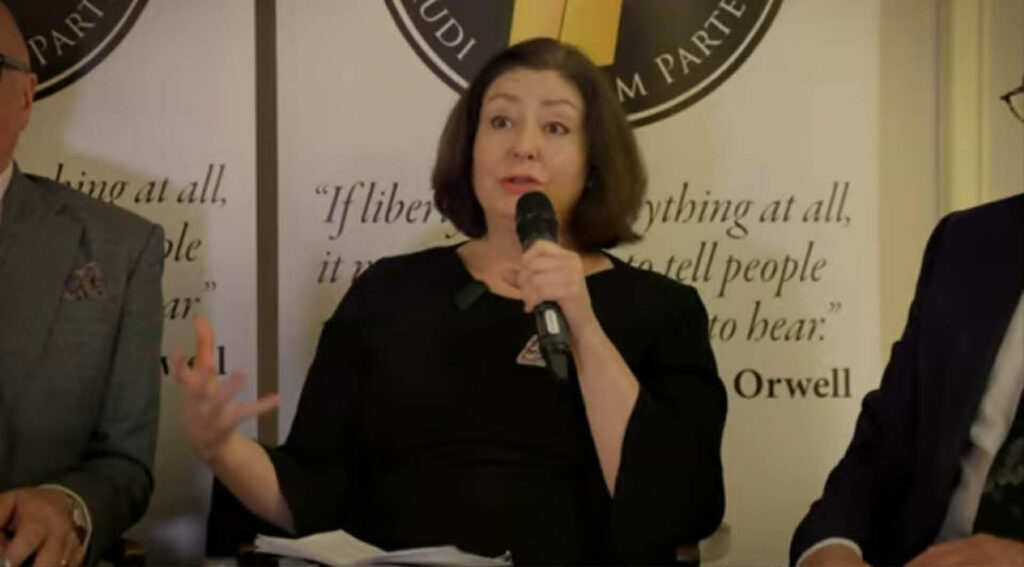
Maryam NamazieThe following, first published in The Freethinker, is an expanded and updated essay based on Maryam Namazie’s remarks at the launch of Steven Greer’s book, Islamophobia and Free Speech, on 15 April 2026, hosted by the Free Speech Union. 

Maryam Namazie speaking at the launch of Steven Greer’s book, 15 April 2026. Photo: screenshot from Free Speech Union’s YouTube recording.

Greer is Professor of Law at the University of Bristol. He was accused of ‘Islamophobia’ in 2021, a charge that was not upheld following a university investigation. (See here and here for an interview with Greer and a review of an earlier book of his, respectively.) The discussion included Sir John Jenkins, a former British diplomat, and was chaired by Free Speech Union’s David Rose. You can watch the discussion here.

Maryam Namazie 🪶Accusations of ‘Islamophobia’ and the like control dissent. I know this from experience. I have been labelled an ‘Islamophobe’ for criticising Islam, Hamas, and the Islamic regime of Iran; an ‘antisemite’ for criticising the Israeli state; and an ‘undercover jihadi’ for defending Muslims and migrants. The aim is always to silence dissent.

It is important to state at the outset that anti-Muslim racism is real. Whether or not Muslims are a ‘race’ is beside the point. Anti-Muslim hostility operates like racism, through name, appearance, and background, not merely belief. This reflects a broader shift in how racism operates. Biological racism has largely been discredited, but it is often rearticulated through culture and religion. Muslims are racialised not as a biological group but as a cultural one. This shift has been reinforced by a cultural relativism that treats Muslims as a homogeneous population defined by fixed ‘authentic’ beliefs and behaviours.

It is precisely because anti-Muslim racism is real that the language of Islamophobia is used to conflate the distinctions between Islam, Islamism, and Muslims. Islam is a body of ideas, subject to criticism and contestation. Islamism is a far-right political project. Muslims are diverse individuals.

‘Islamophobia’ is mobilised by authority to deflect criticism, determining what can be said, who can speak, and which forms of dissent are permissible. It protects authority by repackaging criticism of an idea or a religious-right political project as racism. In doing so, it disciplines dissent, stabilises authority, and shifts attention away from the structures of power being criticised. That is the crux of the matter: obfuscation in the service of power.

Of course, Muslims may be influenced by Islam, just as Italians may be influenced by Catholicism. But religion, even as a reactionary set of ideas, is also a lived experience. People are mainly born into it due to a lottery of birth. As Kenan Malik has consistently argued, sharia is not stitched into the DNA of every person from a Muslim background. People are not collectively good or bad.

Despite this, the default is to conflate people with the belief. The implication is that Islam is uniquely hateful and misogynistic, and this results in an inevitable ‘clash of civilisations’ narrative. But you can find similar forms of hate and misogyny in the Bible and Torah. And the same political project in other religious-right movements.

A recent example illustrates this conflation. I was misquoted on the back cover of Islamophobia and Free Speech as stating: ‘Greer’s book offers a compelling repost [sic] to the current campaign to denounce any criticism of Muslims and Islam as “Islamophobic”.’ The original statement was reduced to a sentence about ‘Muslims and Islam’, collapsing the distinction I had made.1 This is analogous to conflating criticism of Judaism into hostility toward Jews, and labelling both as ‘antisemitism’.

It is true that the failure to distinguish between criticism of Islam and Muslims is being politically weaponised to restrict free speech. But it is also true that the conflation between Islam and Muslims is used to promote hatred against people, to homogenise and place collective blame.

For me, any criticism of an idea is legitimate. It does not have to be measured, evidence-based, or polite. Free expression is an individual right, not a group right. Its limits cannot be determined by authority or claims of offence. It doesn’t even have to conform to existing law. Otherwise, how would women in Iran oppose the hijab? Expression is legitimate as long as there is no incitement to violence. Free expression is not an abstract principle; it is a precondition for all rights—a demand from those without power against authority.

Yet the institutions that claim to defend free expression do not apply this principle consistently. Organisations such as the Free Speech Union present themselves as defenders of free expression, yet their most visible interventions are in cases framed around Islam and ‘cancel culture’, even though restrictions on speech are not limited to accusations of ‘Islamophobia’. Academics face exclusion when accused of ‘antisemitism’ for criticism of Israeli state policy, and those supporting Palestine Action have been arrested under expansive public order and counter-terror frameworks. In each case, a similar mechanism operates: criticism of power is reframed as harm to a people or a nation, not to protect people, but to protect authority and manage dissent.

This is why the focus of the debate is often misdirected toward an ‘unholy alliance’ between Islamism, sections of the left, and liberal institutions, while the primary role of the state is disappeared.

The language of ‘Islamophobia’ is useful to authority. It allows the state to appear protective while controlling dissent. On the one hand, the state imposes surveillance frameworks such as Prevent, counter-terror powers, and protest restrictions, producing a chilling effect on speech. On the other hand, it co-opts and selectively recognises and funds particular ‘community representatives’, marginalising dissenting voices and managing ‘the Muslim community’ through established authority structures. Disruptive feminist dissent, which cuts across family, religion, community, and state, is consistently marginalised.

Authority benefits in multiple ways. The state manages minoritised populations through its recognised representatives. Religion is shielded from criticism. And religious-right political movements are insulated from challenge.

Moreover, the focus on the left obscures the fact that Islamism did not emerge in isolation. It was significantly shaped by Cold War geopolitics, including US support for Islamist groups to create an Islamic belt around the Soviet Union, alongside the suppression of left and secular alternatives.

Identity politics, particularly in the form of state-led multi-faith policy, reframes conflict horizontally, as communities set against each other, rather than vertically, as citizens against power. It fragments opposition and redirects anger. It obscures class and material conditions. In doing so, it displaces conflicts rooted in labour and inequality into the language of culture, where they can be managed rather than addressed.

Economic insecurity, austerity, housing inequality, lack of local resources, and low wages are recast as problems of culture or demography. The result is that structural issues are left untouched while the most vulnerable are made the focus of political ‘solutions’. We see this clearly in anti-immigration and anti-Muslim narratives. When structural inequality is reframed as a problem of demography or culture, the solution becomes exclusion, deportation, community management, or surveillance rather than redistribution, housing, wages, and democratic rights.

The most powerful restrictions on speech come from the state, through law, surveillance, and protest controls, but the focus of this debate is only on the left and ‘cancel culture’. State controls are rarely described as censorship, precisely because they are embedded in law and governance rather than framed as cultural conflict.

This has material consequences for how harm itself is understood.

Take the example of the ‘grooming gang’ scandals. Of course, fear of being labelled Islamophobic could have played a role. But official inquiries document decades of institutional failure rooted in victim blaming, contempt for working-class girls, and systematic failures of safeguarding. The same report that documented ethnic patterns in certain regions also concluded that the ethnicity data across the UK was not sufficient to support statements about the ethnicity of group-based child sexual exploitation offenders at the national level.

Data on child sexual abuse shows that most identified perpetrators in the UK are white and that abuse is not confined to any one ethnic or religious group. Most violence against women and girls is committed by someone known to the victim, often a partner or former partner. The focus on ethnicity has been used to externalise male violence, treating it as something that arrives with particular communities rather than something structural that cuts across all sections of society.

When abuse is committed by white men, whether by the likes of Jeffrey Epstein and Jimmy Savile or within the Catholic Church and elite institutions, it isn’t treated as a problem of ‘Christian culture’ or ‘Western culture’. A Guardian investigation found that 41% of those arrested during the Southport riots had prior domestic abuse reports. In these circumstances, it is analysed in terms of male violence, power, misogyny, and institutional failure. But when perpetrators are racialised minorities, violence against women and girls is instrumentalised and the frame shifts to culture, religion, and ‘community’.

During the panel discussion, a member of the audience associated with the Restore Britain party responded to the fact that most perpetrators are white men by stating that Britain is a ‘white country’. If demographic majority explains why most perpetrators are white, then it cannot also explain the disproportionate focus on minorities. Violence is analysed structurally when it is associated with white men, but culturally when it is associated with minoritised men. Her remark made explicit what often remains implicit in debates on Muslims and migrants: that the purpose is not safeguarding women or protecting free expression, but reinforcing the false assumption that violence is inherent in minority populations and to defend whiteness and the Christian right. Britain is, as I said then, not a ‘white country’, but a country with a diverse and plural population.

Misdiagnosing violence as ‘Muslim culture’ is politically useful. It externalises the problem, shifting responsibility away from institutions and toward communities, while reinforcing narratives that justify exclusion and control. It provides cover for racist movements that promote white nationalism by presenting minorities as inherently criminal. At the same time, it obscures a feminist analysis: that violence against women is not a cultural aberration imported from elsewhere, but a structural feature of society. This fails victims and survivors. Addressing it requires investment in services, legal reform, and accountability.

The same dynamic operates in debates on migration. The right to asylum is recognised under national and international law, and those fleeing persecution often have no choice but to travel without documentation. Yet they are increasingly labelled ‘illegal’, transforming vulnerability into criminality.

In each of these cases, social and political problems are reframed through identity, allowing power to present itself as protective while exercising control.

Religion is central to this process. It is not just belief, but a system of authority, one of the oldest and most effective in human history. It organises social reproduction, regulating women’s bodies, labour, and sexuality in ways that sustain existing social and economic hierarchies. It shapes law and governs dissent. And this is not unique to Islam. When religion is fused with state power, whether in Christian, Jewish, Hindu or other contexts, it shapes society in similar ways.

What we see today is not new but a modernised form of older mechanisms of blasphemy, heresy, and sedition, translated into the language of identity and harm. The term ‘Islamophobia’ is a case in point. Like older mechanisms, it does not protect people but religion and, through it, the structures of power. The issue, then, is not simply speech, but the organisation of power itself: how criticism is reframed, how populations are managed, and how structural problems are disappeared.

Any serious position must insist that no belief system is beyond criticism and that no people are subject to collective blame. Where that distinction is erased, criticism is not merely discouraged; it is made structurally impossible. That is how power reproduces itself, and it is why the demand for free expression must be, at its root, a demand against power.This is the original quote I sent to Greer:

Steven Greer’s book is of special relevance to those of us who have faced accusations of ‘Islamophobia.’ Islam, like all religions or beliefs, must be open to criticism. The right to blasphemy is a cornerstone of free expression. It is not limited to or dependant [sic] on one’s ‘identity’ or lottery of birth. In fact, it matters most to those living under or fleeing from totalitarian and theocratic states where it can be punishable by death. In countries like Iran and Afghanistan, being a woman in and of itself is an act of blasphemy—her hair, voice and body; being an atheist, gay, apostate or ex-Muslim and opposing a religious state or the rule of clerics are all blasphemies. The struggle to blaspheme is a struggle for the right to be fully human. Conflating blasphemy with bigotry only serves the fundamentalists in imposing de facto blasphemy laws and further vilifies dissenters whilst doing nothing to combat racism, xenophobia and anti-Muslim bigotry.

Greer told me that he sent me the edited version of the endorsement and, not having received a reply, assumed I was content with the changes. This is not the case. I did not respond because I did not agree to the revised wording. I had already provided a quote reflecting my position and did not want one written for me that departed from it. The edited version alters the meaning of my original statement by collapsing a distinction I consider essential. Greer responded that the distinction between criticising Muslims and criticising Islam is ‘subtle and not well understood’.

First published: ‘Islamophobia’, identity politics, and free speech, The Freethinker, 30 April 2026.

Maryam Namazie is a  is a British-Iranian secularist,
communist and human rights activist, commentator, and broadcaster.

‘Islamophobia’, Identity Politics, And Free Speech

Nick Cohen Writing From LondonRecommended by Kate Yo.

The UK's Authoritarian Hypocrisies

Yesterday afternoon the British police charged Liam Óg Ó hAnnaidh from the Irish language hip-hop group Kneecap with a terrorism offence.

His case has every chance of turning into a spectacular example of political and cultural hypocrisy. Today’s left and right want freedom for their supporters to incite violence but not for their political opponents.

Neither side is willing to accept that free societies should set the bar for state censorship high if they wish to remain free. Neither side is even willing to admit the existence of their own double standards.

We, however, can talk frankly. Let’s start with the left and those brave Kneecap boys.

Liam Barker, a now elderly victim of the IRA, Liam Barker tried to persuade people to shun the band by telling the BBC how the provos kneecapped him. A gang of masked men beat him unconscious with hammers for joyriding when he was 15. They attempted to blow his knees off. But the gun jammed. So, they dropped paving slabs on his legs instead.

Kneecap are “making a living out of other people's misery,” he said. 

Left-Wing Irish Bigots And Right-Wing British Bigots 🪶 Is Free Speech Only For My Tribe?

Barry Gilheany ✍ Last week’s announcements by Mark Zuckerberg, founder of Facebook now Meta that fact checkers on his platforms, Facebook, Instagram and Threads, are to be abolished and that his networks will “prioritise free speech” just in time for the return of Donald Trump to the White House cements the new loci of power in the global media and information ecosystem. 

Zuckerberg has made little secret of his genuflection towards the current political climate in the USA by defining the results of the 2024 Presidential as “a cultural tipping point towards, once again, prioritising speech”. To accommodate this new reality, fact checkers are to be ditched because “they are too politically biased” and that Meta intended to “get a rid of a bunch of restrictions on topics like immigration and gender that are just out of touch with mainstream discourse.” It is proposed that the fact checkers be replaced by the Readers’ Community Notes system as implemented on Twitter/X. A form of voluntary regulation then. But never mind, while changes to the way Meta filters content may mean “we’re going to catch less bad stuff” it will still take seriously “a lot of bad stuff out there, drugs, terrorism, child exploitation.” [1] Note, for example, the absence of health lies and misinformation around vaccines and cancer cures, for example, from that list of iniquities.

This move and the flagrant interventions of Elon Musk in the politics of nations like the UK and Germany plus his soon to be assumed key strategic role in the incoming Trump administration represents a further and possibly irreversible development in the evolution of “surveillance capitalism”` as conceptualised by Shoshana Zuboff in 2016. The original sin of surveillance capitalism is that of “primary extraction” in Zuboff’s opinion. The term describes how the social media behemoths took our private actions and lives by utilising machine learning and artificial learning to gather and organise our personal data and constructing models of each of us, and then declare corporate ownership of these assets which are then used to design algorithms that silently and deviously manipulate us for profit.[2]

The Cambridge Analytica scandal shows how the social media companies connived in the sale of this data to bad actors who then used it to undermine the democratic process during the Brexit referendum in the UK and the US Presidential election in 2016. Now the disavowing of any accountability for the dissemination of untruthful content, no matter the social and political harm caused, to suit the agenda of Donald Trump and other authoritarian leaders, by the tech titans represent the consolidation of a new oligopoly in plain sight. A new dispensation of political elites running nations in executive concert with the digital moguls.

Last week’s announcement represents a full return to the status quo ante prior to the “apology tour” of the United States Zuckerberg undertook in 2017 in the aftermath of the revelations of Facebook’s role in serving US voters Russian disinformation and as a superspreader of what entered common vocabulary as “fake news”. As part of his mea culpa, he announced that Facebook had amended its algorithms and a major initiative to include “third party factcheckers” as part of the content moderation reforms. Now, two election cycles later, Zuckerberg, borrowing from a Trump tirade in 2022 on how the “Silicon Valley tyrants” had colluded to “silence the American people”, Zuckerberg accused the factcheckers themselves for “eroding trust” and “government and legacy media pushing to censor more and more” The “censorship cartel” or tech platforms, academics and civil society groups studying and campaigning against the unrestricted spread of disinformation, is the top target of America’s top communications regulator Brendan Carr, the Trump appointee for chair of the Federal Communications Chair (FCC).[3]

The synchronicity between the imperatives of the incoming White House and Meta’s new agenda is further cemented by the departure of former Deputy British Prime Minister, Liberal Democrat party leader and self-professed “radical” centrist as its global policy chief in favour of a Republican-leaning one plus the appointment of Dana White, the Ultimate Fighting Championship (UFC) CEO to Meta’s board. A stark symbolism of this extinction event for the idea of objective truth on social media is the intended removal by Meta of the remains of its trust and safety and content moderation teams from liberal California and the location of its US content moderation team in staunchly Republican Texas.[4]

Clues as to the nature of free speech in the brave new world of the Metaverse are laid out unambiguously in its guidelines which allow users to call others mentally ill on the basis of their sexuality or gender identity and its recommendation of “more political content based on. personalised signals.”[5] A specific injunction against calling transgender or non-binary people “it” has been deleted. The rationale behind the new guidelines on mental health and gender identity is that they reflect “political and religious discourse about transgenderism and homosexuality and common non-serious words like “weird.” The policies are designed to permit types of speech including people “using insulting language in the context of discussing political and religious issues, such as transgender rights, immigration, or homosexuality.” While Meta’s policies regarding people with protected characteristics, it is now possible to compare women to household objects or property and to compare people to faeces, filth, bacteria, viruses, diseases, and primitives. Meta has deleted warnings against self-admission of racism, homophobia, and Islamophobia; allows users to say that transgender people “do not exist” and to post about the “China virus;” Donald Trump’s frequent categorisation of the coronavirus. Warnings against expressions of hate and abuse such as “cunt,” “dick” and “asshole” have also been removed.[6]

Considering recent charge sheets against Facebook for its facilitation of the profusion of hate speech against Rohingya Muslims in Myanmar which was such a contributory factor in the genocidal attacks on that ethnic group by the military junta in that country in 2018 which led to the deaths of tens of thousands of Rohingya and its failure to stop anti-Muslim hate speech and conspiracy theories and calls for violence in India on its platforms,[7] their new guidelines can reasonably be interpreted as direct licences to hate.

A possible direction of travel for Meta could be “boomer radicalisation” or the susceptibility of older people to misinformation or radicalisation. Since Facebook is the social media platform of choice for older people and since according a Guardian analysis of hundreds of defendants charged after last summer’s anti-immigration riots in England as much as 35% were in their 40s and over, anti-extremist campaigners and researchers are becoming concerned about the vulnerability of this demographic to far right disinformation in which Facebook is the chief MO. Professor Sara Wilford of De Montford University, a lead researcher on a pioneering pan-European project called Smidge (Social Media Narratives: Addressing Extremism in Middle Age) is concerned that the crowd-sourced ‘community notes’ approach will not encourage middle-aged users at risk of exposure to extremist content in that they are reluctant to fact check[8] (limited educational attainment and growing up in fairly homogeneous communities are possible factors in such reticence). The hyper-locality of the Facebook experience in that anti-migrant Facebook groups were central to the organisation of attacks on asylum centres and the transformation of the Facebook experience by seismic, transformative events such as Brexit, Covid, Trump’s 2016 election win and the migration controversy .acted as catalysing agents for engagement for far or Alt-Right politics via Facebook according to Dr Natalie-Anne Hall of Cardiff University, author of Brexit, Facebook, and Transnational Right-Wing Populism. She states that “Facebook is a key site for algorithmically driven encounters with these harmful ideas within people’s everyday practices of social media use.”[9]

How have we arrived at this juncture in the evolution of the (mis) information industrial complex headed by bad actors in politics and their accomplices in the new digital media global empires. A good starting point is the “Market for Lemons” synonym with information systems developed by the economist George Akerlof who was to share a Noble Prize for his work in this area. Akerlof published a twelve-page article with this title in 1970 in the Quarterly Journal of Economics which looked at how information asymmetries could adversely affect economic markets, and how to solve the problem. His principal comparison was the market for used cars.[10]

Akerlof explained that buyers in the hunt for a used car struggle to figure out whether the seller is offering a reliable used car or a “lemon.” The seller knows the vehicle from experience. Since potential buyers lack this vital knowledge, make lower offers, discounting the offering price by the probability that the car will be unreliable. The depressed price for used cars caused by the information deficit or asymmetry forces better-quality cars out of the market because potential vendors who possess high-quality used cars are less willing to sell them at a lower price. With a higher proportion of lemons in the market, buyers discount their offers even more, and the downward spiral continues.[11]

In the “cheap speech” era, the market for political information has come to resemble Akerlof’s used car market. Bad information is eclipsing good, and voters are discounting all information as potentially unreliable (“They are all as bad as each other” pathology). This market failure deals a blow to the basic conditions of democratic governance: voters must be able to access sufficiently reliable and accurate information about the state of the world to permit them to vote in step with their interests and values and have confidence in a fair and impartial election system.[12]

Hasen points to the decline and disappearance of quality (especially local) journalism in the USA due to changing business models whereby advertising money that once supported newspapers now flows to digital media platforms, mostly Facebook and Google. According to analysis by the Guardian, between 2000 and 2015 newspaper print advertising revenue declined from $60 billion to $20 billion per year. Meanwhile, Google and Facebook collected 59 percent of digital advertising revenue in 2019 and were on track for a $77-billion year in advertising revenues before the pandemic struck.[13]

With the disappearance of local newspapers due to the drying up of traditional advertising revenue and unable to operate behind a paywall, voters are deprived the precious resource of relevant information. Without journalists making freedom-of-information requests, attending government meetings, pursuing tips from whistleblowers and generally monitoring government, valuable information concerning corruption, maladministration and lack of official accountability never sees the dawn of day. This draining of the oasis of this important public good, the turning away of younger demographics from consumption of traditional media towards digital outlets like Tik Tok and the proliferation of cheap speech outlets particularly partisan news sites like Breitbart, Fox News and podcasts like Joe Rogan show alongside the wider disenchantment with “elites” and “establishments has created a meteorology that has led to the perfect storm of today’s bromance between the oligarchs of Silicon Valley and the Trump world. The revolution of reactionaries. Back to the future of the robber barons of the contemporary communications world and the reminiscences of 1930s populism.

References

[1] Robert Booth Dismay as factchecking ditched on Facebook on ‘free speech’ drive. Zuckerberg describes Trump re-election as ‘cultural tipping point. Guardian 8th January 2025.

[2] Quoted in Maria Ressa (2022) How to Stand Up to a Dictator. The Fight for Our Future. London: WH Allen p.248.

[3] Emily Bell, Facts Just Don’t Matter to Men Who Wage War on the Truth. Guardian Opinion 11th January 2025.

[4] Chris Stokel-Walker.An extinction-level reversal for truth-seeking. Guardian. 11th January 2025.

[5] The Guardian Comment 9th January 2025 Meta has done far too little to tackle hate and lies. Now it wants to do even less.

[6] Guardian, 9th January 2025.

[7] Ibid.

[8] Ben Quinn. Fears of radicalisation of older people with no Meta factcheckers. Guardian 13th January 2025.

[9] Ibid.

[10] Richard Hasen (2022) Cheap Speech. How disinformation poisons our politics – and how to cure it. New Haven and London: Yale University Press p.30

[11] Ibid

[12] Ibid pp.30-31

[13] Ibid p.32
 
Barry Gilheany is a freelance writer, qualified counsellor and aspirant artist resident in Colchester where he took his PhD at the University of Essex. He is also a lifelong Leeds United supporter.

Free Speech For The Few 🪶Hate Speech, Lies And Disinformation For The Masses In The Dystopia Of The Metaverse 🪶 Zuckerberg Removes Fact Checkers From His Platform

Barry Gilheany ✍ The recent announcement by the new Labour Government to further restrict smoking in public places in order to reduce the number of deaths caused by tobacco has lit up familiar cultural debates.

They are about the extent to which public health goals should impede on the liberty of the individual, invoking a familiar libertarian trope - the nanny state. 

To what extent should the state intrude on the autonomy and decision making capacities of adults in pursuit of wider public goods; be these be increase in alcohol and junk food pricing to reduce the harmful impacts of both or the introduction of 20 miles an hour speeding zones and low vehicle emission zones in order to promote clean air and community safety? Such debates invariably pit ‘hard pressed’ motorists and ‘ordinary’ smokers and drinkers against the ‘intrusive’ and ‘evangelical’ agendas of public health and Net Zero environmental zealots. Opposition to lockdowns and other restrictive measures imposed during the Covid-19 pandemic also form part of the contours of this statist versus libertarian conflict.

I should declare a couple of interests here. The new anti-smoking measures propose that smoking be banned in pub gardens; as well as in areas fronting restaurants and in the vicinity of hospitals and schools. Smokers are to be moved on – even from the pavement outside, even from the nightclub smoking areas into “somewhere down the street.”[1] I am an ex-smoker having attempted to give up on seven occasions before ultimate success. I therefore welcome any attempt to dissuade smoking be it public information bulletins or smoking cessation clinics. But I am also a frequenter of public houses; specifically free houses or those who serve cask or real ale and belong to the Campaign for Real Ale (CAMRA) to promote such; CAMRA being one of the UK’s fastest growing consumer organisations.

This measure could seriously jeopardise the future of such establishments which are valued community assets and social spaces for the otherwise isolated due to the deterrent effect on their smoking patrons. No one should be exposed to second hand smoke (especially children in the family home and car) which was the rationale for the original prohibition of smoking in enclosed spaces. But for me, smokers like all addicts need help not persecution and stigmatisation which criminalising their habit in open spaces where the risks to the wider public of inhaling second hand smoke are minimal amounts to. 

The experience of prohibition regimes on other addictive substances shows that the incidence of the habit and its harmful impacts are merely shifted to lawless spaces as in the United States during the Prohibition Era. In short addicts need safe spaces to smoke, inject etc alongside treatment for and recovery from addiction. Furthermore, closure of pubs means that retailers of cheaper and higher strength alcohol such as large supermarkets will be the beneficiaries and that the harmful societal and personal impact of alcohol will be much more pronounced.

So, I do not buy the “exposure to second hand smoke” case for these additional anti-smoking measures which are more coercive than persuasive. I am far from an opponent of the “nanny state.” Big business wants us to eat, smoke and drink our way to an outsized grave[2] and have gone to inordinate lengths to win new markets with ultra subliminal advertising; to suppress their own commissioned research into the deadly effects of their products and to influence and thwart public policy making by its armies of lobbyists. But, like Martha Gill, I draw the line where the pushing from authorities has to stop at this point. Or you begin to prove the libertarians right.[3] Besides, why devote policing resources to enforce the unenforceable?

However, common sense arguments against these proposed regulations have been drowned out by outrageous posturing from the usual suspects. First up, was Reform UK leader Nigel Farage MP who performed a typically faux man-of-the-people shtick by having his photo taken lighting up and smoking a B and H outside the Westminster Inn in another faux act of rebelliousness. Leaving aside his long history of xenophobic nationalist dog whistling and his more recent role in stirring mistrust of the police in the aftermath of the Southport stabbings, any public representative who encourages or can be interpreted as encouraging smoking is frankly not fit to hold public office. Next was a post by Esther McVey, Conservative MP for Tatton and latterly Minister for Common Sense in the last Tory Government on X/Twitter, citing the famous poem by Pastor Dietrich Bonhoeffer “First They Came” reflecting on the progression of Nazi tyranny in Germany beginning with. It reads:

First, they came for the Communists, and I did not speak out. Because I was not a Communist.

The they came for the Jews. And I did not speak out. Because I was not a Jew.

Then they came for me. And there was no one left to speak out for me.

“Pertinent words re Starmer’s smoking ban” was her warning about what she regards as the first step in a similar descent into totalitarianism in Britain.

A predictable clamour of outrage resulted, particularly from Jewish groups. The Board of Deputies for Jews called it “a repugnant action” and called for her to delete the tweet and apologise for this “breathtakingly thoughtless comparison.” Ms McVey proceeded to double down on her initial comment by denying any comparison with the Holocaust. For her it was merely an “analogy” – those who restrict freedoms start with one target then expand their reach, she explained.

She then delivered this bullish defence of “free speech.”

I will not be bullied into removing a tweet by people who are deliberately twisting the meaning of my words and finding offence where they know none was intended. We already have too much of that politically correct bullying designed to silence any free speech they don’t like. If they think I can be bullied in that way they have picked the wrong target. Someone has to make a stand against the metropolitan politically correct bullies.[4]

So, is this the litmus test for Voltaire’s famous but misquoted advocacy of free speech: “I may disagree with what you say but I will defend you to the death to say it”? Related to this old conundrum, is there, in modern parlance, a right to be offended by Esther McVey’s invocation of the Nazi era in her opposition to the extension of the smoking ban?

In calling for Ms McVey to delete her tweet, are the Board of Deputies asserting a right to be offended on the grounds of the historic sensibilities of the Jewish population? When advocates of the UK’s withdrawal from the EU complained of a master-slave type relationship between UK and Brussels, did the descendants of enslaved Africans have a similar right to assert offence?

The common-sense response to Ms McVey’s use/misuse of Pastor Niemoller’s poem is to ridicule the sheer ahistoricity of it. Promulgation of individual restrictions in pursuit of beneficial social goods such as improved public heath such as curbs on outdoor smoking should not be seen as libertarians would have it, as the beginning of “the slippery slope” towards dictatorship; be it the accumulation of anti-Jewish measures in Nazi Germany leading inexorably towards the Holocaust or the creeping erosion of civil society spheres and electoral choices in today’s populist pseudo-democracies like Hungary, Turkey and Venezuela. For one thing, liberal democracies have sufficient guard rails to prevent such journeys (although there must always be vigilance as to any potential diminution of their effectiveness). For another, the industrial scale and unprecedented aims of the Nazi extermination programme negate most comparisons.

But it is also true that drawing comparisons with Nazism always touches raw nerves, and it is fair to say that Ms McVey would be fully aware of the emotional impact and outrage that her use of Niemoller’s poem would generate. Any attempt to relativise Nazi atrocities; be it by antiabortion activists; by anti-communists who posit an equivalence between the crimes of Nazism and Stalinism or by pro-Palestinian lobbies who routinely compare Israel to Nazi Germany; always stir passions bordering on the visceral.

But there can never be a category of thought crimes. People can never be criminalised or silenced for the expression of mere opinions no matter how grating they appear to others. Holding of racist/discriminatory/” extremist” opinions should only become problematic is used in tandem with the infliction of physical harm on others. That is why Holocaust denial and support of the Learned Protocols of the Elders of Zion are not illegal in most democracies (apart from Germany and Austria). For they are merely stand-alone “offences.” But when anti-migrant or anti-Muslim online speech morphs into incitement to violence against mosques and migrant residences as occurred in this month’s race riots in England and Northern Ireland, then such speech becomes criminal. Similarly, Donald Trump’s “Freddy Star Ate My Hamster” spiel in last week’s US Presidential debate about immigrants eating pet cats and dogs and, even more appalling, his statement that in Arizona, 200,000 illegal migrants posed a danger of rape and sodomy to that state’s children, most definitely cross that threshold.

It is when prejudicial and xenophobic speech masquerading as anti-elite populism is weaponised by powerful figures like Trump, that speech is no longer free but becomes a serious societal and even global expense. To return to the case of Esther McVey, it must be remembered that she held a Cabinet post as “Minister of Common Sense” with a brief to monitor and counteract “woke” activity in the Civil Service, Universities, and wider civic society. She thus had the power to restrict freedom of literary, artistic, and political expression in the guise of protecting society from a mythical “woketariat.” The same phantom entity that she claims is trying to censor her when she offends their sensibilities by her deployment of the symbolism of one of the twentieth century’s famous dissident truth tellers to power.

But the best antidote to the exercise of Esther McVey and other bloviators’ freedom to nonsensical speech is ridicule in the bar of public opinion. In this spirit, I am reminded of this reply in the House of Commons to the apocalyptic pronouncement by Tory MP G.E. Smith that the Disestablishment of the Church of Wales Bill had “shocked the Christian conscience of Europe” – “Chuck it, Smith.”

Chuck it, Esther.

[1] Martha Gill, I love the nanny state, but let’s leave outdoor smokers to puff away in peace. The Observer. 1st September 2024

[2] Ibid

[3] Ibid

[4] Backlash as Tory MP Esther McVey uses Holocaust poem to attack smoking ban. ITV News 30th August 2024

Barry Gilheany is a freelance writer, qualified counsellor and aspirant artist resident in Colchester where he took his PhD at the University of Essex. He is also a lifelong Leeds United supporter. 

Behind The Smokescreen Of Free Speech And The Nanny State

Caoimhin O’Muraile ☭ “I disagree with what you say but I will defend to the death your right to say it”. 

This quote is often attributed to Voltaire in 1778 but there are those historians who credit the first writing of these words to S,G Tallentyre, a pseudonym of historian Evelyn Beatrice Hall, in her 1906 work; The Friends of Voltaire.

Irrespective of who first said or wrote these words they are said to form the basis of the freedom of speech we enjoy today. “Freedom of speech and expression” were also one of President Franklyn D. Roosevelt’s ‘four freedoms’, the other three being “Freedom from want”, “Freedom from fear” and “Freedom of Worship”. The question is how far do we defend a person’s right to say what they wish, even if we disagree, about whom they wish and when they wish? On the surface this is a no brainer as free speech is bedrock of our freedoms in a supposed civilised society, but is it? When President Roosevelt uttered his four freedoms it was at a time of political unease particularly across Europe where free speech in fascist Italy and Nazi Germany were freedoms of the past. When Voltaire supposedly said his famous quote, the world was a far different place than in these days of post-modernity and liberal democracy. So, in today’s world which is not a very nice place, how far do we defend free speech?

Do we defend the rights of the far-right to spread racial disharmony and hatreds over issues such as immigration? Do we defend the rights of offended minorities, whom the far-right aim their sickening policies, in retaliating with language which can be anti-white? These such comments, limited as they are because these minority groups are not out to spread hatred - the indigenous fascist groups do enough of that - do tend to give the green light to the far-right. The ‘how come he can call me a “piece of white trash” yet if I call him a “black bastard” I am being racist’ syndrome! Do we condemn both these negative comments or just the white racist? 

Firstly, we must look briefly who are the offended race (depending on the definition of race), which with a brief look is black people. Therefore any retaliation cannot be viewed as racist in the same light as those using discriminatory language against those whose lands have been plundered and raped by invading white peoples chiefly England (later Britain) Prussia (later incorporated into a greater Germany, the Second Reich) the Spanish, Belgium’s, Dutch and many others including most recently, the USA. As a Marxist and internationalist I see only one race and that is the ‘human race’ which has no room for disharmony and hatreds preached by fascists and racists. Yet, and it cannot be ignored, the defence of free speech is often used by these hate-filled organisations, whose ultimate aim is to abolish free speech altogether, having used the same free speech to spread their sick message. There may be an argument under such circumstances to curtail the use of free speech? Is it prudent to allow such speeches as; “send all these blacks and Asians back to where they come from”? “We have a housing problem of our own without importing more difficulties, send them back and homes for the Irish” do we allow, under free speech, such volatile narratives as these? The question is should these racists be allowed to undermine free speech to the point of abolishing the freedom enjoyed in most western countries?

The contradictions appear here in Roosevelts ‘Four Freedoms’. They are highlighted by the racists who use ‘Freedom of Speech and Expression’ as their platform to spread racial hatreds because while doing this they are, quite intentionally, undermining ‘Freedom from Fear’. If racially discriminating, threatening or even murderous remarks are made about ethnic and racial minorities then it follows some of these communities will live in a state of fear. Fear of physical assault, fear for their children as the racists stalk the streets, fear to go to the shops. In such cases if we defend free speech at all costs we undermine, which is what the racists want, other freedoms. Do we defend free speech even if this causes fear even terror among a section of the community? Do we trade free speech in order to defend freedom from want, freedom of fear and freedom of worship?

The same principle applies to those who spread anti-Semitism using freedom of speech to do so. How can ‘Freedom of Worship’, another of Roosevelts ‘Four Freedoms’, apply if those who attack one particular religion, Judea, many advocating the eradication of Judea and Jewish people? During the 1950s the British Nazis under Colin Jordan used the slogan, under free speech, “Perish Judea” therefore under the guise of free speech totally ignore freedom of worship and religion. See the contradictions?

Of course, abolishing free speech is exactly what the leaderships of the far-right and fascist right want. If they can force the liberal democracies to do this for them all the better from their point of view. Abolishing free speech we must never do as it would enact the policies of the far-right for them.

Legislation against the misuse of ‘Freedom of Speech and Expression’ might be a feasible answer but this also has potential problems. For example, how far should such laws go? Would laws such as these be a contradiction in themselves against free speech? A conundrum to say the least and one which the leaderships of these right-wing fanatics will be acutely aware of! Instead of laws against misuse of free speech, perhaps tougher laws against spreading racial disharmony and hatreds may be the answer. The same principle could apply to spreading homophobia, xenophobia and ethnocentrism in its extreme. Such legislation may be the answer while leaving the right to free speech intact. We must not enter into a maze of legislation, just simple laws defending minorities.

The point is, we already have laws in place such as ‘behaviour likely to cause a breach of the peace’ and ‘incitement’ laws such as ‘incitement to riot’ which could be used against the language employed by the racists. Racism itself is a crime and such legislation should be used and perhaps extended to quell such narratives by the far-right. Perhaps a question which should be asked is; how many of those charged with enforcing the law may share sympathies with the fascist right? Throughout history this is something which has plagued many police forces across the globe when it comes to dealing with the far-right and fascist right. To believe An Garda Siochana and the PSNI/RUC are any different is naïve to say the least. Equally how many judges share the far-right and fascists views? Recently in England racial tensions reached fever pitch after the murder of three children in Southport in the north west. The police, it was claimed, were stretched as far-right groups hijacked the situation, causing mayhem across the country. The leaderships of these groups, similar to in Ireland, stir the hornet’s nest then sit back and watch the effects! The police, as far as I could see on various news clips, did not go in overtly heavy handed despite coming under ferocious attack. Compare this with the mounted policing and cavalry charges launched against pickets during the coal miner’s strike 1984/85 organised in defence of jobs, pits and communities by a left-wing trade union, the National Union of Mineworkers (NUM). During the race riots evolving from Southport there were no sign of mounted baton wielding policemen just foot soldiers albeit in riot gear. The heavy handed almost cavalry tactics used against miners and other workers during the eighties was in sharp contrast to those used against racist gangs! Could it be some senior police officers privately might agree with the rioters?

The racist and fascist arguments are easy to defeat if the opposition would organise themselves properly. Firstly the crap about migration causing the crisis in housing is rubbish. The 26-county state has had a housing crisis ever since its inception in 1922. Back in the 1960s ‘Housing Action Groups’ were formed to tackle the chronic situation in the housing sector and rising homelessness. This I researched many years ago, around 2002, for the IRSP, and these groups were formed for a specific reason during the 1960s; to combat the crisis in housing and the rising numbers of homeless people. This was long before any immigrant, legal or otherwise, stepped foot on Irish soil, six or twenty-six counties! 

The racist claim that immigration is adding to the crisis in our health service is another baseless argument. Ask anybody who has received treatment in our hospitals what racial or ethnic origin their doctor or nurses were. Immigration has helped not retarded our health service and without migrant nurses and doctors we would be in an even worse state than we are presently. Another load of crap pedalled by the far-right and naively listened to by some is the myth these migrants “carry diseases”. Again, this is rubbish. In fact, historically speaking, it was the marauding armies of European whites, including many Irish in their ranks, which spread diseases to these people’s lands. 

The fascists will always look for easy scapegoats, starting with immigrants. Who next to blame? Disabled people perhaps? People involved in road traffic accidents (RTAs), after all they do clog up the health service! The list of scapegoats is endless but the fascists don’t care about that. I would suggest those gullible folk who are listening to this shit read their own history and, I strongly recommend, the works of James Connolly. Those who fall back on the heroes of the 1916 Easter Rising against ‘international protection seekers’ or refugees should ask themselves this; why did James Connolly have his 1903 election literature translated into Yiddish and Hebrew in order the small Jewish community among the electorate could understand his political message? Hardly the actions of somebody who would oppose ethnic groups. Connolly argued against racism among the Irish working class in the USA arguing that they themselves had suffered the same discriminations now aimed at themselves, the Irish, by the US workers! He also remonstrated with the descendants of George Washington, the so-called ‘Father of Freedom’, over their treatment of slaves. Connolly also saw anti-Semitism against Jewish people and anti-Catholic sectarianism as two of the same evils. So, enough of this evoking the 1916 leaders into the racist argument, it does not hold up. It is true in our past we have had a minority of racists counted by some as being among our heroes but to evoke 1916 is wrong and misleading.

Free speech which we all enjoy today must be upheld but equally misuse of the same must be combatted. These far-right groups, just as did Adolf Hitler, use, or abuse, free speech in order to gain support. If they ever gain positions of political power and major influence they will, at the stroke of a pen, abolish this freedom: be under no illusions about that. Those who are misguided enough to follow the likes of Justin Barret, Herman Kelly and others of the far-right and fascist leanings will only have themselves to blame when their so-called friends of today come calling early in the morning for them tomorrow! 

When, or if, these people ever get their way and clear all immigrants out of the 26 counties and the health service does not improve but, on the contrary, deteriorates, because migrant doctors and nurses will have been forced to leave, who are they going to blame then for the state of the health service? Will all the social problems become the fault of communists, republicans, socialists, Gay people, Alcoholics, Drug Addicts, people with long hair - where would it stop? When the numbers of homeless people continue to rise and all scapegoats have been expelled from the land who then will the fascists blame for social problems? The very people who today are rallying to their sick call, the ordinary people in the street, in other words you and me!

Caoimhin O’Muraile is Independent Socialist Republican and Marxist.

How Far Should We Defend Free Speech?

Gearóid Ó Loingsigh ☭ writing in Socialist Democracy.

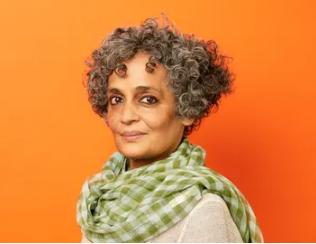
Arundhati Roy

Arundhati Roy, the famed author of The God of Small Things is to be prosecuted in India under the Unlawful Activities Prevention Act, over remarks she and academic Sheikh Showkat Hussain made about Kashmir.(1) 

What she said was that Kashmir had never really been an integral part of India. This is a clear case of the blindingly obvious. Kashmir is divided in three, between Pakistan and India, on the one hand, following partition in 1947 and another part that is ruled by China, with them taking more land from both Pakistan and India in 1962. Even the United Nations has not agreed that it is an integral part of India and various resolutions have called for a democratic plebiscite to determine the status of nation and whether it should form part of India or Pakistan. 

The case against Roy has been bubbling since 2010, but the decision to go ahead with it comes at a time when governments around the world are suppressing Palestinian protests, criminalising thought crimes through hate speech legislation, clamping down on movements opposed to the NATO proxy war in Ukraine and Julian Assange remains in prison for daring to expose US crimes.

Arundhati Roy is famous as a novelist but is perhaps better known to some as an activist, having published more nonfiction on political matters than novels and engaging in campaigns in India and abroad. She has spoken out on many occasions about and supported both Edward Snowden and also Julian Assange, meeting both of them(2) something some of the liberals who like to quote her ran a mile from and have stayed a safe distance from ever since.

She has never backed down from controversy and has stood up to Hindu nationalism and the reactionary BJP on many occasions. In the same year as her remarks on Kashmir she ventured into a large area of India controlled by Maoist guerrillas, publishing an essay Walking with the Comrades, bringing both national and international attention to this little know but remarkably powerful and resilient group.(3)

In 2011, a year after the remarks she is now being prosecuted for and for which BJP activists laid siege to her home, she published alongside Tariq Ali and other authors a book titled Kashmir: The Case for Freedom.(4) In it, she and others argued for Kashmiri independence and against the Indian state, which Roy has frequently and accurately described as not being a democratic state, despite how it is lauded by the western media as the “largest democracy”. In 2014 she republished an annotated edition of Ambedkar’s speech The Annihilation of Caste, with a lengthy introduction from herself The Doctor and the Saint in which she eviscerated the figure of Gandhi, exposing him for the reactionary he was and correcting the historical narrative surrounding the figure and his politics.(5)

Now she is being punished for her ideas. The Modi regime clearly believes that the moment is ripe to strike. At a time when the West is doing the same to Palestinian activists and India supports the Zionist regime, Modi knows that the West will say little to jailing a woman who advocates the break-up of the Indian state and an end to repressive laws when it also supports the suppression of national liberation movements.

She has a somewhat favourable press amongst western liberals due to her environmental activism, her support for Snowden and Assange may have put some off her, but is a sign of her commitment to standing up on issues regardless of what liberals think of her. 

The move against her in the Indian courts is not an isolated incident. India as she has repeatedly pointed out is not a democracy, its repression in Kashmir includes not just occupation, martial law, but rape as a weapon, displacement and the disappearance of opposition leaders. There are over 700,000 military, police and paramilitary forces occupying Kashmir (with a population of about 13 millions) and there are an estimated 8000 to 10,000 disappeared.(6) People are not the only ones to disappear, the stories about them and other aspects of repression also disappear with India forcing editors to remove stories from their website. It has also raided offices and destroyed hard copies as well as confiscating journalists’ computers and erasing information and articles they had written.(7) The move against Roy is just one more push against freedom to dissent from a thoroughly despotic regime.

But it has to be placed in the context of western powers pursuing Palestinian activists in Europe and the US, banning marches, attempting to criminalise demands for boycotts and even criminalising arguing for a Palestinian state. Western states have also seen a flurry of attempts to introduce hate speech legislation, frequently with the support of liberals and reformist left organisations. Such legislation targets gender critical feminists and was promoted on that basis with the support of the left, it is now quite clear that the intent is to use it against Palestinian and other solidarity activists. It is the criminalisation of thought and India’s foremost thinker finds herself in the crosshairs of the thought police. There is no room for complacency or tolerance for cancel culture. In and of itself, it is thoroughly reactionary, and it is particularly pernicious in that it provides the ideological basis for the persecution of the left, something sectors of the left have, depending on the issue, being willing to participate in and promote.

Arundhati Roy deserves the solidarity of all. It would mark a new low were a state able to imprison an author and activist of such note and would embolden other states around the world to intensify the clampdown on Palestinian activists, and in general limit the right to dissent, which includes the right to be in solidarity with Palestine, Kashmir and other oppressed nations or the right to be gender critical.

Notes

(1) The Guardian (15/06/2024) India: autor Arundhati Roy to be prosecuted over 2010 Kashmir remarks. Clea Skopeliti. 

(2) Roy, A. (02/08/2016) When Arundhati Roy met Ed Snowden and Julian Assange. 

(3) Roy, A. (2010) Walking with the Comrades. Delhi. Outlook Magazine

(4) See Ali, T et al (2011). Kashmir: The case for freedom. London. Verso.

(5) See, Ambedkar, B.R. (2014) The Annihilation of Caste. London. Verso

(6) See SWK (20/08/2021) Enforced disappearance in Kashmir. 

(7) See Aakash Hassan (23/11/2021) Kashmir’s vanishing newspaper archives. 

⏩ Gearóid Ó Loingsigh is a political and human rights activist with extensive experience in Latin America.

Arundhati Roy, Freedom of Speech And The Right To Dissent

Jason Michael McCann writing in Unprecedented Times last year discusses the limits of free speech. 

According to the First Amendment of the Constitution of the United States (1791), ‘Congress shall make no law… abridging the freedom of speech, or of the press;’ thus securing US citizens’ right to speak their minds freely without fear of censorship or legal consequence. 

In recent decades, this particular idea of free speech as a right has been imbued in popular belief across the entire world, thanks in large part the United States’ efforts at global cultural dominance, with the status of a universal human right. In December 1948, following the horrors of Nazi totalitarianism, the Holocaust, and the Second World War, something of this was articulated in the Universal Declaration of Human Rights (Art. XIX):

Everyone has the right to freedom of opinion and expression; this right includes freedom to hold opinions without interference and to seek, receive and impart information and ideas through any media and regardless of frontiers.

Naturally, this leads to some confusion. As the racist far-right continues to recruit support across social media and to make its presence felt on the ground in real world populist opinion and politics, its activists have vociferously taken up the fight for the protection of the right to free speech. 

Continue Reading @ Unprecedented Times.

The Limits Of Free Speech

Matt Welchwriting in Reason. Recommended by Christopher Owens.

When it comes to conflicts with people engaged in unpopular or disfavored speech, too many journalists side with the feds.

The sitting vice president, shortly before moving to Washington, D.C., successfully scapegoated through heavily publicized if legally unsuccessful pimping prosecutions a career newspaperman who last week shot himself to death at age 74 rather than sit through yet another prostitution-facilitation trial that he insisted to his dying days was an attack on free speech.

Yet the chances of Kamala Harris being asked this week—or any week—about the late James Larkin, or her starring role in the demonization of his and Michael Lacey's online classified advertising company Backpage as "the world's top online brothel," are vanishingly small. That's because people have a natural revulsion toward anything associated—however falsely—with child prostitution or sex trafficking, true. But it also stems from something far less excusable: When it comes to conflicts between the feds and those from the professionally unpopular corners of the free speech industry, journalists have been increasingly taking the side of The Man.

Continue reading In Reason.

Why Kamala Harris Won't Be Asked About the Suicide of a Newspaperman She Persecuted