Showing posts with label The Village. Show all posts
David Burke Soldiers F and G used an armoured personnel carrier or ‘pig’ assigned to them, as a mobile torture chamber to electrocute people in Belfast in the weeks after Bloody Sunday.
Introduction.

The brutality displayed by David Cleary (Soldier F) and Ron Cook (Soldier G) of 1 Para on Bloody Sunday in Derry on 30 January 1972 was not an aberration. After murdering a string of unarmed civilians, they were taken to Fort George where they beat up a group of innocent prisoners including a priest. They then returned to Belfast. What is revealed here for the first time is how they used the armoured personnel carrier or ‘pig’ assigned to them as a mobile torture chamber to electrocute people in Belfast in the weeks after Bloody Sunday.
1. Murder

Cleary is alive and may yet face criminal charges for his actions on Bloody Sunday when he and Cook (who is dead) were conveyed in their ‘pig’ into the Bogside at speed. They leapt out of the vehicle and took up positions behind a low wall adjacent to a ramp on Kells Walk from where they shot Michael Kelly. Kelly was unarmed and standing at a nearby rubble barricade, a threat to no one.

Continue reading @ Village.

Bloody Sunday Murderers Operated A Mobile Torture Chamber

The Village ✑ David Cleary knows enough to blackmail the British government.

By David Burke, author of ‘Kitson’s Irish War: Mastermind of the Dirty War in Ireland’.

1. Kitson’s Private Army.

David Cleary is the real name of Soldier F, the Bloody Sunday mass murderer. A judicial review has been brought by the family of some of his victims to reinstate criminal charges against him for their murder. If successful, Cleary will face the genuine prospect of spending the rest of his life behind bars. Meanwhile, he is the keeper of many secrets about the events of Bloody Sunday.

Lance Corporal David Cleary was a member of the elite Support Company of the 1st Parachute Regiment which was commanded by Colonel Derek Wilford. Wilford reported upwards to Brigadier Frank Kitson. All were assigned to 39 Brigade area which operated in Belfast and its environs.

Support Company of 1 Para was known as ‘Kitson’s Private Army’ and was infamous for its brutal behaviour in Belfast.

Lance Corporal Cleary was ‘gazetted’ or ‘mentioned in dispatches’ for his “gallant” behaviour during the internment swoops of August 1971. Cleary could not have received that minor honour without the full support of his superiors. Clearly, he was one of the more important soldiers in Kitson’s Private Army.

Continue reading @ The Village.
Soldier F’s Bloody Sunday Secrets

Deirdre Younge Freddie Scappaticci, a British agent inside the IRA, sought immunity from prosecution from British legal authorities so he could claim he was not Agent Stakeknife at a secret meeting with a tribunal in Dublin.


Introduction

Freddie Scappaticci became an agent for British Army intelligence in 1978. A member of the IRA in Belfast he worked his way up the IRA hierarchy, eventually becoming second in command of the ‘Internal Security Unit”, known as the feared “nutting squad”. He joined the British Army’s newly-formed Force Research Unit in 1982. Scappaticci has consistently claimed he is not an agent called ‘Stakeknife’ or ‘Steaknife’ including in his dealings with the Smithwick Tribunal in Dublin. The latter was established to investigate allegations of Garda collusion in the murders of Chief Superintendent Harry Breen and Superintendent Bob Buchanan in South Armagh, after they had left a meeting in Dundalk Garda Station in March 1989.

Freddie Scappaticci
Scappaticci had an extensive engagement with the Smithwick Tribunal set up in 2005 which reported in 2013. Though he did not give sworn evidence his legal team argued on his behalf that he was not an agent called ‘’Steaknife’ or ‘Stakeknife’.

Through letters obtained through Freedom of information requests to the Lord Advocate of Scotland and the Attorney General of England and Wales it is clear that Scappaticci obtained protection from prosecution or immunity in relation to his interactions with Smithwick from the Lord Advocate of Scotland. He did not not receive a similar immunity or amnesty from the Attorney General of the UK despite Smithwick’s assertions that witnesses from the UK and Northern Ireland had received such protection.

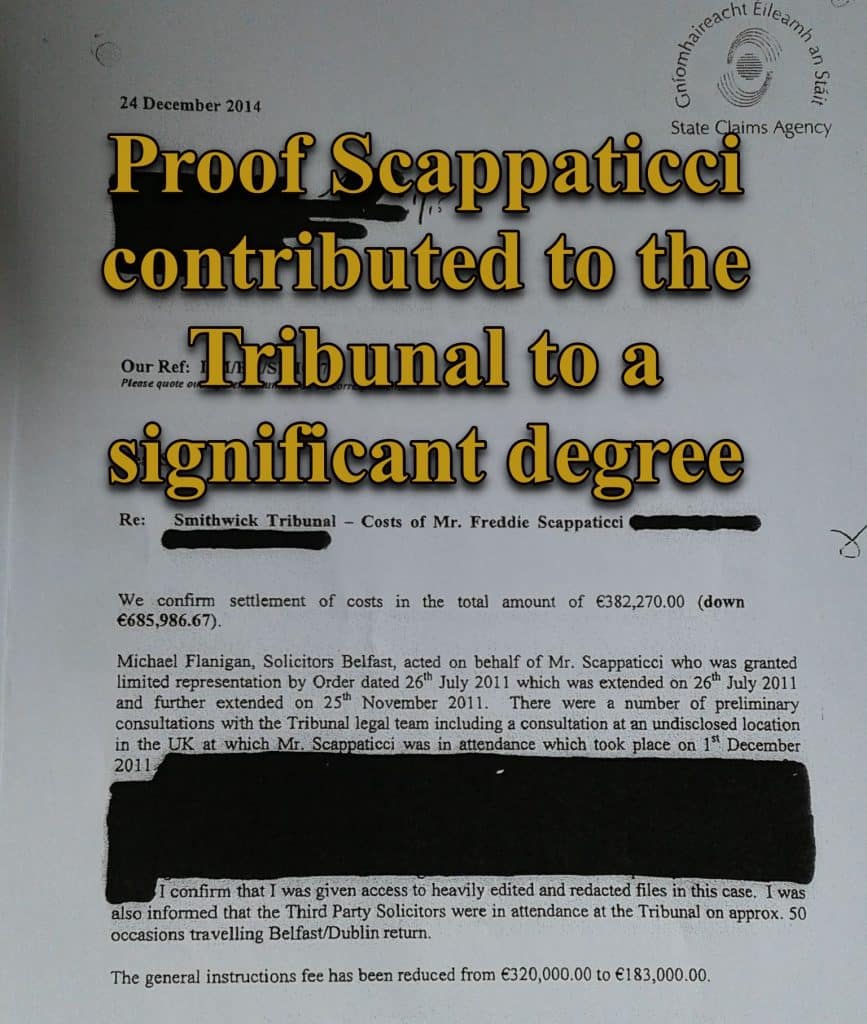
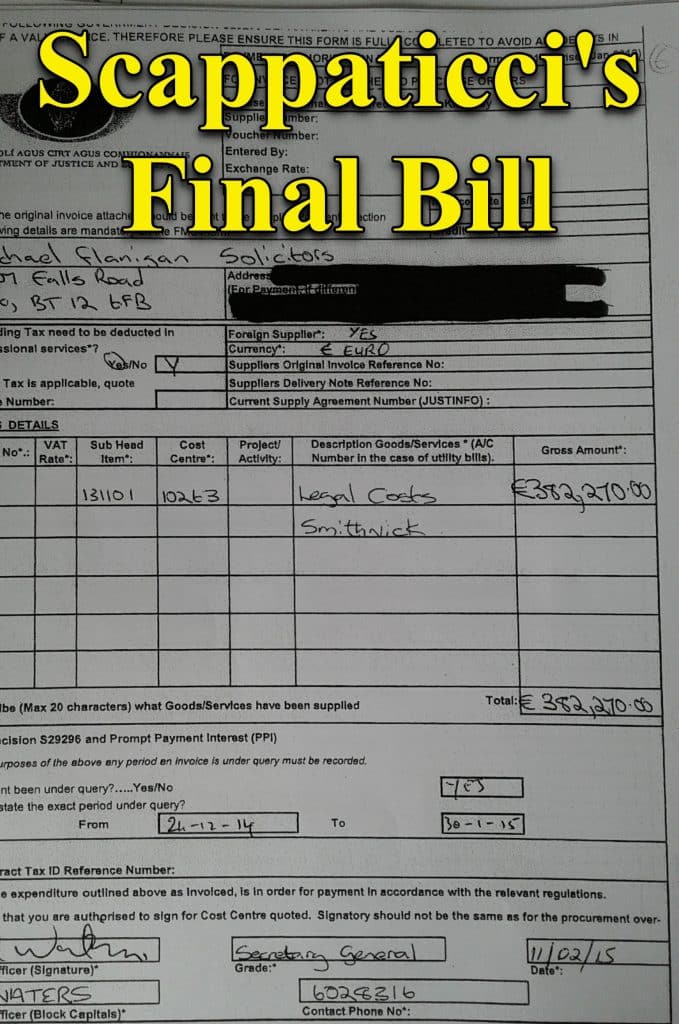
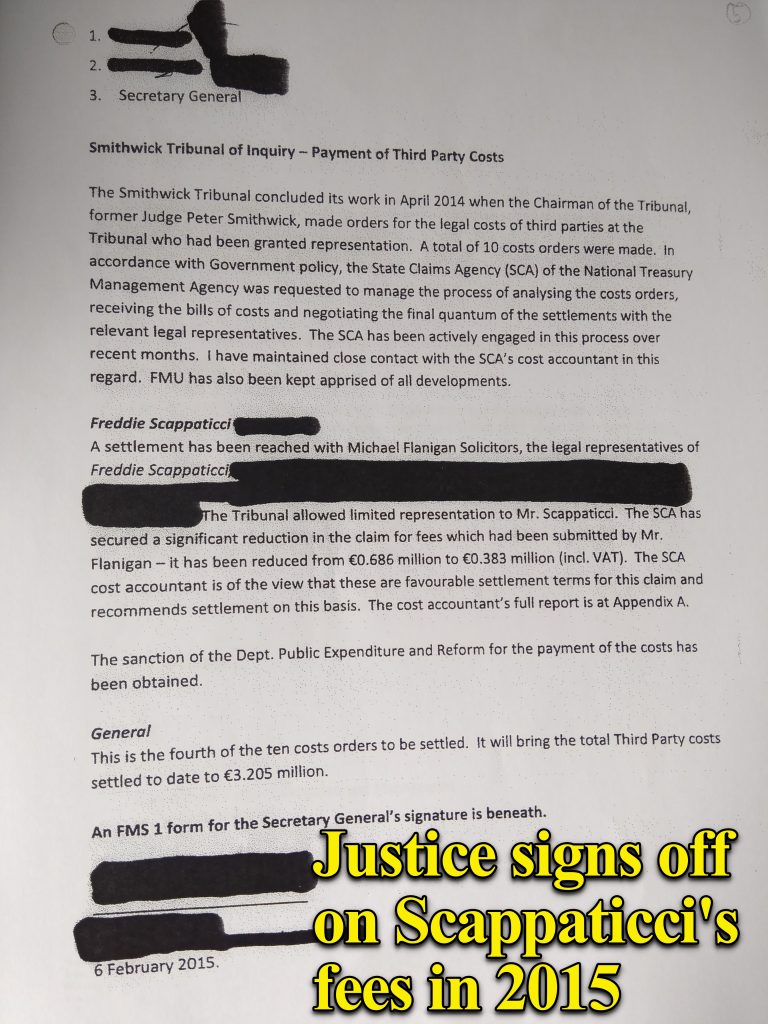
Documents obtained through Freedom of Information requests to the (Irish) Department of Justice show Scappaticci was paid his full legal costs of 382,270 euro in 2015. The bills were paid by the Department of Justice, signed off by the Department of Public Expenditure.

The Letter From The British Attorney General

The absence of such an amnesty has enormous implications in light of perjury allegations against Scappaticci in relation to his continual denials that he is an agent called ‘Steaknife’ or ‘Stakeknife’. It also calls into question the decision by the Smithwick Tribunal, set up in 2005 by Dail Eireann, not to reveal details of covert meetings with him and the decision by the Irish State to pay Scappaticci nearly 400,000 in legal costs, primarily to claim he was not a British Military Intelligence and MI5 Agent called Steaknife or Stakeknife. Senior legal sources assert that Scappaticci spent three days in Dublin talking to the Tribunal. Documents released by the Department of Justice under FOI in relation to substantial legal costs paid to him in 2015, indicate extensive interactions between Scappaticci and the Tribunal.

Smithwick On Amnesty

In the opening chapters of his 2013 report Judge Peter Smithwick has a chapter on amnesty for witnesses and the legal cover afforded by the Irish Tribunals of Evidence Act as follows:

Any witness before the Tribunal would have protection in this jurisdiction from criminal prosecution on the basis of evidence given before it. The protection is enshrined in section 5 of the Tribunals of Inquiry (Evidence) Act 1979 which provides as follows:
A statement or admission made by a person before a Tribunal or when being examined in pursuance of a commission or request issued under subsection (1) of section 1 of the Principal Act shall not be admissible as evidence against that person in any criminal proceedings (other than proceedings in relation to an offence under subsection (2) ( c ) (as inserted by this Act) of that section) – ( and that is a reference to the offence of providing false testimony to the Tribunal) and subsection (3) of that section shall be construed and have effect accordingly.

The Judge went on to explain how witnesses from outside the jurisdiction could be provided with legal cover, particularly those from Northern Ireland and the UK:

However, given the cross-border aspects of the Inquiry, it was equally important to securing the attendance of witnesses that such protection be extended to the United Kingdom. The Tribunal therefore sought and received an undertaking from the then Attorney General of England and Wales, the Right Hon., The Baroness Scotland Q.C., to similar effect. Subsequent to the devolution of policing and Justice powers to Northern Ireland on the 12th April 2010, Sir Alistair Frasier, the Director of Public Prosecutions for Northern Ireland confirmed that he would continue to honour Baroness Scotland’s undertaking. After the change of Government in the United Kingdom…the new Attorney General of England and Wales..Dominic Grieve Q.C M.P provided the Tribunal with confirmation that Baroness Scotland’s undertaking would continue to apply. The Tribunal subsequently, at the request of Freddie Scappaticci, sought and received a similar undertaking from the Lord Advocate, in relation to Scotland. This was given in terms specific to Mr Scappaticci.. - (Page 9, the final Smithwick Report, 2013).

Judge Smithwick went on to to refer specifically to Scappaticci in the one and only reference to him in the Tribunal report, as follows:

The Tribunal subsequently, at the request of Freddie Scappaticci, sought and received a similar undertaking in relation to Scotland. This was given in terms specific to Mr Scappaticci ...


The Lord Advocate of Scotland in her role as Crown Prosecutor gave Freddie Scappaticci an amnesty to cover his interactions with the Smithwick Tribunal so that he could provide “a full account” to the Tribunal in 2012.
An extract from the letter shown in full above

The AG of England and Wales it is now apparent gave no such amnesty to Scappaticci.

Other witnesses from the UK and Northern Ireland included Scappaticci’s former FRU / British Army Intelligence handler, retired Major David Moyles, other British army officers, as well as ex RUC and PSNI officers. Witnesses also included representatives of the IRA ASU who talked to the Tribunal from 2008 onwards.

First Representation

Scappaticci’s solicitor first made an application for legal representation in 2006 but this was refused.

However his legal representative, Belfast solicitor Michael Flanagan submitted his first bill in relation to meetings in 2007.


Like all Scappaticci’s covert interactions with the Smithwick Tribunal, information about these meetings were withheld from other interested parties at the Tribunal.

By May 2011 the Tribunal decided that Scappaticci would get limited legal representation which was later to develop into full legal representation. He had now been brought into evidence by the various assertions of Ian Hurst, a former Sergeant in the British Army’s Force Research Unit who put a ‘statement’ online in 2011 containing various allegations concerning Scappaticci.

Kevin Fulton whose real name was Peter Keeley, a former FRU, RUC and PSNI Special Branch agent and informant also implicated Scappaticci in his statements and evidence in December 2011. He had already described Scappaticci, who he called ‘Michael’ in his book ‘Unsung Hero’ and claimed that he (Keeley) had acted as a driver for the Internal Security Unit including Scappaticci and John Joe Magee.

In evidence he accused Scappaticci of involvement in the abduction of Louth farmer Tom Oliver in July 1991. ( See ‘Smithwicks Secret Witness’ for details of these allegations ). Scappaticci emphatically denied involvement in Oliver’s abduction and murder. Kenova is investigating the murder of Mr Oliver and has recently appealed for witnesses to come forward.

Scappaticci Denials

Most Importantly Scappaticci received legal representation to deny claims that he was not the British Agent known as Steaknife or Stakeknife.

In July 2011 Judge Smithwick made a ruling as follows:

He (Scappaticci) has consistently denied these allegations and maintains that denial. Nevertheless the public may identify him with ‘Stakeknife’. Mr Flanagan argues cogently that he should receive all documentation in relation to the ‘Stakeknife’ allegation so that his client may disprove the allegation once and for all and secondly, so that his client has the opportunity to test such evidence as that could impact on the credibility which the Tribunal ultimately attaches to the witnesses who made this allegation.

Scappaticci was awarded legal representation accordingly.

In a final legal submission given to the Tribunal on his behalf in 2013 Scappaticci himself claimed that Smithwick extended legal cover primarily to allow him to claim he was not an agent called Steaknife or Stakeknife.

Steaknife’s Handler

Scappaticci’s British Army Intelligence handler during most of his career as a Force Research Unit (FRU) agent, Major David Moyles, giving evidence in April 2012 about Agent Steaknife (his spelling), was clearly answering questions about Scappaticci. In particular in response to ex-FRU Sergeant Ian Hurst’s assertions that Scappaticci was a Garda handler, he denied that the agent had ever given him information relating to Gardai colluding with the IRA or had given prior warnings relating to the IRA ambush of Chief Superintendent Harry Breen and Superintendent Bob Buchanan in March 1989.

At the end of Witness 82, Moyles’ cross examination, Scappaticci’s Junior Counsel Ms Fitzgerald reiterated Scappaticci’s denials in a somewhat surreal exchange:

Q – I am aware, Mr Chairman, of the witness’s position that he won’t confirm or deny. I merely want to ask him if he is aware of the fact that my client has always and continues to deny those allegations that he was in fact a British agent.

A – Sorry I don’t know who your client is.

Q – I appear for Mr Scappaticci.

A – OK.

Q –  ... Witness 82. So you will be aware of those allegations I am sure. And are you aware of the fact that my client has always and continues to deny those allegations ?

A – I believe that is in the public domain.


Costs Awarded

At the end of the Smithwick Tribunal Scappaticci was awarded his costs, signed off by the Secretaries General of the Departments of Justice and Public Expenditure. They were cut almost in half by the State Claims Agency. A heavily redacted document also referred to one meeting with Scappaticci in the UK but the rest of the paragraph, presumably relating to other contacts, was redacted.


After the Tribunal Owen Corrigan took a Judicial Review against certain assertions in Judge Smithwick's report. The fact of Scappaticci’s involvement was highly relevant new evidence. The solicitor for the Tribunal denied emphatically he gave ‘evidence’ in the following terms:

Without prejudice to the relevance ... we can confirm that Mr Scappaticci did not provide evidence to the Smithwick Tribunal. Mr Scappaticci ( who is outside the jurisdiction) would not cooperate in providing evidence. He declined to provide a signed statement to the Tribunal and declined to give oral evidence.

These assertions are highly reliant on a strict definition of evidence which in the context means a signed statement or sworn evidence. It is evident the Tribunal withheld important information from lawyers.

In Belfast, as part of its investigation into Agent Steaknife or Stakeknife, Operation Kenova under Chief Superintendent Jon Boutcher submitted files relating to perjury to the PPS. One of those files is believed to relate to Freddie Scappaticci.

Frank Mulhern, whose son Joe was murdered by the IRA internal Security Squad in 1993 and who received information from Scappaticci about the manner of his death, is now appealing the PPS’s decision not to proceed to prosecution on the Scappaticci perjury file through his solicitor Kevin Winters of KRWLaw.

In the High Court in Belfast Judge Horner has refused to grant Operation Kenova’s application (September 23) that a stay be put on civil proceedings in relation to ‘historic crimes’ committed by FS – the ‘alleged agent Stakeknife’. That ruling will no doubt have relevance in relation to perjury allegations against Scappaticci. Judge Horner’s ruling means that 25 civil cases against the Chief Constable of the PSNI and the Ministry of Defence in relation to the activities of ‘Stakeknife’ can now proceed.

The response of the Attorney General of England and Wales to the FOI request about Scappaticci begs questions about who is prepared to defend his activities and whether or not he may escape behind any new legislation proposed by the British Government in an attempt to draw a line under legacy investigations, before the full grim truth of Scappaticci’s grisly activities is revealed. 

Deirdre Younge is a writer/producer/director.

Licence To Lie

From The Village Two recent hearings of the Independent Investigation Child Sexual Abuse (IICSA) in London heard arguments for and against abandoning its investigation into the allegation of sexual abuse made against the late Greville Janner. 


Now the Chair of the IICSA has determined that this module will go ahead but that the majority of its evidence will be adduced and examined in private and that any report will similarly be limited.

In this article, Christopher Stanley, Litigation Consultant with KRW LAW LLP in Belfast, who represents a survivor of abuse in both Belfast and then in London, provides an insight into the manner in which the IICSA has approached the inquiry into the allegation against Greville Janner.

Introduction

The operation of a statutory inquiry is, after the initial impact of victim statements, taken little notice of until, perhaps, the publication of a report and recommendations. In Ireland, in relation to the Conflict, we saw this in the Smithwick and Barron inquiries in relation to the murder of two senior RUC officers and the Dublin-Monaghan Bombings of 1974 respectively. My wistfulness covers territory extensively covered in Village – historic institutional sexual abuse.

At the point of publication of the auspicious inquiry report there may be either the furore of joy or outrage or muted despair as a 20,000 page document enters the space of the circular filing cabinet.

Continue reading @ The Village.

The Accused And The Accusers ➤ If Not Now, When?

🔺Since this article was written the Public Prosecution Service of Northern Ireland has decided not to press charges relating to perjury against three people - two public officials and another, believed to be Freddie Scappaticci, on foot of files submitted by Operation Kenova. The present DPP N.I Stephen Herron, appears to have accepted that Scappaticci was entitled to rely on the ‘defence of necessity’ in May, 2003 when he took a judicial review against Jane Kennedy, a Minister in the Northern Ireland Office. Scappaticci had asked the Minister to deny allegations in the media that he was the agent called ‘Steaknife’ or ‘Stakeknife’ which she refused to do on the grounds that it was standard policy to give a ‘neither confirm nor deny’ (NCND) response to questions related to National Security. The Minister's decision was upheld in August 2003 when Scappaticci’s application for Judicial Review was dismissed. 
An official in the Public Prosecution Service in 2006, reviewing Scappaticci’s sworn statements of 2003 on foot of complaints received, accepted that Scappaticci had committed perjury but that he was justified in claiming that he was not the agent ‘Steaknife’ or ‘Stakeknife’ in the circumstances, as to do otherwise would have put his life in danger - the ‘defence of necessity’. That decision was itself reviewed in 2018 by the then DPP Barra McGrory with the consequences explained below. The latest decision by the DPP Stephen Herron therefore, accepts Scappaticci’s defence.

By Deirdre Younge 

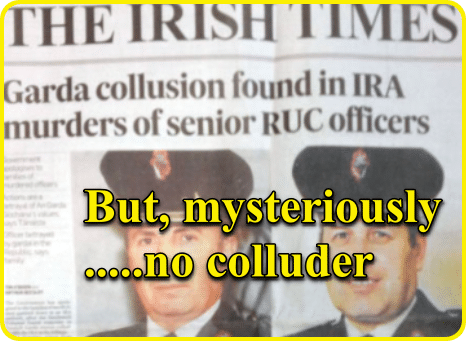
From the Village ➤ Smithwick Tribunal found Garda collusion in murder of RUC officers, but couldn’t name the colluder. 

This was partly because it allowed a motley band of FRU operatives, informants and agents like the serial ‘intelligence nuisance’ Fulton and elusive thug Scappaticci endlessly to mislead it on who the colluder was so that, when MI5 conduit Drew Harris gave definitive evidence to the contrary, the Tribunal was forced to give what the authorities, North, South and in the UK wanted: a false finding of collusion that was impossible for anyone, particularly an unnamed colluder, to challenge.

‘He was the Golden Egg, something that was very important to the Army. We were terribly cagey about Fred’ – General Sir John Wilsey ex GOC N.I 2012.

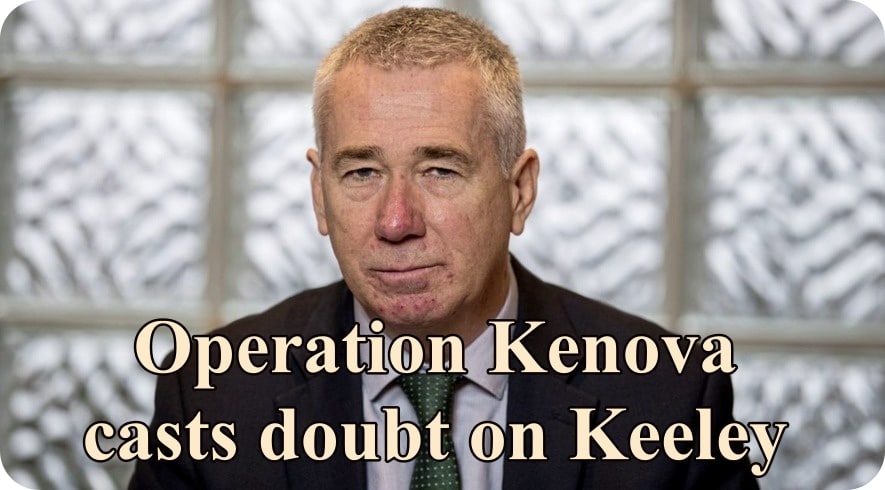
Chief Constable Jon Boutcher, from Bedfordshire Police, is leading operation Kenova whose independent team is investigating a range of activities surrounding an elusive individual intriguingly codenamed Stakeknife, or Steaknife.

Freddie Scappaticci/Stakeknife/Steaknife
Its detectives arrested and interviewed the British Army agent Freddie Scappaticci, a 72-year-old Belfast man, in early 2018. He is widely suspected of being that individual. A member of the Belfast IRA from the early 1970s, he was recruited as an agent for the Army’s Intelligence Corps in the mid to late 1970s. He moved to British Army intelligence Force Research Unit (FRU) in Northern Ireland which secretly penetrated terrorist organisations in 1982 with his then handler, Major David Moyles, who instructed him and channelled his information. 

Scappaticci was observed operating around Dundalk and the Border region North and South from around 1982 until 1990. He is believed to have attempted to take over a unit run by another IRA man in Louth in the early 1980s. He was also described as the co-ordinator of its North-South operations. Later he was second in command to JJ Magee in the Internal Security Unit which conducted IRA interrogations along the border.

He is linked to at least 20 murders.

But he fell out with the IRA, and in with MI5 and its emanations which paid him £80.000 a year. Serious allegations have emerged to the effect that, to protect his cover, the British government allowed up to 40 people to be killed via the IRA’s Internal Security Unit or ‘Nutting Squad’ which he led.

It appears Kenova is pursuing several perjury cases against Scappatacci for denying he is Stakeknife or Steaknife. Some are sceptical whether he will be held to account as it has, for example, been alleged he retains tapes of his dealings with his handlers.

A number of individuals connected to the Stakeknife scandal, and keen for an accounting, have claimed perjury is the easiest way to ensure the alleged spy will appear in a court of law.

According to Henry McDonald in the Guardian:

The whistleblower who first publicly identified Stakeknife as Scappaticci, the former Force Research Unit soldier Ian Hurst, has described the perjury route as a ‘slam dunk’ if Boutcher and his detectives decide to prosecute on that front.

The focus of this article is on how such an eminently unreliable persona was allowed to elaborately subvert the naïve and misdirected Smithwick Tribunal that reported in the Republic in 2013.

One gauge of the unreliability is perhaps that in court in 2019 counsel for Britain’s Ministry of Defence revealed the total number of lawsuits against the alleged spy.

Tony McGleenan QC said: “There are 31 claims. Some have taken the form of correspondence [but] 24 writ actions have been issued. All of these name the second defendant (Scappaticci)”.

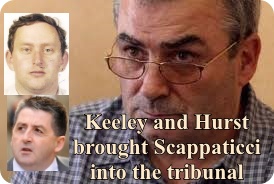
Scappaticci had been outed as the alleged agent Stakeknife or Steaknife at the time of the Stevens Inquiry in London in 2003. The outing is credited to his sometime associate Peter Keeley aka Kevin Fulton. But it is also attributed to a former Sergeant in the Army Intelligence Corps and FRU, Ian Hurst aka Martin Ingram. Scappaticci was also the subject of allegations in relation to the Tom Oliver murder in County Louth in the book Stakenknife published in 2003 by Journalist Greg Harkin and Ian Hurst under his pseudonym Martin Ingram. That’s three different line-ups alleging the identity.

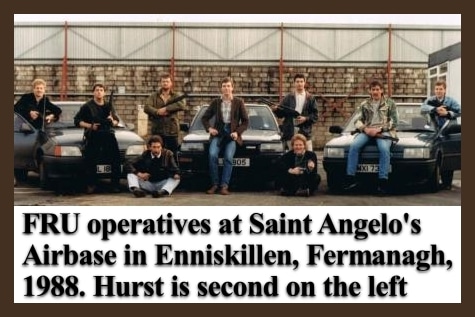
Keeley and Hurst are egregiously shadowy figures who were to feature in the Smithwick Tribunal and whose allegations led to Scappaticci being afforded unlikely credence and indeed getting legal representation there.

Members or agents of British Army Intelligence were to play a huge role in the Smithwick Tribunal which investigated whether there was collusion between the Garda in Dundalk and the IRA killers of two RUC officers, Chief Superintendent Harry Breen and Superintendent Bob Buchanan, who were shot dead in South Armagh in March 1989, shortly after leaving a meeting in Dundalk Garda station. 


BBC ‘Spotlight’ (October 1, 2019) revealed that Scappaticci conducted the IRA debrief assessment after its East Tyrone active service unit, led by Patrick Kelly and Jim Lynagh, were shot dead by forces including RUC Special Branch /TCG, SAS and UDR soldiers, at Loughgall in 1987. RUC Detective Chief Inspector Ian Phoenix led the operation against the IRA unit. His reaction to the deaths at Loughgall was described in a book ‘Phoenix: Policing the Shadows’ (1997), compiled after his death in 1994.

Harry Breen became a target for the IRA after Loughgall. He was believed to have been in charge of the armed members of the RUC Divisional Mobile Unit at the Co Armagh RUC station, when it came under attack by the IRA in 1987. After the fatal operation he was photographed with weapons retrieved from the dead IRA men.

The IRA representatives who talked to Smithwick said those published pictures were used to identify Breen.

The IRA plan was that Breen would be captured and interrogated about an alleged informer who betrayed that operation but instead he was shot dead.

Village has elsewhere reported credible if shocking allegations that Breen supplied weapons and information to Loyalist terrorists.


Smithwick found, incoherently, that there had been collusion but, partly due to a last-minute intervention which seems to have thrown him, never stated who the colluder was. Most lawyers would say that if you do not know who the colluder is it is unlikely you would pass the standard of proof necessary to make a finding of collusion.

Drew Harris, now – extraordinarily – the Republic’s Garda Commissioner, compounded Smithwick’s problems when he arrived, as the PSNI’s liaison officer with MI5 (!), to whisk the rug from under the Tribunal at the very last minute, in October 2012, with his evidence of a new Garda not identified to the Tribunal who had been the ‘real’ colluder in the murders of Breen and Buchanan and a man called Tom Oliver.

This man, on whom so much should have rested, has not yet been identified and while the Garda Commissioner stands by his evidence he has not elaborated further in public.

Most of the establishment, and the media, in Ireland and the UK have played down or failed to understand the significance of Harris’s intervention, or the discrediting anomaly of a judge making a decision that anybody can see was inept, that there had been collusion but not by anybody in particular.


The whole evolution of the Smithwick Tribunal, and the selection of a Circuit Court judge with known links to Britain, who was determined to find the desired conclusion of collusion, to chair it, merits sustained investigation.

This article looks at the villains who misled the Tribunal, enabling it to come to such an unlikely conclusion. It focuses in particular on Freddie Scappaticci’s role in diverting it at enormous cost, and on whether perhaps imminent perjury prosecutions in Northern Ireland may finally frame some of the stranger calls on the facts made by Mr Justice Smithwick. 

Scappaticci got full legal representation, paid for by the Irish Government to allow him to disprove the allegations “once and for all” (in the words of Judge Smithwick) that he was Agent Steaknife or Stakeknife, despite the fact that his handler, Major David Moyles, who obviously would have known, effectively corroborated that he was. Clearly observing army protocols, indeed he gave evidence unnamed as ‘Witness 82’, Moyles would only refer to an agent called Steaknife but he knew that everyone understood he was referring to Scappaticci.

In 2013 lawyers for Scappaticci submitted a written statement to Smithwick vigorously denying the reality that Scappaticci was Stakeknife. The following extract shows what was at steak:


The statement noted allegations from:

Kevin Fulton (aka Peter Keeley) and Ian Hurst (aka Martin Ingram) that Mr Scappaticci worked as an agent for the Force Research Unit (FRU) of the British Army under the codename ‘Stakeknife’…Both have a history of headline-grabbing and sensationalist publications. It has become clear from evidence given to this Tribunal that the sole source of the allegation is Mr Hurst…who told the Tribunal that ‘Kevin Fulton knew nothing of Scappaticci’s role until I told him..’….Mr Hurst has persisted in repeating the ‘Stakeknife’ allegation since 1999 and this allegation has fed into a more general claim that for much of the Troubles in the North of Ireland, the number of informers was so great and so highly placed within both Loyalist and Republican organisations that the British Government effectively controlled or were in a position to prevent many of the tragic incidents which occurred at that time. This allegation has been and continues to be denied by Mr Scappaticci.


The Smithwick Tribunal, set up in 2005, began consideration of applications for legal representation in 2006 and Scappaticci’s solicitor applied at this point, but was refused.

It is now clear that by 2007 the Tribunal lawyers had made contact with Scappaticci and his Belfast solicitor, Michael Flanigan. 


By 2011 he had gained full legal representation at the Tribunal. The PSNI and the British Army liaised with the Tribunal over the appearances of RUC and Military officers and in dealings with Scappaticci and other agents or handlers. Information contained in a statement obtained by Village in the response to an FOI request, throws light on how Scappaticci wended his way into the Tribunal and finally got a full legal team at public sessions. The Tribunal detailed the three allegations now being made against Scappaticci –

1. That Mr Scappaticci was the agent “Steaknife” — also spelt Stakeknife — working with the IRA on behalf of British Security services
2. That Mr Scappaticci, as a member of the IRA, was the handler of Garda Sergeant Owen Corrigan and
3. That Mr Scappaticci was involved in the abduction and interrogation of Mr Tom Oliver, a man murdered by the IRA. 

Judge Smithwick continued:

“He has consistently denied these allegations and maintains that denial. Nevertheless the public may identify him with ‘Stakeknife’. Mr Flanagan [sic] argues cogently that he should be represented and receive all documentation in relation to the ‘Stakeknife’ allegation so that his client may disprove the allegation once and for all and secondly, so that his client has the opportunity to test such evidence as that could impact on the credibility which the Tribunal ultimately attaches to the witnesses who made this allegation.

The Tribunal accordingly extends the right of Mr Scappaticci to limited representation on those occasions when either Mr Scappaticci or “Stakeknife” is mentioned”.

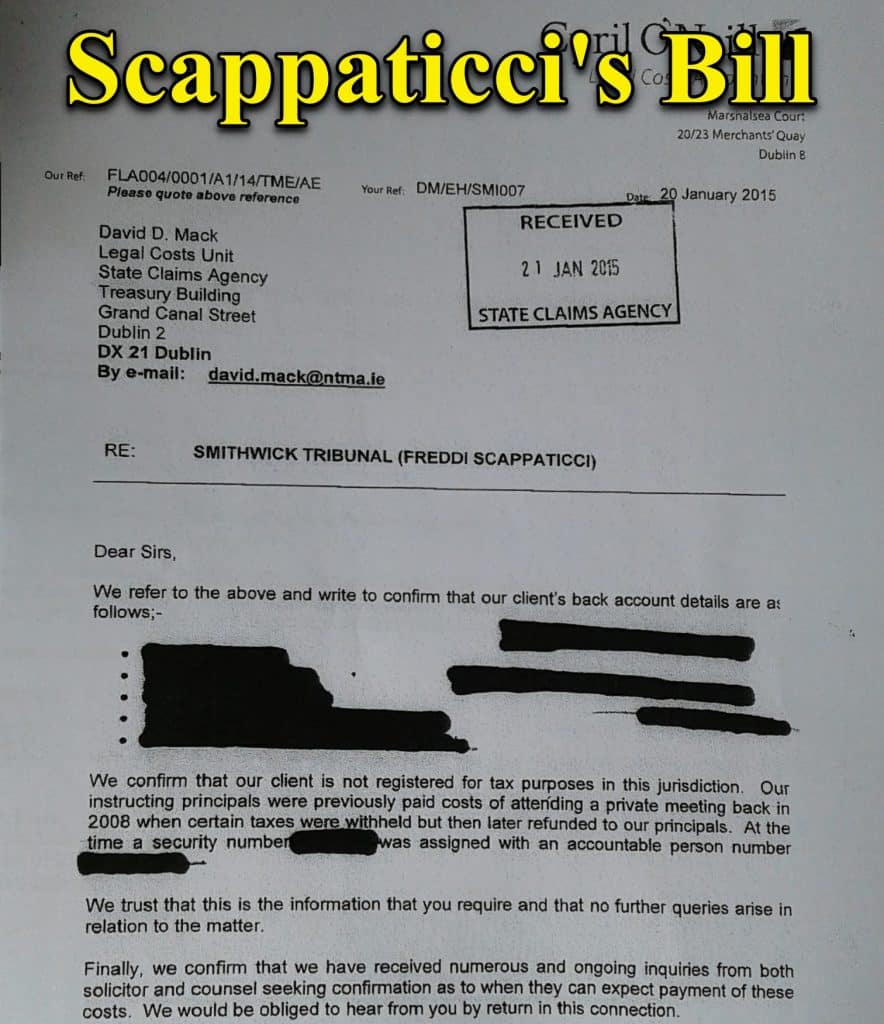
After the awarding of costs Cyril O’Neill, cost accountant, submitted a statement on behalf of  Scappaticci and his lawyers to the State Claims Agency.

Throughout the Tribunal Judge Smithwick referred to unsworn statements or conversations as ‘evidence’ but – contrariwise – the Tribunal, despite holding meetings with Scappaticci privately and granting him legal representation, emphatically denied, in judicial review proceedings taken by the man who was (falsely) alleged to have been the Garda informer who informed the IRA, Owen Corrigan, in November 2015, that Scappaticci had ever given ‘evidence’:

“Without predjudice to its relevance…we can confirm that Mr Scappaticci did not provide evidence to the Smithwick Tribunal. Mr Scappaticci (who is outside the jurisdiction) would not cooperate in providing evidence. He declined to provide a signed statement to the Tribunal and declined to give oral evidence”. The Tribunal went out of its way to deny Scappaticci had the formality of involvement necessary to constitute his contribution as ‘evidence’. Much of the Tribunal’s time was taken up by discussions with Scappatticci of which there is no record except the extraordinary bill for the public.


However, documents exclusively obtained by Village from the Department of Justice under Freedom of Information show that Scappaticci met the Tribunal’s lawyers in the UK. A high-level source has told Village that Scappaticci also had meetings with the Tribunal over three days in Dublin. The Tribunal clearly went out of its way, also, to engage Scappaticci.

In part reflecting this behind the scenes and unofficial activity, the investigatory phase of Smithwick was three times longer than the public hearings. This is contrary to the spirit and intentions of the Tribunals Act.

Remarkably then, Scappaticci gets one cursory mention in the Smithwick Report published in 2013 and only in connection with the subject of amnesty for witnesses. The brevity is deceptive. It’s now apparent through material revealed through FOI and through informed sources, that Scappaticci had extensive covert engagement with the Tribunal and that by the end of the Tribunal Scappaticci’s lawyers including his Solicitor, QC and Junior Counsel, were paid nearly 400,000 euro, ostensibly for less than two years representation at the Tribunal, principally in order that he could rebut accusations that he was the notorious agent.

Normally third-party costs are not granted. However, Judge Smithwick explains why this case was different:

There are, however, other costs which are incurred. Potential witnesses have to be sought out by the Tribunal and encouraged to make a statement. Some of them have concerns about doing so lest they breach the Official Secrets Act in their jurisdiction or expose themselves to conviction for criminal offences there. I have several cases of this kind and Mr Flanagan’s client is one. It is a matter of very great delicacy and in order to persuade his client to help us his client needs to have Mr Flanagan’s assurance that it will be safe for him to do so.

Is it conceivable in 2015 when legal fees were authorised, that the Department of Justice or the Smithwick legal team were unaware that Scappaticci was in fact beyond all reasonable doubt this notorious agent or that it was open to endless entertainment of the doubt? Or is it more likely much of his evidence was not about who he was but concerned Corrigan?

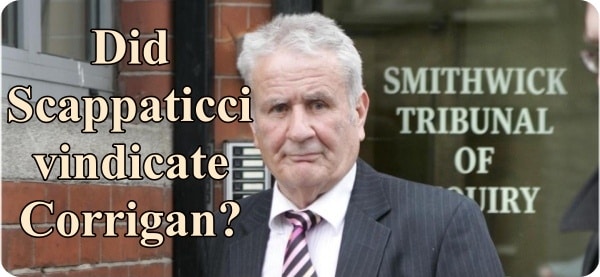
The fact that the Tribunal withheld all the information of their dealings with Scappaticci was a grave omission and may have heavily, and illegally, disadvantaged Corrigan.


In a judgment by Justice O’Neill in the High Court in October 2005 – Owen O’Callaghan v Judge Alan Mahon – dealing with disclosure disputes, he asserted (concerning the Planning Tribunal) that the applicant’s right to defend his good name prevails over others right to privacy, in relation to the obligation of a tribunal to properly disclose documents or information, Mr Justice O’Neill quoted passages from Mr Justice Geoghegan in an associated Supreme Court Judgment of March 9th, 2005, as follows:

Whereas the Tribunal undoubtedly has the latitude which may not be available to a court of law, it is always bound to ensure, as far as possible, compliance with Constitutional rights and obligations and that, of course, includes the vindication of a person’s good name. It was absolutely essential that the documents and materials which were sought for the purpose of carrying out a worthwhile cross-examination in the extraordinary circumstances where wild allegations were flying around the Tribunal against Mr O’Callaghan and of which he had not prior notice, be duly produced.

There is a serious danger that the fundamentally questionable approach of the Smithwick Tribunal – collusion without colluder, which was inexplicable and therefore appeared to have come from nowhere, was in fact driven by the upshot of its undue reliance on the utterly unreliable Scappaticci. The fact is that the source of the allegations was never “duly produced”. All of this may have made it more difficult for Smithwick too to name a colluder since the allegation about both collusion and colluder was manufactured.

This all seems analogous to the evidence given by James Gogarty to the Planning Tribunal. The Supreme Court overturned most of the findings based on his evidence, including serious findings against Ray Burke and Joe Murphy, on the basis there had never been an opportunity for their lawyers to cross-examine Gogarty in circumstances where among the plausible allegations he made were some that were deemed utterly unsustainable about Fine Gael TD Nora Owen and former Supreme Court judge Seamus Henchy. If Gogarty had been cross-examined this implausible evidence would have been used to subvert his credibility.

Is it possible Scappaticci’s centrality to the Tribunal’s thinking was suppressed to avoid his being cross-examined and discredited?

Smithwick’s unshakeable reliance on his deeply flawed witness, Keeley, the covert nature of his relationship with Scappaticci, the non-sharing of possibly exculpatory Intelligence and reliance on untestable hearsay assertions allow for uncomfortable comparisons.

Did Smithwick have legal advice that he could not name the person he wanted to name as colluder because the process involving Scappaticci was illicit? 


Peter Keeley joined FRU in 1981 and was sent to Northern Ireland. He gave evidence to Smithwick under the alias ‘Kevin Fulton’. Without Keeley there would have been no inquiry. A preliminary inquiry by a former Canadian Supreme Court judge, Peter Cory, made it clear he was the last-minute witness that persuaded him to recommend a public inquiry. The last-minute witness seems to be an unfortunate pattern in this benighted sphere. That inquiry was to be the Smithwick Tribunal.

It seems to have been an essential policy agreed between the UK and Ireland that there would be such an inquiry, perhaps as a quid pro quo for other inquiries that the Irish Government wanted conducted by the British government into murky murders in the North. What they hadn’t reckoned on however, was that the Inquiry would be held in the South and therefore be hobbled from the start, by having no authority or jurisdiction over the RUC, PSNI or British army and just ‘grace and favour’ access to their intelligence files. 


Still, many managed not to focus too much on the dramatic legal dysfunctionalities obvious both in its genesis and its conclusions. According to the Irish Times at the time of publication of the Tribunal’s considered but incoherent report: “in terms of fallout it seems unlikely that there will be a major negative political dimension to the Smithwick report”. This was because, as the Irish Times unquestioningly noted:

The judge found there was Garda collusion but that it was localised and, it seems, at a low-ranking level. Such corruption is hard to come to terms with, but will hardly damage British-Irish or North-South relations. 

And that, against the background of nasty but murky murder, was the entire purpose of the exercise.

Anyway, impelled in part by the conclusions of the Canadian judge, as far as Smithwick was concerned Keeley was his star witness and no amount of inconsistency or changed stories dented that premise.

In November 2011 Keeley was cross-examined by Scappaticci’s barrister whose central focus was that Keeley dragged Scappaticci into his narrative for publicity and to pressurise the State over his financial package. The Queen’s Counsel also questioned Keeley about his role in a legal claim being pursued by his wife against Scappaticci. When asked why Scappaticci did not feature in his book in relation to the Tom Oliver case Keeley washed his hands of editorial responsibility, blamed the ghost writers and denied the relevance: “Scappaticci, to me …you are saying he is relevant because he is your client but to everybody else he is not that relevant”.

Indeed sources close to Keeley have told Village that the statement was invented or “written up” and given to Keeley so as to kick-start an inquiry into the murders of Breen and Buchanan.

Senior security sources say the RUC Special Branch and M15 spent years desperately trying to put the ‘Fulton’ genie back in the bottle and only succeeded after offering him an apartment and expenses around 2005. He still operates under their watchful eye and under threat of arrest.

Keeley’s so-called ‘Fulton statement’ to Cory in 2003 said a Garda tipped off IRA man Patrick ‘Mooch’ Blair that Breen and Buchanan had arrived at Dundalk Garda Station. Fulton alleged he was in a car with Blair when the Garda told them that “they” had arrived at Dundalk Garda station, thus triggering the ambush of the two men. 

The allegation later changed in 2006 at Smithwich to centre on an alleged conversation between Blair and Corrigan in a car in the car park of a pub. This time the collusion involved the passing of information about Tom Oliver. The subject of the conversation, the location and the year changed between Cory and Smithwick. So, in 2006 when Fulton aka Keeley was under the ‘protection’ of M15 his central allegation changed completely from the murders of Chief Superintendent Harry Breen in South Armagh in 1989 to that of Tom Oliver in Co Louth in 1991. 


Patrick “Mooch” Blair adamantly denied that he ever had such a meeting and said his life would have been in danger if a meeting had taken place. Corrigan vehemently denied all Fulton’s allegations and sources close to Keeley, who had an insight into everything that happened at the time, confirmed to Village that no such meeting had ever happened.

This change of story is something that is extraordinarily important in assessing the performance of the Smithwick Tribunal.

In any event, the changed story and statement brought Scappaticci into the frame. By the time the statement made its way to Smithwick the central collusion allegation had transmogrified into one not about Breen and Buchanan but about the murder of farmer Tom Oliver. Bizarrely, nevertheless, the Smithwick Tribunal’s lead SC declared at a public sitting that the Oliver murder was not part of the Tribunal’s remit, even though Scappaticci was to get legal representation partly to counter accusations implicating him in the Tom Oliver murder.

Tom Oliver, murdered by the IRA in 1991
The case of Tom Oliver, who was abducted from his home, on the Cooley Peninsula in Louth, murdered and dumped in County Armagh, was brought into evidence by three former members of the British Army Intelligence Corps. Scappaticci was alleged to have been part of the IRA Interrogation Unit which abducted Oliver. In fact it would appear that after 1990 and events surrounding the interrogation of another informer, Alexander Lynch in Belfast, designed to entrap a senior Sinn Féin spokesperson, Danny Morrison, Scappaticci had become persona non grata for a time, and was not part of the interrogation team at the date of Oliver’s murder.

Ian Hurst first contacted the Smithwick Tribunal after it was set up in 2005. He claimed that he was being prevented from giving relevant information because of a ‘gagging order’ imposed by the UK Ministry of Defence. The Tribunal wrote to the UK Treasury Solicitor, the Ministry of Defence and the Northern Ireland Office about his possible appearance.

Hurst had made a number of assertions in the co-authored book Stakeknife published in 2004.

One was that an agent in the IRA had made recordings of Tom Oliver’s conversations with gardaí in Dundalk which led to Oliver’s murder.


In his statement to Smithwick in June 2011 he made the key allegation that there was Intelligence implicating retired Special Branch Sergeant Owen Corrigan in passing information to Scappaticci. These allegations were published by some credulous reporters and Corrigan has sued successfully on a number of occasions.

However, Hurst’s heinous and untrue allegations gained him access to the Tribunal. They were also to ensure that Scappaticci was granted full legal representation paid for by the Irish State. 

Hurst’s allegations ensured that both Hurst and Scappaticci were witnesses at the Tribunal. Even with Hurst discredited, he had opened the door for Scappaticci to corroborate Keeley. He had served his purpose.

Moyles was emphatic that Steaknife, who he handled, was not aware of the procurement of information from Corrigan or any other member of the Garda and that he had not seen any intelligence generated by Scappaticci suggesting he had.

He also said that Steaknife had no advance knowledge of the IRA ambush of Breen and Buchanan, nor did he ever indicate that it was based on information provided by a member of the Garda.


Despite Moyle’s emphatic evidence that he had seen no secret store of Army intelligence about Garda collusion, Smithwick chose to believe Keeley because without him there was no evidence of collusion.

That was a momentous mistake. Much of the Tribunal’s time was taken up by discussions with Scappatticci of which there is no record except the extraordinary bill for the public.

Operation Kenova too has found no intelligence or evidence linking Scappaticci with Oliver, according to reliable sources.

It is submitted that the evidence of Mr Hurst must be disregarded by the Tribunal of Inquiry on the basis that both he and his evidence are lacking in any credibility. For the following reasons.

↦ Mr Hurst has admitted under oath to being a liar.
↦ Mr Hurst by reason of his training within the FRU and elsewhere, is trained, to an exceptional level, in deceit.
↦ In the context of his report on Bloody Sunday, Lord Saville of Newdigate came to the following conclusions about the evidence given to him by Mr Hurst”.

In fact Hurst had left the Army in 1991 in good standing on full pension and with an “exemplary record”. Nonetheless, even Smithwick rejected Hurst, noting in his report:

We formed the view that Martin Ingram (Hurst) had, at best, an imperfect recollection of events and that it would be unwise to rely on his evidence.
We are of the view that Martin Ingram to a substantial degree exaggerated the importance of his role at HQNI and the level of knowledge and access in intelligence. I attach no weight to the evidence given by Ian Hurst.

Hurst had wilted under cross examination at the Tribunal but his statement along with Keeley’s levered Scappaticci into the Tribunal by his obtaining expensive legal representation if not in person.

Hurst is credited with first revealing that Scappaticci was agent Steaknife.

Keeley’s wife and he also allege they were interrogated by Scappaticci in 1994 after an attempt on the life of a senior RUC officer failed. Reliable sources tell Village Scappaticci had in fact been stood down as an enforcer by this time. She has taken a case against the Chief Constable to which she has attempted to join Scappaticci.

Doubting Keeley’s authenticity Scappaticci noted in his statement that no Military Intelligence handlers appeared before the Tribunal to give evidence or verify Keeley’s account of himself. 

Again damagingly, in one of a number of actions before the courts dealing with alleged entrapment in 1985, (R v Patrick Quinn) the British Army has refused to engage with Keeley as they maintained he wasn’t working for them then.


It remains to be seen if they will maintain this stance in future civil actions.

Chief Superintendent Boutcher has submitted 12 files to the Public Prosecution Service in Northern Ireland for its consideration. Three of those files have reportedly been in relation to perjury. We may speculate what they concern.

For example, Belfast man Joe Mulhern was shot dead by the IRA in 1993; his body was left on the road in Castlederg, County Tyrone. After his death Joe’s father, Frank Mulhern, was told by Scappaticci how his son had died.

Frank Mulhern’s campaign for Justice was central to the setting up of Operation Kenova despite the fact that Kenova has found no evidence to connect Scappaticci to his death.

In 2017 Frank Mulhern initiated a judicial review action against a decision of the PPS (NI) not to bring a prosecution against Scappaticci for the offence of perjury in denying he was Stakeknife in relation to a 2003 case brought by Scappaticci, against a Northern Ireland Minister, Jane Kennedy. Mulhern’s lawyers referred to a 2017 Panorama television programme, ‘A Spy in the IRA’, which alleged that Scappaticci was agent Stakeknife and disclosed the PPS decision not to prosecute.

Frank Mulhern’s court actions revealed a letter from the then Director of Public Prosecutions Northern Ireland, Barra McGrory, to this effect. The letter from the DPP’s office read as follows:

The Director has asked me to reply to your letter of 16th May 2017.
You will appreciate that the PPS is unable to make any comment on the suggestions in your letter as to the identity of the agent codenamed Stakeknife.
It is correct however that an individual was reported to the PPS in 2006 for the alleged offence of perjury during court proceedings in 2003 involving the individual referred to in your letter. While it was considered on the evidence that perjury was committed, the view was taken that the individual concerned had a viable defence of necessity and a ‘no prosecution’ decision issued. These matters are now the subject of investigation by Operation Kenova and it would be inappropriate to comment further.

It was clear that, if Kenova had not been investigating, the PPS would have considered initiating a prosecution itself:

I have serious concerns in relation to this decision [not to prosecute]. Having reviewed all of the available evidence I consider that the original decision did not take into account relevant considerations, and also took into account irrelevant factors. I have concluded that the original decision was not within the range of decisions that could reasonably be taken in the circumstances. This decision has been set aside.


Another possible case for perjury was strangely revealed in a final legal written submission made to the Smithwick Tribunal on Scappaticci’s behalf in 2013 which referred to the 2003 case taken against Minister Jane Kennedy, which unsuccessfully sought to force her, in the wake of publication of the Harkin and Hurst book ‘Stakeknife’, to deny allegations he was the eponymous ‘mole’ in the IRA. Scappaticci’s denials in this case were considered as possible grounds for his prosecution for perjury. Scappaticci retained the same solicitor who had acted for him in the Kennedy case, to represent him at Smithwick. 

In September 1989 journalist Martin O’Hagan was interrogated by the South Armagh Brigade of the IRA. His name had been found in a notebook taken from the car in which Chief Superintendent Harry Breen and Superintendent Bob Buchanan had been travelling when they were shot. The ‘internal security unit’ carried out the questioning of O’Hagan.


But the extraordinary outcome of the Smithwick Tribunal was that by awarding Freddie Scappaticci legal representation to defend his reputation and prove “once and for all” that he wasn’t Agent ‘Stakeknife’ or ‘Steaknife’, the Irish State was forced to hand over hundreds of thousands of pounds for a man believed to be a notorious British Army Agent. An agent who is under investigation for perjury in relation to his denials, and his alleged involvement in multiple murders.

Scappaticci ended his final submission with a final denial and a reminder of the role of the two FRU operatives Fulton and Hurst:

Mr Scappaticci is represented because he made the point that there was an allegation, which he denies, that he is a person under the sobriquet of ‘Stakeknife’… The only people who assert this position are Mr Fulton and Mr Hurst. ..It is contended that both of these men have proven to be unreliable witnesses. Their allegations concerning Mr Scappaticci are wholly inaccurate. They have abused their opportunity to give evidence to the Tribunal and used it as a platform on which to make sensationalist claims and further their campaign against Mr Scappaticci. They are both individuals who have been trained in deceit and it is submitted they have both used those skills in an attempt to deceive the Tribunal. 


Operation Kenova, led by Chief Superintendent Boutcher, looks likely to attempt “once and for all” to prosecute Freddie Scappaticci for perjury, so framing the Smithwick Tribunal’s decision to give him credence and pay his legal fees.

If Kenova finishes up identifying the person who perpetrated the Stakenife horrors and further undermining the Smithwick Tribunal’s implausible report it would have significantly advanced the fragile cause of justice in benighted Northern Ireland.


See Killusion By Deirdre Younge - the backstory of how Freddie Scappaticci got "pulled" into the Smitwhwick Tribunal.

Deirdre Younge is a writer/producer/director. 

MI5 High Steaks ➤ The Kenova Investigation Could Nail Scappaticci For Perjury So Why Did Smithwick Pay His Legal Bills?

The Village poses a question - Maurice The Mole? The Provisional IRA knew Sir Maurice Oldfield, Chief of MI6, was a homosexual. Did the Soviets know too? By Joseph de Burca. 

Forty years ago this month Margaret Thatcher called the veteran MI6 spymaster Maurice Oldfield out of retirement and sent him to Northern Ireland to co-ordinate the activities of the various branches of British Intelligence on the island. Did the KGB know he was gay? Did they learn he had a relationship with the paedophile in charge of Kincora Boys' Home? MI5 investigated him in 1980 to see if he was a traitor.

Forty years ago this month Margaret Thatcher sent Sir Maurice Oldfield, the former Chief of MI6, to Belfast to co-ordinate the activities of the various branches of British Intelligence in Ireland.

Kieran Conway, the former Provisional IRA Director of Intelligence in the 1970s, has confirmed to Village that the Provos knew Oldfield was gay.

In 2017 the Hart Report into child sex abuse published details of an MI6 document which revealed a “small collection of papers in file three which relate to the relationship [Oldfield] had with the Head of the Kincora Boys’ Home (KBH) in Belfast”. The “Head” of Kincora was “Warden” Joseph Mains who abused teenage boys at Kincora and elsewhere.

What, if anything, did the Soviet intelligence apparatus, the KGB, know about Oldfield’s homosexuality? More significantly, if the KGB found out, what did they do with the information? Joseph Mains, according to MI6 records he had a “relationship” and a “friendship” with Oldfield.

The answer is nothing despite the fact it could have destroyed him. Such inaction makes no sense as Oldfield was reputed to have been a highly effective opponent of the KGB. The notorious MI6 traitor Kim Philby described him as an officer of “high quality” and “formidable” in his memoirs.

Continue reading @ The Village.

Maurice The Mole