Showing posts with label The Freethinker. Show all posts
Maryam Namazie ✊ Writing in The Freethinker.

The landscape of modern political activism has become a moral minefield, where universal values are routinely sacrificed on the altar of narrow, identity-driven loyalties. Multiplicity is treated as betrayal, and simplicity is weaponised. What should be a principled commitment to universal women’s rights is increasingly overwhelmed by rigid binaries that demand allegiance to one power bloc over another.

Nowhere is this tension more evident than in debates around women’s rights and the question of Palestine. The essential opposition to Israel’s occupation and genocide is conflated with a defence of Hamas and anti-Semitism. Conversely, opposing Hamas and Islamism is recast as defending the Israeli state and Islamophobia. It’s a false binary that ignores the lived experiences of women.

Acknowledging multiple forms and fronts of harm, or recognising that rights can and are violated across opposing sides, is seen as an affront to group loyalty. A commitment to universal women’s rights is treated as treachery by both sides, suffocating our movements, our solidarities, and the possibility of liberation itself.

The fringe ‘Palestine Liberation is a Feminist Issue’ event and the grassroots feminist group FiLia’s October conference, at both of which I was a speaker, perfectly encapsulate this moral incoherence.

At the fringe event, organised by the Anti-Imperialist Feminist Network to coincide with the FiLia conference, my contribution on the necessity of liberation from Hamas as well as Israeli occupation was denounced with cries of ‘shame’. Per Kay Green in the Morning Star, apparently only another speaker was able to ‘soothe tensions’ by reminding the audience that I was in no way ‘a genocide apologist’. (Organisers are not releasing the video footage under the bogus claim of security concerns.)

That a principled critique of Hamas could trigger such hostility is not surprising. I have seen this played out for many decades now: defend apostates and you are ‘Islamophobic’. Oppose anti-Muslim racism and you’re an undercover Jihadi. Condemn the Islamic regime of Iran and you’re accused of legitimising US militarism. Oppose Israeli attacks on Iran and you become pro-regime. (I have previously discussed identity politics as a breeding ground for division and dehumanisation here.) The script is always the same: refuse the binary and you are automatically placed into the ‘enemy’ camp.

You are either for us or against us. And depending on who us is, you will either excuse Israeli rape, occupation, and genocide as self-defence or you will defend Hamas’ rape and terrorism as resistance, even though it is well established that rape has always been used as a weapon of war. (See the UN Special Representative on Sexual Violence in Conflict’s conclusion of reasonable grounds to believe that rape and gang rape occurred during the 7 October attacks and the allegations of sexual torture and abuse of Palestinian detainees by Israeli security forces documented by the UN Office of the High Commissioner for Human Rights.)

Even if you have made a career of opposing violence against women, you will magic away the rape and sexual assaults of Hamas or IDF forces depending on your politics. Those who oppose the Christian right in their own country, will defend Islam, the veil, Sharia law, and theocracy in ours or a Jewish fundamentalist state in Israel. Political violence, rape, fundamentalism, and misogyny become acceptable as long as it is carried out by one’s own ‘side’. Feminism is conditional, depending on which tribe of women is being sacrificed.

This is not only because of a refusal to engage with nuance and multiplicity or due to a false sense of tribal loyalty. Fundamentally, this is because many people everywhere have bought into the oldest political con: the myth that those in power and the ruling class somehow embody ‘their’ people, and that opposition to one system of domination obliges allegiance to another. Tribal or identity politics homogenises societies so completely that elites become the ‘authentic representatives’ of the people through this manufacturing of acquiescence and consent.

The political swindle ensures that real solidarity is substituted with allegiance to power.

Certainly, there are those who are not merely accused of supporting a power bloc but openly and unapologetically do so. Some defend the Israeli state, the machinery of occupation, dispossession, starvation, and mass killing behind the language of protecting ‘Jewish women’ or ensuring ‘Jewish safety’. By collapsing the distinction between a people and a state, they treat any criticism of Israeli policy as a threat to Jewish existence itself. Likewise, there are those who have a real ideological affinity with Islamism and hide behind Palestinian suffering to defend a misogynistic, theocratic, authoritarian force. They invoke the language of liberation while shielding a movement that would deny women, LGBT people, ex-Muslims, secular Palestinians, and dissenters their most basic rights. In both cases, the suffering of women becomes a political alibi used to whitewash the power of states and fundamentalists.

This selective solidarity is not confined to Palestine. On parts of the Western left, white nationalism is rightly condemned, yet Islamist fundamentalism in power is romanticised as anti-imperialist. Meanwhile, the Western right warns obsessively of Sharia law while championing their own Christian nationalism that attacks abortion rights, LGBT rights, and women’s rights.

Clearly, liberation cannot be built on the backs of competing ruling classes. If our politics cannot condemn both the Israeli state and Hamas, if we cannot stand with women rather than their tyrants, then our frameworks do not merely fall short; they reproduce the very harm we claim to resist.

Of course, the Israeli state and Hamas are not equal in power. Israel is an occupying force, with huge military and economic might backed by Western states. Yet, the crimes of the Israeli state do not erase the crimes of Hamas, a misogynistic, theocratic force that emerged to undermine the Palestinian struggle and is supported by powerful regional and international regimes such as Iran, Russia, and Qatar.

It is important to note that critiquing Hamas does not mean collapsing the Palestinian struggle into Hamas. Palestinians have long resisted occupation through feminist, secular, labour, and grassroots movements that Hamas actively suppresses. Likewise, there is a rich history of resistance by Israelis and Jews against occupation and the atrocities committed in their name.

A feminist position on Palestine must oppose Israeli occupation and genocide and oppose Hamas’s misogynistic, theocratic rule. This is not contradictory. These are inseparable, principled stands.

A principled approach must target all authoritarian forces that oppress women, not side with one over another. My enemy’s enemy is not my friend. The fight for liberation has always meant fighting on many fronts.

In their 2024 Statement on the Genocide in Gaza, Feminist Dissent did exactly that by condemning Israel’s genocidal campaign while also naming Hamas as a fundamentalist, anti-democratic force whose repression of women and minorities cannot be excused in the name of liberation.

As Palestinian academic Nahla Abdo argues, Palestinian women’s struggle necessarily combines ‘gender issues with the national and anti-colonial struggle’, showing that liberation must confront both internal patriarchy and external colonial domination.

This is a lesson we have learnt in Iran. Women were told to wait ‘until after liberation’ from the Shah’s dictatorship to demand their rights. That time never came. Women’s liberation postponed is liberation denied. Also, liberation without women’s liberation is meaningless.

Militarism, colonialism, and fundamentalism are not separate systems. They feed off of and mirror each other, always at the expense of women. During the Cold War, the US empowered fundamentalist movements as a bulwark against communism. Israel itself enabled the rise of Hamas to weaken the secular Palestine Liberation Organization.

The same pattern of tribalism appeared in attacks on Rahila Gupta of Southall Black Sisters, whose speech at FiLiA’s plenary condemned Israeli genocide as well as fundamentalism. Uproar ensued, and she was instantly labelled anti-Semitic and pro-Hamas.

Across the ideological divide, accusations of anti-Semitism and Islamophobia serve the same function: to silence criticism of power. Both hatreds are real (though I prefer the term ‘anti-Muslim hate’ to ‘Islamophobia’) and must be confronted. But when they are used to shut down criticism of the powerful, they protect the ruling class, not women.

When solidarity is replaced by tribal loyalty, feminism ceases to challenge power and begins to mirror it. The task before us is not to choose the lesser of two authoritarianisms (the lesser always being subjective), but to refuse the terms on which the powerful demand our allegiance.

A universalist women’s liberation movement recognises that liberation can be undermined from within as well as attacked from without; that anti-colonial struggle without women’s rights doesn’t bring about fundamental change; and that the fight against religious oppression is inseparable from the fight against military and state violence. The Woman, Life, Freedom movement in Iran (drawing on the Kurdish slogan first developed within the Kurdish women’s freedom movement and popularised in Rojava) embodies this principle: liberation without women’s liberation is meaningless.

To truly defend women’s rights is to hold every power—state or fundamentalist, local or foreign—to the same standard. The strength of internationalism lies precisely here: in refusing the false binary between rival oppressors and standing instead with the women who are refusing and resisting every day.
Maryam Namazie is a political activist, campaigner and blogger

On Israel, Hamas, And Refusing The Binary

Maryam Namazie ✒ Interviewed by Emma Park for The Freethinker.


Maryam Namazie is the founder of the Council of Ex-Muslims of Britain and a founding member of One Law for All. Born in Iran, she moved to the US in 1983 after the revolution of 1979, and to the UK in 2000. She is a tireless campaigner for women’s rights and against both Islamism and racism. In 2005, she was named Secularist of the Year by the National Secular Society. She has received many other awards, including the International Secularism Prize of the Comité Laïcité République in 2016.

Maryam’s uncompromising stance, such as in her topless protests, and her refusal to censor her views, have caused controversy in some quarters. For instance, in 2020, she spoke at Warwick University for a TedX event. Her title was ‘Creativity in Protesting Religious Fundamentalism’. TedX waited a year before publishing a video of her talk, but refused to publish her slides and accompanied the video with a trigger warning.

I met Maryam in the office of the CEMB, King’s Cross, on 23rd February 2022. She spoke to me about the CEMB and its work, the experience of not ‘belonging’ in the UK, and why the radical Left seems to have allied itself with the Islamist movement. Other topics included the Iranian tradition of political protest, the relationship between religious freedom and freedom of speech, and more. Below are extracts from our interview, edited for clarity and concision, with occasional glosses inserted in square brackets.~ Emma Park.

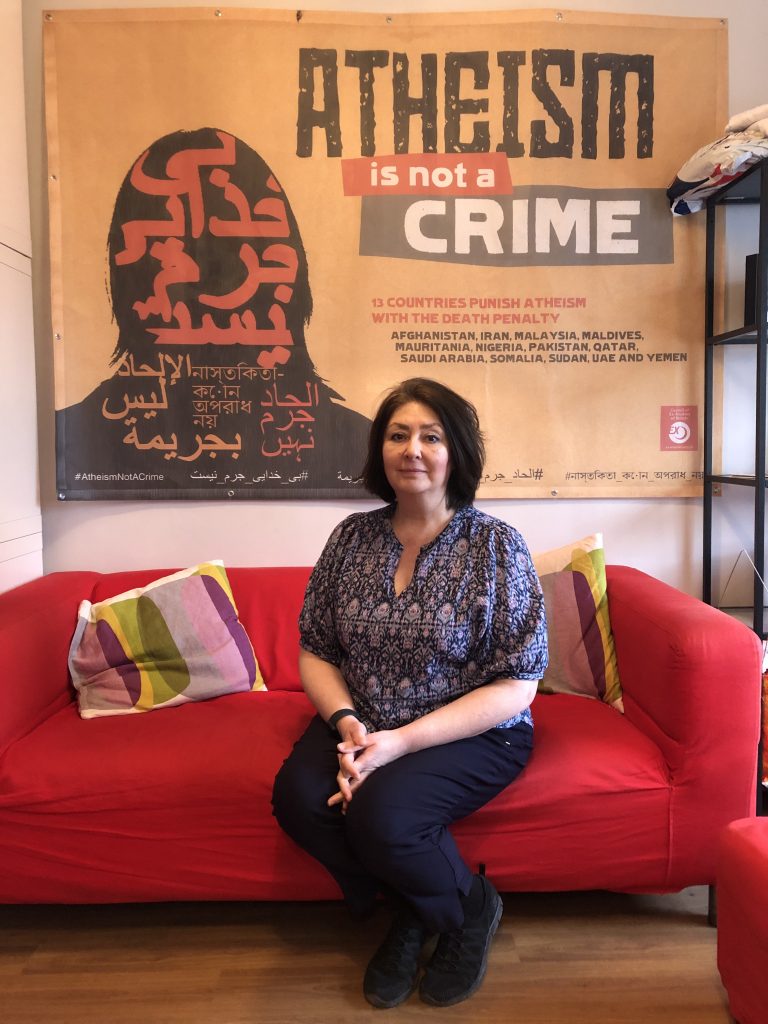
Maryam Namazie In Her Office In King’s Cross.
Photo: Emma Park

EP: Let’s start with the Council of Ex-Muslims of Britain. How large an operation is it?

MN: It started quite small in the sense that very few people were willing to call themselves ex-Muslims or to come out publicly and do that. The idea behind the organisation was that having people come out publicly normalises it and breaks the taboo, and makes it accessible to all. When there’s all this discrimination and pressure and intimidation, coming out publicly is a way of resisting the status quo and trying to change things.

When we started it [in 2007], people were saying that we were being absurd, there are no ex-Muslims around, and we were trying to get attention. It was hard initially. For example, at our first conference at Conway Hall, there were very few ex-Muslims there, and those that were there were hiding on the balcony, up where they couldn’t be photographed or filmed. People were like, “You’re talking about ex-Muslims – where are they?” Now, fifteen years on, things have changed incredibly in favour of this visibility and presence, and there are many ex-Muslims.

So I would say, yes, we are a small, a relatively new movement. We are not as established as other freethought, atheist, humanist, secularist movements in Europe and Britain, partly because a lot of us are refugees, new migrants, and we don’t have access to the same resources. CEMB is largely a volunteer-run organisation. All our funding comes from individual donors primarily, but people have been hit hard by Covid, so it’s really gone down, to the point where we are not sure we’ll be able to carry on next year. But somehow people are helping every time we’re about to close down. Our costs are quite minimal. It’s the rent, the website, publicity, stipend, and volunteer support and assistance. I’m the only paid person, on £10,000 a year.

EP: Where would you put yourself on the political spectrum?

MN: I’m a communist – so basically as far left as it goes. But not a communist that supports the Soviet Union or China or all of these so-called communist groups out there. I’m on the left spectrum of pro-refugees, pro-open borders, pro-freedom of expression. And also anti-racist and against bigotry against Muslims, or placing collective blame on all Muslims because of the religious right amongst them.

EP: In your view, is bigotry against Muslims a form of racism, or is it analogous to racism?

MN: I think it’s a form of racism. Of course there are all different races of Muslims. We all hear, whenever there is any criticism of ‘bigotry against Muslims’, they all say, well, Muslims are not a race, therefore we can’t be bigoted against Muslims, because there are also white Muslims, and so on. That’s the argument you often hear. But the reality is that it is seen as a brown religion, a black religion, a minority religion, and one that’s alien to Western societies.

EP: What are the CEMB’s biggest achievements over the last fifteen years?

I think the greatest achievement has been to highlight the fact that there are non-believers in the so-called Muslim community. I think that’s an important thing to do, because very often, the Left that supports Islam and sees Islamism as a revolutionary or anti-imperialist force, also sees Muslims as homogenous, and therefore, if you criticise Islam, you’re seen to be attacking an entire community of people. And for the far Right, anyone who is a Muslim is bringing in a foreign ideology into the country, and they’re destroying Western civilisation and that sort of thing. So both Left and Right look at the Muslim community or Muslim society, so-called, as homogenous.

EP: So they’re just generalising?  

MN: Yes, but what happens when you generalise about something is that you recognise those in power as its authentic representatives. Given the fact that we are living in a period of the rise of the [Islamist] religious Right, it’s they who are seen to be representatives and authentic Muslims, and therefore women who don’t wear the veil are viewed as westernised, or self-hating, and the veil is viewed as the authentic dress of those who come from a Muslim background. What the Left does is that it maintains the demands of the religious Right on the population. So the Left says you shouldn’t blaspheme, because it hurts sentiments, even if it’s people from Muslim backgrounds doing it.
So I think that achievement is something that’s quite valuable, and over the long run I think we will recognise it as such: the fact that we have shown that Muslim communities and societies are not homogenous. I think this is key in humanising people and in making them see that any given community or society is not reactionary, or progressive, all at the same time. There are differences of politics and opinions. People can see that in Britain, they can’t see it when it comes to the Muslim community.

EP: How far have the radical Left got into bed with the Islamist religious Right?

MN: This is something that I’ve had to deal with a lot: progressive student unions barring me from speaking, and saying I’m inflammatory and inciting hatred against Muslims. I think it comes from a good place, in general, because it’s the attitude that you want to not tolerate racism where you see it. I think that’s a good thing. But conflating criticism of the Islamic Right with an attack on Muslims in general is very problematic.

And not everything comes from a good place. There is also political self-interest for some of these groups: they are anti-imperialist, and they see Islamism as an anti-imperialist force, and therefore they side with it versus US or UK imperialism.

EP: Is Islamism anti-imperialist?

MN: It is an imperialist force in and of itself. It has eradicated cultures and art, music, dress – it’s destroyed so much in all of the countries that it has gained access to and power over. The Left that supports it doesn’t see that it’s a counter-revolutionary force. It has eradicated Left and working-class movements in those societies.

EP: How did the Iranian revolution of 1979 affect you?

MN: I was born in 1966. When the Islamic regime was established in 1980 after the revolution, we left the country. We didn’t all leave together, because we couldn’t. My mum brought me to India to go to school, because they shut the schools down in Iran, and then my dad told her not to come back, so we stayed, and then my dad joined us later. We came to the UK in 1982, but we weren’t allowed to stay here, so we went to the US in 1983. I came back to the UK in 2000. My family is still in the US.

EP: What made you move to the UK?

MN: To be closer to Iran and my political party, which used to be the Worker-Communist Party. I left it a few years ago. Basically, I just got fed up.

EP: Are you affiliated to any political party now?

MN: No.

EP: What was it like growing up in Iran before the revolution?

MN: The Shah’s regime was a dictatorship, and the revolution was against this. There was a period when there was a lot of freedom, before the Islamic regime took complete power, which it did by massacring lots of people. I went to a mixed school, I wasn’t veiled, my family’s quite secular. Religion wasn’t really an issue for me. We didn’t fast during Ramadan. Some people in our family did, some didn’t. My grandmother sometimes wore the veil, sometimes didn’t. The first time I came across in-your-face religion was when the Islamic regime took over.

EP: Did you grow up as a believing Muslim?

MN: I was born a Muslim, the way people are out of no choice of their own, because of where you’re born. My father had a very strict Muslim upbringing. He still doesn’t eat pork, drink or gamble, and my grandfather was a cleric. My last name, Namazie, means ‘prayer’. But my father never required us to pray, to wear the veil, so I never felt that I was less because I was a girl. It’s also my family’s background. My mum is from Nepal. She was Christian, and she converted to Islam to marry my dad. All of my aunts and uncles from Iran, they’ve married Indians, Iranians, different types of people, so we’ve got quite a mixed family. Some prayed, some didn’t. I think it was like that in quite a lot of countries in the Middle East at that time. It was much more relaxed, and now it’s much more forced. Before, you could eat in front of someone who was fasting. Now, out of respect, you’re not supposed to. What happens with the religious Right is that it changes the demarcation line, makes it stricter and more difficult for people to pick and choose as they want.

EP: Would you be able to go back to Iran now?

No. I’ve had threats from the Iranian government, and also – it’s a long story. There is the possibility of being kidnapped. [Compare the alleged plot against the Iranian-born journalist Masih Alinejad.]

EP: In terms of your identity, how do you see yourself?

MN: I always believe that you are from where you live and that home is where you work and struggle. But the older I get, the more I miss Iran. It’s very strange, I can’t explain it – it’s very nostalgic and emotional.

EP: How did you become an ex-Muslim?

MN: I became an atheist many years ago, I don’t remember exactly when. It was gradual, for sure. By university I was an atheist. I never called myself ex-Muslim, I don’t even like the term. It’s just an idea that came up about being able to promote the idea that there is freethought and freethinkers amongst Muslims.

EP: How many people would you estimate are ex-Muslims around the world?

MN: We don’t really know the scale of it, but I do think that every family has an ex-Muslim. I think it’s much stronger where Islam is in power. You don’t see it as much because of the lack of freedom to express yourself. But if people said in the UK what they say in Iran about Islam, it would be considered very Islamophobic. One of the trending hashtags in Iran is #IShitOnIslam. Imagine having that here – it would be considered so inappropriate. That rage… You can see even from the response of government officials. The Egyptian government set up a partnership with the Ministry of Youth and Sports to combat atheism. Saudi Arabia considers atheism a form of terrorism. When Deeyah Khan did her documentary about us [Exposure: Islam’s Non-Believers, 2016], there were texts being sent to Muslims in Britain, warning them not to let their children see the film. Atheism is a real threat to these states.
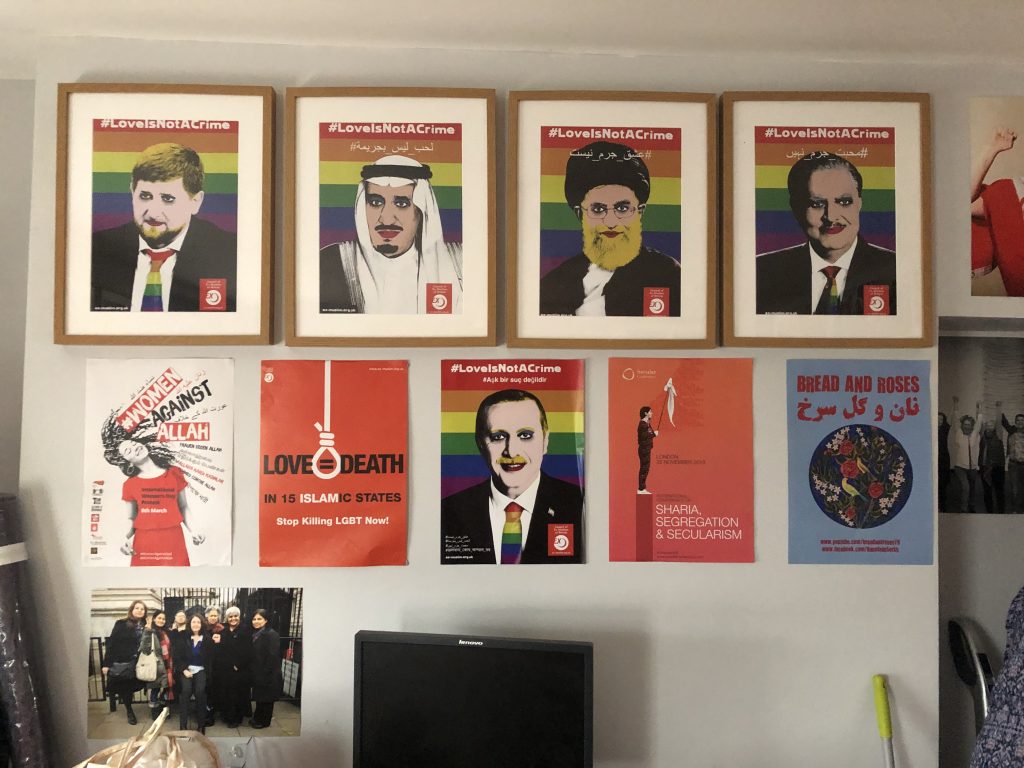
Wall Above Maryam’s Desk In Her Office. Photo: Emma Park

EP: How connected are the different Islamist movements in different countries around the world, including the UK?

MN: They have their rivalries. There are some who are more supportive of Assad and the Islamic regime, or pro-Saudi, or the Muslim Brotherhood in Egypt. There are divisions, in the same way that you have far Right groups in the West that have differences of opinion and divisions. But they are one movement, because despite the differences, they fundamentally want very much the same thing.

EP: What do they want?

MN: They are nostalgic for some golden age of Islam. They want a Caliphate and sharia law, they want the ideal Islamic state as was the case when Mohammed was alive. What that means to them is the idea that doubt and freethought cannot be allowed. Women need to know their place in society. In Britain, they will say, we’re not for the execution of apostates, but they are for it in an ideal Islamic state. There’s a lot of doublespeak and propaganda to dupe people into thinking that they’re the nice version in Britain.

EP: How strong is the Islamist movement in Britain today?

MN: Britain is one of its strongholds. In a country where they’re not in state power, Britain is one of those countries where they are well-established. If we look at Islamists who have got access to positions of power in the UK, and if you look at the whole idea of sharia law, how we have so many sharia courts in this country, and despite various Parliamentary groups looking into this issue, there has never been a decision made on it. The government is always justifying it as people’s choice of religion, whereas it’s something very different and very sinister – it’s part of the political wing of the Islamist movement.

EP: Roughly how many sharia courts are there in the UK at present?

MN: There’s no set number, because they’re not registered. Not that I think they should be registered – it would be like registering FGM clinics. In some reports there have been up to a hundred. A lot of them are ad hoc, in mosques. It’s not like a registered court, where you would know the exact number. Sharia courts were only established in this country in the mid-80s. It goes back to our argument that it’s part of the religious Right movement. There were Muslims before in this country, none of them needed to go to sharia courts, they did not have to go.

EP: Not being a Muslim in terms of your religious beliefs, how do you see your Iranian side?

MN: For me, it’s the protest and the resistance. That makes me proudest to be Iranian. I think it’s a continuation of the original Iranian revolution, that was never allowed to achieve its goals. Look at the French revolution. It happened so long ago, but we still feel the effects of it today, when we talk about laïcité, or secularism in the proper sense, not in the wishy-washy British sense. So I think the revolution and its politicisation of society in Iran, to the extent that a majority of people were born under an Islamic regime, and are fighting it tooth and nail. I see that as a really proud history, and one that I am a part of.

EP: Do you have any favourite Iranian authors?

MN: I’m going to sound like a party hack, I’m not in the Worker Communist Party any more, but – the leader of that, Mansoor Hekmat, I became a communist because of him. I find his writing so human, and seeing the world in such a fundamental way. But there are also many great poets in Iran. There’s Ahmad Shamlou, who was very critical of the state, or a woman poet, Forough Farrokhzad, who was such a taboo-breaker.

EP: Is there a long history in Iran of criticising the state?

MN: Yes, definitely. And also a history of freethought. There is Sadegh Hedayat, he’s a well-known writer who is an atheist, very critical of religion. Also there’s a very funny character, it’s called Molla Nasreddin, which is famous in Iran, but also in Azerbaijan and other countries, and it’s a bumbling clergyman – all the cartoons are making fun of religion and religious rule. For example, he’s following a group of donkeys and they’re going to Mecca, that sort of anti-clericalism, like in Charlie Hebdo.

EP: Talking of Charlie Hebdo and laïcité, you mentioned that British secularism seems ‘wishy-washy’ by comparison to the French version. Would you be in favour of a more French approach over here?

MN: I think that’s the only approach. Not to say that I am completely supportive of the French government, I don’t think it is completely promoting laïcité, I think there’s a lot of politics as well involved. But the idea of the state being incompetent, where it has no position on religion, it’s separate completely, is hugely important. It’s not enough to be neutral.

EP: The idea that the state should not have any influence on politics?

MN: Any influence, but also on the educational system, in public policy. Faith schools, for example, are not good for children.

EP: Why should religion not have any influence on education or public policy?

MN: Faith and education seem to be antithetical to each other. Education should promote freethought, doubt, questioning. Faith is the opposite of that. Is it the role of an educational system, to teach people to be submissive, or to learn about dogma? I think not. Also religion shouldn’t have a place, for example, in a court of law or when making public policy. Why should there be faith-based health services? We all bleed the same. It’s just a way of helping to bring the religious right more into the public space, whereas it shouldn’t really have any space. That’s different from being neutral. A state should be playing an active role in combating religion. Yes, you have the right to your religion, but that’s very different from having a right to a religious school, or a right to faith-based services. Those are separate things.

EP: So, in your view, religious freedom should have certain limits?

MN: Yes, because religion is a private matter. That’s where there’s a problem, that for some reason, it’s as if religious freedom means you can shove your religion down everybody’s throat. You may have the freedom to believe in what you want, but when it comes to the public space, it’s not about a personal right any more, it’s about a right that imposes on society. If we recognise it as a private belief, it becomes a lot easier to manage it.

EP: Talking about Charlie Hebdo: how important are laughter and satire in promoting free speech?

MN: Charlie Hebdo is really important not just for French society but for all of us. I spoke at the third anniversary of the attacks on Charlie Hebdo. I was the only English speaker there, because you know how it’s been over here in supporting them: if there have been any media reports on the attacks, they don’t show the cartoons, they don’t show any of the images – that’s the whole point, isn’t it? They [Charlie Hebdo] have been left alone to a large extent, because it is that same idea that criticising Islam is detrimental to Muslims. The argument I made was that what Charlie Hebdo does is important for freethinkers from Muslim backgrounds, because it’s opening the space up for us as well. It means a lot to Islam’s non-believers, as well as its benefits for free speech in European countries.

EP: What is the best way in Britain of countering Islamist fundamentalism, while at the same time not promoting anti-Muslim bigotry?

MN: Islamism is part of UK foreign and domestic policy. How can you have relations with the Saudi government, or with the Pakistani or Iranian government, and then address Islamism in your own country? It’s impossible, because in order to justify your relationship with those countries, you’ve justified Islamism, so it makes it easier for it to grow roots here as well.

At the same time, the idea that we foreigners are never British citizens… The jihadi bride, Shamima Begum – the fact that her citizenship can be taken away says a lot about how this government views the ‘other’ and minorities. Even if you are born here, because your parents happen to be from Bangladesh you’re never part of this country. This idea is that you belong to the Muslim umma [the worldwide Muslim community] – the Muslim community, a Muslim country, you’re never really British. It gives people the feeling that they don’t belong, and also, the government itself is saying ‘You don’t belong’ with this policy.

EP: Since being in the UK, have you experienced racism yourself?

MN: Yes. The first time I experienced it was when we left India in 1982. We went to Bournemouth, because my dad knew someone there. We were walking down the street, and some lady was saying something, and my mum was waving to her, she thought she was just saying hello, and she was like, “You fucking foreigners, get out of this country!” So that was the first time. Since 2000, it’s, you know, the looks you get if you’re talking in another language – on the train, for example. It’s constantly being told, if you disagree with anything the UK government says, “Why don’t you just go home?” You never belong.

Since I’ve got a son now, my idea was always, “You’re British, you were born here, you’re not Iranian.” This was always my propaganda to him. Then he’s grown up, and he’s faced so much racism at school [in London]. I feel very sorry for him, because it affects him quite a lot. I guess you then feel like, who are you? You don’t belong anywhere. I can see why people feel so disillusioned, that they’re not part of British society.

EP:  Have you had women in stricter Muslim communities telling you of some of the problems they have had, or what it’s like being in that very repressive sort of environment in the UK?

MN: In the work I do with One Law for All, we have been talking to lots of women, gathering testimonies. We did quite a bit of that for the Parliamentary Committee that was going to be looking into sharia courts, that never did. [See Parliamentary discussion in May 2019.] It was before lockdown. We gathered testimonies, and I provided evidence to the Committee, and we did written submissions. In those situations, there are women who talk about the awful things that have happened to them in the sharia courts. People say, “The sharia courts are not stoning anyone to death, they’re not amputating them, they’re just dealing with marriage and divorce and child custody.” But those are pillars of women’s oppression in the family. So it trivialises what happens to women.

EP: Is it difficult for these women to integrate with other British people, non-Muslims, or into wider society?

MN: It is difficult, partly because some of the problems include the fact that men may have only married women in a nikah (an Islamic marriage), and so when there’s violence or divorce, the women don’t have any rights, because it was never a proper marriage – they were led to believe that it was. Plus if you’re looking at relationships where there’s coercion and violence, women are also kept very isolated. They may not even be able to speak the language, or have many friends outside, who the husband has given them permission to have relationships with. We’re talking about some of the most vulnerable people in society. They’re not protected and they’ve been left at the mercy of these sort of kangaroo courts.

EP: What’s the attitude of the Left?

MN: I think they think it’s people’s right to religion. But again, the counter-argument is, religion is a private matter.

We’ve talked of the way that racism and criticism of religion may be associated in some people’s minds. Is one of the problems with the approach of the Left that they’re so worried about racism that they are not able to tackle these issues of abuse within Muslim communities?

MN: It’s not all the Left. Practically everyone I work with is on the Left. A lot of ex-Muslim groups are also Left-leaning, though there are other groups too – and a lot of the women’s groups I work with are Left-leaning. A lot of the protest movements that we’re seeing in Iran or Afghanistan, they are Left-leaning as well. There is a very vibrant Left that is opposed to both fundamentalism and racism.
But there is that section of the Left that hides behind the idea of racism and bigotry, as a way of saying, we’re so concerned about racism, we’re going to support sharia courts and so on. But they’re not very concerned with the racism that ex-Muslims face, for example. If freethinkers are killed, suddenly they’re not so vocal about human rights. They see Islamism as a revolutionary and anti-imperialist force. It’s an uncomfortable ally, but one that they want.

EP: Where does the CEMB fit in with other freethought movements in the UK?

MN: With the National Secular Society we have very good relations. They are also seen to be a bit more upfront with this criticism of religion. Most of our relationships in the UK are with minority and women’s groups, such as Southall Black Sisters, or Centre for Secular Space, or Iranian and Kurdish women’s rights organisations. I can’t think of any freethought groups we work with. I think we are seen to be a bit much, in the sense of going too far. But I think you need to go too far, especially with what they’re doing [in Islamism] – for goodness’ sake, they’re decapitating people.

EP: Topless protests: why?

MN: Topless protest is the most difficult thing I have ever done. The first time I did it, I didn’t get my period for six months, that’s how stressed I felt. I still feel really embarrassed when my parents come and see pictures of it. The reason I did it is because Aliaa Magda Elmahdy in Egypt did it in 2012. She was under a lot of attacks and pressure, and I said, “Let’s do something in support of her, let’s do a topless calendar.” And of course, suggesting it, I had to do it myself. The idea is that a woman’s body is considered to be the source of chaos and fitna [‘Islam. Unrest or rebellion, esp. against a rightful ruler,’ S.O.E.D.], that’s why we have to be veiled. Therefore owning your body and using it as a tool for protest and liberation is really a great way of challenging this view that a woman’s body is obscene and shouldn’t be seen and heard.

EP: Final question: what limits should be set to free speech in the law?

MN: I don’t think there should be any limits. Hate speech is really subjective. A lot of what I say is considered hate speech. Even saying that the Holocaust didn’t happen, let people say that ridiculous, absurd thing, and let others be able to challenge it. The best way to combat bad speech is with good speech. You have to have the freedom to be able to listen to various views and to be able to challenge them. We’re living in an age where speech is considered akin to causing physical harm. We need to push for a period where you could say anything, you could have very challenging conversations with one another, and manage to still be friends, families, and move on with your life without getting your head chopped off.

Of course there’s a difference between hate speech and inciting violence. That’s where we should be drawing the line. But otherwise, I think we should let people talk. And it would be good for people to learn to listen as well. You don’t have to agree with everything you hear – that’s fine. This whole thing of safe spaces, of things being so harmful that you can’t say it anywhere, is problematic for society. It feeds into this idea that that’s why they have to cut your head off, because you’ve upset them so much. I’m upset by a lot of things I hear, but nobody would say I have a right to go and attack someone physically.

⏩Maryam Namazie is an Iranian-born activist and Spokesperson of the Council of Ex-Muslims of Britain and One Law for All.

‘The Best Way To Combat Bad Speech Is With Good Speech’