Showing posts with label Ten Commandments. Show all posts
Friendly Atheist  The Conway School District's reckless gamble with Christian Nationalism backfired as a federal judge expanded his injunction

An Arkansas school district that defied a court order and put Ten Commandments posters up in classrooms has now been ordered by a federal judge to take them down.

I’ve been writing about these attempts to shove Christianity into classrooms for a while now, but here’s the short version of what happened in Arkansas: Their law required every public school classroom to display a copy of the Ten Commandments. Those posters didn’t even need a disclaimer explaining the supposed historical relevance of the Decalogue.

Similar laws have already been struck down by the courts and this was was even more egregious than those, which is why a coalition of church/state separation groups filed a lawsuit against it.

When U.S. District Court Judge Timothy L. Brooks (an Obama appointee) finally weighed in earlier this month, he issued a preliminary injunction, putting the law on hold, at least in the districts attended by the students involved in this case. Everyone was still waiting for him to issue a final ruling that might apply statewide.

Continue @ Friendly Atheist.

Judge Orders Arkansas School District To Remove Illegal Ten Commandments Posters

Michael Nugent with the thirty second in a series of pieces on whether gods exist.


Picture adapted from Rembrant’s Moses
Smashing the Tablets of the Law

Despite their centrality to Christianity, the Ten Commandments are not even the same set of laws that the Bible describes as the Ten Commandments.

In the Book of Exodus, the god wrote the ten commandments on two tablets of stone and gave them to Moses, who broke them (Ex 32:15-19).


32:15 And Moses turned and went down from the mountain, and the two tablets of the Testimony were in his hand. The tablets were written on both sides; on the one side and on the other they were written. 16 Now the tablets were the work of God, and the writing was the writing of God engraved on the tablets. 17 And when Joshua heard the noise of the people as they shouted, he said to Moses, “There is a noise of war in the camp.” 18 But he said: “It is not the noise of the shout of victory, Nor the noise of the cry of defeat, But the sound of singing I hear.” 19 So it was, as soon as he came near the camp, that he saw the calf and the dancing. So Moses’ anger became hot, and he cast the tablets out of his hands and broke them at the foot of the mountain.

The god then recalled Moses to give him the same rules again (Ex 34:1-4).


34:1 And the Lord said to Moses, “Cut two tablets of stone like the first ones, and I will write on these tablets the words that were on the first tablets which you broke. 2 So be ready in the morning, and come up in the morning to Mount Sinai, and present yourself to Me there on the top of the mountain. 3 And no man shall come up with you, and let no man be seen throughout all the mountain; let neither flocks nor herds feed before that mountain.” 4 So he cut two tablets of stone like the first ones. Then Moses rose early in the morning and went up Mount Sinai, as the Lord had commanded him; and he took in his hand the two tablets of stone.


And these are the rules that God told Moses: (Ex 34:11-26).

  • Do not make treaties with other tribes (34:11-13)
  • Do not worship other gods or make moulded gods (34:14, 17)
  • Do not intermarry with other tribes (34:15-16)
  • Keep the feast of unleavened bread (34:18)
  • Give the god the firstborn of your livestock apart from donkeys (34:19-20)
  • Rest on the seventh day (34:21)
  • Observe three named festivals during the year (34:22-24)
  • Do not offer the blood of sacrifice with leaven (34:25)
  • Bring the best of first fruits of your ground to the church (34:26)
  • Do not boil a kid in its mother’s milk (34:26)

God then told Moses to write down these words, and Moses wrote on two new stone tablets “the words of the covenant, the ten commandments” (Ex 34:27-28).

34:27 Then the Lord said to Moses, “Write these words, for according to the tenor of these words I have made a covenant with you and with Israel.” 28 So he was there with the Lord forty days and forty nights; he neither ate bread nor drank water. And he wrote on the tablets the words of the covenant, the Ten Commandments.

The Bible is inconsistent about what sets of rules are what. Today’s Ten Commandments actually appear elsewhere in the Book of Exodus (20:1-17). The Bible does not call them the ten commandments, and they are not written on tablets of stone. Instead, in a different incident, God speaks them directly from Mount Sinai. It seems likely that later leaders chose to downplay the ritual laws, and to instead brand the other set of laws as being “the Ten Commandments.”

In a later story, when Moses is recalling these events, he misremembers the exact words of these laws and mistakenly says that the god wrote them onto stone tablets (Deut 5:6-22). This later story contradicts the Book of Exodus, unless the tablets had twenty laws on them. It seems more likely that the writer of Deuteronomy made mistakes or alterations when transcribing, perhaps centuries later, the Exodus story.

Whether or not the Bible stories are true, neither set of ten commandments is a guide for ethical conduct. Neither is based on universal values of right and wrong, because the rules were never intended to apply to all people. They were designed to protect the stability and interests of one Bronze Age tribe, specifically because this tribe was set apart from all other people.

They did this mainly by regulating how the tribe worshipped its god, by protecting the position of the tribe’s adult males, and by treating members of the tribe differently than strangers. They demanded unthinking obedience, based on desire for amazing rewards and fear of horrific punishments meted out by this god, and enforced by threats of being stoned to death by other members of the tribe.

This is no basis upon which to build an ethical moral code.

Michael Nugent is Chair of Atheist Ireland

Do Gods Exist? ➤ 32 The Other Ten Commandments

Michael Nugent with the thirty first in a series of pieces on whether gods exist.

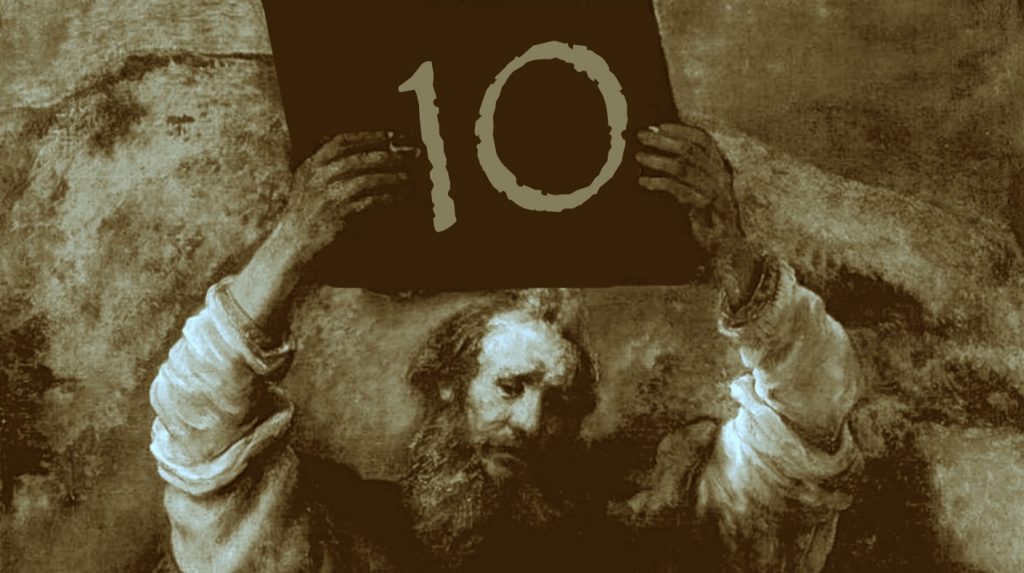
Picture adapted from Rembrant’s Moses
Smashing the Tablets of the Law

The tenth commandment of the Christian god is that you should not desire things or people owned by your fellow tribesmen.

According to the Bible, the tenth commandment is


Thou shalt not covet your neighbour’s house; you shall not covet your neighbour’s wife, nor his male servant, nor his female servant, nor his ox, nor his donkey, nor anything that is your neighbour’s. (Ex 20:17, Deut 5:21)

In the Deuteronomy version, the order of house and wife is reversed, and the neighbour’s field is also included.

The first thing to note about this law is that it is absurd. It seeks to regulate what you think, not what you say or do, and no law can enforce what you think. Furthermore, if people did not covet things owned by other people, nobody would ever purchase anything from anybody else.

The second thing to note is a man’s property includes his wife and his servants. I give other examples of this in my analysis of the earlier commandments.

The Roman Catholic and Lutheran churches typically divide this commandment into two, to make up for the fact that they omit the second commandment that forbids making graven images.

This allows them to separate a man’s wife from the rest of his property. But there is only one sentence in the tenth commandment, and there is no justifiable reason to divide it in two.

So that is commandment number ten. I will examine the other ten commandments in my next post.

What? The other ten commandments? Yes, the different ones that the god gave to Moses after he broke the first set. The ones that the Bible actually calls the Ten Commandments.

Michael Nugent is Chair of Atheist Ireland

Do Gods Exist? ➤ 31 Do Not Covet

Michael Nugent with the thirtieth in a series of pieces on whether gods exist. 

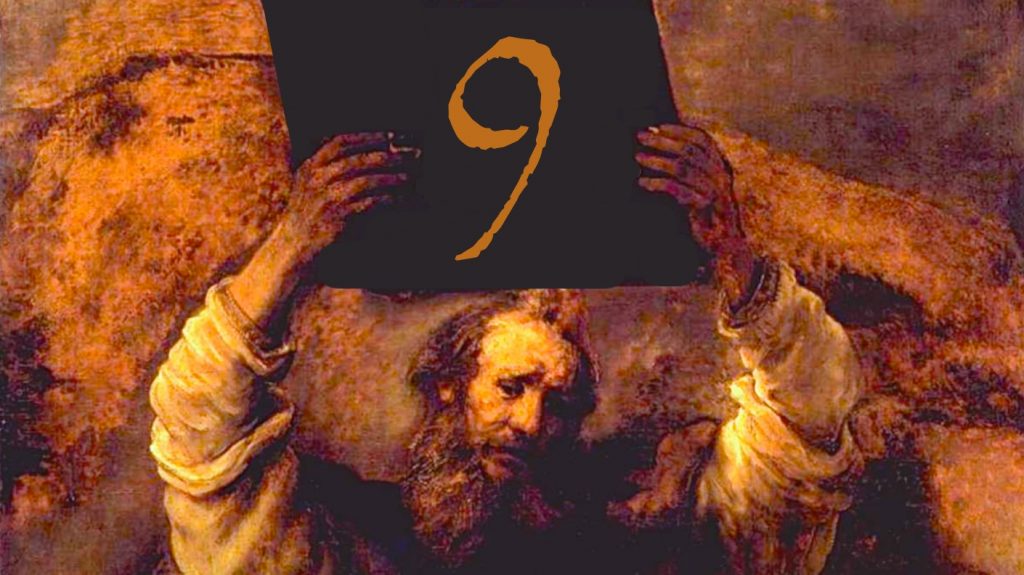
Picture adapted from Rembrant’s Moses Smashing the Tablets of the Law

According to the Bible, the ninth commandment is: "Thou shalt not bear false witness against thy neighbour.” (Ex 20:16, Deut 5:20)

You must not defraud your neighbour, or pervert justice by not judging your neighbour fairly, or spread slander among your people (Lev 19:13-16). The punishment was a fine (Deut 22:18-19) or giving a ram to a priest, who will eat it to make atonement for your sin (Lev 6:1-7).

19:13 You shall not cheat your neighbour, nor rob him…16 You shall not go about as a talebearer among your people.

22:18 Then the elders of that city shall take that man and punish him; 19 and they shall fine him one hundred shekels of silver and give them to the father of the young woman, because he has brought a bad name on a virgin of Israel.

6: And the Lord spoke to Moses, saying: 2 If a person sins and commits a trespass against the Lord by lying to his neighbour … 3 or if he has found what was lost and lies concerning it, and swears falsely… 5 he shall restore its full value, add one-fifth more to it… 6 And he shall bring his trespass offering to the Lord, a ram without blemish from the flock, with your valuation, as a trespass offering, to the priest. 7 So the priest shall make atonement for him before the Lord.

But the ban on lying applied only to “your neighbour” or “your people” (Lev 19:18) or “your brother” (Deut 19:18). The god consistently instructed his tribe to dispense different standards of justice to strangers and foreigners.

For example, Israelites could own foreign slaves for ever, but had to release Israelite slaves after six years (Lev 25:44-46, Ex 21:2). Israelites could charge interest on loans to strangers, but not to their brothers (Deut 23:20). Their neighbour or brother could sometimes keep property they had lent to them, but a foreigner still owed it (Deut 15:1-3). More seriously, strangers would be killed if they approached the tabernacle (Num 18:7).

In accordance with this policy, the god allowed, rewarded and even instructed lying to foreigners and strangers. All three Biblical Patriarchs told lies.

The prophet Abraham repeatedly lied that his wife Sarah was only his sister, in order to give her to the Pharaoh and save his own life (Gen 12:11-13). Actually his wife was also his half-sister, but he was still deliberately deceiving the Pharoe.

12:11 And it came to pass, when he was close to entering Egypt, that he said to Sarai his wife, “Indeed I know that you are a woman of beautiful countenance. Therefore it will happen, when the Egyptians see you, that they will say, ‘This is his wife’; and they will kill me, but they will let you live. 13 Please say you are my sister, that it may be well with me for your sake, and that I may live because of you.

In a remarkable coincidence, Abraham’s son Isaac also lied that his wife Rebekah was his sister for similar reasons (Gen 26:6-7). In this case, Rebekah wasn’t even Isaac’s half-sister. She was his cousin. What a family!

26:6 So Isaac dwelt in Gerar. 7 And the men of the place asked about his wife. And he said, “She is my sister”; for he was afraid to say, “She is my wife,” because he thought, “lest the men of the place kill me for Rebekah, because she is beautiful to behold.

When it came to the third Biblical Patriarch, the god was even flexible with the “only lie to strangers” rule. He blessed Isaac’s son Jacob when he lied to his father to steal his brother’s birthright (Gen 27:19-20).

27:19 Jacob said to his father, “I am Esau your firstborn; I have done just as you told me; please arise, sit and eat of my game, that your soul may bless me.” 20 But Isaac said to his son, “How is it that you have found it so quickly, my son?” And he said, “Because the Lord your God brought it to me.”

The god told Moses to lie to the Pharaoh that his tribe only wanted to leave Egypt for three days (Ex 3:18) and saved the life of Rahab for lying about Israelite spies (Josh 2:4-6, Heb 11:30-31) and caused four hundred prophets to lie to the King of Israel (1 Kings 22:22-23). Jehu lied to the prophets of Baal to lure them into being killed (2 Kings 10:18-20).

3:18 Then they will heed your voice; and you shall come, you and the elders of Israel, to the king of Egypt; and you shall say to him, ‘The Lord God of the Hebrews has met with us; and now, please, let us go three days’ journey into the wilderness, that we may sacrifice to the Lord our God.

2:4 Then the woman took the two men and hid them. So she said, “Yes, the men came to me, but I did not know where they were from. 5 And it happened as the gate was being shut, when it was dark, that the men went out. Where the men went I do not know; pursue them quickly, for you may overtake them.” 6 But she had brought them up to the roof and hidden them with the stalks of flax, which she had laid in order on the roof.

11:30 By faith the walls of Jericho fell down after they were encircled for seven days. 31 By faith the harlot Rahab did not perish with those who did not believe, when she had received the spies with peace.

22:22 The Lord said to him, ‘In what way?’ So he said, ‘I will go out and be a lying spirit in the mouth of all his prophets.’ And the Lord said, ‘You shall persuade him, and also prevail. Go out and do so.’ 23 Therefore look! The Lord has put a lying spirit in the mouth of all these prophets of yours, and the Lord has declared disaster against you.

10:18 Then Jehu gathered all the people together, and said to them, “Ahab served Baal a little, Jehu will serve him much. 19 Now therefore, call to me all the prophets of Baal, all his servants, and all his priests. Let no one be missing, for I have a great sacrifice for Baal. Whoever is missing shall not live.” But Jehu acted deceptively, with the intent of destroying the worshipers of Baal.

Again, this law is not about universal values of right and wrong. It is about protecting the stability and interests of one tribe at the expense of others.

So that is commandment number nine. I will examine the tenth commandment in my next post.

Michael Nugent is Chair of Atheist Ireland

Do Gods Exist? ➤ 30 Do Not Lie

Michael Nugent with the twenty-ninth in a series of pieces on whether gods exist.

Picture adapted from Rembrant’s Moses
Smashing the Tablets of the Law

The eighth commandment of the Christian god is that you should not steal things or people owned by your fellow tribesmen.

According to the Bible, the eighth commandment is “Thou shalt not steal.” (Ex 20:15, Deut 5:19)

You cannot cheat or steal from your neighbour (Lev 19:13). If you steal a person and sell him, you will be put to death (Ex 21:16, Deut 24:7). If you catch a thief, you can either kill him, make him pay restitution, or sell him as a slave (Ex 22:2-3).

19:13 ‘You shall not cheat your neighbour, nor rob him.

21:16 He who kidnaps a man and sells him, or if he is found in his hand, shall surely be put to death.

22:2 If the thief is found breaking in, and he is struck so that he dies, there shall be no guilt for his bloodshed. 3 If the sun has risen on him, there shall be guilt for his bloodshed. He should make full restitution; if he has nothing, then he shall be sold for his theft.

The first thing to note here is that you can buy or sell or steal a person. Israelites could buy foreign slaves, and own them for ever, and pass them on to their children as inheritances (Lev 25:44-46). They could forcibly take foreign women and children after battles (Deut 20:14, Deut 21:10-14).

25:44 And as for your male and female slaves whom you may have—from the nations that are around you, from them you may buy male and female slaves. 45 Moreover you may buy the children of the strangers who dwell among you, and their families who are with you, which they beget in your land; and they shall become your property. 46 And you may take them as an inheritance for your children after you, to inherit them as a possession; they shall be your permanent slaves. But regarding your brethren, the children of Israel, you shall not rule over one another with rigour.

20:14 But the women, the little ones, the livestock, and all that is in the city, all its spoil, you shall plunder for yourself; and you shall eat the enemies’ plunder which the Lord your God gives you.

21:10 “When you go out to war against your enemies, and the Lord your God delivers them into your hand, and you take them captive, 11 and you see among the captives a beautiful woman, and desire her and would take her for your wife, 12 then you shall bring her home to your house, and she shall shave her head and trim her nails. 13 She shall put off the clothes of her captivity, remain in your house, and mourn her father and her mother a full month; after that you may go in to her and be her husband, and she shall be your wife. 14 And it shall be, if you have no delight in her, then you shall set her free, but you certainly shall not sell her for money; you shall not treat her brutally, because you have humbled her.

Israelites could also buy and sell Israelite slaves, and could own the wives and their children of these slaves, but they had to release Israelite slaves after six years (Ex 21:2-6). Men could sell their daughters as slaves (Ex 21:7). A man could have sex with a female slave without being stoned to death, even if she was engaged, because she was not free (Lev 19:20).

21:2 If you buy a Hebrew servant, he shall serve six years; and in the seventh he shall go out free and pay nothing. 3 If he comes in by himself, he shall go out by himself; if he comes in married, then his wife shall go out with him. 4 If his master has given him a wife, and she has borne him sons or daughters, the wife and her children shall be her master’s, and he shall go out by himself.

21:7 And if a man sells his daughter to be a female slave, she shall not go out as the male slaves do.

19:20 Whoever lies carnally with a woman who is betrothed to a man as a concubine, and who has not at all been redeemed nor given her freedom, for this there shall be scourging; but they shall not be put to death, because she was not free.

The second thing to note is that this law only applied internally within the Israelite tribe. Their god encouraged them to steal the treasures, animals, women and children of enemy tribes (Deut 20:14-15). After one battle against the Midianites, they plundered about 200kg of gold, 800,000 livestock and 32,000 virgin women. As an aside, Moses and Eleazer the priest took about one per cent of all of these spoils, as an offering to God (Num 31:25-54).

20:14 But the women, the little ones, the livestock, and all that is in the city, all its spoil, you shall plunder for yourself; and you shall eat the enemies’ plunder which the Lord your God gives you. 15 Thus you shall do to all the cities which are very far from you, which are not of the cities of these nations.

31:25 Now the Lord spoke to Moses, saying: 26 “Count up the plunder that was [b]taken—of man and beast—you and Eleazar the priest and the chief fathers of the congregation; 27 and divide the plunder into two parts, between those who took part in the war, who went out to battle, and all the congregation. 28 And levy a tribute for the Lord on the men of war who went out to battle: one of every five hundred of the persons, the cattle, the donkeys, and the sheep; 29 take it from their half, and give it to Eleazar the priest as a heave offering to the Lord. 30 And from the children of Israel’s half you shall take one of every fifty, drawn from the persons, the cattle, the donkeys, and the sheep, from all the livestock, and give them to the Levites who keep charge of the tabernacle of the Lord…

The Israelites also stole the land of other tribes. Their God told them to drive out all of the inhabitants, take possession of the land and settle in it, and divide it up according to their clans (Num 33:50-54, Deut 2:31-34, Deut 20:16-17). Indeed, stealing the land of other tribes was the whole point of the covenant between the Israelites and their God.

33:50 Now the Lord spoke to Moses in the plains of Moab by the Jordan, across from Jericho, saying, 51 “Speak to the children of Israel, and say to them: ‘When you have crossed the Jordan into the land of Canaan, 52 then you shall drive out all the inhabitants of the land from before you, destroy all their engraved stones, destroy all their moulded images, and demolish all their high places; 53 you shall dispossess the inhabitants of the land and dwell in it, for I have given you the land to possess. 54 And you shall divide the land by lot as an inheritance among your families; to the larger you shall give a larger inheritance, and to the smaller you shall give a smaller inheritance; there everyone’s inheritance shall be whatever falls to him by lot. You shall inherit according to the tribes of your fathers.

2:31 “And the Lord said to me, ‘See, I have begun to give Sihon and his land over to you. Begin to possess it, that you may inherit his land.’ 32 Then Sihon and all his people came out against us to fight at Jahaz. 33 And the Lord our God delivered him [k]over to us; so we defeated him, his sons, and all his people. 34 We took all his cities at that time, and we utterly destroyed the men, women, and little ones of every city; we left none remaining.

20:16 “But of the cities of these peoples which the Lord your God gives you as an inheritance, you shall let nothing that breathes remain alive, 17 but you shall utterly destroy them: the Hittite and the Amorite and the Canaanite and the Perizzite and the Hivite and the Jebusite, just as the Lord your God has commanded you.

This law is not about universal values of right and wrong. It is about protecting the stability and interests of one tribe at the expense of members of other tribes.

So that is commandment number eight. I will examine the ninth commandment in my next post.

Michael Nugent is Chair of Atheist Ireland

Do Gods Exist? ➤ 29 Thou Shalt Not Steal

Michael Nugent with the twenty-eighth in a series of pieces on whether gods exist.

Picture adapted from Rembrant’s Moses Smashing the Tablets of the Law

The seventh commandment of the Christian god is that you should not commit adultery, because men own their wives.

According to the Bible, the seventh commandment is

“Thou shalt not commit adultery.” (Ex 20:14, Deut 5:18)

But why is adultery wrong? Based on the Bible, adultery is a crime committed against the husband of the woman involved, but not against the wife of the man involved. A man owns his wife from the time they become engaged. Predictably, the punishment is death (Lev 20:10).

20:10 The man who commits adultery with another man’s wife, he who commits adultery with his neighbour’s wife, the adulterer and the adulteress, shall surely be put to death.

If another man has sex with an engaged virgin, he has committed a crime against her future husband, and must be stoned to death. If the woman did not scream for help, she must also be stoned to death (Deut 22:23-27).

22:23 If a young woman who is a virgin is betrothed to a husband, and a man finds her in the city and lies with her, 24 then you shall bring them both out to the gate of that city, and you shall stone them to death with stones, the young woman because she did not cry out in the city, and the man because he humbled his neighbour’s wife; so you shall put away the evil from among you.

25 But if a man finds a betrothed young woman in the countryside, and the man forces her and lies with her, then only the man who lay with her shall die. 26 But you shall do nothing to the young woman; there is in the young woman no sin deserving of death, for just as when a man rises against his neighbour and kills him, even so is this matter. 27 For he found her in the countryside, and the betrothed young woman cried out, but there was no one to save her.

If a newlywed man alleges that his bride was not a virgin, the bride’s father must prove her virginity. If the bride’s father can bring her blood-stained bedsheets to the elders of the city, her husband will pay him a fine for slander. If her father cannot produce the blood-stained bedsheets, the bride will be stoned to death on her father’s doorstep (Deut 22:13-21).

22:13 If any man takes a wife, and goes in to her, and detests her, 14 and charges her with shameful conduct, and brings a bad name on her, and says, ‘I took this woman, and when I came to her I found she was not a virgin,’ 15 then the father and mother of the young woman shall take and bring out the evidence of the young woman’s virginity to the elders of the city at the gate. 16 And the young woman’s father shall say to the elders, ‘I gave my daughter to this man as wife, and he detests her.

17 Now he has charged her with shameful conduct, saying, “I found your daughter was not a virgin,” and yet these are the evidences of my daughter’s virginity.’ And they shall spread the cloth before the elders of the city. 18 Then the elders of that city shall take that man and punish him; 19 and they shall fine him one hundred shekels of silver and give them to the father of the young woman, because he has brought a bad name on a virgin of Israel. And she shall be his wife; he cannot divorce her all his days.

20 But if the thing is true, and evidences of virginity are not found for the young woman, 21 then they shall bring out the young woman to the door of her father’s house, and the men of her city shall stone her to death with stones, because she has done a disgraceful thing in Israel, to play the harlot in her father’s house. So you shall put away the evil from among you.

If a man suspects his wife of adultery, he must bring her to a priest, who will make her drink bitter water that will curse her. If she has been unfaithful, this will cause her to have a miscarriage. If she has been faithful, she will be able to give birth. (Num 5:11-31).

5:11 And the Lord spoke to Moses, saying, 12 “Speak to the children of Israel, and say to them: ‘If any man’s wife goes astray and behaves unfaithfully toward him, 13 and a man lies with her carnally, and it is hidden from the eyes of her husband, and it is concealed that she has defiled herself … 14 … or if he becomes jealous of his wife, although she has not defiled herself, 15 then the man shall bring his wife to the priest.

17 The priest shall take holy water in an earthen vessel, and take some of the dust that is on the floor of the tabernacle and put it into the water. 18 Then the priest shall stand the woman before the Lord, uncover the woman’s head, and put the offering for remembering in her hands, which is the grain offering of jealousy. And the priest shall have in his hand the bitter water that brings a curse. 19 And the priest shall put her under oath, and say to the woman, “If no man has lain with you, and if you have not gone astray to uncleanness while under your husband’s authority, be free from this bitter water that brings a curse.

20 But if you have gone astray while under your husband’s authority, and if you have defiled yourself and some man other than your husband has lain with you” 21 then the priest shall put the woman under the oath of the curse, and he shall say to the woman “the Lord make you a curse and an oath among your people, when the Lord makes your thigh rot and your belly swell; 22 and may this water that causes the curse go into your stomach, and make your belly swell and your thigh rot.” ‘Then the woman shall say, “Amen, so be it.”
23 ‘Then the priest shall write these curses in a book, and he shall scrape them off into the bitter water. 24 And he shall make the woman drink the bitter water that brings a curse, and the water that brings the curse shall enter her to become bitter … 27 When he has made her drink the water, then it shall be, if she has defiled herself and behaved unfaithfully toward her husband, that the water that brings a curse will enter her and become bitter, and her belly will swell, her thigh will rot, and the woman will become a curse among her people. 28 But if the woman has not defiled herself, and is clean, then she shall be free and may conceive children. 
29 This is the law of jealousy, when a wife, while under her husband’s authority, goes astray and defiles herself, 30 or when the spirit of jealousy comes upon a man, and he becomes jealous of his wife; then he shall stand the woman before the Lord, and the priest shall execute all this law upon her. 31 Then the man shall be free from iniquity, but that woman shall bear her guilt.”

The Bible has a lot else to say about sex generally, but its laws against adultery are based on the unethical premise that a woman is the property of her husband, and are enforced under the threat of being stoned to death.

So that is commandment number seven. I will examine the eighth commandment in my next post.

Michael Nugent is Chair of Atheist Ireland

Do Gods Exist? ➤ 28 Adultery

Michael Nugent with the twenty-seventh in a series of pieces on whether gods exist.

Picture adapted from Rembrant’s Moses
Smashing the Tablets of the Law

The sixth commandment of the Christian god is that you should not kill people other than in the many cases where the god allows or instructs you to kill them.

According to the Bible, the sixth commandment is: 

Thou shalt not kill. (Ex 20:13, Deut 5:17).

Some recent Christian Bibles have edited this to read “you shall not murder.” But even this revised version did not apply to the man who God chose to convey this very law to the Israelites.

When Moses was an adult, he saw an Egyptian hitting an Israelite. Moses checked to see if anybody was watching, then killed the Egyptian and buried his corpse in the sand (Ex 2:11-12). Moses then went into hiding, knowing that he had acted unlawfully (Ex 2:14-15). And when the Israelite God decided that he needed somebody to lead his tribe, this is who he chose (Ex 3:9-10).

2:11 Now it came to pass in those days, when Moses was grown, that he went out to his brethren and looked at their burdens. And he saw an Egyptian beating a Hebrew, one of his brethren. 12 So he looked this way and that way, and when he saw no one, he killed the Egyptian and hid him in the sand.

2:14 Then he said, “Who made you a prince and a judge over us? Do you intend to kill me as you killed the Egyptian?” So Moses feared and said, “Surely this thing is known!” 15 When Pharaoh heard of this matter, he sought to kill Moses. But Moses fled from [b]the face of Pharaoh and dwelt in the land of Midian; and he sat down by a well.

3:9 Now therefore, behold, the cry of the children of Israel has come to Me, and I have also seen the oppression with which the Egyptians oppress them. 10 Come now, therefore, and I will send you to Pharaoh that you may bring My people, the children of Israel, out of Egypt.

The sixth commandment does not apply if you kill your slave, as long as the slave takes a day or two to die (Ex 21:20-21). Or if you stone to death a man gathering sticks on the Sabbath (Num 15:32, 35-36). Or if you slaughter all of the adults and children of every city you attack, apart from the virgin women who you can keep for yourself (Deut 2:31-34, Num 31:12-18).

21:20 And if a man beats his male or female servant with a rod, so that he dies under his hand, he shall surely be punished. 21 Notwithstanding, if he remains alive a day or two, he shall not be punished; for he is his property.

32 Now while the children of Israel were in the wilderness, they found a man gathering sticks on the Sabbath day… 35 Then the Lord said to Moses, “The man must surely be put to death; all the congregation shall stone him with stones outside the camp.” 36 So, as the Lord commanded Moses, all the congregation brought him outside the camp and stoned him with stones, and he died.

2:31 “And the Lord said to me, ‘See, I have begun to give Sihon and his land over to you. Begin to possess it, that you may inherit his land.’ 32 Then Sihon and all his people came out against us to fight at Jahaz. 33 And the Lord our God delivered him [k]over to us; so we defeated him, his sons, and all his people. 34 We took all his cities at that time, and we utterly destroyed the men, women, and little ones of every city; we left none remaining.

31:12 Then they brought the captives, the booty, and the spoil to Moses… 14 But Moses was angry with the officers of the army…15 And Moses said to them: “Have you kept all the women alive? … 17 Now therefore, kill every male among the little ones, and kill every woman who has known a man intimately. 18 But keep alive for yourselves all the young girls who have not known a man intimately.

You must kill witches, or people who sleep with an animal, or who sacrifice to another god (Ex 22:18-20). You must also kill mediums (Lev 20:27) and strangers who approach the tabernacle (Num 18:7). There are many more examples. Ironically, on his very return from Mount Sinai with the ten comandments, Moses ordered his tribesmen to kill three thousand of their brothers, friends and neighbours (Ex 32:27-28).

22:18 You shall not permit a sorceress to live. 19 Whoever lies with an animal shall surely be put to death. 20 He who sacrifices to any god, except to the Lord only, he shall be utterly destroyed.

20:27 A man or a woman who is a medium, or who has familiar spirits, shall surely be put to death; they shall stone them with stones. Their blood shall be upon them.

18:7 Therefore you and your sons with you shall attend to your priesthood for everything at the altar and behind the veil; and you shall serve. I give your priesthood to you as a gift for service, but the outsider who comes near shall be put to death.

32:27 And he said to them, Thus says the Lord God of Israel: ‘Let every man put his sword on his side, and go in and out from entrance to entrance throughout the camp, and let every man kill his brother, every man his companion, and every man his neighbor.’ 28 So the sons of Levi did according to the word of Moses. And about three thousand men of the people fell that day.

In effect, the sixth commandment is really “you should not kill people other than in the many cases where the god allows or instructs you to.” But there is no ethical basis to this god’s arbitrary killing choices.

He once drowned the entire population of the world apart from one family (Gen 7:19-23). He killed Lot’s wife for looking around (Gen 19:26). He killed Onan for not completing sexual intercourse with his dead brother’s wife (Gen 38:7-10). He killed the first-born child of every Egyptian family (Ex 12:29-30).

7:19 And the waters prevailed exceedingly on the earth, and all the high hills under the whole heaven were covered. 20 The waters prevailed fifteen cubits upward, and the mountains were covered. 21 And all flesh died that moved on [c]the earth: birds and cattle and beasts and every creeping thing that creeps on the earth, and every man.

19:26 But his wife looked back behind him, and she became a pillar of salt.

38:7 But Er, Judah’s firstborn, was wicked in the sight of the Lord, and the Lord killed him. 8 And Judah said to Onan, “Go in to your brother’s wife and marry her, and raise up an heir to your brother.” 9 But Onan knew that the heir would not be his; and it came to pass, when he went in to his brother’s wife, that he emitted on the ground, lest he should give an heir to his brother. 10 And the thing which he did [a]displeased the Lord; therefore He killed him also.

12:29 And it came to pass at midnight that the Lord struck all the firstborn in the land of Egypt, from the firstborn of Pharaoh who sat on his throne to the firstborn of the captive who was [h]in the dungeon, and all the firstborn of livestock. 30 So Pharaoh rose in the night, he, all his servants, and all the Egyptians; and there was a great cry in Egypt, for there was not a house where there was not one dead.

He killed 14,000 Israelites for murmering against Moses (Num 16:41-49). He killed 50,000 men for looking into his Ark (1 Sam 6:19) and another man for trying to stop the Ark from falling over when an ox shook it (2 Sam 6:6-7).

16:41 On the next day all the congregation of the children of Israel complained against Moses and Aaron, saying, “You have killed the people of the Lord … 44 And the Lord spoke to Moses, saying, 45 “Get away from among this congregation, that I may consume them in a moment” And they fell on their faces … 49 Now those who died in the plague were fourteen thousand seven hundred, besides those who died in the Korah incident.

6:19 Then He struck the men of Beth Shemesh, because they had looked into the ark of the Lord. He struck fifty thousand and seventy men of the people, and the people lamented because the Lord had struck the people with a great slaughter.

6:6 And when they came to Nachon’s threshing floor, Uzzah put out his hand to the ark of God and took hold of it, for the oxen stumbled. 7 Then the anger of the Lord was aroused against Uzzah, and God struck him there for his error; and he died there by the ark of God.

As there is no ethical basis to this god’s arbitrary killing choices, there is no ethical basis behind this commandment, which is ironically enforced under the threat of being killed (Ex 21:12).

21:12 He who strikes a man so that he dies shall surely be put to death.

It is not about universal values of right and wrong. It is about protecting the stability and interests of one tribe.

So that is commandment number six. I will examine the seventh commandment in my next post.


Michael Nugent is Chair of Atheist Ireland

Do Gods Exist? ➤ 27 Thou Shalt Not Kill

Michael Nugent with the twenty-sixth in a series of pieces on whether gods exist.   
 
Picture adapted from Rembrant’s
Moses Smashing the Tablets of the Law

The fifth commandment of the Christian god is that you should honour your parents so that you will live longer and will not be stoned to death.

According to the Bible, the fifth commandment is:

Honour thy father and thy mother, that thy days may be long upon the land that God giveth thee. (Ex 20:12, Deut 5:16)

So this law is based not on respect for your parents, but on the selfish desire to live longer. But why would honouring your parents cause you to live longer?

One obvious reason was that, if you were stubborn and rebellious, and you continuously refused to obey your parents, they would take you to the elders of the city, and all of the men of the city would stone you to death (Deut 21:18-21).

21:18 If a man has a stubborn and rebellious son who will not obey the voice of his father or the voice of his mother, and who, when they have chastened him, will not heed them, 19 then his father and his mother shall take hold of him and bring him out to the elders of his city, to the gate of his city.

20 And they shall say to the elders of his city, ‘This son of ours is stubborn and rebellious; he will not obey our voice; he is a glutton and a drunkard.’ 21 Then all the men of his city shall stone him to death with stones; so you shall put away the evil from among you, and all Israel shall hear and fear.”

A more subtle reason places the emphasis on the phrase “upon the land that God giveth thee.” If the tribe’s children learn to obey their parents, then the tribe will continue to obey the commandments, and in return the god will allow the tribe to remain in the promised land for longer.

This law does not foster loving, caring, mutually respectful family values. It commands unthinking obedience, regardless of right or wrong, under fear of being stoned to death.

For example, should the virgin daughters of Lot have honoured their father when a gang wanted to rape two of his guests, who were angels from God, and Lot offered the gang his daughters instead? (Gen 19:4-8)

19:4 Now before they lay down, the men of the city, the men of Sodom, both old and young, all the people from every quarter, surrounded the house. 5 And they called to Lot and said to him, “Where are the men who came to you tonight? Bring them out to us that we may know them carnally.”

6 So Lot went out to them through the doorway, shut the door behind him, 7 and said, “Please, my brethren, do not do so wickedly! 8 See now, I have two daughters who have not known a man; please, let me bring them out to you, and you may do to them as you wish; only do nothing to these men, since this is the reason they have come under the shadow of my roof.” 


So that is commandment number four. I will examine the fifth commandment in my next post.


Michael Nugent is Chair of Atheist Ireland

Do Gods Exist? ➤ 26 Your Parents