Showing posts with label Islamism. Show all posts
Maryam NamazieWith a response to Azar Majedi and Homa Arjomand.

A politics of emancipation must confront both imperialism and the religious-Right. The attempt to subordinate one to the other is a form of political erasure. This essay takes up Azar Majedi and Homa Arjomand’s response to my earlier piece and defends the third pole against those who have abandoned it.

Gaza: The Principled Position

Opposing the Israeli state's genocide in Gaza is a moral and political necessity. But progressive politics does not end with denunciation of one pole of power. It interrogates all dominant forces, including those within societies facing imperialism and occupation.

Islamism is not merely a religious ideology. It is a form of political rule, organising society through religious authority, suppressing working class organisation, enforcing patriarchal control, and crushing secular and emancipatory movements. Its hostility to labour, to women, and to dissent is structural.

A principled position names both the Israeli state's genocide and Hamas's terrorism simultaneously, not as a concession but as a refusal to subordinate one form of domination to another. This is what makes it possible to oppose both without collapsing into civilisational binaries. That Western governments also condemn Hamas does not make our condemnation a Western project, any more than Western governments' condemnation of the Iranian regime makes opposition to the Islamic regime by civil society a Western project.

This was the shared position of Majedi and Arjomand as signatories to the Third Camp Manifesto in 2006. To treat one reactionary camp as primary in a way that renders the other secondary is to abandon that method, and to abandon those who live under both simultaneously.

Imperialism Is Not the Only Reality

There is no serious socialist politics that denies imperialism. US militarism has devastated the Middle East and the world. None of this is in dispute. But Majedi and Arjomand’s argument leaps from the empirical claim that Western military power is larger, to the analytical claim that Western domination is therefore primary, to the practical conclusion that other forms of domination are secondary and deferrable. These are three separate claims.

A political movement can prioritise the campaign against the state with the greatest capacity to wage genocide without conceding that other forms of domination are analytically less real or structurally derivative. The woman imprisoned in Iran for burning her hijab does not become a secondary victim because the US military is larger. The labour organiser tortured in Evin does not become a secondary casualty because Washington has more bombs. Domination must be analysed where it operates, not ranked against a global ledger of military force. The scale of power does not determine the legitimacy of resistance to it.

Islamism was fostered in specific historical conditions such as the US Cold War strategy to create an Islamic belt around the Soviet Union and the West’s role in the expropriation of the Iranian revolution by Islamism. These origins are relevant. But causation is not exoneration. Whatever the origins, Islamism has its own institutions, its own coercive apparatus, and its own governing programme. It is an independent political force with its own logic of rule. The Islamic regime of Iran, brought to power in conditions shaped by US imperialism, is not reducible to Washington’s power. Hamas, enabled by Israel as a counterweight to the secular PLO, is not reducible to Israeli strategy. To explain them as secondary displaces the social relations through which domination is exercised.

Majedi and Arjomand ask: “Do you really believe that Islamic terrorism has the same weight and power of state terrorism in the international geopolitics?” But that is not the question. The question is whether the victims and survivors of both forms of domination deserve a politics that confronts both.

The Politics of Enforced Binaries Is Eurocentric

Their politics is clear: political positions must align with one of two opposing camps; critique becomes illegitimate if it risks benefiting the other. Dissent is judged not on its truth but on its geopolitical alignment. This is the politics of enforced binaries. It is also Eurocentric. By centring Western power as the organising axis, it renders all other forms of domination derivative. People living under the rule of the religious-Right cease to be political subjects. Their struggles are acknowledged only insofar as they fit the dominant anti-imperialist narrative. When they do not, they are minimised or erased. Exploitation, domination, and resistance, however, must be analysed where they occur, in their material conditions, and in the actions of those who struggle against them.

The late Marxist leader Mansoor Hekmat named the ideological cover for this as "petit-bourgeois anti-imperialism," used to justify Islamic terrorism by reference to Western government crimes. He insisted there was:

not the slightest real and justified relationship between the sufferings of the deprived people of Palestine and the terrorism of Islamic or non-Islamic organisations attributed to these people.

A left that refuses to analyse Islamism as a form of reaction ends up with less ground to confront reaction anywhere. The far-Right and Islamism are not opposites. They belong to the religious-Right; they feed off each other.

The practical consequence of Majedi and Arjomand’s method leads to absurdities: anti-war protests flying the flags of Hamas and the Islamic regime of Iran; sections of the Western Left marching for women's rights while defending a regime that has made women's subordination a cornerstone of its rule. This is the logical outcome of a framework that grants full political agency to those resisting Western imperialism, while denying it to those resisting other forms of power.

The Hamas Question: What Kind of Society?

Majedi and Arjomand invoke the African National Congress (ANC) during apartheid South Africa as precedent and argue that condemning Hamas in the current context aligns with imperial narratives. But what kind of society does Hamas seek to build?

Hamas is not simply a “resistance” force. It is a governing apparatus, institutional, coercive, and theocratic, that has displaced the Palestinian Left, suppresses secular organisation, and reorganises Palestinian social life around religious fundamentalism.

Israel enabled Hamas’s rise as a deliberate strategy to divide and weaken the secular PLO but Hamas is responsible for its own crimes. Hamas governs, disciplines, and coerces. Its victims are primarily Palestinians. Patriarchal controls such as dress codes, restrictions on public movement, and the subordination of women’s testimony and inheritance rights within a Sharia framework are central mechanisms of social discipline. A liberation movement that subordinates women is not a liberation movement.

On October 7th, Hamas killed at least 828 civilians, including 36 children. The UN Special Representative on Sexual Violence in Conflict concluded there are reasonable grounds to believe rape and gang rape occurred during those attacks. Hostages were taken. A progressive position cannot ignore sexual violence or the killing of civilians regardless of political context. The right to resist occupation has never included the right to rape, massacre civilians, or take hostages. Questions about Israeli intelligence failures on that day do not alter what Hamas did, who the victims were, or what a principled politics must say about it.

Moreover, the ANC comparison does not hold. The ANC’s Freedom Charter was committed to a non-racial, secular society with universal rights, linking national liberation to social emancipation. Hamas’s founding charter articulates a theocratic political project. These are not analogous.

The 1979 Iranian revolution provides a clear historical example. Islamism came to power in conditions engineered in significant part by Cold War strategy, fostering Islamism as a bulwark against the Soviet Union and Left. Then, too, sections of the Left subordinated their criticism of Islamism to their opposition to the Shah, treating the clerical movement as a lesser enemy to Western imperialism. A politics unable to confront multiple forms of domination simultaneously has no ground from which to resist.

The “Clash of Civilisations” Inversion

Majedi and Arjomand use the discussion on Gaza to attack the ex-Muslim movement. They claim it was “created to serve as a weapon against Islam… a piece of the puzzle of the ‘Clash of Civilisations.’” Their argument reproduces the Clash of Civilisations thesis, which denies internal complexity by essentialising people and society into civilisational blocs. Dissent from religion is explained not as a social phenomenon but as an extension of Western power. In this framework, criticism cannot originate within society itself but must be attributed to external forces. This is the standard accusation of theocratic regimes, that apostates, secularists, and feminists are agents of foreign powers. The Islamic regime of Iran has used it for decades to imprison, torture, and execute opponents.

Ex-Muslims, however, are the product of material conditions in which belief is enforced through state, law, family, community, and violence. They emerge wherever the freedom to believe or not believe is denied. Their existence is not explained by imperialism but by the contradictions within societies governed by religious fundamentalism.[i]

The reduction of dissent to an instrument of Western power means no criticism is valid if it can be appropriated by a dominant power. That would render all emancipatory politics impossible.

Collective Blame and the Denial of Agency

The same logic that reduces dissent to imperial instrument also reduces dissenters to a homogeneous bloc serving a single geopolitical function.

Civil rights movements emerge from material conditions, not from imperial design. The gay rights movement was not created by Western state power. It was created by people persecuted for who they are. The women's liberation movement was not a geopolitical instrument. It was built by women who refused subordination. The ex-Muslim movement was established for the right to apostasy and blasphemy because those rights are denied. It brings together people across a wide political spectrum, united by opposition to apostasy and blasphemy laws, not by shared ideology. Its members hold widely different political views, as do Muslims. To say ex-Muslims serve imperialism is the same as saying Muslims serve Islamism. It erases individual agency, social movements, and class politics. It imposes a fixed collective identity carrying collective blame, guilt and punishment.

Provocation, Civil Disobedience, and Who Decides

If political legitimacy is determined by which camp you are aligned with, then forms of resistance that do not conform to it are recast as illegitimate.

Majedi and Arjomand characterise CEMB’s fast-defying protests as “provocative and hostile”[ii] and ask what they achieve. The question itself is revealing; effectiveness is recognised only when resistance aligns with their framework. In Morocco, Ibtissame Betty Lachgar and MALI organised a public picnic during Ramadan. Lachgar is currently serving two and a half years in prison for wearing an Allah is Lesbian t-shirt. In Iran, women burn their hijabs, people sing and dance at funerals, acts of collective presence in public space that the state has criminalised, making coercion visible and contesting it.

Civil disobedience has always worked this way, from Montgomery to Tehran, by asserting the right to act against unjust authority, exposing the mechanisms of control, and shifting what is considered permissible. Its effectiveness lies precisely in making visible what power seeks to normalise.

Topless protest is another example. There is a difference between the commodification of women's bodies, which serves domination, and their autonomous use as instruments of resistance, which challenges it. Conflating the two reproduces the terms through which women's bodies are policed, now in the name of political propriety rather than religion, but with the same effect.

Like Majedi and Arjomand, the powerful have always described resistance as provocation. Refusing compulsory veiling is framed as offence. Eating during Ramadan is framed as subversion. Dissent from apostasy laws is framed as incitement. In each case what is treated as the problem is not the coercion but the refusal of it.

None of this is new. In 2012, Majedi dismissed the Nude Photo Revolutionary Calendar, made in solidarity with Aliaa Magda Elmahdy as “idiocy” and “buffoonery,” and criticised acts of bodily defiance as aiding reaction. The same argument is repeated here.

Insinuation, Antisemitism, and the Collapse of Evidence

Once dissent is treated as illegitimate, it can be easily discredited. In a video interview, Majedi claimed, without evidence, that feminists and secularists who declined her conference did so because their organisations were funded by Soros and "effectively corrupt." In an article, she says that Soros "was a Jewish Nazi collaborator in Hungary, during the war." Independent fact-checking has shown this to be false.

In a separate interview, Majedi references Jews "eating babies' blood" in connection with a synagogue tunnel incident. The Associated Press documented that the incident involved an unauthorised tunnel built by a religious faction over an internal dispute, with no evidence of any crime. Blood libel is one of the oldest antisemitic fabrications in recorded history.[iii]

This is where the logic of enforced binaries leads. When alignment becomes the criterion of truth, evidentiary standards collapse, and what would otherwise be immediately challenged passes in the name of anti-imperialism.

The Third Pole: From Principle to Necessity

What emerges across these arguments is a consistent political method: the subordination of one form of domination to another, the delegitimisation of dissent, and the erosion of evidentiary standards. The question that follows is what kind of politics can oppose this.

Hekmat articulated the third pole as a material necessity: a force rooted in workers, women, secularists, and dissidents, standing against both poles of reaction simultaneously. It is not a position of balance but one grounded in the struggles of those subjected to multiple forms of domination.

This was the shared position of Majedi and Arjomand as signatories to the Third Camp Manifesto in 2006. That manifesto was an insistence that the working class and the oppressed have no camp among reactionary powers, that their interests are served neither by US-led imperialism nor by Islamism, and that building an independent force against both is a precondition of any meaningful emancipatory politics.

To treat one reactionary camp as primary in a way that renders the other secondary is to abandon that method, and to abandon those who live under both simultaneously.[iv]

Conditions have changed since the manifesto was published but the necessity for a third pole has not. If anything, it has become more urgent with perpetual wars in the Middle East between reactionary forces.

Conclusion: No Liberation Through Erasure

A politics that subordinates one form of domination to another does not clarify the world. It obscures it. It does not strengthen opposition to oppression. It leaves those who confront multiple forms of domination without a politics that represents them. There is no emancipation in ranking oppressions or deferring struggles.

This is the practical consequence of the method they defend. By treating imperialism as the organising axis of all analysis, it renders other forms of domination secondary or derivative. By treating dissent as alignment, it delegitimises those who refuse that framework. By replacing analysis with insinuation, it lowers the standard of political argument itself.

The alternative is not a false choice between competing powers, but independence from them. A third pole confronting both imperialism and the religious-Right simultaneously.

This requires opposing genocide in Gaza and the bombing of Iran without qualification. It requires naming US militarism and Israeli occupation as structural forms of domination. It requires refusing to treat Islamism as anything other than a reactionary political project that suppresses workers, subordinates women, and eliminates dissent. It requires defending the right to leave religion without coercion or punishment. It requires a politics that does not ask any section of the oppressed to wait.

The third pole does not disappear because it is denied. It exists wherever people confront multiple forms of domination simultaneously. This is the condition of any politics of emancipation.

References

[i] Secular conference manifestos from CEMB and One Law for All condemn all religious-Right movements, including Christian, Hindu, Jewish, Buddhist, and Islamic. The charge of double standards on Judaism is contradicted by a consistent public record.

[ii] CEMB’s fast-defying actions take place in front of the embassies of Iran, Pakistan, Morocco, and Saudi Arabia. They target states that imprison, flog, and kill people for eating during Ramadan. The solidarity action is with those persecuted during this month.

[iii] Links to statements are available here.

[iv] Majedi and Arjomand say: “8 months into a genocide… Ex-Muslim had not even whispered a word against this genocide…” For context: I refused to sign their March 2024 statement on “Genocide in Gaza, Where Does the Women's Rights Movement Stand” precisely because it condemned genocide without one word against Hamas. I supported Feminist Dissent’s April 2024 statement, which named both. The October 2024 statement by a number of ex-Muslims named both as well. The timing of a response is not analysis. It does not show that Islamism is politically secondary, that criticism of Hamas is illegitimate, or that the third pole should be abandoned. It establishes only a demand for silence on one form of domination in the name of another. On the December 2023 conference co-organised by CEMB and Laiques sans Frontiere, the conference was specifically about laïcité and the separation of religion and state.

Maryam Namazie is a  is a British-Iranian secularist,
communist and human rights activist, commentator, and broadcaster.

Against Political Erasure 🪶The Third Pole And The Limits Of Anti-Imperialism

Christy Walsh  Irish far-left politics likes to present itself as the moral opposition . . . 

. . .  anti‑imperialist without compromise, pro‑uprising by instinct, committed to gender equality, and internationalist by self‑description.

People Before Profit (PBP) gives this posture institutional weight because it holds Dáil seats and helps shape protest culture. On the fringe, Saoradh express the same instincts with fewer euphemisms.

The problem is not that Irish left condemn Western abuses. The problem is the optical defect: sharp moral vision when the oppressor is Western‑aligned, and selective blindness when the oppressor belongs to the anti‑West camp. If you want to see it cleanly, line up what is said about Palestine and Hamas with what is said, or not said with comparable urgency or qualification, about Iran’s repression of popular protest, and about Russia’s imperial war on Ukraine. The pattern looks less like universalism and more like a hierarchy of victims.

Palestine Is Not Hamas, And Liberation Is Not Islamism

Islamism is a political ideology that subordinates individual liberty to clerical authority and treats dissent, minority rights, freedom of conscience and women’s equality as negotiable. Where it governs, it usually collides with basic freedoms. Islamist movements are not synonymous with anti‑colonial liberation movements. Their programme is often theocratic and authoritarian, which places them in conflict with universal human rights, including women’s rights, freedom of belief, and political pluralism. Islamism is the coercive use of religion.

Palestinian self‑determination and a freedom struggle against occupation are legitimate political goals. The rights at stake do not depend on whether Hamas exists. Palestinians have the right to safety, equality, political rights, and an end to collective punishment.

But it is precisely here that much Irish activism commits its first analytical and moral error: collapsing Palestinian liberation into the political project of Hamas and Islamism. Hamas is not ‘Palestinian resistance’ in the abstract. It is an Islamist organisation whose goals are not Palestinian freedom. When the Irish left treats Hamas as the authentic or inevitable expression of Palestinian struggle, it launders an Islamist programme into liberation language and recasts religious extremism as the legitimate voice of Palestinians, including Christian and LGBTQ Gazans. The left silences valid criticism of Islam by adopting terms like “Islamophobia” into their vocabulary.

This is not merely a theoretical point. It goes to the heart of what solidarity is supposed to mean. A consistent pro‑Palestinian position can and should defend Palestinian rights while refusing to romanticise, excuse, or rebrand Islamist human‑rights abuses and atrocities as “resistance”. When activists cannot hold these two thoughts at once, solidarity becomes factional allegiance rather than principle.

Iran: Resistance Versus Repression

A large current in UK and Irish pro‑Palestinian politics frames Hamas as “legitimate resistance” that may fight back by any means necessary. October 7 is often handled as context, blowback, or the inevitable eruption of rage under occupation, rather than as a moral and political line. October 7 started as a well‑planned operation and descended into wanton terrorism because the goal was to spark Muslims around the world to attack Jews. Hamas atrocities are excused by whataboutary even when the victims are innocent Israelis and children.

That is the rhetorical move that matters, because it becomes portable. Once you learn to dissolve agency whenever the actor is in the “anti‑West” camp, you can dissolve almost anything.

Now place beside that rhetoric the Iranian “Woman, Life, Freedom” uprising after Mahsa Amini’s death in custody. The protests were overwhelmingly non‑violent. Women, students, and workers marched, chanted, and defied compulsory veiling. Security forces responded with live ammunition, mass arrests, torture allegations, deaths in custody, and executions after flawed trials. If the moral doctrine supports popular struggle against oppression, Iran should have been a natural cause célèbre.

Yet this is where the cross‑eyed pattern appears. Violent Islamist militancy is elevated as “resistance” in Gaza, while non‑violent mass resistance in Iran is treated as secondary, awkward, or far less urgent to mobilise around. Treating armed theocratic violence as emancipatory while downplaying peaceful demonstrators shot in the streets is not a minor inconsistency. It is a collision between professed principles and real allegiances. We saw the left’s pattern of excusing a similar abusive and oppressive regime in Syria.

Support for Islamism differs from support for Palestinian liberation, which is a legitimate struggle. Left support for Hamas involves conscious blindness that sacrifices Gazan civilians to Islamism’s strategic goals. Hamas effectively strapped a suicide belt around the entire Gaza Strip, using Gaza as the fuse for a wider ideological war and not Palestinian freedom. When Irish activism fuses Palestine to Hamas, it does not strengthen Palestinian rights. It strengthens religious extremism and makes solidarity morally incoherent, and Iranian peaceful protest becomes an inconvenient contradiction. Self-determination struggles try to avoid civilian casualties; Hamas’ religious ideological war requires civilian casualties.

Gender Equality With A Blindfold

Irish left discourse advocates for gender equality unless Islamism is involved. Iran is the sharpest mirror because the uprising was triggered by the policing of women’s bodies by the morality police, and women were central to the protests against compulsory religious dress codes and gender oppression. The repression was not subtle or contested. It was a security state enforcing clerical power through violence.

If women’s liberation is a principle, then Iranian women resisting compulsory veiling should have been treated with the same moral clarity that Irish left activism claims for other causes. When gender equality is deployed with full force against one adversary but becomes hesitant or marginal when the oppressor is an anti‑West theocracy, the conclusion is unavoidable. The left overlooks gender inequality and other abuses because it is more committed to “anti‑West” resistance than to universal human rights.

The same point applies to minorities inside Iran. Kurdish, Baluchi, and other communities suffered disproportionately in protest crackdowns and long‑standing discrimination. An Irish left that makes anti‑racism central at home cannot plausibly bracket oppression abroad because the oppressor is useful against the West.

Workers’ Solidarity That Stops At Certain Borders

Irish left mobilisation leans heavily on trade‑union language and symbolism. Protests are dense with “solidarity” rhetoric. Yet Iran again exposes the selectivity. Labour activists and striking workers have faced detentions and harsh repression after protesting. If labour internationalism is real, Iranian workers and teachers facing a theocratic‑security dictatorship should not be an afterthought or expendable when “anti‑West” rhetoric is more important.

The same structural problem appears in how activists frame international law. On Gaza, Irish left rhetoric often invokes universal standards: collective punishment, war crimes, genocide claims, UN conventions, ICC referrals, diplomatic expulsions. Whatever one thinks of the exact legal characterisations, the rhetorical posture is universalist. But a universalist posture cannot coherently become selective when applied to Iran’s killings of protesters, torture in detention, and executions. If human‑rights law is universal, it travels. If it does not travel, it is not a standard. It is a weapon.

Ukraine And Russia, The Second Mirror Of Palestine

The Russia problem mirrors the Iran problem because it arises from the same “anti‑West” lens. In the UK, Stop the War‑style framing has often centred NATO expansion and “blocs,” sometimes sliding into narratives where Western policy becomes the primary culprit and Russia’s agency is contextualised into the background.

Similar impulses appear among the left, including a tendency to treat Ukraine as a proxy rather than a people resisting invasion, and to moralise primarily against NATO rather than Russia. The convenience of the left’s selective cross‑eyed view is stark here because it requires wilful blindness to Putin’s unprovoked war of aggression on a peaceful neighbour. Precisely the "imperialism" the left claims to oppose.

Set beside Palestine, the contradiction is sharp. Irish far‑left discourse demands self‑determination for Palestinians and insists that the dominated have a right to resist domination. Yet parts of the same milieu oppose military aid to Ukraine or frame Ukrainian defence as “escalation”, while treating Russian imperial acts as reactive or secondary. The left does not have a principled anti‑war ethic. It is a selective anti‑West ethic.

The rhetorical technique is also revealing. In Israel‑Palestine discourse, “both sides” framing is attacked as moral evasion because it obscures power and responsibility. The Left justify Russian atrocities as consequence of NATO provocations: Ukraine is an innocent party and not part of NATO. Symmetrical language becomes tolerable precisely where it disregards this unprovoked act of invasion. Invasion means invasion. The outcome is predictable: victims are downgraded whenever the oppressor is not Western‑aligned.

PBP are elected, visible, and influential in street politics. That creates a duty to be precise. PBP explicitly opposed €100 million in non-lethal military-mine sweepers, radar systems and anti-drone jamming devices to protect civilian population centres. When an organisation claims to champion self‑determination, gender equality, and workers’ rights as universal standards, its positions on Ukraine and Iran are not optional side‑issues. They are tests. If the emphasis repeatedly flows toward NATO‑bashing while the moral clarity reserved for Gaza is not sustained toward Russia’s aggression or Iran’s repression, the gap between principle and practice becomes political fact, not internet argument.

Anti‑West atrocities are rebranded as ‘anti‑imperialist blows,’ Islamist terror is dismissed as ‘propaganda’ or explained as difference in culture. Russia’s war framed as part of a “multipolar” resistance to Western power. In that form, the cross‑eyed logic is explicit. If it harms the West, it is resistance. If the West condemns it, it is propaganda. If the victim resists an anti‑West state, the victim’s cause becomes complicated, inconvenient, conditional, or ignored. Human rights are not universal where religious or cultural exceptions might apply. Groups like Saoradh show the endpoint of the same habit: universal human rights replaced by bloc loyalty, immoral support is framed as solidarity.

Viewing Gaza through the lens of the Troubles is emotionally resonant, but it is structurally flawed: the IRA was a secular nationalist movement, whereas Hamas -extremist religious ideology.

Three Explanations Account For The Pattern Of Contradictions

  • First, politics is organised around US‑aligned versus US‑opposed states, with indulgence granted to the latter because they function as counterweights.
  • Second, Islamist movements are miscast as progressive anti‑colonial forces, obscuring their religious extremism and turning critique into betrayal of the “anti‑imperialist” narrative.
  • Third, Palestine/Gaza have close parallels with the Six Counties. But Iran’s internal struggle and Ukraine’s national defence do not fit as neatly into a simple coloniser‑colonised binary, so they receive less activist energy even when state violence is open and lethal.

These explain how the left can sincerely speak universal language while acting in selective ways.

A Hierarchy Of Victims

Hamas uses the legitimate Palestinian liberation struggle to piggyback religious extremism. The left collapses these categories, laundering Islamist ideology into liberation language and miscasting it as progressive anti-colonialism. Iranian women and workers resisting a theocratic police state deserve the same moral clarity routinely claimed elsewhere. Ukrainian civilians resisting annexation deserve the same self-determination principle invoked for Palestine.

Traditional Irish republicanism was always anti-imperialist and committed to self-determination. There is no consistent solidarity in supporting Islamist terror or Russian imperialism alongside it. Palestinian freedom must include freedom from Islamist extremism, liberation means nothing if it installs in Gaza the theocratic repression that Iranian women brave bullets to escape.

If the Irish far left wants to keep claiming moral leadership, the demand is simple. Apply the standard consistently. Condemn Iran’s repression with the same urgency used for Gaza. Treat Russian aggression as aggression, and treat Ukraine’s right to resist as the same principle you insist on elsewhere. If that cannot be done, the rhetoric has been exposed. It is not principled anti-imperialism. It is selective outrage.

For all the West’s faults and hypocrisies, the freedoms that make Irish and British protest politics possible are protected by liberal-democratic law. Those protections are precisely what authoritarian systems, including authoritarian Islamist regimes, suppress. It is morally indefensible for the left to enjoy those rights at home while minimising, excusing, or romanticising Russian and Iranian regimes abroad that crush them for others. The left exercises in Ireland freedoms (protest, speech, organisation) that would be extinguished under the regimes they defend or excuse. The left is not merely inconsistent - it practises moral hypocrisy.

⏩ Christy Walsh was stitched up by the British Ministry of Defence in a no jury trial and spent many years in prison as a result.

The Cross-Eyed Left 🪶 One Eye Sees What It Wants While The Other Looks Away

Maryam Namazie ✊ Azar Majedi and Homa Arjomand’s recent criticisms of feminists, secularists and ex-Muslims under the guise of defending the Palestinian people are worrying given their use of Islamist and pro-Islamist Left propaganda.

Their statement ‘Genocide in Gaza: Where does the Women’s Rights Movement stand?’ rightly condemns genocide but has not one word condemning Hamas and the Islamist movement. (Whilst I agree with it in general, I refused to sign because of this glaring omission.)

This position, which sees US-led militarism as the greater threat and therefore only focus, is particularly disturbing coming from women’s rights campaigners and communists who have struggled against the Islamic regime of Iran for decades.

Though they pay lip service to the third pole, representing humanity, vis-a-vis two poles of international terrorism: US-led state and Islamic (as laid out by Mansoor Hekmat in The World After September 11), in effect, they dismiss Islamism’s role in the suppression and the right-wing restructuring of societies. And they do so with language that has been used against the Left, working class and progressive movements in Iran and the Middle East for decades.

For example, in criticising Mina Ahadi’s call to protest Islamism after an attack in Manheim, Germany, Azar uses scaremongering and deception to make her points. She says an ‘Iranian Leftist’ (meaning Mina) has called for an ‘anti-Islamic jihad’ ‘eight months after a genocide that continues’ (far-Right language not used by Mina). She says this call to protest is preparing the ground ‘for anti-Muslim pogroms,’ ‘Muslim ghettos’ and ‘ovens that this time will be used to burn Muslims.’ (starting at 11:12 minutes). This shocking language is directly from the literary arsenal of the Islamists.

And even worse, in the same video, Azar completely denies the threat of Islamism as she rhetorically asks: ‘Is the Islamic movement really a threat in Europe? Has it really threatened anyone?’ (5:50 minutes). She then lists threats such as the restrictions on freedoms and democratic rights, war mongering, poverty… (as if we cannot have more than one threat in society at any given time). She adds: ‘These are dangers, not Islamic terrorism,’ which she goes on to say is supported by western governments.

She continues ‘Is the Islamic regime really carrying out terrorist activities in Europe now? Is it mad? It must maintain itself. They will bomb it and destroy it. It is suicide for it.’ (10:48 minutes) This despite the fact that the regime’s terrorist activities in Europe against the opposition are well documented.

Whilst Azar rightly criticises the far-Right and anti-Muslim bigotry, she repeats the tired mantra that criticism of Islam and Islamism adds fire to the fascist movement. (Where does that leave criticism of our Islamist fascists then? Are we to remain silent? Are only white fascists cause for concern? And if we stop criticising Islam and Islamism, will that end the rise of the far-Right. If so, countries with blasphemy laws would not have far-Right movements.)

Azar says this call to protest against Islamism ‘should be read as anti-Muslim, since no ordinary person can make a distinction between Islamists and Muslims’ (2:40 minutes)! This is absurd. It is as if to say that ordinary people cannot make a distinction between Christians and the Klu Klux Klan, English Defence League, or National Front so one must stop criticism of white nationalists. Isn’t this the very accusation of ‘Islamophobia’ that we have battled for many decades? How many times have we said that criticism of the religious-Right and religion are not the same as attacking people? How many times have we said that we cannot excuse the religious-Right because of racism, nor excuse racism because of the religious-Right?

In an interview with Partow TV, when asked to further explain her position that Islamism is not a threat, Azar says that she meant that there is no threat in Europe from Islamic terrorism and the Islamic regime of Iran. It’s in the region or in Africa that they are threats. (If they are threats in the region, why are Hamas and Islamism not mentioned in the statement ‘Genocide in Gaza: Where does the Women’s Rights Movement stand’?)

In the interview, she goes on to say that those critical of her views have bought into Israeli and Western propaganda and want to ‘link Hamas and the Israeli genocide in order to ignore a clear genocide.’ (starts at 12:34) Apparently those critical of her views are silent on genocide when the issue at hand is her silence on Islamism’s role and crimes, including in destroying the Palestinian movement for self-determination and liberation.

At the end of the interview, she takes aim at ex-Muslims. It is important to note here that the ex-Muslim movement is a civil rights one, calling for an end to blasphemy and apostasy laws and insisting on the right to freedom of conscience and thought, the right to be non-believers and criticise religion without threats and fear. On this Azar says ‘unfortunately, there are some whose anti-religious activities is only to provoke, constantly provoke Muslim people.’ (31:52 minutes)

She goes on to say that this doesn’t happen to other religious groups. Her example is a shocking anti-Semitic trope usually promoted by the likes of Hamas, the Islamic regime of Iran and conspiracy theorists. She says even though, for example, the NY police found ‘blood and that children have been sacrificed,’ the news about their ‘eating babies’ blood’ in an underground tunnel linked to a Synagogue was censored (32:09 minutes). These allegations of blood libel originate in the Middle Ages when Jews were falsely accused of ritualised murder, in particular of children, so as to legitimise violence against them. See fact-check on the Synagogue incident here.

Any Left political personality should face a political scandal for the articulation of these outrageous right wing views but apparently, any nonsense can be uttered on a Left wing TV programme and not challenged once.

She then goes on to say she is in favour of unconditional freedom of expression But (the famous But) ‘don’t provoke people, don’t go in front of a mosque and drink alcohol’ (34:13 minutes). Again, Azar relies on deception. Our fast-defying annual actions are designed to highlight the repressive nature of theocratic states against citizens who are coerced to fast. It follows from an action that was first carried out in 2010 in Morocco by the group Alternative Movement for Individual Liberties (M.A.L.I.).

In fact, we at the Council of Ex-Muslims of Britain (CEMB) always go in front of embassies, not mosques. This year, we had RUMadan in front of the embassies of the Islamic regime of Iran, Pakistan, Morocco and Saudi Arabia to condemn the persecution of people for defying fasting rules. She deceptively portrays our political action as provocation against Muslims when in fact many Muslims are also persecuted for eating and drinking during Ramadan. Again, Azar uses Islamist language and morality to make her point. Women defying hijab rules, those transgressing sex apartheid, those who become atheists, etc are always considered provocateurs and punished with the full severity of Sharia. Blurring the distinction between Islamists and Muslims is in actuality another far-Right position made both by Islamists and white nationalists, albeit for different reasons, to scaremonger people into embracing their politics of hate.

In any case, Azar should know that provocation is an important way for the powerless to open spaces, break taboos, force conversations and demand change. But the fundamental question remains, who is provoking whom? Is drinking in front of an embassy provocation or the persecution and murder of those who defy Sharia rules?

Azar’s use of Islamist language is so blatant that she has even been quoted positively in Mashregh, a media outlet of the Islamic regime. The quote from an interview on Ru Dar Ru with Mahmood Ahmadi is telling.

In response to those ‘feminists and secularists’ who did not speak at her online conference on where the women’s rights movement stands on Gaza, she says what the regime and Islamists have always said about women’s rights and secularist organisations; she also throws in an anti-Semitic trop against Soros, who is the bogeyman of the far-Right, for good measure. She says:

‘Some replied negatively because the funds they get from western governments or western foundations will be in danger if they speak about Israel and they will lose their funds…’ (from 7:18 minutes)
‘Some didn’t attend because they want to maintain their organisations that are reliant on western governments and democracy organisations like Soros, which gives money to a lot of secular and women’s groups in the region and effectively makes them corrupt… This is the cause for their silence.’ (From 32:45 minutes)

Which organisations Azar? Why not list them and expose their ‘corruption?’

Whilst I am here, I would be remiss not to mention an article penned by her comrade Homa Arjomand critical of the Council of Ex-Muslims of Britain (CEMB) for organising a Celebrating Dissent conference ‘during a genocide’. Homa should know that we have organised conferences since 2008 (she has spoken at some) and that it takes more than a year to organise the largest gathering of ex-Muslims world-wide to defend the rights to apostasy, blasphemy and free expression (especially since these are punishable by death in countries under Islamic laws).

Since then, our conferences, CEMB and One Law for All have criticised all religions and all religious right movements, including Hindu, Jewish, Christian, Buddhist-Right, and Sikh. See manifestos and conference discussions here. Also, we have worked for years against the far-Right, racism, xenophobia, against anti-Muslim bigotry… See for example our reports: Enemies not Allies: The Far-Right and Siding with the Oppressor: The Pro-Islamist Left.

But I suppose when one relies on deception and Islamist language and morality (Homa also says we ‘drink alcoholic drinks in front of places attributed to Muslims’), facts don’t matter. As long as criticism of Islam and Islamism can be vilified and discouraged.

I am curious; did Homa also write a piece criticising Pride for holding its annual Gay Pride, or refugee rights groups for organising around International Refugee Day ‘during a genocide?’ Or is her ire only for those who criticise Islam and Islamism?

This is neither here nor there but she laughably mentions ‘prophet’ Richard Dawkins and his position on Christianity and Judaism as if all atheists think alike. Muslims, ex-Muslims, atheists are not homogenous. Ex-Muslims and atheists are linked in protest for civil rights, not identity or politics and opinion. I vehemently disagree with Dawkin’s position on Christianity. I have said it many times before, religion must come with a health warning: it kills. I also disagree with his calling Ayaan Hirsi Ali a hero when she is promoting the Christian-Right and neo-conservatism, but yes, shock, horror, we are both atheists. Grouping people to ‘expose’ them is no different again than what the far-Right does. An Islamist demands Sharia law, therefore all Muslims and those who look ‘foreign’ don’t have proper values, and ergo, they must all be deported to Rwanda or pushed back into the sea.

Of course, a lot more could be said to expose the goldmine of deceptions, smoke screens and tired old arguments but this should suffice to show how Homa Arjomand, Azar Majedi and their comrades have now firmly joined the camp of the Pro-Islamist Left and are diminishing and ignoring the threat of Islamism as a right-wing tool of suppression and restructuring in the Middle East and globally.

If they would care to see what a principled position on the genocide in Gaza and Hamas’ terrorism looks like, I would recommend Feminist Dissent’s Statement on the Genocide in Gaza and Bread and Roses programme on the Israeli state genocide and Hamas’ terrorism.

Azar Majedi says history will be the judge. Indeed it will.

Maryam Namazie is an Iranian-born activist and Spokesperson of the
Council of Ex-Muslims of Britain and One Law for All.


Azar Majedi And Homa Arjomand’s Islamist Propaganda And Morality

National Secular Society ✏ After a councillor was denied mayoralty for criticising Islam, Jack Rivington warns politicians are playing into the hands of Islamist fundamentalists.


Last week, members of Boston Borough Council decided that the principle of free expression, and the traditions of their mayoralty, were less important than potentially offended religious feelings.

By convention as the longest serving member, Councillor Mike Gilbert was due to be appointed mayor of Boston for a one year term. However, following an intervention by several fellow councillors, he was blocked from taking up the position last month on the grounds that he had made past comments criticising aspects of Islamic religious doctrine.

These comments, posted on social media during the football World Cup in Qatar, drew attention to several features of Islam which Cllr Gilbert considered to be in conflict with the rights of women and LGBT people. Namely that in Islam, homosexuality is punishable by death, and women are considered to be of a lower status than men.

Despite Cllr Gilbert very clearly stating that his criticisms were not of Muslims themselves but of particular religious doctrines, a number of borough councillors saw fit to denounce him for what they characterised as 'hate speech'.

Continue reading @ National Secular Society.

Why Are Councillors Doing Islamists’ Work For Them?

Maryam Namazie ✒ Translation of Interview in Charlie Hebdo.


She fled the Iran of the Mullahs and founded, in Great Britain, the Council of Ex-Muslims of Britain. We caught up with Maryam Namazie at the big gathering of atheists – many of them ex-Muslims – Celebrating Dissent, which she organized in Cologne on August 21-22. A few days after Salman Rushdie’s attack, Namazie says she is more combative and optimistic than ever: this attack is proof that atheists are dangerous for Islamists.

Charlie Hebdo: This event must have a special connotation for you, a few days after the attack on Salman Rushdie?

Maryam Namazie: I would say that there are so many Islamist attacks that each time there is a gathering of this kind it is a singular moment. But of course it has a special meaning after the attack on Salman Rushdie. We know who is responsible; it was Iran that issued this fatwa. With this demonstration, atheists and freethinkers want to show that there is a great resistance movement against the Islamists.

CH: Were you surprised by the attack?

MN: I think anyone who knows Islamism is not surprised. Salman Rushdie is not the first and will not be the last to be threatened by a fatwa. He is known in the West, but there are so many other brave people fighting for freedom of expression who are under threat. During this rally, we will also pay tribute to Soheil Arabi, accused of blasphemy and sentenced to eight years in prison, and now under house arrest.

CH: The Islamists do not seem to be losing ground, are you afraid?

MN: On the contrary, we must remember that this attack means how much the Islamists are afraid of us! They want to silence us, because they know how loud our voices are and how many we are. They are more afraid of us than we are of them. And the reason is that we are dangerous for them: there is a tsunami of atheism in Iran today, especially among the younger generations. Because the vast majority of the Iranian population is young, there will one day be a clash with the fundamentalists. No one understands the need for secularism better than someone who lives in a theocracy. And these young people want secularism. When we look at history, there are always two camps, those who want to submit and those who resist, and who advance society. We are on this side of history. This will be the advent of dissidents.

CH: Are you sufficiently supported by Western countries? What about left-wing parties?

MN: That’s a problem: many western countries support the oppressors, support the Iranian regime, and don’t give a damn about human rights. As for left-wing political parties – I am a communist myself – the fight against religions remains a left-wing fight. There is a part of the left which has become pro-Islamist, it is a betrayal. Yet they do not understand that the Islamists have swept away the workers’ movement. But fortunately, there are also many on the left who continue this anticlerical discourse and defend secularism. Sometimes this focus on the left is a way to attack him. In reality, much support for Islamist movements comes from right-wing governments.

CH: How do you respond to those who accuse you of having the same discourse as the extreme right in your criticism of Islam?

MN: The far right criticizes Islam because it hates immigrants and Muslims. We criticize Islam because we fight for a society in which believers and non-believers can live freely. This fight is not against Muslims, but against fundamentalism. Let’s not forget that the Islamists are on the far right too! Why not fight these two far-rights head-on? It is possible to defend the reception of refugees, the opening of borders, and to denounce fundamentalism.

Maryam Namazie is an Iranian-born activist and Spokesperson of the Council of Ex-Muslims of Britain and One Law for All.

The Islamists Are Afraid Of Us

Atheist Republic ✒ The decision of the United Kingdom's Department of Education to prohibit a Salafi activist from spreading his hateful teachings was welcomed by the National Secular Society (NSS). 


This ruling notes that several harmful sermons were published. This decision prevents the former faith school proprietor from managing private or state school teachings.

As publicly declared by the Department of Education (DfE), self-ascribed Salafi, Abu Khadeejah (his most recognized name) was banned from officiating school teachings or engaging in conduct that is "aimed at undermining the fundamental value of individual liberty."

Abu Khadeejah, aka Waheed Alam (his real name), once managed the teachings at Islamic Redstone Educational Academy in Birmingham, UK.

Alam produced several sermons using an online platform and writings between 2015 & 2019 that reflected his aversion to the LGBTQ population and distaste for women's rights. His works, as the Department of Education, describes, "fail to show tolerance of, and respect for, the rights of others." The publishings included his views seeking to "restrict the activities of women" and "denigrate and demonize gay men."

Continue reading @ Atheist Republic.

Islamic Leader Banned By UK Dept of Education For Homophobia & Misogyny

Atheist Republic On May 23, 2022, the Charity Commission for England and Wales ordered Islamic Research Foundation International (IRFI) to shut down after an inquiry found that it had funded TV programming that promoted violence.


The National Secular Society (NSS) has expressed its concerns about IRFI since 2018 while questioning the involvement of Zakir Naik, founder and president of the IRFI, in an open letter to the charity commission.

The NSS specified the IRFI's record in its 2019 report, “For the public benefit?”, which calls for reform of charity law to remove 'the advancement of religion' from being listed as a ‘charitable purpose.’

PeaceTV, a television program involved with the IRFI, was reprimanded in 2012 by the Broadcasting regulator Ofcom after Naik said he "tended to agree" that Muslims should be executed if they leave Islam and tried to proselytize a different religion "against Islam."

In 2020, Naik’s Peace TV and Peace TV Urdu were fined £300,000 for “broadcasting hate speech and incitement to commit murder.”

According to the NSS, they also had a long line of very controversial speakers like Bilal Philips, who the US government named as a co-conspirator in the 9/11 attacks.

Continue reading @ Atheist Republic.

Islamic Charity Shut Down By UK Government For Promoting Violence

Maryam Namazie ✒ Interviewed by Emma Park for The Freethinker.


Maryam Namazie is the founder of the Council of Ex-Muslims of Britain and a founding member of One Law for All. Born in Iran, she moved to the US in 1983 after the revolution of 1979, and to the UK in 2000. She is a tireless campaigner for women’s rights and against both Islamism and racism. In 2005, she was named Secularist of the Year by the National Secular Society. She has received many other awards, including the International Secularism Prize of the Comité Laïcité République in 2016.

Maryam’s uncompromising stance, such as in her topless protests, and her refusal to censor her views, have caused controversy in some quarters. For instance, in 2020, she spoke at Warwick University for a TedX event. Her title was ‘Creativity in Protesting Religious Fundamentalism’. TedX waited a year before publishing a video of her talk, but refused to publish her slides and accompanied the video with a trigger warning.

I met Maryam in the office of the CEMB, King’s Cross, on 23rd February 2022. She spoke to me about the CEMB and its work, the experience of not ‘belonging’ in the UK, and why the radical Left seems to have allied itself with the Islamist movement. Other topics included the Iranian tradition of political protest, the relationship between religious freedom and freedom of speech, and more. Below are extracts from our interview, edited for clarity and concision, with occasional glosses inserted in square brackets.~ Emma Park.

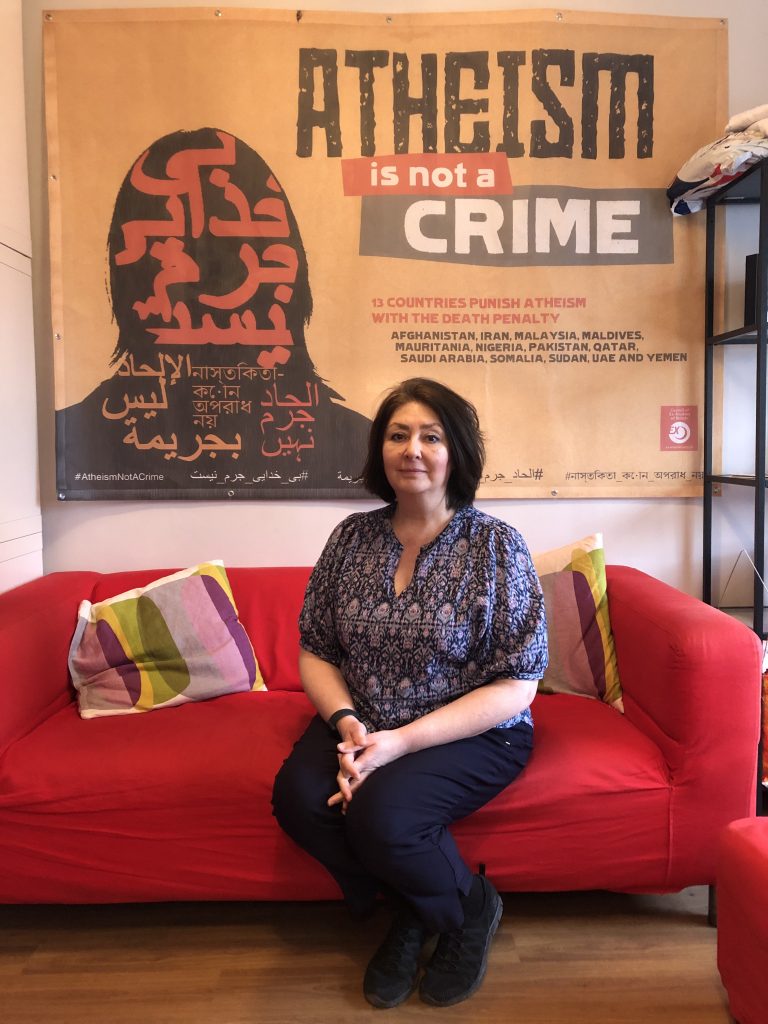
Maryam Namazie In Her Office In King’s Cross.
Photo: Emma Park

EP: Let’s start with the Council of Ex-Muslims of Britain. How large an operation is it?

MN: It started quite small in the sense that very few people were willing to call themselves ex-Muslims or to come out publicly and do that. The idea behind the organisation was that having people come out publicly normalises it and breaks the taboo, and makes it accessible to all. When there’s all this discrimination and pressure and intimidation, coming out publicly is a way of resisting the status quo and trying to change things.

When we started it [in 2007], people were saying that we were being absurd, there are no ex-Muslims around, and we were trying to get attention. It was hard initially. For example, at our first conference at Conway Hall, there were very few ex-Muslims there, and those that were there were hiding on the balcony, up where they couldn’t be photographed or filmed. People were like, “You’re talking about ex-Muslims – where are they?” Now, fifteen years on, things have changed incredibly in favour of this visibility and presence, and there are many ex-Muslims.

So I would say, yes, we are a small, a relatively new movement. We are not as established as other freethought, atheist, humanist, secularist movements in Europe and Britain, partly because a lot of us are refugees, new migrants, and we don’t have access to the same resources. CEMB is largely a volunteer-run organisation. All our funding comes from individual donors primarily, but people have been hit hard by Covid, so it’s really gone down, to the point where we are not sure we’ll be able to carry on next year. But somehow people are helping every time we’re about to close down. Our costs are quite minimal. It’s the rent, the website, publicity, stipend, and volunteer support and assistance. I’m the only paid person, on £10,000 a year.

EP: Where would you put yourself on the political spectrum?

MN: I’m a communist – so basically as far left as it goes. But not a communist that supports the Soviet Union or China or all of these so-called communist groups out there. I’m on the left spectrum of pro-refugees, pro-open borders, pro-freedom of expression. And also anti-racist and against bigotry against Muslims, or placing collective blame on all Muslims because of the religious right amongst them.

EP: In your view, is bigotry against Muslims a form of racism, or is it analogous to racism?

MN: I think it’s a form of racism. Of course there are all different races of Muslims. We all hear, whenever there is any criticism of ‘bigotry against Muslims’, they all say, well, Muslims are not a race, therefore we can’t be bigoted against Muslims, because there are also white Muslims, and so on. That’s the argument you often hear. But the reality is that it is seen as a brown religion, a black religion, a minority religion, and one that’s alien to Western societies.

EP: What are the CEMB’s biggest achievements over the last fifteen years?

I think the greatest achievement has been to highlight the fact that there are non-believers in the so-called Muslim community. I think that’s an important thing to do, because very often, the Left that supports Islam and sees Islamism as a revolutionary or anti-imperialist force, also sees Muslims as homogenous, and therefore, if you criticise Islam, you’re seen to be attacking an entire community of people. And for the far Right, anyone who is a Muslim is bringing in a foreign ideology into the country, and they’re destroying Western civilisation and that sort of thing. So both Left and Right look at the Muslim community or Muslim society, so-called, as homogenous.

EP: So they’re just generalising?  

MN: Yes, but what happens when you generalise about something is that you recognise those in power as its authentic representatives. Given the fact that we are living in a period of the rise of the [Islamist] religious Right, it’s they who are seen to be representatives and authentic Muslims, and therefore women who don’t wear the veil are viewed as westernised, or self-hating, and the veil is viewed as the authentic dress of those who come from a Muslim background. What the Left does is that it maintains the demands of the religious Right on the population. So the Left says you shouldn’t blaspheme, because it hurts sentiments, even if it’s people from Muslim backgrounds doing it.
So I think that achievement is something that’s quite valuable, and over the long run I think we will recognise it as such: the fact that we have shown that Muslim communities and societies are not homogenous. I think this is key in humanising people and in making them see that any given community or society is not reactionary, or progressive, all at the same time. There are differences of politics and opinions. People can see that in Britain, they can’t see it when it comes to the Muslim community.

EP: How far have the radical Left got into bed with the Islamist religious Right?

MN: This is something that I’ve had to deal with a lot: progressive student unions barring me from speaking, and saying I’m inflammatory and inciting hatred against Muslims. I think it comes from a good place, in general, because it’s the attitude that you want to not tolerate racism where you see it. I think that’s a good thing. But conflating criticism of the Islamic Right with an attack on Muslims in general is very problematic.

And not everything comes from a good place. There is also political self-interest for some of these groups: they are anti-imperialist, and they see Islamism as an anti-imperialist force, and therefore they side with it versus US or UK imperialism.

EP: Is Islamism anti-imperialist?

MN: It is an imperialist force in and of itself. It has eradicated cultures and art, music, dress – it’s destroyed so much in all of the countries that it has gained access to and power over. The Left that supports it doesn’t see that it’s a counter-revolutionary force. It has eradicated Left and working-class movements in those societies.

EP: How did the Iranian revolution of 1979 affect you?

MN: I was born in 1966. When the Islamic regime was established in 1980 after the revolution, we left the country. We didn’t all leave together, because we couldn’t. My mum brought me to India to go to school, because they shut the schools down in Iran, and then my dad told her not to come back, so we stayed, and then my dad joined us later. We came to the UK in 1982, but we weren’t allowed to stay here, so we went to the US in 1983. I came back to the UK in 2000. My family is still in the US.

EP: What made you move to the UK?

MN: To be closer to Iran and my political party, which used to be the Worker-Communist Party. I left it a few years ago. Basically, I just got fed up.

EP: Are you affiliated to any political party now?

MN: No.

EP: What was it like growing up in Iran before the revolution?

MN: The Shah’s regime was a dictatorship, and the revolution was against this. There was a period when there was a lot of freedom, before the Islamic regime took complete power, which it did by massacring lots of people. I went to a mixed school, I wasn’t veiled, my family’s quite secular. Religion wasn’t really an issue for me. We didn’t fast during Ramadan. Some people in our family did, some didn’t. My grandmother sometimes wore the veil, sometimes didn’t. The first time I came across in-your-face religion was when the Islamic regime took over.

EP: Did you grow up as a believing Muslim?

MN: I was born a Muslim, the way people are out of no choice of their own, because of where you’re born. My father had a very strict Muslim upbringing. He still doesn’t eat pork, drink or gamble, and my grandfather was a cleric. My last name, Namazie, means ‘prayer’. But my father never required us to pray, to wear the veil, so I never felt that I was less because I was a girl. It’s also my family’s background. My mum is from Nepal. She was Christian, and she converted to Islam to marry my dad. All of my aunts and uncles from Iran, they’ve married Indians, Iranians, different types of people, so we’ve got quite a mixed family. Some prayed, some didn’t. I think it was like that in quite a lot of countries in the Middle East at that time. It was much more relaxed, and now it’s much more forced. Before, you could eat in front of someone who was fasting. Now, out of respect, you’re not supposed to. What happens with the religious Right is that it changes the demarcation line, makes it stricter and more difficult for people to pick and choose as they want.

EP: Would you be able to go back to Iran now?

No. I’ve had threats from the Iranian government, and also – it’s a long story. There is the possibility of being kidnapped. [Compare the alleged plot against the Iranian-born journalist Masih Alinejad.]

EP: In terms of your identity, how do you see yourself?

MN: I always believe that you are from where you live and that home is where you work and struggle. But the older I get, the more I miss Iran. It’s very strange, I can’t explain it – it’s very nostalgic and emotional.

EP: How did you become an ex-Muslim?

MN: I became an atheist many years ago, I don’t remember exactly when. It was gradual, for sure. By university I was an atheist. I never called myself ex-Muslim, I don’t even like the term. It’s just an idea that came up about being able to promote the idea that there is freethought and freethinkers amongst Muslims.

EP: How many people would you estimate are ex-Muslims around the world?

MN: We don’t really know the scale of it, but I do think that every family has an ex-Muslim. I think it’s much stronger where Islam is in power. You don’t see it as much because of the lack of freedom to express yourself. But if people said in the UK what they say in Iran about Islam, it would be considered very Islamophobic. One of the trending hashtags in Iran is #IShitOnIslam. Imagine having that here – it would be considered so inappropriate. That rage… You can see even from the response of government officials. The Egyptian government set up a partnership with the Ministry of Youth and Sports to combat atheism. Saudi Arabia considers atheism a form of terrorism. When Deeyah Khan did her documentary about us [Exposure: Islam’s Non-Believers, 2016], there were texts being sent to Muslims in Britain, warning them not to let their children see the film. Atheism is a real threat to these states.
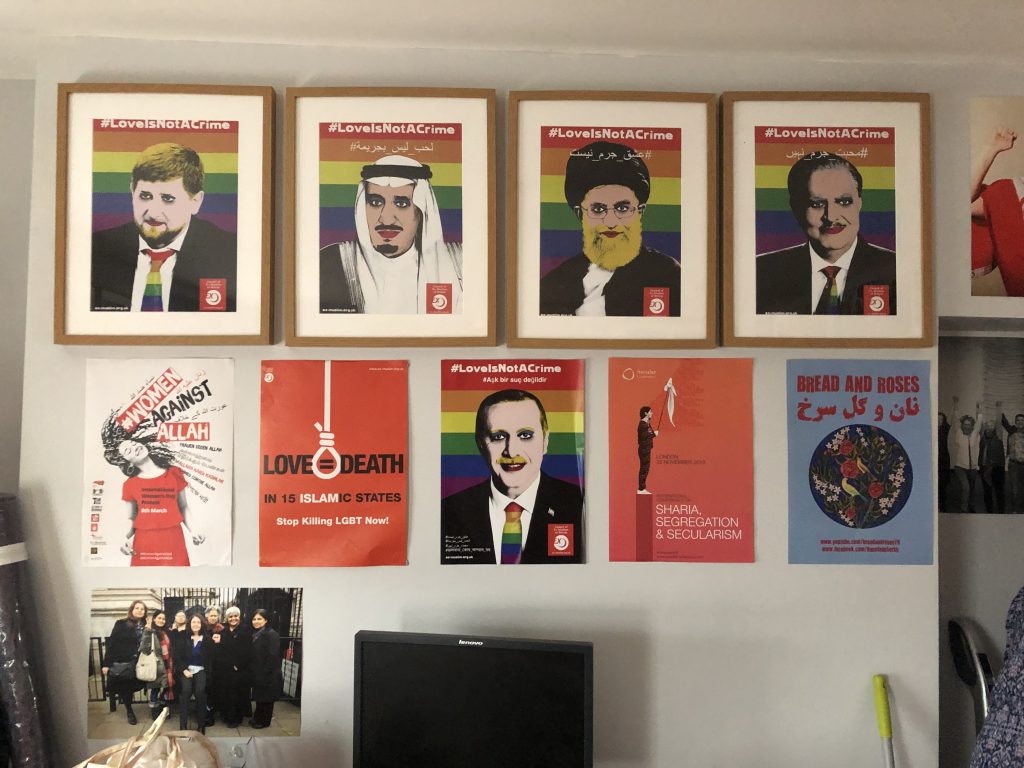
Wall Above Maryam’s Desk In Her Office. Photo: Emma Park

EP: How connected are the different Islamist movements in different countries around the world, including the UK?

MN: They have their rivalries. There are some who are more supportive of Assad and the Islamic regime, or pro-Saudi, or the Muslim Brotherhood in Egypt. There are divisions, in the same way that you have far Right groups in the West that have differences of opinion and divisions. But they are one movement, because despite the differences, they fundamentally want very much the same thing.

EP: What do they want?

MN: They are nostalgic for some golden age of Islam. They want a Caliphate and sharia law, they want the ideal Islamic state as was the case when Mohammed was alive. What that means to them is the idea that doubt and freethought cannot be allowed. Women need to know their place in society. In Britain, they will say, we’re not for the execution of apostates, but they are for it in an ideal Islamic state. There’s a lot of doublespeak and propaganda to dupe people into thinking that they’re the nice version in Britain.

EP: How strong is the Islamist movement in Britain today?

MN: Britain is one of its strongholds. In a country where they’re not in state power, Britain is one of those countries where they are well-established. If we look at Islamists who have got access to positions of power in the UK, and if you look at the whole idea of sharia law, how we have so many sharia courts in this country, and despite various Parliamentary groups looking into this issue, there has never been a decision made on it. The government is always justifying it as people’s choice of religion, whereas it’s something very different and very sinister – it’s part of the political wing of the Islamist movement.

EP: Roughly how many sharia courts are there in the UK at present?

MN: There’s no set number, because they’re not registered. Not that I think they should be registered – it would be like registering FGM clinics. In some reports there have been up to a hundred. A lot of them are ad hoc, in mosques. It’s not like a registered court, where you would know the exact number. Sharia courts were only established in this country in the mid-80s. It goes back to our argument that it’s part of the religious Right movement. There were Muslims before in this country, none of them needed to go to sharia courts, they did not have to go.

EP: Not being a Muslim in terms of your religious beliefs, how do you see your Iranian side?

MN: For me, it’s the protest and the resistance. That makes me proudest to be Iranian. I think it’s a continuation of the original Iranian revolution, that was never allowed to achieve its goals. Look at the French revolution. It happened so long ago, but we still feel the effects of it today, when we talk about laïcité, or secularism in the proper sense, not in the wishy-washy British sense. So I think the revolution and its politicisation of society in Iran, to the extent that a majority of people were born under an Islamic regime, and are fighting it tooth and nail. I see that as a really proud history, and one that I am a part of.

EP: Do you have any favourite Iranian authors?

MN: I’m going to sound like a party hack, I’m not in the Worker Communist Party any more, but – the leader of that, Mansoor Hekmat, I became a communist because of him. I find his writing so human, and seeing the world in such a fundamental way. But there are also many great poets in Iran. There’s Ahmad Shamlou, who was very critical of the state, or a woman poet, Forough Farrokhzad, who was such a taboo-breaker.

EP: Is there a long history in Iran of criticising the state?

MN: Yes, definitely. And also a history of freethought. There is Sadegh Hedayat, he’s a well-known writer who is an atheist, very critical of religion. Also there’s a very funny character, it’s called Molla Nasreddin, which is famous in Iran, but also in Azerbaijan and other countries, and it’s a bumbling clergyman – all the cartoons are making fun of religion and religious rule. For example, he’s following a group of donkeys and they’re going to Mecca, that sort of anti-clericalism, like in Charlie Hebdo.

EP: Talking of Charlie Hebdo and laïcité, you mentioned that British secularism seems ‘wishy-washy’ by comparison to the French version. Would you be in favour of a more French approach over here?

MN: I think that’s the only approach. Not to say that I am completely supportive of the French government, I don’t think it is completely promoting laïcité, I think there’s a lot of politics as well involved. But the idea of the state being incompetent, where it has no position on religion, it’s separate completely, is hugely important. It’s not enough to be neutral.

EP: The idea that the state should not have any influence on politics?

MN: Any influence, but also on the educational system, in public policy. Faith schools, for example, are not good for children.

EP: Why should religion not have any influence on education or public policy?

MN: Faith and education seem to be antithetical to each other. Education should promote freethought, doubt, questioning. Faith is the opposite of that. Is it the role of an educational system, to teach people to be submissive, or to learn about dogma? I think not. Also religion shouldn’t have a place, for example, in a court of law or when making public policy. Why should there be faith-based health services? We all bleed the same. It’s just a way of helping to bring the religious right more into the public space, whereas it shouldn’t really have any space. That’s different from being neutral. A state should be playing an active role in combating religion. Yes, you have the right to your religion, but that’s very different from having a right to a religious school, or a right to faith-based services. Those are separate things.

EP: So, in your view, religious freedom should have certain limits?

MN: Yes, because religion is a private matter. That’s where there’s a problem, that for some reason, it’s as if religious freedom means you can shove your religion down everybody’s throat. You may have the freedom to believe in what you want, but when it comes to the public space, it’s not about a personal right any more, it’s about a right that imposes on society. If we recognise it as a private belief, it becomes a lot easier to manage it.

EP: Talking about Charlie Hebdo: how important are laughter and satire in promoting free speech?

MN: Charlie Hebdo is really important not just for French society but for all of us. I spoke at the third anniversary of the attacks on Charlie Hebdo. I was the only English speaker there, because you know how it’s been over here in supporting them: if there have been any media reports on the attacks, they don’t show the cartoons, they don’t show any of the images – that’s the whole point, isn’t it? They [Charlie Hebdo] have been left alone to a large extent, because it is that same idea that criticising Islam is detrimental to Muslims. The argument I made was that what Charlie Hebdo does is important for freethinkers from Muslim backgrounds, because it’s opening the space up for us as well. It means a lot to Islam’s non-believers, as well as its benefits for free speech in European countries.

EP: What is the best way in Britain of countering Islamist fundamentalism, while at the same time not promoting anti-Muslim bigotry?

MN: Islamism is part of UK foreign and domestic policy. How can you have relations with the Saudi government, or with the Pakistani or Iranian government, and then address Islamism in your own country? It’s impossible, because in order to justify your relationship with those countries, you’ve justified Islamism, so it makes it easier for it to grow roots here as well.

At the same time, the idea that we foreigners are never British citizens… The jihadi bride, Shamima Begum – the fact that her citizenship can be taken away says a lot about how this government views the ‘other’ and minorities. Even if you are born here, because your parents happen to be from Bangladesh you’re never part of this country. This idea is that you belong to the Muslim umma [the worldwide Muslim community] – the Muslim community, a Muslim country, you’re never really British. It gives people the feeling that they don’t belong, and also, the government itself is saying ‘You don’t belong’ with this policy.

EP: Since being in the UK, have you experienced racism yourself?

MN: Yes. The first time I experienced it was when we left India in 1982. We went to Bournemouth, because my dad knew someone there. We were walking down the street, and some lady was saying something, and my mum was waving to her, she thought she was just saying hello, and she was like, “You fucking foreigners, get out of this country!” So that was the first time. Since 2000, it’s, you know, the looks you get if you’re talking in another language – on the train, for example. It’s constantly being told, if you disagree with anything the UK government says, “Why don’t you just go home?” You never belong.

Since I’ve got a son now, my idea was always, “You’re British, you were born here, you’re not Iranian.” This was always my propaganda to him. Then he’s grown up, and he’s faced so much racism at school [in London]. I feel very sorry for him, because it affects him quite a lot. I guess you then feel like, who are you? You don’t belong anywhere. I can see why people feel so disillusioned, that they’re not part of British society.

EP:  Have you had women in stricter Muslim communities telling you of some of the problems they have had, or what it’s like being in that very repressive sort of environment in the UK?

MN: In the work I do with One Law for All, we have been talking to lots of women, gathering testimonies. We did quite a bit of that for the Parliamentary Committee that was going to be looking into sharia courts, that never did. [See Parliamentary discussion in May 2019.] It was before lockdown. We gathered testimonies, and I provided evidence to the Committee, and we did written submissions. In those situations, there are women who talk about the awful things that have happened to them in the sharia courts. People say, “The sharia courts are not stoning anyone to death, they’re not amputating them, they’re just dealing with marriage and divorce and child custody.” But those are pillars of women’s oppression in the family. So it trivialises what happens to women.

EP: Is it difficult for these women to integrate with other British people, non-Muslims, or into wider society?

MN: It is difficult, partly because some of the problems include the fact that men may have only married women in a nikah (an Islamic marriage), and so when there’s violence or divorce, the women don’t have any rights, because it was never a proper marriage – they were led to believe that it was. Plus if you’re looking at relationships where there’s coercion and violence, women are also kept very isolated. They may not even be able to speak the language, or have many friends outside, who the husband has given them permission to have relationships with. We’re talking about some of the most vulnerable people in society. They’re not protected and they’ve been left at the mercy of these sort of kangaroo courts.

EP: What’s the attitude of the Left?

MN: I think they think it’s people’s right to religion. But again, the counter-argument is, religion is a private matter.

We’ve talked of the way that racism and criticism of religion may be associated in some people’s minds. Is one of the problems with the approach of the Left that they’re so worried about racism that they are not able to tackle these issues of abuse within Muslim communities?

MN: It’s not all the Left. Practically everyone I work with is on the Left. A lot of ex-Muslim groups are also Left-leaning, though there are other groups too – and a lot of the women’s groups I work with are Left-leaning. A lot of the protest movements that we’re seeing in Iran or Afghanistan, they are Left-leaning as well. There is a very vibrant Left that is opposed to both fundamentalism and racism.
But there is that section of the Left that hides behind the idea of racism and bigotry, as a way of saying, we’re so concerned about racism, we’re going to support sharia courts and so on. But they’re not very concerned with the racism that ex-Muslims face, for example. If freethinkers are killed, suddenly they’re not so vocal about human rights. They see Islamism as a revolutionary and anti-imperialist force. It’s an uncomfortable ally, but one that they want.

EP: Where does the CEMB fit in with other freethought movements in the UK?

MN: With the National Secular Society we have very good relations. They are also seen to be a bit more upfront with this criticism of religion. Most of our relationships in the UK are with minority and women’s groups, such as Southall Black Sisters, or Centre for Secular Space, or Iranian and Kurdish women’s rights organisations. I can’t think of any freethought groups we work with. I think we are seen to be a bit much, in the sense of going too far. But I think you need to go too far, especially with what they’re doing [in Islamism] – for goodness’ sake, they’re decapitating people.

EP: Topless protests: why?

MN: Topless protest is the most difficult thing I have ever done. The first time I did it, I didn’t get my period for six months, that’s how stressed I felt. I still feel really embarrassed when my parents come and see pictures of it. The reason I did it is because Aliaa Magda Elmahdy in Egypt did it in 2012. She was under a lot of attacks and pressure, and I said, “Let’s do something in support of her, let’s do a topless calendar.” And of course, suggesting it, I had to do it myself. The idea is that a woman’s body is considered to be the source of chaos and fitna [‘Islam. Unrest or rebellion, esp. against a rightful ruler,’ S.O.E.D.], that’s why we have to be veiled. Therefore owning your body and using it as a tool for protest and liberation is really a great way of challenging this view that a woman’s body is obscene and shouldn’t be seen and heard.

EP: Final question: what limits should be set to free speech in the law?

MN: I don’t think there should be any limits. Hate speech is really subjective. A lot of what I say is considered hate speech. Even saying that the Holocaust didn’t happen, let people say that ridiculous, absurd thing, and let others be able to challenge it. The best way to combat bad speech is with good speech. You have to have the freedom to be able to listen to various views and to be able to challenge them. We’re living in an age where speech is considered akin to causing physical harm. We need to push for a period where you could say anything, you could have very challenging conversations with one another, and manage to still be friends, families, and move on with your life without getting your head chopped off.

Of course there’s a difference between hate speech and inciting violence. That’s where we should be drawing the line. But otherwise, I think we should let people talk. And it would be good for people to learn to listen as well. You don’t have to agree with everything you hear – that’s fine. This whole thing of safe spaces, of things being so harmful that you can’t say it anywhere, is problematic for society. It feeds into this idea that that’s why they have to cut your head off, because you’ve upset them so much. I’m upset by a lot of things I hear, but nobody would say I have a right to go and attack someone physically.

⏩Maryam Namazie is an Iranian-born activist and Spokesperson of the Council of Ex-Muslims of Britain and One Law for All.

‘The Best Way To Combat Bad Speech Is With Good Speech’