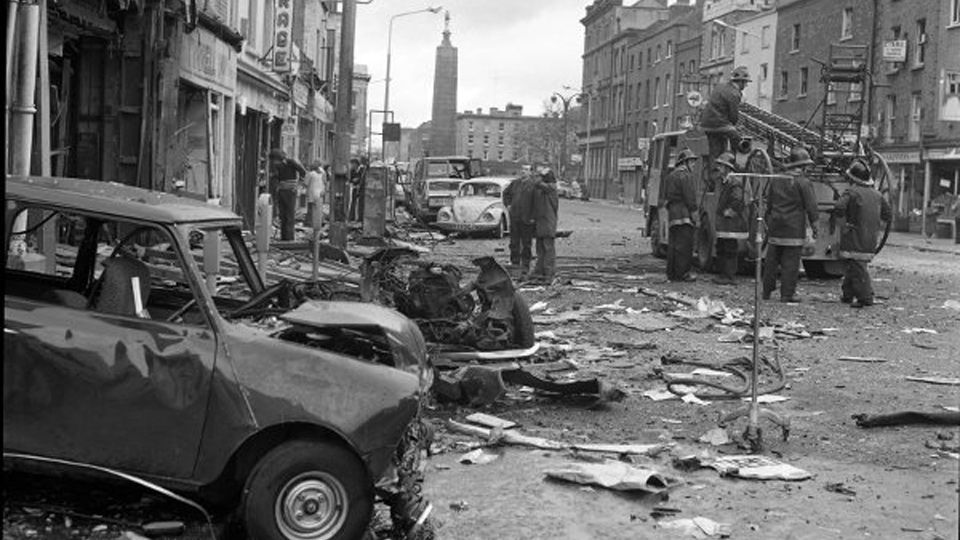
Fifty years ago, on May 17th bombs exploded in Dublin and Monaghan killing 34 people. The anniversary was marked in Talbot St. Dublin beside the monument erected in memory of those murdered on that day. It was addressed by Michael D. Higgins, the southern president.(1)
He made a number of points in his speech, mixing his praise for the Good Friday Agreement and Elizabeth Windsor’s visit to Ireland with calls for the rights of the victims to know the full truth, oblivious to the inherent contradictions in his statement. He did acknowledge that there were huge problems with the subsequent investigations and cited the Barron Report.
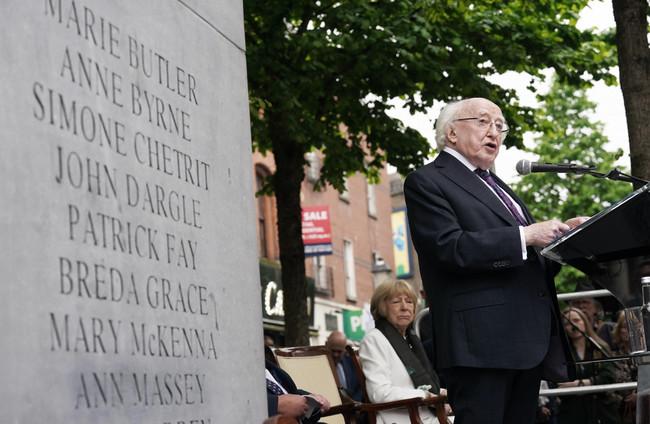 |
| President Higgins |
He made a number of points in his speech, mixing his praise for the Good Friday Agreement and Elizabeth Windsor’s visit to Ireland with calls for the rights of the victims to know the full truth, oblivious to the inherent contradictions in his statement. He did acknowledge that there were huge problems with the subsequent investigations and cited the Barron Report.
The report compiled by the late Judge Henry Barron, published 10th December 2003, provided some of the answers, pointing as it did to systemic failures at State level, one that included possible collusion between the security forces and loyalist paramilitaries, the disappearance of important forensic evidence and files, the slow-motion conduct of the investigation, a reluctance to make original documents available, and the refusal to supply other information on security grounds.(2)
There is nothing surprising about this. The dust had barely settled in Dublin and Monaghan and the Irish government and the opposition rushed out to deflect and supress any debate. Both the Taoiseach at the time, Cosgrave (Fine Gael) and the opposition leader Jack Lynch (Fianna Fáil) both issued statements that were remarkably similar. In them they broadened out responsibility for the attacks to anyone who had been involved in any violent act i.e. they blamed the IRA by implication and failed to mention loyalists at all. This was not accidental. It was deliberate.
The nature of the bombings, the coordination, technology used all indicated the involvement of the British secret services, coupled with the fact that the loyalists never again showed the same capability ever. Under no circumstances was the southern establishment going to accuse the British of anything. Just over two years earlier, following the murder of 14 people on the streets of Derry by the Parachute Regiment in full view of TV cameras, an angry nation protested and burnt the British Embassy in Dublin to the ground. Cosgrave and Lynch sought to avoid a repetition of that.
As the Barron Report pointed out the Garda investigation was poor, forensic evidence was destroyed, the team set up to investigate it was wound down after just two months and the murder inquiry itself was closed after seven months. All of this shows clearly that they had no interest in getting to the bottom of it. So much so, when the RUC informed them that they had arrested some suspects in relation to the bombing, the Gardaí did not follow it up.
As the Barron Report pointed out the Garda investigation was poor, forensic evidence was destroyed, the team set up to investigate it was wound down after just two months and the murder inquiry itself was closed after seven months. All of this shows clearly that they had no interest in getting to the bottom of it. So much so, when the RUC informed them that they had arrested some suspects in relation to the bombing, the Gardaí did not follow it up.
Years later when Judge Barron carried out his investigation, it was not just the British who were uncooperative. The Gardaí and the Department of Justice didn’t provide him with any information, their files were “missing”. So, any call for truth means demanding the southern government reveal what it knows and also who shut down the inquiry, why, what happened to the files etc. It was ironic that the Taoiseach, Simon Harris, the former Taoisigh, Micheál Martin (Fianna Fáil) and Leo Varadkar (Fine Gael) who were present and laid wreaths represent those who covered up the bombings. If we are going to talk about truth, then a starting point should be that Fine Gael and Fianna Fáil covered it up and bear part of the blame for the failure to prosecute anyone.
But when Higgins and others demand the British hand over files and information, including the information offered at the time but not sought by the Gardaí, a question arises. Why would you ask the British government for information and files on a bombing that took place in Dublin? There is only one possible answer: the British were involved in the bombing. So, a good starting point would be not so much to talk euphemistically of full disclosure, but rather for them to admit their guilt and tell us all what they did and how and provide all the documentation relevant to their admission of guilt. No Irish politician has ever demanded that the British own up for it. The demand is they give over information on those who carried it out, as if they were not serving members, at the time, of the British security forces.
The Irish state deliberately failed the victims of the bombings and continues to do so, to this day. It is telling that the Barron Report on the bombings in not available on Irish government sites but rather on a site set up by victims of the bombings, Justice for the Forgotten. The Irish state has little interest in talking about the issue or of informing the Irish public, most of whom were born after the bombings.
Though Higgins criticised the Legacy Act, which puts a time limit on prosecutions, the Good Friday Agreement was always about drawing a line under what had happened. The GFA rewrote history to portray the British as honest brokers in a tribal sectarian conflict and not as an imperial power. Acknowledging their role in the Dublin and Monaghan bombings would undermine that carefully crafted and now universally accepted lie about the British role in Ireland. The British will not release the files as to do so would be an admission of what their role in Ireland is. The southern establishment despite its occasional calls for clarity and truth, dreads the British even considering such a move, as again it would undermine their role as well in the conflict and their responsibility for the ensuing cover up.
Notes
(1) See Speech at the Commemorative Event Marking the 50th Anniversary of the Dublin and Monaghan Bombings
(2) Ibíd.
⏩ Gearóid Ó Loingsigh is a political and human rights activist with extensive experience in Latin America.
But when Higgins and others demand the British hand over files and information, including the information offered at the time but not sought by the Gardaí, a question arises. Why would you ask the British government for information and files on a bombing that took place in Dublin? There is only one possible answer: the British were involved in the bombing. So, a good starting point would be not so much to talk euphemistically of full disclosure, but rather for them to admit their guilt and tell us all what they did and how and provide all the documentation relevant to their admission of guilt. No Irish politician has ever demanded that the British own up for it. The demand is they give over information on those who carried it out, as if they were not serving members, at the time, of the British security forces.
The Irish state deliberately failed the victims of the bombings and continues to do so, to this day. It is telling that the Barron Report on the bombings in not available on Irish government sites but rather on a site set up by victims of the bombings, Justice for the Forgotten. The Irish state has little interest in talking about the issue or of informing the Irish public, most of whom were born after the bombings.
Though Higgins criticised the Legacy Act, which puts a time limit on prosecutions, the Good Friday Agreement was always about drawing a line under what had happened. The GFA rewrote history to portray the British as honest brokers in a tribal sectarian conflict and not as an imperial power. Acknowledging their role in the Dublin and Monaghan bombings would undermine that carefully crafted and now universally accepted lie about the British role in Ireland. The British will not release the files as to do so would be an admission of what their role in Ireland is. The southern establishment despite its occasional calls for clarity and truth, dreads the British even considering such a move, as again it would undermine their role as well in the conflict and their responsibility for the ensuing cover up.
Notes
(1) See Speech at the Commemorative Event Marking the 50th Anniversary of the Dublin and Monaghan Bombings
(2) Ibíd.
⏩ Gearóid Ó Loingsigh is a political and human rights activist with extensive experience in Latin America.