Showing posts with label British state terrorism. Show all posts
Tommy McKearney  In the opening chapter of The State and Revolution, Lenin quotes Marx: ‘… the state is an organ of class rule, an organ for the oppression of one class by another…’ This means the bourgeois state will take whatever steps it deems necessary to maintain its dominance. While this preservation of class power is common to all capitalist societies, the British state is no exception, having long practised the strategy ruthlessly.


However, in order to maintain a workable day-to-day consensus among those it governs, the British state has always claimed that it observes the highest principles with its legal practices and behaviour, all impartially applied. Consequently, the British government goes to extraordinary lengths to disguise its often blood-soaked misbehaviour. To a certain extent this may be described as hypocrisy but in reality, it is the brutal outworking of class domination through the maintenance of power.

When that dominant class ruled an empire, this led to killings and massacres across its territories. The list of atrocities is long and chilling. During the century of its imperial decline, the atrocities continued unabated. From Amritsar through Kenya, Malaya, and Aden to Derry’s Bogside on Bloody Sunday, there is an unbroken line of state-sponsored murder. It does not stop there. In July of last year, The Observer newspaper reported that British troops had been accused of killing unarmed men and boys. Interestingly too, the report, Cover-up after Cover-up, began by saying, ‘This is the story of the silencing operation – deletion of evidence, unheard witnesses, police obstruction, injunctions, delay and denials.’

Understandably, some readers may take this report to refer to events in the Six Counties, thinking perhaps it was something leaked by members of the Kenova team. In fact the story concerned SAS operations during night raids in Afghanistan. As the old saying goes, mutatis mutandis little changes when the British state feels the need to project power.

While many of the killings for which the British state was responsible took place in far-flung regions of its dominions, we in Ireland know many have taken place closer to its administrative centre. And, moreover, with the same familiar pattern of official obfuscation, often referred to as the policy of deny, delay, and die.

In other words, the state initially denies any involvement, or if that’s not possible, claims to have acted within the law. If or when outright denial becomes impossible, there follows the process of almost interminable delay utilising each and every apparatus of state to prolong or actually obstruct investigation. This latter stratagem of delay is used on the understanding that with the passage of time, those with direct knowledge of the event or family connection to the victims will become either incapacitated by age or die.

To a large extent the above applies to the recently published Kenova Report. This enquiry was originally established to examine the case of an agent known as Stakeknife. The enquiry subsequently expanded into reviewing several other events and organisations including the activities of a loyalist hit-squad known as the Glenanne gang.

The report established several already well-known facts. It confirmed, for example, that the Glenanne gang contained many members of the locally based crown forces. Still, it was unable (or unwilling) to tell whether the gang had any connection to British Intelligence or other state officials. Something that certainly seems questionable when elsewhere in the report it states that, ‘… everything done in respect of Stakeknife was done with MI5’s knowledge and consent and MI5 had an influential role…’ This surely begs the question why such control over one agent yet no presence within the loyalist group?

Of course, the full facts are never disclosed. Hidden behind a wall that includes the oft-used National Security fall-back that denies access to any material deemed sensitive by the government. Then there is the ubiquitous NCND (neither confirm nor deny) policy preventing identification of all state agents and or assets. The NCND policy thus ensures that those guilty of any offence whatsoever remain beyond accountability and more significantly, guarantees that the British state cannot be made accountable for their agents’ actions.

As a relative of one of the victims asked recently after the British Supreme Court denied access to information to the family of murdered Paul Thompson; what have they got to hide?

What indeed has the British state to hide? In light of history and such deliberate obfuscation, it is difficult to disagree with an assessment made by the Pat Finucane Centre in a study entitled A Case to Answer published in 2004. The centre opined that the British state had been:

… manipulating and directing the nature of the conflict in Northern Ireland for political and military purposes and as part of a counter-insurgency strategy. 

As Marx wrote, an organ for the oppression of one class by another. Enough said.

Tommy McKearney is a left wing and trade union activist.
He is author of The Provisional IRA: From Insurrection to Parliament.
Follow on Twitter @Tommymckearney

British Imperialism In Ireland 🪶 State-Directed Killings

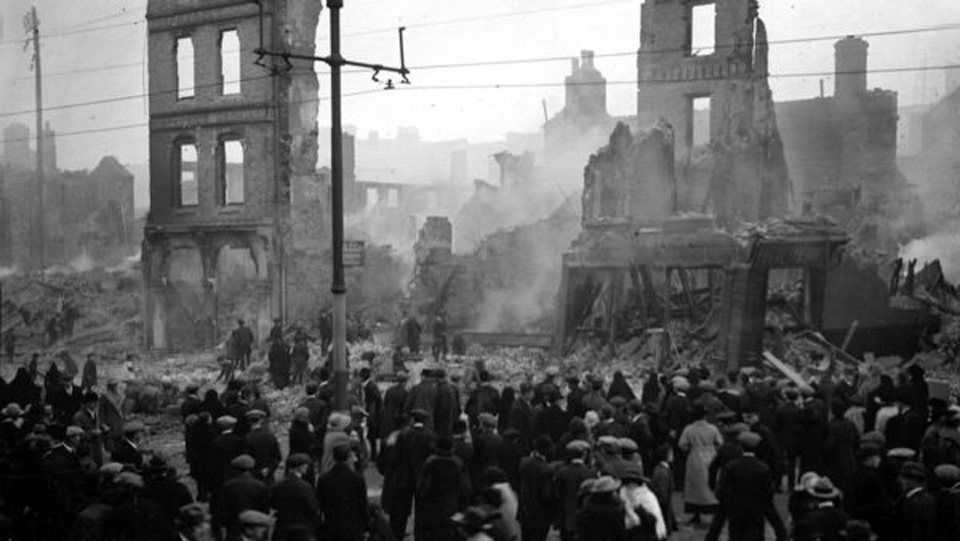
Matt TreacyIn the aftermath of a series of IRA military successes, including the killing of the intelligence agents in Dublin on Bloody Sunday and the ambush on the Auxiliaries at Kilmichael on November 28, it was decided to declare martial law in four Munster counties; Cork, Tipperary, Limerick and Kerry which came into effect on December 10.
 

That was enabled by the Restoration of Order in Ireland Act which had been passed in August, and replaced civil courts and inquests with military procedures. This was in large part due to the increasing numbers of murders, lootings and burnings being carried out by British forces and the findings against them by civilian inquests.


It was no accident that Cork was one of the main targets of the increased repression from British authorities. It had become one of the main centres of IRA actions along with Tipperary, Limerick and Dublin and the licensing of revenge by the Tans and Auxies following the recent setbacks, particularly the Kilmichael ambush, ensured that Cork was one of the cities more likely to bear the brunt.

The Cork No.1 Brigade which had been growing increasingly aggressive and effective in the city decided to meet the new scenario head on. On the night of December 10, six Volunteers from A Company of the 1st Battalion based on the north side, under the command of Seánie O’Donoghue staged an ambush on two lorry loads of Auxies who were on their way from Victoria Barracks, now Collins Barracks, on the Old Youghal Road to make sure that the curfew was being adhered to.

The ambush took place just after 8pm as the Auxies drove in the direction of Dillon’s Cross. Most of the 13 members of the Auxiliary K company were wounded and one died. When news reached the barracks the other members of Auxiliary K Company, under the command of Charles Schulze, planned what was to become a night of mayhem.

They left Victoria barracks again at 9.30pm and their first stop was Dillon’s Cross where passers by were beaten and the family home of a deceased Fenian prisoner, Brian Dillon, was burned.

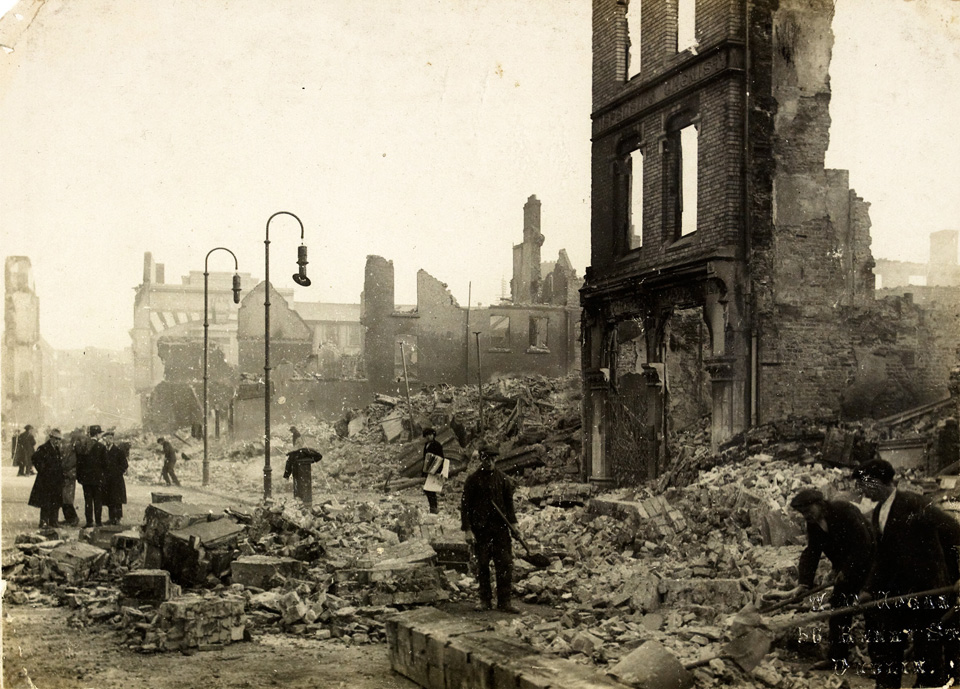
Workers clearing the rubble in Patrick’s Street,
Cork after the burning of the city
 
They then made their way to Summerhill where a tram was attacked and were joined in Patrick’s Street by parties of Black and Tans where a tram was burned. Much of the initial violence was directed at civilians who were robbed at gun or bayonet point.

Then the Tans and Auxies turned their attention to pubs which were looted of their tills and whiskey and the drunken mob proceeded to embark on an orgy of burnings of houses and shops which only came to an end at 6am when Murphy’s clothes shop on Washington Street was unburdened of much of its stock and then burned down.

At four in the morning loud explosions were heard in the vicinity of Union quay when the City Hall and Carnegie Library were set alight by incendiary bombs after the buildings were doused in petrol. Those acts of cultural destruction tend not to be dwelt upon by revisionist historians who decry the Dublin Brigade’s burning of Gandon’s Custom House in May 1921.

In total, 300 homes and 40 shops were burned to the ground. When the fire service arrived they were first refused assistance from the British military and then prevented from tackling fires with water hoses cut and firemen attacked. The damages were estimated at £3 million in 1920 which would equate to over €150 million today.

Two IRA Volunteers were also killed after bloodhounds allegedly tracked one of the ambushers to the farm of the Delaney brothers Con and Jeremiah on Dublin Hill. They were shot dead at 2am that morning and are remembered in the name of the Delaney Brothers GAA club which is still based in the area close to Dillon’s Cross.

The reaction to the burning of Cork made world news. It was raised in the American Congress and at Westminster and undoubtedly had an impact on deciding future British policy which while it continued to impose a heavy handed military strategy, seems to have restricted some of the more undisciplined but clearly officially approved terrorism.

December was also the month in which Lloyd George began to sound out various Dáil leaders with a view to a deal, and preferably one that would undermine national unity. That proved to be more successful than the Tans.

London would have been encouraged by the actions of some of the less resilient Sinn Féiners such as Wexford TD Sweetman, and the Sinn Féin members on Galway County Council who on December 3 had repudiated the Republic and declared for surrender.

Cork was not for turning. As the city reeled from the devastation of the night before Bishop Daniel Cohalan had given a sermon in the North Monastery placing the ultimate blame for the burning of Cork on the IRA. That was greeted with outrage by many in attendance and rejected by many local priests, one of whom Canon Magnier was killed along with his neighbour Tadgh Crowley at Dunmanway by a contingent of Auxies on the way to the funeral of the one killed at Dillons Cross. Cork Corporation also voted to reject the Bishop’s accusation.

As an old Cork friend reminded me when discussing this, not only were Cork city republicans successful in defeating the British militarily but also retained jurisdiction over the city until it fell to Free State forces during the Civil War in August 1922. Up the Rebels!


Matt Treacy has published a number of books including histories of the Republican Movement and of the Communist Party of Ireland.
He is currently working on a number of other books; His latest one is a novel entitled Houses of Pain. It is based on real events in the Dublin underworld. Houses of Pain is published by MTP and is currently available online as paperback and kindle while book shops remain closed.

100 Years Ago ➖ The Burning Of Cork By The Tans Made World News

Anthony McIntyre
 shares his thoughts on a film about British state terrorism. 

I watched Unquiet Graves the night after it broadcast on RTE.  Having been too weary to view it live, I opted to record it. In the interim period I fortuitously picked up on some observations made by the journalist Malachi O’Doherty who was sceptical towards its objectivity. I approached the film with that in mind. 

I ultimately disagreed with O’Doherty’s take although his critique was considerably more measured than much of the online unionist reaction which basically amounted to little more than the film being the work of a republican propagandist: the evidence seemingly that the director Sean Murray’s father had a long association with the senior echelons of the Provisional IRA and had served a number of stretches in prison. The “mutant” gene must therefore have found its way into the grey matter of the son. Like father, like son, Sean Jnr was rendered genetically incapable of producing anything other than “Provo propaganda.” Sean Murray’s mother ran a café business at one time and I suppose it could as plausibly be said that because of that he sought to serve up some seriously overcooked republican cuisine just to annoy the taste buds of unionists and give them indigestion.  Just, that you would need to have the critical faculties of a bible basher to buy that sort of bull.

Murray explained his reasons for making the film. There was nothing untoward about them. He could of course be making it all up, just that there is nothing to suggest he is; and a lot of substance in the film to allow the inference to be drawn that he has made a compelling case for the Prosecution. The case for the Defence, if there is one, lies in the files that the British have been refusing to make public. The current Garda Commissioner while serving with the PSNI:

has been accused of fighting attempts to get information about the perpetrators of atrocities like the Miami Showband murders and of blocking access to files about the many murders carried out by the Mid-Ulster, UVF ‘Brigadier’ Robin Jackson.

In 2017 Brian Feeney referred to:

a lengthy self-serving epistle from the chief constable explaining why he is going to appeal a High Court order commanding him and his force ‘to expeditiously honour its enforceable public commitment to provide an overarching report into the Glenanne group of cases’.

It is hardly Murray who needs to explain himself.

UUP politician and former member of the British military Doug Beattie insisted that the film looked “like a work of fiction.” He is correct if the fiction he has in mind is something crafted by Stephen King. This was nothing short of a horror movie where the monsters were real. The one former RUC officer who ventured outside the fold in order to speak to the families was one of the few good apples in a rotten barrel.

As much as political unionism and state terrorism deniers might wax outraged, this film cannot be swept aside as conspiracy theory such as happened to an early work in the field of collusion, A Very British Jihad. Although in fairness to the author of that particular book, people should revisit it armed with the knowledge that now exists about the long history of British state terrorism in Ireland, around which there is a burgeoning and compelling narrative. The phenomenon has only this week led to the Irish President urging the British to face up to their terror role in the country.

Eamonn McCann concisely summed up the essence of Unquiet Graves:

It details how members of the RUC, UDR and MI5 colluded with loyalist killers resulting in the murder of over 120 innocent civilians.
These sectarian murderers assassinated workers, farmers, shopkeepers, publicans and other civilians in a campaign of terror.
Now known as the Glenanne Gang, they rampaged through Counties Tyrone, Armagh and into the South in a sectarian campaign that lasted from July 1972 to the end of 1978. 


This loudly echoes an earlier BBC characterisation in respect of the British running the agent Stakeknife: murder on an industrial scale. 

Much of the criticism of Murray's film has focused on the claim that at one point the Glenanne Gang had discussed killing all the infants and teachers in a Catholic primary school. This is not the first time the allegation has been made. What seemed new in Unquiet Graves was the suggestion that the idea was proposed by people in the Security Services. It was speculation on the part of former RUC member, John Weir,  and Sean Murray did not make it out to be anything else. Many of the people in the Glenanne Gang were Christian fundamentalists and biblical literalists. Former urban UVF prisoners have commented on the religious fundamentalism of some of their rural membership. Driven by Hate Theology, a quick rummage through the Old Testament would easily have convinced them that "Happy the one who takes and dashes Your little ones against the rock." It might well turn out that nobody in the British security services suggested any such thing. But they were running as agents those who thought it a good idea.

Perhaps, most disappointing has been the general silence of the media in the South towards the film. If the horrific killing of Paul Quinn can produce such intense media hostility towards Sinn Fein, its quietude towards Unquiet Graves makes the Quinn furore seem contrived, impelled by political considerations rather than investigative ones. That the media has not camped outside the Phoenix Park residence of Drew Harris in the wake of the film is a serious indictment. They clamped themselves to Mary Lou McDonald for less.  

The reason for the media reticence might be simple. The media has said much about the Provisional IRA campaign. What it does not want to say is that the Provisional IRA - despite all is faults and failings, its injustices and atrocities - was at war with British state terrorism. And that is a truth that must be given no quarter. Better that the graves stay quiet than allow something like that to emerge from them. 

⏩Follow on Twitter @AnthonyMcIntyre

Unquiet Graves

Deirdre Younge writing in Village about the covert war waged by the British state in the North.

It was early November.1993. A senior RUC officer surveyed the docking area of a container ship in Teesport, Cleveland. ‘The Inowroclaw’ was sailing from Gdynia in Poland to Teesport and from there to its declared final destination of Belfast Port and into the hands of the UVF. It was jammed with armaments.

However, another RUC officer and a battalion of UK Customs officers would be waiting on Teesport docks to ‘intercept’ the shipment before it reached its declared destination

Recruited by M16 in the early 1970s, he had been in Teesport weeks in advance to ensure that nothing could go wrong. This time the weapons would not be distributed as had happen six years previously. If the arms were added to the UVF arsenal it would match anything imported from Libya by the IRA.

This is not the plot of a Northern Ireland ‘noir’ novel, but a ‘false flag’ operation at the tail end of the undercover war in Northern Ireland.

Continue reading in Village.

False Flags In Teesport

Arron Merat on the part played by British state terrorism in the war on the people of Yemen.


Britain does not merely supply the bombs that fall on Yemen – it provides the personnel and expertise that keep the war going. But is the government breaking the law? 

For more than four years, a brutal Saudi air campaign has bombarded Yemen, killing tens of thousands, injuring hundreds of thousands and displacing millions – creating the world’s worst humanitarian crisis. And British weapons are doing much of the killing. Every day Yemen is hit by British bombs – dropped by British planes that are flown by British-trained pilots and maintained and prepared inside Saudi Arabia by thousands of British contractors.

The Saudi-led military coalition, which includes the UAE, Bahrain and Kuwait, has “targeted civilians … in a widespread and systematic manner”, according to the UN – dropping bombs on hospitals, schools, weddings, funerals and even camps for displaced people fleeing the bombing.

Saudi Arabia has in effect contracted out vital parts of its war against Yemen’s Houthi movement to the US and the UK. Britain does not merely supply weapons for this war: it provides the personnel and expertise required to keep the war going. The British government has deployed RAF personnel to work as engineers, and to train Saudi pilots and targeteers – while an even larger role is played by BAE Systems, Britain’s biggest arms company, which the government has subcontracted to provide weapons, maintenance and engineers inside Saudi Arabia.

“The Saudi bosses absolutely depend on BAE Systems,” John Deverell, a former MoD mandarin and defence attache to Saudi Arabia and Yemen, told me. “They couldn’t do it without us.” A BAE employee recently put it more plainly to Channel 4’s Dispatches: “If we weren’t there, in seven to 14 days there wouldn’t be a jet in the sky.”

Continue reading @ The Guardian.


'The Saudis Couldn’t Do It Without Us’: The UK’s True Role In Yemen’s Deadly War