


 |
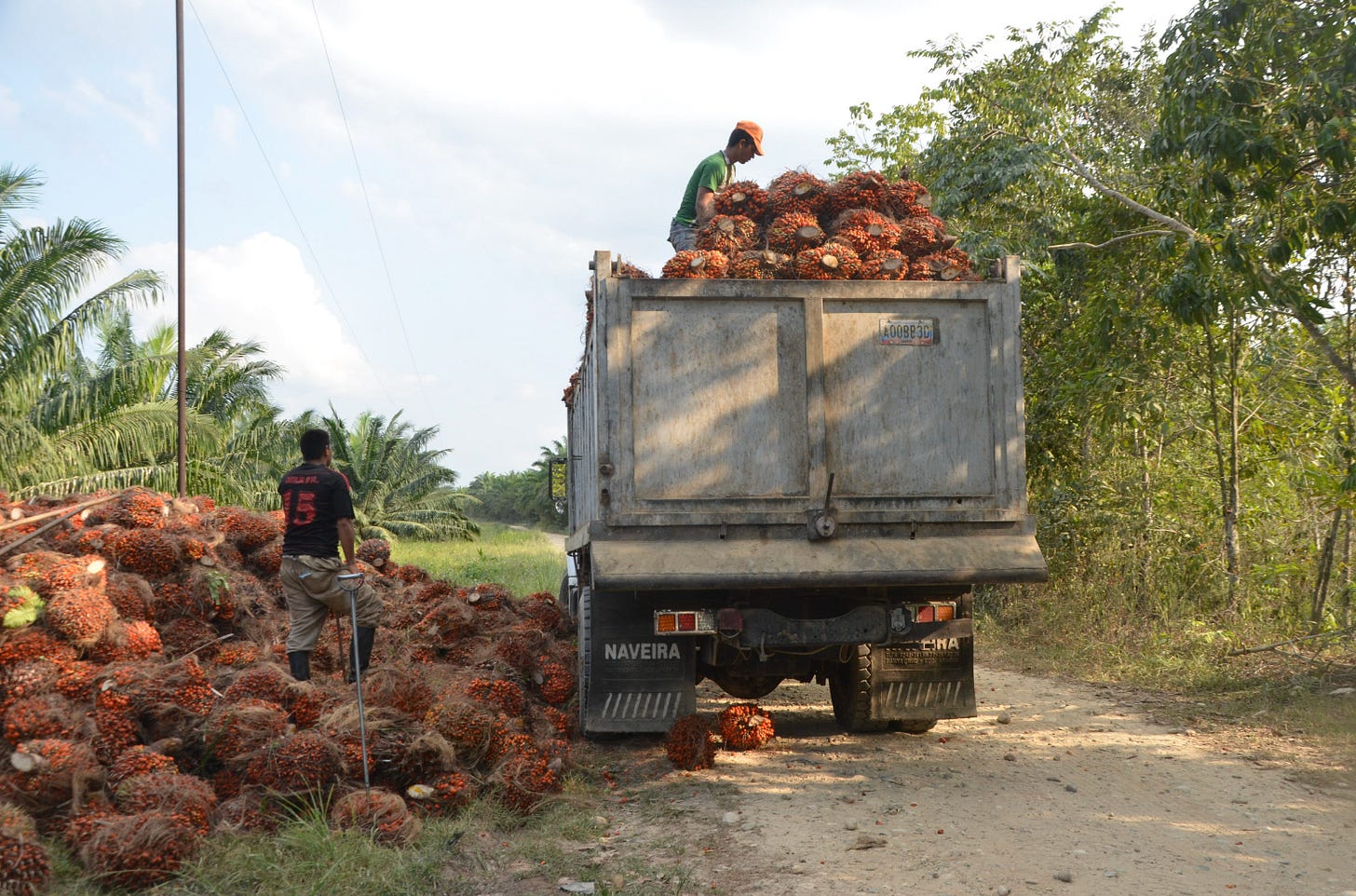
| Photo GOL: African Palm workers Norte de Santander, Colombia |
For a long time successive governments in Colombia have talked about solving the issue of illicit crops and drugs and each one promises to carry out the task and pulls from its sleeve its Ace, its magic bullet that kills the monster like the silver bullets in the horror films. But just like in those films the monster is not what it seems and the magical properties of the silver bullet are a folktale.
The problem partly lies with how they define the problem. The peasant, they say, grows coca because he is poor and coca is a profitable crop and so another profitable crop is required as an alternative. The peasant just simply grew the wrong crop and that is why he is poor. They completely ignore the economic aperture that destroyed the Colombian countryside. Even the first version, in English, of the US counter-insurgent and anti-narcotic project known officially as Plan Colombia acknowledged that in the 1990s 700,000 hectares of agricultural land were lost due to the economic aperture.[1]
Given the collapse of the countryside and the production of food the same project proposed that the peasants specialised in exotic crops for the European and US markets. Amongst the crops that stood out were coffee, African palm and cocoa. Though it should be said that prior to Plan Colombia the Samper government (1994-98) made the same proposal. Nothing is original, the proposals from various governments are almost identical, a copy and paste. They all plagiarise each other. Plagiarism is the basis of all policy on the countryside and drugs, regardless of the government, whether it be Uribe or Petro. The all plagiarise each other: the peasant has to be convinced or forced to change crops without any reference to free trade and the domination of the food production chain by a handful of companies.
They bet on a small number of crops that are already extensively planted in the country, such as coffee and cocoa. In 2001, 675,342 hectares of coffee were harvested producing 637,140 tonnes. In 2024, this had increased to 837,685 hectares with 839,846 tonnes. It reached its zenith in 2017 with 903,950 hectares and a harvest of 851,640 tonnes. In the case of cocoa the improvement was even more dramatic increasing from 83,138 hectares to 197,709 hectares with a corresponding rise in production from 36,731 tonnes to 67,678 tonnes.[2]
Despite this the coca crops and the production of cocaine also increased dramatically i.e. these crops and this model for resolving the coca problem did not work. Despite this, all governments talk alike when it comes to proposing a solution. Petro throughout his government spoke of promoting agroindustry, as if he were the first to think of it. In the election campaign, Iván Cepeda took up the baton and acknowledged the impact of neoliberal measures in the countryside and still stated that they want to “strengthen national production, industrialise the countryside, export foodstuffs with value added and create wealth for the nation and rural communities.”[3]
We will revive productive chains such as cotton, yucca, cocoa, coffee and corn articulating production, industrial transformation and commercialisation with value added in the regions. It is not about going back to the past, but rather of creating a new rural prosperity based on the modernisation of production, the creation of employment, the industrialisation of the countryside and economic justice for the peasant and rural communities.
We will plant crops according to the territorial vocation, water availability, productive calendars, technical support and agrifood health and safety. Will protect national production against contraband, unnecessary importations and commercial practices that destroy in-country capacities.[4]
It sounds nice. But the proposal is very similar to the Export Stake for Colombia 2006-2020 of the criminal and Uribe’s Minister for Agriculture, Andrés Felipe Arias.[5] They all mention that phrase “value added” without explaining what it means in practice and how they will go about it. For example, in the case of coffee value is added when it is roasted, ground and packaged. Except for some special coffees which the multinationals are also buying up, the coffee is roasted and packaged in Europe and the USA. What are they thinking of doing? Roasting it all in Colombia and exporting it?
The sale of coffee beans reached 52 billion US dollars in 2025 and Europe dominates the market.[6] The industry is undergoing a concentration into a few hands of the sale of green bean coffee. How are they going to face up to an entire industry? The green bean coffee industry is profitable partly due to the volume of material that it deals with. They are not going to tolerate an upstart in the market and the multinational companies and consumer countries are not going to tolerate a massive importation of roasted coffee to compete with their multinationals. Starbucks’ income is over 30 billion US dollars per year and Nestlé has sales of coffee in excess of 25 billion US dollars. Governments have been overthrown for less.
All of the Colombian governments have supported the coffee crop and market as it currently exists. Really, there is no need to revive coffee nor cocoa. They are going through their best period as regards crop extension. Not so with cotton. There are currently barely 13,000 hectares compared to 350,000 to 400,000 that existed in the 1970s. It entered in crisis in the 1970s, gave some signs of recovery in the 1980s before entering into its definitive decline following the economic aperture of President Gaviria (1990-94). International competition and the impact of the free trade agreements put the growers under pressure. Cepeda mentions the neoliberal measures, but does not say what they were and what he aims to do about them. For example, the use of certified seeds is now mandated. The peasant who seeks credit has to use them. He cannot use the same seeds he gets from the crop or traditional seeds etc. In practice many peasants have to buy these seeds which are produced by multinationals. It has been state policy for some time and the Colombian Agricultural Institute (ICA) and the Colombian Seed Association (Acosemillas) campaign in favour of their use referring to them as authorised seeds. The phrase is not accidental. Now under the new government of De La Espriella it was proposed that an electronic bill of purchase of authorised seeds be presented before loans and other benefits such as subsidies were awarded.[7]
Cepeda’s proposals do not break with the power structure in the countryside and he was open and explicit about it: “This proposal will go forward hand in hand with the agrifood industry that currently exists in the Colombian countryside, supporting it and integrating it into the national transformation of production.”[8] That is to say, the same collection and distribution points and power structure in the countryside. He proposes to integrate the peasant further still into the agribusiness that currently exists. He states that he will strengthen production according to the zones, ideal crops etc. The same proposal as Felipe Arias as was pointed out earlier.
De La Espriella, for his part, took up the issue of cocoa and promises to expand the crop even more and to support the sector. He states that he reached an agreement with Fedcacaco “which foresees the planting of 50,000 hectares of cocoa where there are currently illicit crops.”[9] The same as before. The eternal plagiarism, though he undoubtedly aims to deepen the changes in the countryside and strengthen further still the power of the agricultural bourgeoisie.
The proposals for the countryside and to resolve the coca issue are always plagiarised, by one and all with slight variations and an untouchable backdrop: the domination by large scale national and international capital of the production of foodstuffs. However, the countryside requires a different solution. It requires a break with the past and the existing power structure in the countryside. It needs a proposal from the peasants. Unfortunately the peasant organisations frequently repeat their own takes on the variations of the plagiarists.
All of the harm done by neoliberalism cannot be undone from one day to the next, and less still when they don’t even mention neoliberalism and capitalism. All the governments seek to guarantee the neoliberal model and that the companies that benefit from it in the countryside remain. The peasant is poor precisely due to capitalism and the current neoliberal model. The debate can be dodged but the peasantry time and again runs up against the economic reality. Under capitalism it is fated to disappear and become rural workers as happened in Europe and the USA. The proposals from Samper, Uribe, Petro and Cepeda to promote agribusiness is a proposal to finish off the peasantry. They take advantage of the coca crops to push the peasantry into the claws of its enemy: the multinational food companies. Meanwhile the coca problem is not resolved because it is a lesser problem for capitalists.
Thanks for reading Gearóid’s Substack! This post is public so feel free to share it.
[1] Plan Colombia (1999) Plan For Peace, Prosperity, And The Strengthening Of The State. P.9
[2] Figures taken from FAOSTAT.
[3] Cepeda, I. y Quilcué, A. (2026) Tres revoluciones para hacer de Colombia una potencia mundial de la vida. pp 71 & 72 https://www.lasillavacia.com/wp-content/uploads/2026/06/plan-de-gobierno-2026-2030.pdf
[4] Ibíd., p.74
[5] Min Agricultura (2006) Apuesta Exportadora de Colombia 2006-2020. https://www.academia.edu/175642883/Apuesta_Exportadora_de_Colombia_2006_2020_Docuemnto_Completo
[6] Fortune (07/09/2026) Coffee Beans Market Size. https://www.fortunebusinessinsights.com/coffee-bean-market-111087
[7] El Tiempo (29/09/2026) Acosemillas propone exigir factura de compra para acceder a créditos y subsidios del campo. María Alejandra Moreno Flórez. https://www.eltiempo.com/economia/acosemillas-propone-exigir-factura-de-compra-para-acceder-a-creditos-y-subsidios-del-campo-3589898
[8] Cepeda, I. y Quilcué, A. (2026) op. cit. p.73
[9] La Razón (17/07/2026) Gobierno electo acuerda con Fedecacao un plan para sembrar 50.000 hectáreas de cacao. https://larazon.co/gobierno-electo-acuerda-con-fedecacao-un-plan-para-sembrar-50-000-hectareas-de-cacao/
⏩ Gearóid Ó Loingsigh is a political and human rights activist with extensive experience in Latin America.


No comments