


 |
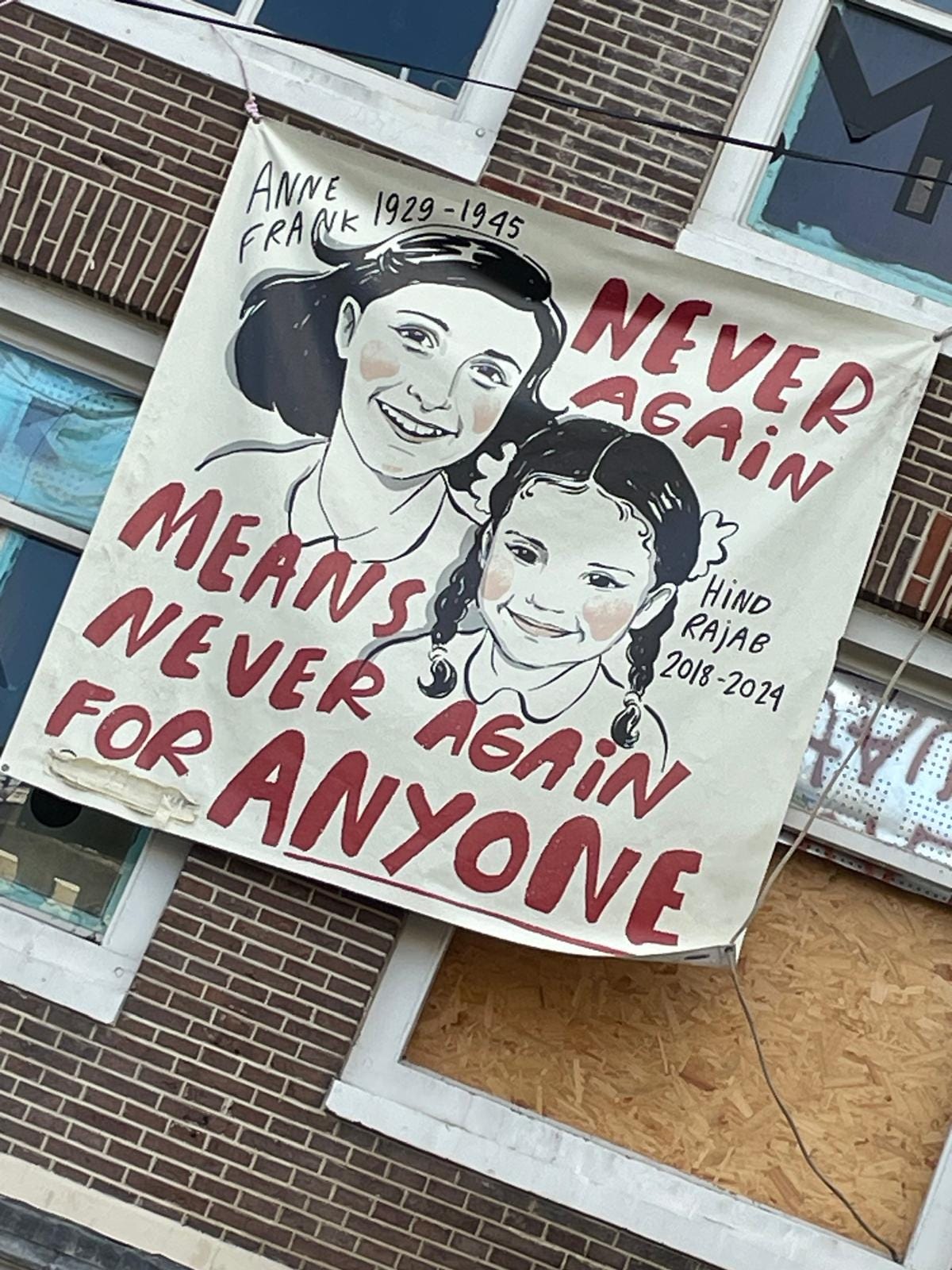
| Photo of a wall poster hanging in Amsterdam, the home of writer and genocide victim, Anne Frank. [Taken Dec 2025 Kevin Doyle] |
The Irish Writers Union (IWU) was founded in the mid-eighties and has campaigned on many issues since: against censorship, for better library loan rates (PLR) for writers, against copyright violations and in recent times for protection for writers from AI theft of their work. In broad terms its role is to “further the professional interests and needs of writers in various media in Ireland”. Affiliated to the trade union SIPTU, the IWU retains full autonomy in running its own affairs. Internationally, it is a member of the European Writers’ Council (EWC), which itself is the largest federation worldwide that solely represents writers. The IWU is also the only nominating body in Ireland for the Nobel Prize for Literature as well the Astrid Lindgren Memorial Award. Today it has over four hundred members and undoubtedly constitutes the main representative organisation of Irish writers.
At the union’s AGM this year, a motion[1] was put forward proposing that the IWU join the cultural boycott of Israel. Specifically, the motion asked IWU members to approve joining the Palestinian Campaign for the Academic and Cultural Boycott of Israel (PACBI).[2] PACBI is the cultural and academic arm of the anti-apartheid boycott movement Boycott, Divest, Sanction (BDS) set up to pressurise Israel to meet its obligations under international law regarding the rights of the Palestinian people.[3] A number of Irish trade unions are signatories to BDS and only last year Trinity College, Dublin agreed to abide by the principles of PACBI and join the academic boycott of Israel.
As it turned out, on the day of the AGM, in somewhat chaotic circumstances[4] the motion was narrowly defeated.[5] A number of the union’s Executive and some members opposed the motion, while another cohort, although supportive, felt they couldn’t vote for the proposal at this stage due to concerns about the impact of a boycott on individual Israeli writers. In the end just one vote divided the sides and the motion fell.[6] Later in a letter to the membership the union’s Chairperson conceded that the outcome was not in keeping with the mood of the AGM. He wrote:
Many Irish writers have since expressed surprise and dismay at the outcome of the IWU vote. It is possible that some members who didn’t attend viewed the result as a foregone conclusion considering what has happened in Gaza and indeed in the West Bank in recent times. Currently Israel stands accused of genocide and ethnic cleansing.[7] A week before the IWU vote, Israel enacted a new law – the Death Penalty for Terrorists Law – which has drawn widespread international condemnation for its fundamentally racist basis.[8]
The IWU vote was close, and there are indeed grounds for disputing the veracity of the outcome.[9] However to engage in bickering over how the AGM was conducted only serves to distract from the more serious issues that arose in the course of the debate about the motion. For example, a number of the union’s Executive refused to support the boycott motion and hid behind the frankly surprising view that the IWU is a ‘non-political’ organisation. But this is not how the Executive saw itself a number of years ago when it quickly issued a statement condemning the Russian invasion of Ukraine. Clearly the IWU union was ‘political’ a few years ago but suddenly isn’t now? So what’s going on?
What does ‘non-political’ mean?
Anyone I’ve asked about the concept that a union could be ‘non-political’ has frankly looked at me like I had three heads. How can a union be ‘non-political’? For example, take some of the campaigns the IWU has been involved in. Isn’t tackling the AI industry’s theft of writers’ work political? What about opposing the Far Right’s physical attacks on Irish libraries for stocking LGBTQ+ books? Surely that’s political as well? Yet, at this AGM, the current Chair, Conor McAnally, stated that the IWU is actually ‘non-political’ and this was why it couldn’t sign up to a boycott of Israel. This point tallies with correspondence I had with the former vice-Chair who told me in the lead up to the AGM that:
At the union’s AGM this year, a motion[1] was put forward proposing that the IWU join the cultural boycott of Israel. Specifically, the motion asked IWU members to approve joining the Palestinian Campaign for the Academic and Cultural Boycott of Israel (PACBI).[2] PACBI is the cultural and academic arm of the anti-apartheid boycott movement Boycott, Divest, Sanction (BDS) set up to pressurise Israel to meet its obligations under international law regarding the rights of the Palestinian people.[3] A number of Irish trade unions are signatories to BDS and only last year Trinity College, Dublin agreed to abide by the principles of PACBI and join the academic boycott of Israel.
As it turned out, on the day of the AGM, in somewhat chaotic circumstances[4] the motion was narrowly defeated.[5] A number of the union’s Executive and some members opposed the motion, while another cohort, although supportive, felt they couldn’t vote for the proposal at this stage due to concerns about the impact of a boycott on individual Israeli writers. In the end just one vote divided the sides and the motion fell.[6] Later in a letter to the membership the union’s Chairperson conceded that the outcome was not in keeping with the mood of the AGM. He wrote:
It was clear in the discussion of the pros and cons that the majority of those present, in person and online, are very distressed about the situation in Gaza.
Many Irish writers have since expressed surprise and dismay at the outcome of the IWU vote. It is possible that some members who didn’t attend viewed the result as a foregone conclusion considering what has happened in Gaza and indeed in the West Bank in recent times. Currently Israel stands accused of genocide and ethnic cleansing.[7] A week before the IWU vote, Israel enacted a new law – the Death Penalty for Terrorists Law – which has drawn widespread international condemnation for its fundamentally racist basis.[8]
The IWU vote was close, and there are indeed grounds for disputing the veracity of the outcome.[9] However to engage in bickering over how the AGM was conducted only serves to distract from the more serious issues that arose in the course of the debate about the motion. For example, a number of the union’s Executive refused to support the boycott motion and hid behind the frankly surprising view that the IWU is a ‘non-political’ organisation. But this is not how the Executive saw itself a number of years ago when it quickly issued a statement condemning the Russian invasion of Ukraine. Clearly the IWU union was ‘political’ a few years ago but suddenly isn’t now? So what’s going on?
What does ‘non-political’ mean?
Anyone I’ve asked about the concept that a union could be ‘non-political’ has frankly looked at me like I had three heads. How can a union be ‘non-political’? For example, take some of the campaigns the IWU has been involved in. Isn’t tackling the AI industry’s theft of writers’ work political? What about opposing the Far Right’s physical attacks on Irish libraries for stocking LGBTQ+ books? Surely that’s political as well? Yet, at this AGM, the current Chair, Conor McAnally, stated that the IWU is actually ‘non-political’ and this was why it couldn’t sign up to a boycott of Israel. This point tallies with correspondence I had with the former vice-Chair who told me in the lead up to the AGM that:
the (Executive) committee did decide that the IWU is not a political organisation and that this is [to be] used as a compass to advise us regarding campaigns etc.
As a former Chair of the IWU, I have looked everywhere for some record of when this decision was taken – indeed if it ever was. There is no official record anywhere. Nor is there evidence of a motion being proposed and seconded; a record of any vote being taken; or indeed any correspondence between whoever took this decision – the Executive? – to the membership informing the membership that a significant redefinition of the union’s status had occurred. So, while the current Chair and some Executive members may believe that the IWU is ‘non-political’ it is highly doubtful if this belief exists anywhere outside of their own heads.
Leaving aside the issue of democracy for a moment does it even make sense? Here the matter becomes more interesting. What does ‘non-political’ amount to? None other than George Orwell has written about this.[10] Orwell confronted the issue of art and politics many times. He pointed out that the opinion that art should have nothing to do with politics is itself a political attitude. So, while the Chair and some of the Executive claim their motive is to keep politics out of the union, they are in fact conducting a political manoeuvre of their own.
The next and obvious question is, towards what end? Here Orwell offers us further insight. He argues that those who subscribe to being ‘non-political’ are essentially those who benefit from the status quo. He added that most people cannot in fact afford the luxury of being ‘non-political’ at all. Day to day living dictates that. And I guess we could evidence here the desperate situation of those living in Gaza.
To further my understanding of what is going on I decided to ask some veterans of the trade union movement for their views. Gregor Kerr, a longstanding member of the Irish National Teachers’ Organisation has been active inside and outside that organisation for many years. He made this point:
… people who think we shouldn’t be ‘political’ should ask themselves: If I was living in a totalitarian regime, if genocide was being committed against my people, if writers in my country were being imprisoned for what they wrote, if trade unionists in my country were being imprisoned for organising…. where could I turn for help? And if I saw people living in a relatively free and comfortable political environment saying ‘that’s too political for me to say anything about’, how would I feel?
He added:
Everything is political … [People] may try to claim it’s ‘not political’, but by choosing to look away they are in effect choosing a side. Desmond Tutu put it well back in 1984 when he said “If you are neutral in situations of injustice, you have chosen the side of the oppressor…
Another activist I asked is Dr Mary Favier. A founder member of Doctors for Choice, she was involved in bringing motions to the Irish Medical Organisation on abortion rights during the difficult years following Savita Halappanavar’s tragic death. She said:
I’ve come across this argument, yes. We brought many motions to our union, the Irish Medical Organisation, asking it to commit to helping with changing the draconian abortion laws that were in Ireland then. We faced a lot of sharp opposition. They often tried to prevent our motions from even being admitted onto the agenda. The argument used was that we were bringing ‘politics’ into the organisation. But how wasn’t reproductive healthcare justice not an issue for the IMO, an organisation of doctors? It clearly was.
She added,
We faced a lot of opposition, but we unpicked their arguments one by one. The claim that a union is ‘non-political’ doesn’t hold up in the end and what we found is that union members accept this when they hear the arguments. Everything a union does is political, and people realised that when they think about it.
Dr Favier also echoed the view that the ‘non-political’ argument is often advocated by people in positions of privilege and who favour the status quo:
[Supporters of this view] are happy with how things are basically. In the IMO in the past there were a lot of doctors who were happy for women to go over to England, unseen and unheard. That was the end of the matter. For them it was like why change anything? If that’s not privilege talking, then what is?
So, to conclude on this point, advocating for the IWU to be ‘non-political’ is really a cloak for supporting the status quo, for advocating for inaction. Which is a shameful position to hold – no? – given that Israel is conducting genocide against the Palestinian people.
What about Ukraine?
I was Chairperson of the IWU from 2021 to 2023 and remained on the union’s executive for a further year after my term. During this time I was never made aware of there being any policy in the organisation to the effect that the union was or should be ‘non-political’. In fact, the opposite seemed to be the case. In 2022, the Irish Writers Union was forthright in publishing its condemnation of Russia’s invasion of Ukraine. At the time I helped draft the statement that was issued. My memory is that no one raised any objections to the issuing of the statement. Nor did anyone suggest that a statement on the matter was beyond the remit of organisation or that we were bound by policy to be ‘non-political’.
The statement by the IWU at the time was well received. It is available here. Interestingly, the European Writers Council also issued a statement about the Russian invasion and it is on the record that the Irish Writers Union was one of early signatories to this statement titled “Ukraine: European and International Writers and Translators against War and Violence”. This statement and a list of its signatories can be viewed here. Was anything similar issued by the IWU or indeed the EWC about Gaza and Israel’s brutal attack on its population? Sadly, the answer is no in both cases.[11]
Gaza, Palestine and Israel first came to the attention of the IWU’s Executive in late 2023. A member of the union, Kate Thompson[12] emailed the Executive asking it to consider adding the IWU’s name to a letter urging the Irish government to join in South Africa’s action against Israel at the International Court of Justice. Recall that South African was the first nation to accuse Israel of war crimes and genocide. Kate Thompson’s letter was discussed by email among the Executive and was met with immediate opposition. The letter petitioning the Irish government to add its name to the ICJ case “seems too political”, one Executive committee member said. Another wrote “[we] agreed that we keep a focus on issues relating to Irish writers (and writers in general). Otherwise, we have the potential to get dragged this way and that by the latest global atrocity and/or the political agendas of others”. Other similar comments abounded. At the time a number of committee members including Glenda Cimino and I dissented.
It was clear by late 2023 and early 2024 that Israel was using excessive force in Gaza. Of course, much worse was to come. We are now in the third year of Israel’s war and blockade of Gaza. The intervening period has been a bloodbath. Tens of thousands of Palestinians have been murdered. Gaza lies in ruins. Israel’s war against the Palestinian people has also gathered pace on the West Bank. As I write, Amnesty International has issued a new report documenting Israeli state involvement in ethnic cleansing there.
In hindsight Kate Thompson’s letter was a small ask, a simple request to add the IWU’s name to a letter of petition to the Irish government. And indeed, irony of ironies, the Irish government did later join South Africa’s legal action – as did a host of other countries including Belgium, Turkey, Brazil, Spain and Columbia. Perhaps aware of its double standards around Ukraine and Palestine, the IWU later issued a statement highlighting the plight of writers and journalists in Gaza, many of whom had been murdered by Israeli troops; the statement called for ceasefire. That is the extent of our union’s commentary.
It is clear from the above that this claim about the IWU being ‘non-political’ is a fig leaf to hide behind. Those who articulate this viewpoint are in fact advocating silence in the face of war crimes, genocide and ethnic cleansing. Orwell arrived at his considered evaluation from his experience as a writer and humanitarian. He saw the rise of totalitarianism and recognised that inaction in the face of wrong doing is a form of action.
Elephants in the room
Is this about racism then? In reality it is difficult to know but clearly Gaza and Palestine have not received equal treatment to Ukraine’s. And considering the gravity of the situation in Gaza and the West Bank, and indeed the existential threat to the Palestinian people as a whole, we are well within our rights to ask for an explanation.
There is of course something else. At the recent AGM, one IWU member, Sally Rooney, addressed this when she spoke in favour of the motion to boycott Israel. She outlined what happened when she first made a public stand around the boycott of Israel – back in 2021. Declining to have her third novel Beautiful World, Where Are You? translated into Hebrew, she identified publicly with the BDS movement. PACBI later issued a statement warmly welcoming her stand.
Sally Rooney told the AGM that she was warned many times by people in the book business that she was doing irrevocable damage to her career and her book sales by taking the stand she was taking – supporting the cultural boycott of Israel. However, she refused to be silenced and went ahead. She has of course taken further action since. Sally Rooney informed the AGM that her book sales have not been affected by her action. On the contrary it seems. So, Israel’s reach doesn’t go quite as far as some fear.
Sally Rooney has made this point also and it is worth noting its wisdom. She said:
I would like to ask my fellow writers and artists, if I may, not to dwell too exclusively on what we stand to lose. There is another more important side to the story. To join in something greater than ourselves, to participate in some small way in a struggle for human liberation. To stand for what we know in our hearts is right and try not to be complicit in what we know is wrong.
Her words had impact on the day of the AGM, but it is clear that some, for whatever reason, have chosen, if not, to cosy up to Israel, then certainly not to speak ill of that country — even though it is conducting an ongoing genocide.
It is not edifying to admit to being a coward, far better to stand on some grand principal such as the union is ‘non-political’. Anthony McIntyre in his post about the AGM documented how the Chair of the union introduced the rantings of a known Zionist – not even a member of the union – as a warning to those at the AGM what might happen to the union if it dared to join a boycott of Israel. It was one of a number of ploys used on the day in an attempt to intimidate people about the impact of voting in favour of the boycott. William Wall, who seconded the AGM motion, said about those involved in scaremongering that they may well be:
thinking of their sales in America, or a possible contract in America, or a possible book tour in America. Or what will the Indo think of them? Or, God help us, Alan Shatter.
He may well be correct there.
The Irish Writers Union has a proud history. It was founded to fight for writers’ interests and to protect our freedom of expression. In terms of who it represents and what it stands for, we must defend its reputation. We certainly cannot let it be said that when we were asked what do we understand by ‘Never Again’ that we replied with silence or worse still we looked the other way.
References
[1] The motion was proposed by Kevin Doyle and seconded by William Wall.
[2] PACBI is part of the BDS movement. A full history of PACBI and its role in the BDS movement can be found at this link.
[3] Israel’s obligations under international law include a full withdrawal from the occupied territories, removal of the separation barrier in the West Bank, full equality for Arab Palestinian citizens of Israel, and promotion of “the rights of Palestinian refugees to return to their homes and properties”.
[4] Attendance at the AGM was in-person or by Zoom link. The online attendance was larger than in-person but the only interface between both groups of attendees was a single laptop. The sound was poor and it was difficult to hear many of the contributions made by online members. This arrangement proved to be less than adequate during the terse debate on the motion.
[5] The vote was initially tied.
[6] PACBI is specifically not a boycott directed at individual artists and writers in Israel. It targets organisations only and in particular organisation complicit in Israel’s effort to sanitise its image abroad. Although this important aspect of PACBI’s work was explained a number of times during the debate on the motion, concerns remained.
[7] In proposing the motion to the AGM I outlined in detail the evidence that now exists that upholds the view that Israel is engaged in genocide in Gaza. See here.
[8] See UN view on this law here.
[9] When the vote was called, it wasn’t clear how many were in attendance and who was voting. A clear number of persons attending didn’t register any response – either a yes, a no or an abstention.
[10] Why I Write, George Orwell, 1946.
[11] It is notable that the EWC has been vociferous about Ukraine and has consistently supported its fight for freedom but has been completely silent about the genocide in Gaza.
[12] Further information about Kate Thompson here. Aside from fiction, Kate Thompson has written the popular Palestine A-Z, a highly readable outline of different aspects of Palestinian history and where we are now.
The Irish Writers Union has a proud history. It was founded to fight for writers’ interests and to protect our freedom of expression. In terms of who it represents and what it stands for, we must defend its reputation. We certainly cannot let it be said that when we were asked what do we understand by ‘Never Again’ that we replied with silence or worse still we looked the other way.
References
[1] The motion was proposed by Kevin Doyle and seconded by William Wall.
[2] PACBI is part of the BDS movement. A full history of PACBI and its role in the BDS movement can be found at this link.
[3] Israel’s obligations under international law include a full withdrawal from the occupied territories, removal of the separation barrier in the West Bank, full equality for Arab Palestinian citizens of Israel, and promotion of “the rights of Palestinian refugees to return to their homes and properties”.
[4] Attendance at the AGM was in-person or by Zoom link. The online attendance was larger than in-person but the only interface between both groups of attendees was a single laptop. The sound was poor and it was difficult to hear many of the contributions made by online members. This arrangement proved to be less than adequate during the terse debate on the motion.
[5] The vote was initially tied.
[6] PACBI is specifically not a boycott directed at individual artists and writers in Israel. It targets organisations only and in particular organisation complicit in Israel’s effort to sanitise its image abroad. Although this important aspect of PACBI’s work was explained a number of times during the debate on the motion, concerns remained.
[7] In proposing the motion to the AGM I outlined in detail the evidence that now exists that upholds the view that Israel is engaged in genocide in Gaza. See here.
[8] See UN view on this law here.
[9] When the vote was called, it wasn’t clear how many were in attendance and who was voting. A clear number of persons attending didn’t register any response – either a yes, a no or an abstention.
[10] Why I Write, George Orwell, 1946.
[11] It is notable that the EWC has been vociferous about Ukraine and has consistently supported its fight for freedom but has been completely silent about the genocide in Gaza.
[12] Further information about Kate Thompson here. Aside from fiction, Kate Thompson has written the popular Palestine A-Z, a highly readable outline of different aspects of Palestinian history and where we are now.
 |
| ⏩Kevin Doyle is a political writer and activist. |


No comments