


 |
| Photo: GOL. |
Sometimes the presidents of Colombia go down in history not just for what they did but rather for what they said. The most stupid of them like Duque (2018-2022) for phrases so lacking in eloquence like “What are you talking about mate? in response to a journalist asking about a bombardment in which children were killed. Others such as Uribe (2002-2010) left us an endless list of quotes amongst which stands out“They weren’t picking coffee” his infamous justification for the murder of defenceless youths, known as the false positives that took the lives of 7,838 youths.
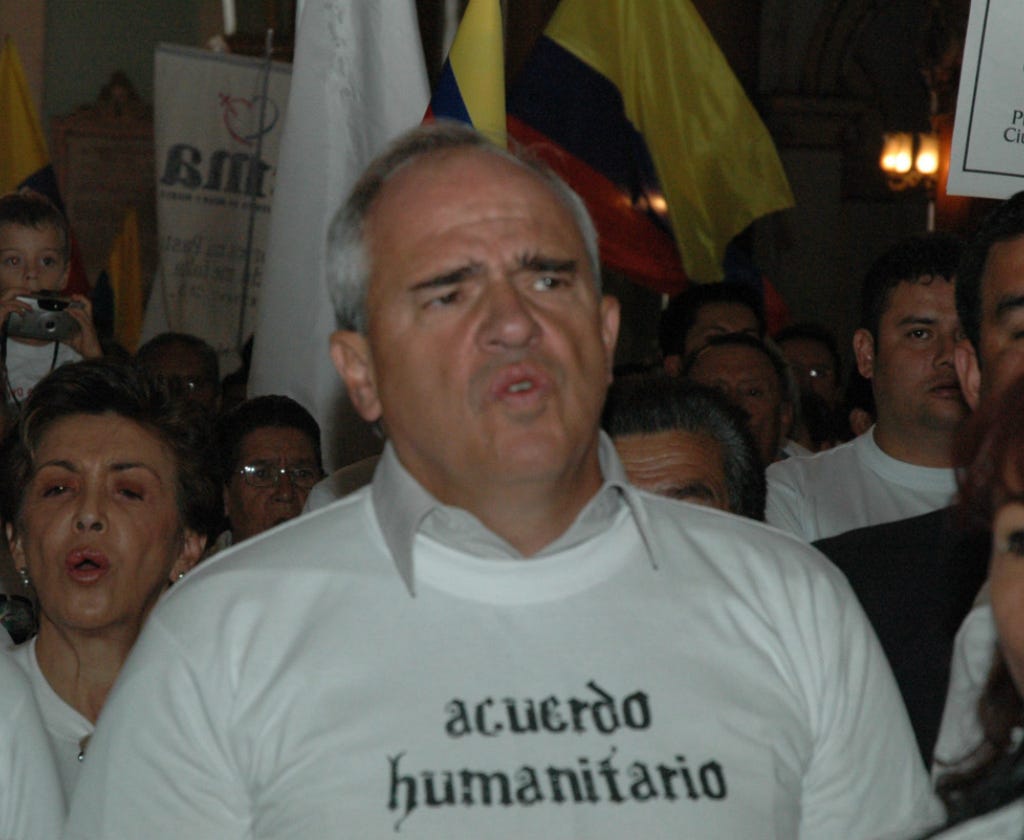
Ernesto Samper (1994-1998) also handed down various expressions. In my opinion the worst one was not what he said about drug money entering his electoral campaign but rather his comments on proposals for a new military code that would exclude certain crimes the military jurisdiction and pass them over to the ordinary justice system and that Due Obedience would not be accepted as a justification in human rights cases. Samper stated that:
It does not sound like the statement of a human rights defender, and as president he wasn’t one. But he turned up in the midst of the election campaign, nodded his head every once in a while, putting himself forward as a human rights defender. He did something similar in Petro’s campaign and even before that the Communist Party invited Samper to their congress where he gave a speech in favour of peace.[2] They put behind them the scandals that dragged his government through the mud such as his tooth and nail defence of the CONVIVIR, the legal façade given to right wing paramilitary groups, created under a decree from president César Gaviria and his minister for defence Rafael Pardo that Samper implemented or the Faceless Justice System, another of Gaviria’s inventions that Samper enthusiastically applied, jailing more than one communist using false and cloned witnesses.[3] Samper is now seen as a man of peace, a human rights defender, a man far removed from the armed conflict of the country. When he was president, nobody spoke of him in such terms. And nobody means nobody. Not even many of the Historic Pact that nowadays have their photos taken with him and share on social media as part of the electoral campaign.
Samper has always denied having any responsibility for the armed conflict and the human rights violations under his presidency. To himself, his government was a blameless government of little angels in the flesh. Samper will be remembered for his expression “it was all done behind my back” in reference to drug money entering his election campaign. He said it so vehemently that he seemed to forget that he was the candidate that the money benefitted. In truth, as far as Samper was concerned everything bad about his government was done behind his back.
In 2007 he got into an argument with Myles Frechette, the US ambassador to Colombia during his government, over the issue of paramilitaries, the CONVIVIR, and the general human rights situation. Samper replied in the best style of Uribe Vélez and with a gall on a par to him.
He took us for fools. To name just two: the generals Rito Alejo del Río and Uscátegui. Rito Alejo was in 1997 the general in charge of Operation Genesis in Urabá in which troops under his command operated in alliance with the paramilitaries. In 2012 he was sentenced to 25 years. Rito Alejo del Río was a key player in the paramilitary network, or as Javier Giraldo describes his long and bloody record, he was a “bulwark for the paramilitaries”.[5] Uscátegui was sentenced to 37 years in 2009 for the massacre of Mapiripan that also occurred in 1997 when Samper was president. There is also the case of Captain Rodrigo Cañas and the pool hall massacres in April 1996 in the town of Segovia. Not as a high a rank as the other cases, but it is noteworthy as Cañas was sentenced to 50 years and never set foot in his place of detention: the Tolemaida military base. No one knows where he went. Perhaps to Israel, perhaps he joined the paramilitary groups. No one knows.
Even in the cases in which the Colombian justice system worked Samper opted for congratulating the military on their dirty work, as in the case of Nydia Erica Bautista:
Samper always defended the military and denied that they violated human rights. In response to a resolution of the European Parliament in October 1996, he stated without blushing:
Throughout his presidency human rights groups took advantage of Samper’s pretty and public discourse on human rights to make a series of recommendations. Samper accepted the state’s responsibility for the Trujillo massacre that took place before his presidency, but despite the requests made he never implemented the recommendations of the commission of investigation. Various organisations also asked him to enact a law making forced disappearance a crime in compliance with Art. 12 of the Colombian Constitution. Amnesty International publicly requested he do so in September 1994 two months after he took over the presidency.[8] He didn’t do it; it fell to his successor Andrés Pastrana in the year 2000. Samper did little of what he was asked and following the murder of the lawyer Eduardo Umaña Mendoza, Amnesty did not hesitate in demanding that the “Colombian Government should tackle pattern of attacks against human rights workers”[9]
It was worth remembering that Umaña was a reference point for almost all those who are now in the Historic Pact and more than one of those who pose for photos with Samper. Samper is spoken of in terms that nobody used when he was president. Towards the end of his term, Amnesty International wrote an open letter to him that all those who back Samper now should read. It is very telling and the parts cited here describe him in terms that few dare use nowadays.
[3] As the witnesses identity was not known the same “witness” would appear in various different processes as if a different person in each case.
[4] Caracol (31/03/2007) Frechette: ‘El gobierno sabía que las Convivir se estaban convirtiendo en paramilitares’.
[5] Giraldo, J. (2003) El General (r) Rito Alejo del Río: baluarte del paramilitarismo bajo el blindaje de la impunidad.
[6] AI (1996) Op. Cit. p.4
[7] HRW (1996) Colombia’s Killer Networks.
[8] AI (18/09/1994) Colombia: Further information: “Disappearances”: President must promulgate draft law against “disappearances” and new concern: Death threats.
[9] AI (20/04/1998) Colombian Government should tackle pattern of attacks against human rights workers.
Ernesto Samper (1994-1998) also handed down various expressions. In my opinion the worst one was not what he said about drug money entering his electoral campaign but rather his comments on proposals for a new military code that would exclude certain crimes the military jurisdiction and pass them over to the ordinary justice system and that Due Obedience would not be accepted as a justification in human rights cases. Samper stated that:
As President and commander in chief of the Armed Forces I prefer to see the military fighting the subversives in the mountains and not in the country’s courts responding to groundless charges presented by their enemies.[1]
It does not sound like the statement of a human rights defender, and as president he wasn’t one. But he turned up in the midst of the election campaign, nodded his head every once in a while, putting himself forward as a human rights defender. He did something similar in Petro’s campaign and even before that the Communist Party invited Samper to their congress where he gave a speech in favour of peace.[2] They put behind them the scandals that dragged his government through the mud such as his tooth and nail defence of the CONVIVIR, the legal façade given to right wing paramilitary groups, created under a decree from president César Gaviria and his minister for defence Rafael Pardo that Samper implemented or the Faceless Justice System, another of Gaviria’s inventions that Samper enthusiastically applied, jailing more than one communist using false and cloned witnesses.[3] Samper is now seen as a man of peace, a human rights defender, a man far removed from the armed conflict of the country. When he was president, nobody spoke of him in such terms. And nobody means nobody. Not even many of the Historic Pact that nowadays have their photos taken with him and share on social media as part of the electoral campaign.
Samper has always denied having any responsibility for the armed conflict and the human rights violations under his presidency. To himself, his government was a blameless government of little angels in the flesh. Samper will be remembered for his expression “it was all done behind my back” in reference to drug money entering his election campaign. He said it so vehemently that he seemed to forget that he was the candidate that the money benefitted. In truth, as far as Samper was concerned everything bad about his government was done behind his back.
In 2007 he got into an argument with Myles Frechette, the US ambassador to Colombia during his government, over the issue of paramilitaries, the CONVIVIR, and the general human rights situation. Samper replied in the best style of Uribe Vélez and with a gall on a par to him.
That high-ranking officers of the armed forces of the country were linked to favouring paramilitary groups is totally false, it is just a strategy to discredit the government of the period.[4]
He took us for fools. To name just two: the generals Rito Alejo del Río and Uscátegui. Rito Alejo was in 1997 the general in charge of Operation Genesis in Urabá in which troops under his command operated in alliance with the paramilitaries. In 2012 he was sentenced to 25 years. Rito Alejo del Río was a key player in the paramilitary network, or as Javier Giraldo describes his long and bloody record, he was a “bulwark for the paramilitaries”.[5] Uscátegui was sentenced to 37 years in 2009 for the massacre of Mapiripan that also occurred in 1997 when Samper was president. There is also the case of Captain Rodrigo Cañas and the pool hall massacres in April 1996 in the town of Segovia. Not as a high a rank as the other cases, but it is noteworthy as Cañas was sentenced to 50 years and never set foot in his place of detention: the Tolemaida military base. No one knows where he went. Perhaps to Israel, perhaps he joined the paramilitary groups. No one knows.
Even in the cases in which the Colombian justice system worked Samper opted for congratulating the military on their dirty work, as in the case of Nydia Erica Bautista:
Following an unprecedented decision by the Procurator Delegate for Human Rights, in September 1995 an army brigadier-general in active service was dismissed from the armed forces for responsibility in the abduction, torture and murder of a political activist in 1987. The dismissal of Brigadier-General Alvaro Velandia Hurtado was strongly opposed by senior military commanders and sectors of Colombian Congress who attempted, unsuccessfully, to reinstate him. Following the Procurator Delegate’s initial call for his dismissal, General Velandia was decorated by the commander of the armed forces, on the order of President Samper. (bold not in original).[6]
Samper always defended the military and denied that they violated human rights. In response to a resolution of the European Parliament in October 1996, he stated without blushing:
It is not true, that the Colombian security forces have developed an emergency strategy, characterized by aid to paramilitary groups, extrajudicial killings, torture and disappearances.[7]
Throughout his presidency human rights groups took advantage of Samper’s pretty and public discourse on human rights to make a series of recommendations. Samper accepted the state’s responsibility for the Trujillo massacre that took place before his presidency, but despite the requests made he never implemented the recommendations of the commission of investigation. Various organisations also asked him to enact a law making forced disappearance a crime in compliance with Art. 12 of the Colombian Constitution. Amnesty International publicly requested he do so in September 1994 two months after he took over the presidency.[8] He didn’t do it; it fell to his successor Andrés Pastrana in the year 2000. Samper did little of what he was asked and following the murder of the lawyer Eduardo Umaña Mendoza, Amnesty did not hesitate in demanding that the “Colombian Government should tackle pattern of attacks against human rights workers”[9]
In June 1997 human rights defenders presented the Colombian Government with a series of proposals to help guarantee their safety. These included a call for members of the security forces responsible for human rights violations to be brought to justice, and for effective action to be taken to dismantle paramilitary groups. Human rights defenders also called for those members of the security forces supporting or operating in unison with paramilitary forces to be brought to justice.
If the Colombian Government had taken such decisive action Dr. Umaña Mendoza and other human rights workers might still be alive. (Bold not in original).[10]
It was worth remembering that Umaña was a reference point for almost all those who are now in the Historic Pact and more than one of those who pose for photos with Samper. Samper is spoken of in terms that nobody used when he was president. Towards the end of his term, Amnesty International wrote an open letter to him that all those who back Samper now should read. It is very telling and the parts cited here describe him in terms that few dare use nowadays.
During your administration, Mr President, human rights defenders have been persecuted on an unprecedented scale. More defenders have been killed in the last four years than during any previous government. Despite repeated commitments to protect human rights defenders your government has relinquished its responsibility and has preferred to hide behind euphemisms attributing the attacks to “fuerzas oscuras” (“dark forces”) which, it is claimed, can neither be identified, confronted, nor held to account.The indifference of your government to the plight of those who peacefully seek to protect human rights and the basic principles of democratic society has constituted at best gross irresponsibility and at worst criminal negligence…
The ambivalence of your government towards human rights organizations has allowed and quite possibly encouraged the escalation of attacks against defenders. Despite statements recognizing the legitimacy of their work, the failure of your government to take action against members of the armed forces, in active service and retired, who falsely accuse human rights defenders of links with subversive organizations has sent a clear message that the campaign of extermination will be tolerated…
It is, therefore, the incontrovertible responsibility of states to guarantee the free exercise of the right to promote and defend human rights. States are fundamentally obliged by international law to protect and promote this right, to prevent it from being threatened, restricted or suppressed and to protect the liberties and security of those who exercise it. Your government, Mr President, has singularly failed to fulfil that obligation.[11]
Amnesty International is a human rights NGO, but it is usually very diplomatic in the language used, so the tone of the letter is telling. Those that rehabilitated Samper and praise him despite the fact that he continues to deny the brutal record of his government, are traitors. They have betrayed the defence of human rights. They insult the memory of the victims of Samper’s government and reduce paramilitarism to just one president: Uribe Vélez, despite the role of all presidents’ in paramilitarism being well documented. Rewriting history in this way and cleaning up the image of such a person is an act of corruption.
Here I have laid out a brief presentation of Samper’s record. On the issue of human rights his record is long and includes states of exception that gave special powers to the military, reduced the age of criminal liability to 14, house searches without a warrant, censorship etc. It is also the case in economic terms, the surrender of natural resources, his attempt to introduce a mining code that favoured the multinationals and in passing his own companies.[12] It is a long list, with enough for not one but many books, doctoral theses even.
Here I have laid out a brief presentation of Samper’s record. On the issue of human rights his record is long and includes states of exception that gave special powers to the military, reduced the age of criminal liability to 14, house searches without a warrant, censorship etc. It is also the case in economic terms, the surrender of natural resources, his attempt to introduce a mining code that favoured the multinationals and in passing his own companies.[12] It is a long list, with enough for not one but many books, doctoral theses even.
Samper as president did everything that the members of the Historic Pact criticise, and despite this, they have him there as one of the stars of the moment. How little historic memory and dignity they have. I hope their reward for grovelling to such a person is worth it. The inclusion of people like him in the Historic Pact’s campaign says a lot about the poverty of their proposals, the lack of audacity and vision.
References
[1] AI (1996) Colombia a deepening human rights crisis.
[2] Semanario Voz (21/07/2017) Unidad para construir un nuevo país .
[1] AI (1996) Colombia a deepening human rights crisis.
[2] Semanario Voz (21/07/2017) Unidad para construir un nuevo país .
[3] As the witnesses identity was not known the same “witness” would appear in various different processes as if a different person in each case.
[4] Caracol (31/03/2007) Frechette: ‘El gobierno sabía que las Convivir se estaban convirtiendo en paramilitares’.
[5] Giraldo, J. (2003) El General (r) Rito Alejo del Río: baluarte del paramilitarismo bajo el blindaje de la impunidad.
[6] AI (1996) Op. Cit. p.4
[7] HRW (1996) Colombia’s Killer Networks.
[8] AI (18/09/1994) Colombia: Further information: “Disappearances”: President must promulgate draft law against “disappearances” and new concern: Death threats.
[9] AI (20/04/1998) Colombian Government should tackle pattern of attacks against human rights workers.
[10] Ibíd.
[11] AI (18/05/1998) Colombia: Open letter to Colombian President Ernesto Samper Pizano.
[12] Ó Loingsigh, G. (2003) La Estrategia Integral del Paramilitarismo en el Magdalena Medio. p.71
[11] AI (18/05/1998) Colombia: Open letter to Colombian President Ernesto Samper Pizano.
[12] Ó Loingsigh, G. (2003) La Estrategia Integral del Paramilitarismo en el Magdalena Medio. p.71
⏩ Gearóid Ó Loingsigh is a political and human rights activist with extensive experience in Latin America.


No comments