


 |
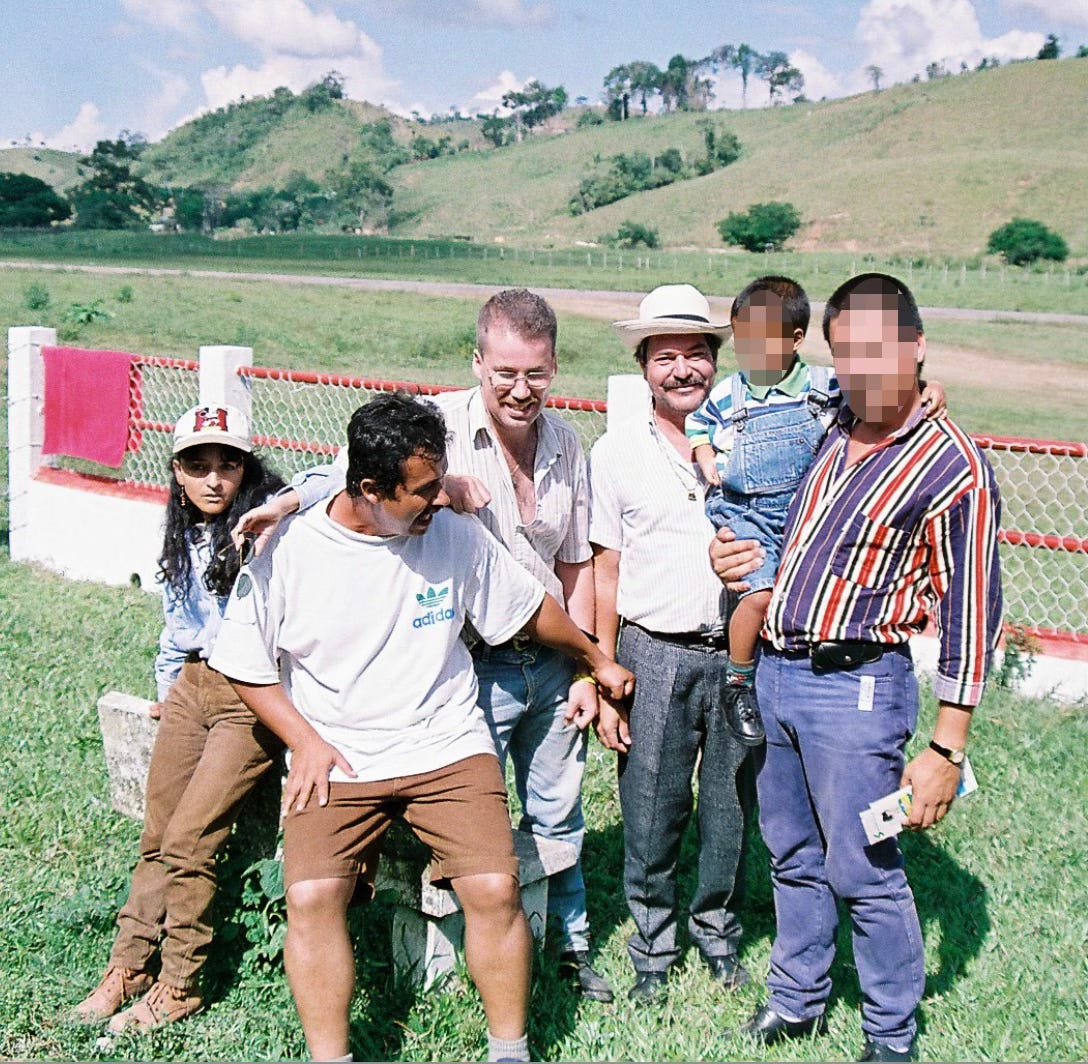
| Photo: From right to left Man with Child (pixelated) Ramiro with hat murdered in 2000, myself, Jaime Ortiz and Margarita Guzmán murdered in 1997. |
On February 23rd, whilst I read the Spanish press on the failed 1981 Coup d’Etat and how President Sánchez was going to declassify official files on the event the news came through that the Inter-American Court of Human Rights had laid the blame for the May 2000 murder of Ramiro Zapata in Segovia on the Colombian state. Once more it was clear why there had never been a coup in Colombia: They never needed one and the archives on State terrorism continue to be hidden.
I met Ramiro in 1995, when along with my then partner I went to live in Segovia for some seven months to work with the Human Rights Committee of the North East of Antioquia that Ramiro was president of. Ramiro didn’t delay in showing what he was made of, he was upfront and faked nothing. A police officer approached us as we entered the Municipal Palace in the centre of the town and said “Ramiro, once again with the Swiss” mistaking us for the Red Cross. Ramiro didn’t miss a heartbeat and replied “We don’t work with the Red Cross, they only make recommendations, we denounce”.
Later he explained that a Red Cross delegation had arrived in Segovia and asked for the Committee to vouch for them and accompany them. But the Colombians couldn’t travel in the Red Cross vehicles, protocols they claimed and neither were they willing to pay the cost of the transport, but like feudal lords they demanded that those they saw as their serfs, bowed down to them. They quickly learned that Ramiro wasn’t like that.
I came to hate that international structure of human rights with its well-paid functionaries living luxurious lives whilst they talked for protocols to justify their lack of action. That delegation visited a family whose house was riddled by the Bomboná Batallion of the Fourteenth Brigade, injuring a child in the foot. The Red Cross interviewed the family but did nothing. I can’t recall why, but it had to do with whether the incident was an act of war or not. Years later I experienced that condescending attitude in person in Barrancabermeja when an inter-institutional delegation was going to the Ciénaga del Opón to inspect the area from which many families had fled, and took refuge in the abandoned former secondary school in Barrancabermeja. Whilst we ate well in the Ciénaga the displaced went hungry as the functionary from the Mayor’s office explained that he had a lot of things to do before the mission and he hadn’t time to give to the order to send food to the school. Some live well in the midst of the conflict, others live well off the conflict.
Then the paramilitaries disappeared the comrade Manuel Navarro and an extraordinary meeting with the police Colonel, whose name I have forgotten and Colonel Ibarra from the Nueva Granada Battalion. None of the functionaries from the United Nations and other bodies criticised the state forces. The functionary who left the displaced without food looked down at the floor. They barely managed a couple of questions, not even recommendations. The only two to raise their voice was a female member of the team and myself. I vividly recall the astonished stupid look on their faces when I explained the reality of Manuel’s disappearance and the lack of action by the state forces. They didn’t move a finger, not even when we told them where the paramilitaries were holding him. I also recall the furious look on Colonel Ibarra’s face.
Ramiro was joyful but at the same time serious. He carried a copy of the Colombian Constitution on him and in the Army’s checkpoints he would quote it to the soldiers, giving out to them for their non-compliance or clear violation of it. He was not afraid of them. One night we were having a drink in the main square of Segovia. It was not a bar, it was a shop, belonging to Don Hector if I am not mistaken. A couple of tables and plastic chairs in the street, it was hardly a terrace. But I loved it. It was the 8th of October and the distance we could see the ELN’s urban militias paint the town with slogans to mark the last battle of Che. With their poor spelling they painted. One piece made us laugh - instead of painting Long Live the 8th of October, Day of the Heroic Guerrilla, they had put erotic guerrilla instead on the house of the Mayor’s bodyguard who was murdered some years later by the paramilitaries. Yes Che was fond of women, heroic and maybe erotic as well. But that night when they painted the town we were relaxed, when we saw the police pass by and shortly heard the sound of gunfire. Everyone ran inside the shop, except for my partner and Ramiro. When I asked her why she told me that she saw Ramiro so calm that she thought it was much ado about nothing. Ramiro interrupted her and said “No young woman, don’t pay any heed to me, I don’t flee, they can kill me where they find me!” That’s what Ramiro was like.
When they murdered him those words came to mind. That last time I saw him was in 1998 in Medellín. He said he was tired of the city and wanted to go back to the town, that the Ministry had tried to relocate him in very dangerous areas and it was better to be in Segovia rather than areas he did not know. I told him not to go. But he returned and survived for a while, but they were never going to forgive his tongue. Ramiro did not know who to keep quiet in the face of injustice and as soon as he arrived he took up his activities in defence of human rights again. One night they dragged him out and took him outside of the town in car. According to locals he didn’t keep quiet in the car either and let them have it.
His murder was not an isolated incident, but rather part of a continuum of murders in the northeast of Antioquia. We left Segovia in February 1996 and in April the military butcher, Captain Cañas carried out the Pool Hall Massacre in which 14 people were murdered. Cañas was sentenced to 50 years in jail for that. His place of confinement was the military base Tolemaida. We don’t know how long he spent there, perhaps he never set foot place in it as some victims lawyers went there and couldn’t find him and the military gave no explanation. The real response of the state to that massacre and wave of murders in Segovia, was on the one hand to declare Remedios and Segovia to be a Special Public Order Zone, thus strengthening the military and paramilitary control and to tap Ramiro’s phone and raid his house, in addition to repeatedly trying to put him on trial. They filed six criminal cases against him.
Later in 1997 a wave of murders in Segovia and the neighbouring municipality of Remedios began with 250 people murdered in the first six months of the year. Amongst those who fell under the bullets of state terrorism were Margarita Guzmán, who put us up, Jaime Ortiz - our right hand man and the trade unionist Nazareno Rivera, all of them linked to the Human Rights Committee. Those from the committee who survived the state terror onslaught took refuge in Medellín. Ramiro’s decision to return to the town was very brave, perhaps imprudent, but no more imprudent than accepting the state’s ill treatment in trying to relocate him to very dangerous zones he did not know. At least he knew Segovia well and his return was in line with his character and commitment to the struggle.
The court’s finding reminds us that Ramiro’s struggle against state terrorism still continues. The struggle against the half-hearted that only make recommendations is also valid, one lot depend on the non-committal responses of the other lot to act with impunity.
I came to hate that international structure of human rights with its well-paid functionaries living luxurious lives whilst they talked for protocols to justify their lack of action. That delegation visited a family whose house was riddled by the Bomboná Batallion of the Fourteenth Brigade, injuring a child in the foot. The Red Cross interviewed the family but did nothing. I can’t recall why, but it had to do with whether the incident was an act of war or not. Years later I experienced that condescending attitude in person in Barrancabermeja when an inter-institutional delegation was going to the Ciénaga del Opón to inspect the area from which many families had fled, and took refuge in the abandoned former secondary school in Barrancabermeja. Whilst we ate well in the Ciénaga the displaced went hungry as the functionary from the Mayor’s office explained that he had a lot of things to do before the mission and he hadn’t time to give to the order to send food to the school. Some live well in the midst of the conflict, others live well off the conflict.
Then the paramilitaries disappeared the comrade Manuel Navarro and an extraordinary meeting with the police Colonel, whose name I have forgotten and Colonel Ibarra from the Nueva Granada Battalion. None of the functionaries from the United Nations and other bodies criticised the state forces. The functionary who left the displaced without food looked down at the floor. They barely managed a couple of questions, not even recommendations. The only two to raise their voice was a female member of the team and myself. I vividly recall the astonished stupid look on their faces when I explained the reality of Manuel’s disappearance and the lack of action by the state forces. They didn’t move a finger, not even when we told them where the paramilitaries were holding him. I also recall the furious look on Colonel Ibarra’s face.
Ramiro was joyful but at the same time serious. He carried a copy of the Colombian Constitution on him and in the Army’s checkpoints he would quote it to the soldiers, giving out to them for their non-compliance or clear violation of it. He was not afraid of them. One night we were having a drink in the main square of Segovia. It was not a bar, it was a shop, belonging to Don Hector if I am not mistaken. A couple of tables and plastic chairs in the street, it was hardly a terrace. But I loved it. It was the 8th of October and the distance we could see the ELN’s urban militias paint the town with slogans to mark the last battle of Che. With their poor spelling they painted. One piece made us laugh - instead of painting Long Live the 8th of October, Day of the Heroic Guerrilla, they had put erotic guerrilla instead on the house of the Mayor’s bodyguard who was murdered some years later by the paramilitaries. Yes Che was fond of women, heroic and maybe erotic as well. But that night when they painted the town we were relaxed, when we saw the police pass by and shortly heard the sound of gunfire. Everyone ran inside the shop, except for my partner and Ramiro. When I asked her why she told me that she saw Ramiro so calm that she thought it was much ado about nothing. Ramiro interrupted her and said “No young woman, don’t pay any heed to me, I don’t flee, they can kill me where they find me!” That’s what Ramiro was like.
When they murdered him those words came to mind. That last time I saw him was in 1998 in Medellín. He said he was tired of the city and wanted to go back to the town, that the Ministry had tried to relocate him in very dangerous areas and it was better to be in Segovia rather than areas he did not know. I told him not to go. But he returned and survived for a while, but they were never going to forgive his tongue. Ramiro did not know who to keep quiet in the face of injustice and as soon as he arrived he took up his activities in defence of human rights again. One night they dragged him out and took him outside of the town in car. According to locals he didn’t keep quiet in the car either and let them have it.
His murder was not an isolated incident, but rather part of a continuum of murders in the northeast of Antioquia. We left Segovia in February 1996 and in April the military butcher, Captain Cañas carried out the Pool Hall Massacre in which 14 people were murdered. Cañas was sentenced to 50 years in jail for that. His place of confinement was the military base Tolemaida. We don’t know how long he spent there, perhaps he never set foot place in it as some victims lawyers went there and couldn’t find him and the military gave no explanation. The real response of the state to that massacre and wave of murders in Segovia, was on the one hand to declare Remedios and Segovia to be a Special Public Order Zone, thus strengthening the military and paramilitary control and to tap Ramiro’s phone and raid his house, in addition to repeatedly trying to put him on trial. They filed six criminal cases against him.
Later in 1997 a wave of murders in Segovia and the neighbouring municipality of Remedios began with 250 people murdered in the first six months of the year. Amongst those who fell under the bullets of state terrorism were Margarita Guzmán, who put us up, Jaime Ortiz - our right hand man and the trade unionist Nazareno Rivera, all of them linked to the Human Rights Committee. Those from the committee who survived the state terror onslaught took refuge in Medellín. Ramiro’s decision to return to the town was very brave, perhaps imprudent, but no more imprudent than accepting the state’s ill treatment in trying to relocate him to very dangerous zones he did not know. At least he knew Segovia well and his return was in line with his character and commitment to the struggle.
The court’s finding reminds us that Ramiro’s struggle against state terrorism still continues. The struggle against the half-hearted that only make recommendations is also valid, one lot depend on the non-committal responses of the other lot to act with impunity.
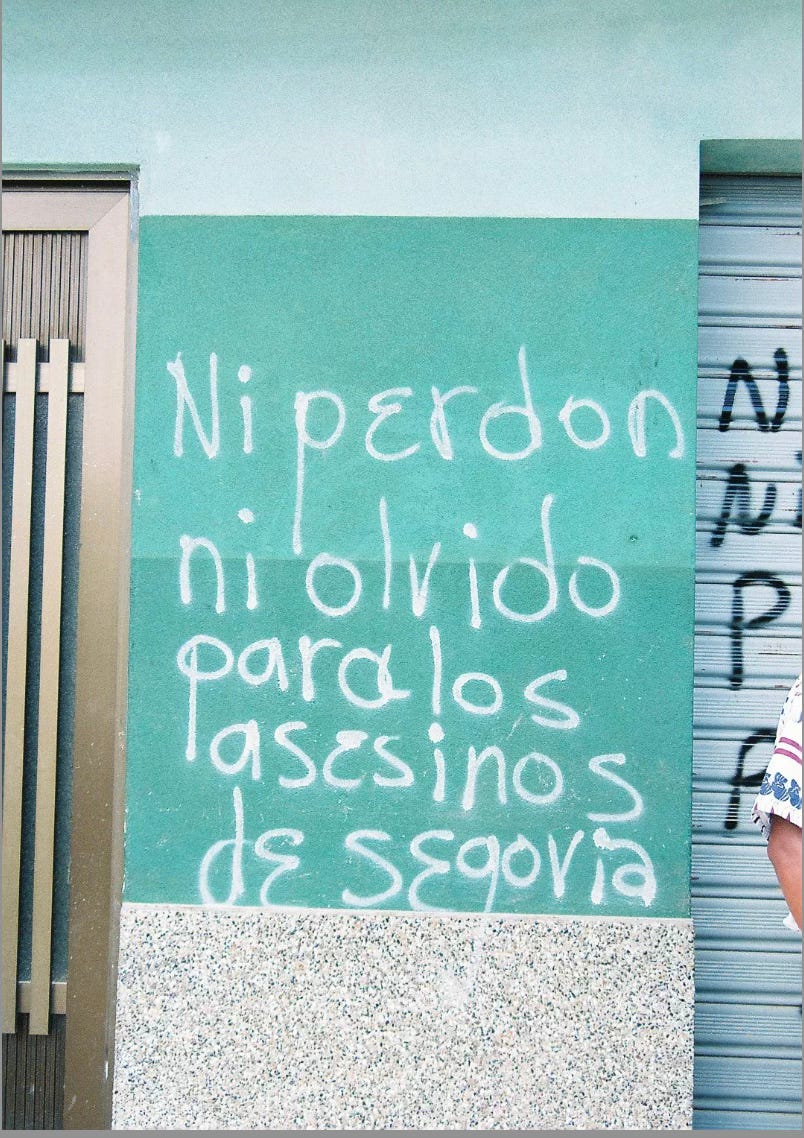 |
| Photo: Neither forgive nor forget the murderers of Segovia. Graffiti 1995. |
I left Segovia in February 1996 and I have not gone back. I may never return. I don’t even know whether I want to. Segovia was a watershed in my life. It is also the beginning of my long journey writing about Colombia. They say the pen is mightier than the sword, but when I think of people like Ramiro I would like to have the hatchet men of Segovia in front of me with that sword to hand. I don’t know what I would do, as I am not violent by nature. But I would like to think that I would dare to try the sword instead of the pen. Justice is not a judgement of an international court, it is the truth and punishment of state terrorists. And so far we don’t know the truth and they haven’t convicted anyone for the murder of Ramiro and other members of the Human Rights Committee. Meanwhile I continue to write for everyone, for Ramiro for a victory over state terrorism and over those who only make recommendations.
⏩ Gearóid Ó Loingsigh is a political and human rights activist with extensive experience in Latin America.


No comments