


 |
| Image from internet |
The phrase ordinary people crops up a lot nowadays. It has been around for quite some time. You hear journalists frequently using it, but it came into vogue on the Left. Listen to any radio or TV show and you will hear representatives of Left organisations always using it. Cut backs affect ordinary people, apparently. The term is so ubiquitous that even people who use the term working-class sometimes slip in the phrase “ordinary people”. It is like those nonsense terms invented by right-wing economists, such as negative growth. Utter nonsense, if the economy is not growing it is shrinking, stalling, stagnating etc. but I have even found myself repeating such nonsensical terms.
So, who are these ordinary people? And how did they become so banal? Why is there nothing of note about them at all, why so ordinary? Is there nothing about them that stands out? Apparently not. Language matters and how we use it has an impact; it is part of a wider justification of policies and exclusions. In our modern “inclusive” society, you have to watch your Ps and Qs as the saying goes. Include a hundred and one letters in some alphabet soup invented by the middle-class, but never you dare include working-class people. They are just ordinary.
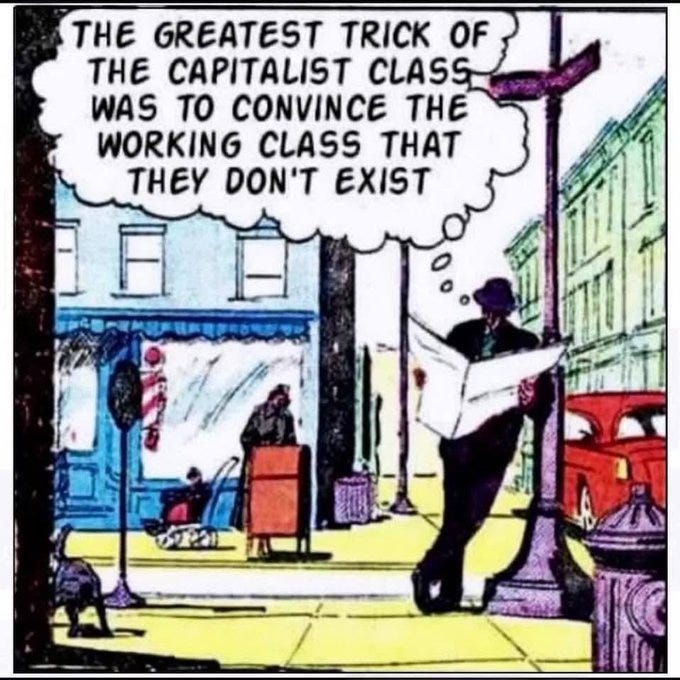
Once upon a time, when they realised there were good jobs to be had in toning down their speech, the middle-class representatives of Left organisations in many parts of the world, but particularly in Ireland and Britain began to drop references to the working-class, like it didn’t exist. Something similar happened in the US where the mainstream media cannot bring itself to talk of the working-class, there is only the middle-class, sometimes referred to as the working middle-class and then the rich. But in Ireland and Britain it is the Left that denies the existence of the working-class by talking about these mythical banal ordinary types that abound everywhere. They are, it is insinuated, in a difficult situation perhaps as a result of how ordinary they are, not because they belong to the working-class.
I took a look at the People Before Profit website as they are one of the main culprits and purveyors of this nonsense in Ireland as are their British masters in the SWP. I shouldn’t have been surprised, it is even in the name People Before Profit, not workers, not the working-class. Here is what they said about the new rental bill.
It is clear to everyone now that the Government is dancing to the tune of speculators and corporate landlords who are profiteering from the housing crisis and the misery it causes for so many. If only the Government would serve the interests of ordinary people with the same unwavering determination.[1]
If you substitute working-class for ordinary people you see how ridiculous their bended knee appeal to the government is. They do occasionally say the poor and I was surprised to see them say “ordinary working class” in one article, though these are exceptions in their public utterances. But it is not just them, across the board organisations on the Left, the mainstream media and even the right-wing parties in the coalition government use the term ordinary people.
Is this important? Yes, it is, one of the ways of telling people they are worthless and should bow to their “betters” (why is there no “worsers”?). It tells them they are ordinary, nothing but run of the mill. The corollary though, is that the rich are rich, not because they are the upper-class or bourgeoisie to use a Marxist expression, but unlike you, they are extraordinary, gifted, talented, clever. If you look at Donald Trump or Boris Johnson and see someone gifted or élite, then you need to see an ophthalmologist or psychologist. Simone Biles is a gifted élite athlete, those two, very much representative of their class are thick, banal gobshites, to use a local phrase. The extraordinary ones are the exception that proves the rule, though they are lauded in the media as somehow being the rule when it comes to the rich.
This nonsense crept in during the 1990s. It wasn’t some semantic shift, a new or better term, an expression that was easier to understand. It is thoroughly vague. The phrase does not describe the class of the people: it does not describe their relationship to capital and labour. Sounds a bit bible bashing or Capital bashing that last expression. So, let’s put it in simple terms, that even PBP/SWP could understand, it doesn’t say whether these people work for a living and are at the mercy of their bosses, or whether they are the bosses. They are just ordinary. Their class is denied. Lots of middle-class types have made a living talking and writing about this, feigning a sophistication and understanding they actually lack, regardless of the letters after their name: that’s a PhD to you, not the alphabet soup, though it may include their “pronouns”. The following quote is from one such commentator, typical of the ilk, and a former radio show host who describes herself as an activist and wellness entrepreneur (let’s not go there). She basically says the working class does not exist, in its place exists a Precariat.
The precariat is not a new word for the working class–it’s a fragmented, unstable, and deeply precarious class, whose members live on the edge of financial collapse. It is the adjunct professor teaching semester to semester, the rideshare driver navigating surge pricing, the freelance writer juggling contracts. What connects them is not the kind of work they do, but the conditions under which they labor: temporary, unstable, and without a safety net. This is not Marx’s proletariat; it is something new…[2]
Like many of the trendy liberals, she hasn’t much of a clue about Marx or even of history, no deluxe edition of some book on precarious work, strategically placed on the coffee table, whilst you sip whatever takes your fancy. This is exactly Marx’s proletariat. Stable working conditions, economic security were the conquests of the… yes, the working-class. They didn’t always exist and they never existed for everyone at any point, anywhere in capitalist economies. She is oblivious to how even at the height of the post war boom, some groups of workers in Europe and elsewhere queued up early in the morning to be hand-picked for jobs. These were not migrant workers, though this type of work was ruthlessly imposed on them as well and is still to be seen nowadays amongst agricultural workers in the US and even in Europe. Our latte sipping hipsters have no monopoly on insecurity. She also seems to think that all working-class jobs were the same before. They were not. Miners and dockworkers were as geographically and socially distinct as uber drivers and teachers are now. What united them was not some rubbish about perception, but the material reality of the class they belonged to. Italian dock workers recently shut down Italy in solidarity with Gaza. It was not because they do the same work as the Palestinian working class, it was a question of politics, solidarity and recognising their common enemy, which to the horror of the blue hair brigade is not the person who doesn’t use your pronouns, but your own capitalist class. She goes on with the following gem.
The great insight of Marx was that our material conditions shape our ideas. But what happens when those conditions are so diverse that they are no longer so easily categorized into binaries? What happens when race, debt, and identity intersect to fragment solidarity? How do we fight back when our enemies are algorithms, landlords, multinational corporations and financial institutions?
With the exception of the algorithms, none of this is new as racial exploitation and divisions are as old as the hills, as old as the slave trade, as old as all the attempts to divide workers along racial lines. Given her own racial background, she could hardly be unaware of this. Debt is not new either, nor is the lack of access to credit, and as for identity, well that sounds new. But it is not. It was the working-class identifying with the bourgeoisie, against the material reality of their existence, that allowed huge numbers of them to go to war and slaughter each other. Really, these arguments are so banal, so ordinary that I find it even more infuriating than when the middle-class refer to us, not by our class but as ordinary people. She is but one example. The internet is full of such liberal commentators and academia is awash with them. Of course, the Left organisations in Ireland and Britain are led by these types.
Another such commentator headlines his article as The Political Marginalization of Ordinary People. He half apologises for the term ordinary people as he uses it as a stand in for another term. No, not the working-class. This snob says that he is “using “ordinary workers” and “ordinary people” in lieu of the off-putting “less-skilled workers” and “less-educated voters.””[3] Though he does talk about class at times, but more in the sense of how we have moved away from class conflict, but it is nice to know that he uses this term instead of other terms we might readily identify as the insults they are: polite middle-class speak for useless and stupid. It brings to mind that horrible expression from social climbers, of which the Left is plagued with who say things like I am economically working class (the mortgage adviser set them right on that one) but I am culturally middle-class, i.e. they have a degree, like reading and watch art-house cinema, particularly films that depict the lives of the working-class. In fairness to him, his Think Tank the Niskanen Center actively argues for a capitalist welfare state, he doesn’t claim to be a socialist. The non-existence of the working-class is an age-old refrain. “Each decade we shiftily declare we have buried class; each decade the coffin stays empty.”[4] Though they only declare they have buried the working-class, the middle-class and upper-class are never declared to be dead. You have to be alive to cash in your ill-gotten gains.
Which brings us back to the Left talking about ordinary people. The working-class exists, unlike the IRA it really didn’t go away or disappear, but it was like them defeated. The rise in precarious work and bad working conditions is not some new hip gig economy for anxious middle-class types worried whether they will have to sell their deluxe coffee table editions. It is due to one simple thing: the defeat of the working class and mainly affects those without the deluxe editions. We no longer get good working conditions, stable contracts and benefits because the unions were defeated and then defanged, though in the case of many unions in Ireland like SIPTU it carried out its own tooth extractions before it was defeated. But in Britain we had huge struggles such as the miners’ strike in the 1980s, the Wapping dispute amongst others. These defeats were part of the return to Victorian style working conditions.
Despite the language of the middle-class spokespersons of Left organisations the working-class exists. We exist and there is nothing ordinary about us. Workers on the dole, minimum wage or even on what used to be considered good salaries struggle to make ends meet. Getting through to the end of the month in such circumstances is extraordinary. Dealing with and surviving a health system that simply prioritises profit over health is extraordinary (though not all make it). Actually, managing to get through an education system where it places every possible obstacle in your way is extraordinary. But even by middle-class standards, the working-class produce extraordinary people in the arts. But because most of them never enjoy any commercial success, in fact some don’t even seek it as such, but work away in their communities, it doesn’t count. But there is no end of people beavering away and some even grab the attention of those middle-class types who have made a career out of talking and writing about ordinary people without producing much that is extraordinary themselves.
Working class writers are not as visible or successful because the middle-class sets out deliberately, or in some cases just as the result of their default prejudice, to exclude them. Publishing in Britain for example is an upper-middle class industry. In 2014, only 12% of publishing professionals were from a working-class background and in 2022, full time writers earned just £7,000. “Publishing is not only difficult to enter for those from working-class backgrounds – it’s nearly impossible to sustain a career within.”[5] Their exclusion is such that one author, Douglas Stuart, a Booker Prize winner, felt impelled to set up a Working-Class Writers Festival to overcome the middle-class gatekeepers.
…working-class writers need to be a part of the conversation when it comes to those important decisions; about who gets to be published, who gets to be reviewed in magazines and newspapers, and who gets to be longlisted and shortlisted for literary awards. The conversation about access needs to be embedded in every policy of every literary charity and organisation, ensuring that working-class writers, both published and unpublished, are not held back by gatekeepers, but that we are able to become the gatekeepers, guaranteeing that the voices that need to be heard find their way to the top, not by luck but because there is a clear route to success.[6]
I fully agree with him. But could you imagine an author submitting a manuscript saying here I am, an ordinary person, writing an ordinary novel about ordinary people? The short shrift they might get would be less than ordinary. Yet, we accept that the middle-class spokespeople of Left organisations refer to us as ordinary.
The term ordinary people is an insult, an extraordinary insult. It is even more extraordinary that groups that claim to be socialist can rarely bring themselves to mention class in their public statements. There is not much point in having some long obtuse internal document that talks about the working-class if when given the chance to speak about it, they duck and dive and go for some amorphous insult like ordinary people. There are of course countries where the term working-class has not fallen out of use, or not as much as in Ireland and Britain. There are languages in which it sounds strange. And perhaps strangely enough, the term proletariat crops up in some parts and contexts. Though we might have to buy a dictionary for many members of PbP/SWP for that particular word. Meanwhile we exist and their service to capitalism by erasing us through language will serve them well when they go back to the career paths mammy and daddy laid out for them, or when they apply for government funding, which most of them do at some point and on occasions get funding to erase another group in society: women. They apparently don’t exist either, anyone who thinks they are a woman, apparently is one. These concepts are not unrelated. The working-class doesn’t exist and neither do women. But we will continue to exist, as will women, when these middle-class reprobates are consigned to the dustbin of history.
References
[1] PBP (11/02/2026) Richard Boyd Barrett Slams Government for ‘Ramming Through’ Residential Tenancies.
[2] Brown, P. (06/12/2024) The Precarious Majority: Why “Working Class” Is No Longer Relevant.
[3] Lindsey, B. (12/10/2026) The Political Marginalization of Ordinary People.
[4] Richard Hoggart cited in Merrick, J. (17/02/2020) Culture is ordinary: why the arts must not become the preserve of the elite.
[5] Flynn, C. (19/06/2025) Widening the literary landscape: Where are all the working class stories?
[6] Carthew, N. (14/11/2022) Our stories matter: why we need more working-class voices in quality fiction.
[1] PBP (11/02/2026) Richard Boyd Barrett Slams Government for ‘Ramming Through’ Residential Tenancies.
[2] Brown, P. (06/12/2024) The Precarious Majority: Why “Working Class” Is No Longer Relevant.
[3] Lindsey, B. (12/10/2026) The Political Marginalization of Ordinary People.
[4] Richard Hoggart cited in Merrick, J. (17/02/2020) Culture is ordinary: why the arts must not become the preserve of the elite.
[5] Flynn, C. (19/06/2025) Widening the literary landscape: Where are all the working class stories?
[6] Carthew, N. (14/11/2022) Our stories matter: why we need more working-class voices in quality fiction.
⏩ Gearóid Ó Loingsigh is a political and human rights activist with extensive experience in Latin America.


Only skimmed through and will read the rest later when back, but why the dig at People Before Profit and the Socialist Workers Party? I had the impression they had good intentions?
ReplyDeleteI think the author believes they are more liberal than left
DeleteCarve it on my tombstone “ordinary working class and proud”
ReplyDeleteOrdinary people is a common enough phrase to describe the average citizen. “Ordinary working class and proud” might be satisfactory to the author.
Delete