Gearóid Ó Loingsigh ☭ writing in Substack on 12-February-2026.
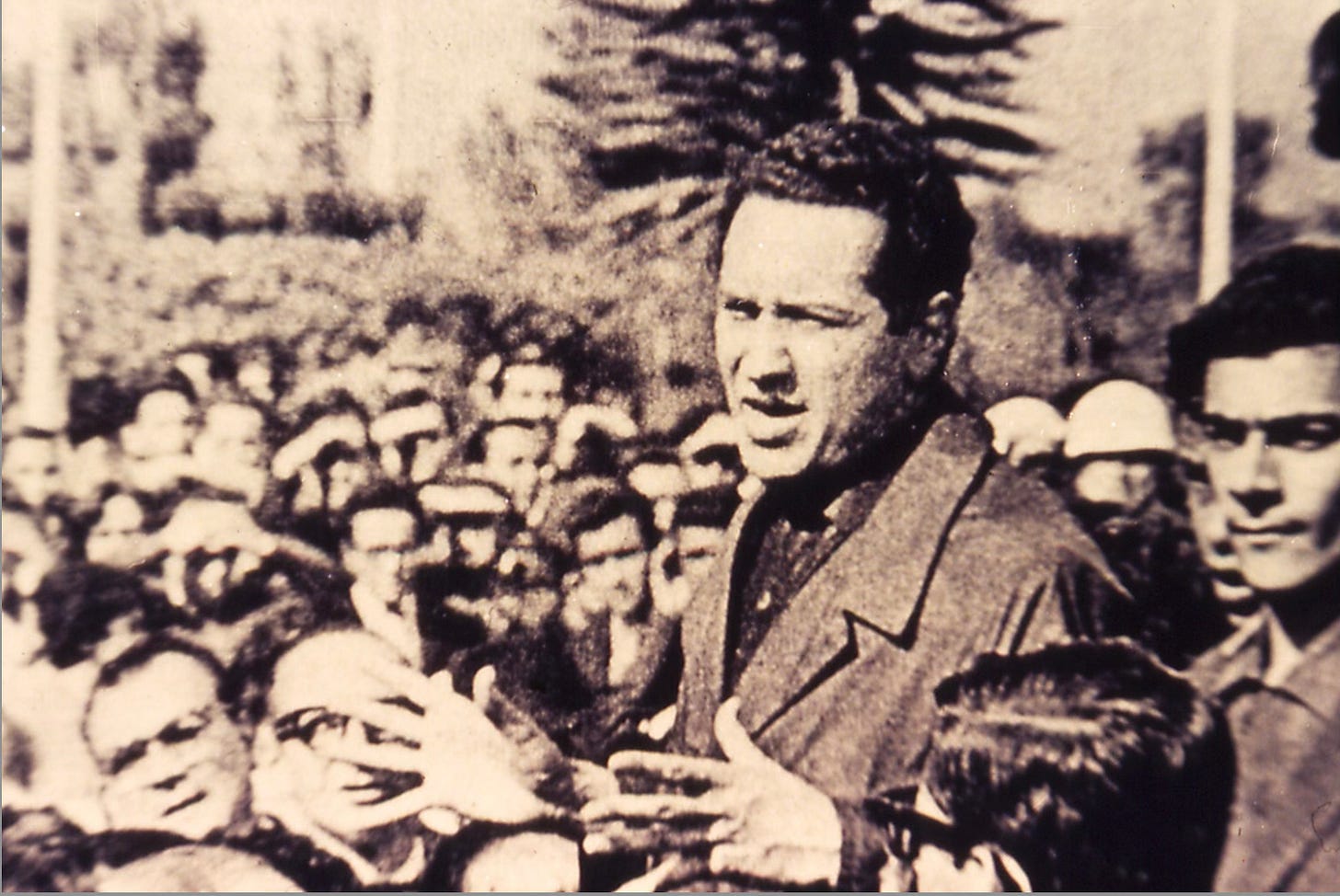
Camilo Torres addressing a public meeting
After 60 years it was announced that they had finally found the remains of the revolutionary priest Camilo Torres, fallen in combat on February 15th 1966 in the ranks of the guerrilla group, the ELN. The state disappeared his body and the strange aspect of it all is that it was the ELN itself that announced it and not the state that disappeared him.

The discovery gave some impetus to the debate on the ELN’s actions, the political and moral positions of Camilo Torres and whether the priest would agree with the today’s ELN or not and whether he would be a militant of an ELN of this nature or in opposition to the said group. This last point seems to be what most excites the social democrats, ex-members of the ELN currently given over to the liberalism of the former right-wing president Juan Manuel Santos and other “pretty” expressions of the Colombian bourgeoise. But this is the least important point. However, it falls to me to deal with it, even if only to dismiss it as a relevant debate.

Joe Broderick has a footnote in the history of Colombia as the author of the great biography of Camilo, an historic book due to its content and the time in which it was written. It is an excellent book, but being a good writer does not make Broderick a political analyst of the reality of Colombia and yet that is what they have turned him into, partly because his current positions coincide with the Zeitgeist. He coincides with Petro’s positions, those of his party the Historic Pact, and of more than one ex-militant of the ELN who live off the tale of their former armed militancy and the current opposition to the ELN. Of course, they have the right to change their opinion and even to criticise all that they see wrong with armed organisations and no doubt there will be issues on which we will say they are right, as a stopped watch tells the right time twice a day and even the greatest drunkard eventually hits the bullseye after numerous attempts.

Broderick, in addition to placing in doubt that the remains found are those of Camilo stated in his interview with El Espectador that the guerrilla movement in Colombia was a failure,[1] and he has a point in the sense that no guerrilla group took power or came even close. This is down to many factors such as the political and military errors of the insurgencies as well as the repression of the mass movement and the bloodbath from the right-wing paramilitary groups. We should never forget that many of the current champagne socialists used to describe the paramilitaries as the state’s loose cannon and they even published reports that argued that. We are where we are not only because of the insurgencies’ mistakes but also due to the murderous strategies of all of Colombia’s presidents, without exceptions. There is not a single president since the founding of the ELN that does not have innocent blood on his hands and I include Petro in that. And as much as the champagne socialists might wish to think so, the paramilitaries did not go away. They are still around. As the priest Javier Giraldo s.j. explains:

The impunity of the most horrendous crimes such as massacres, executions, disappearances and others of such severity is solved today though the strategy of ANONYMINITY, but the daily paramilitary crimes have found another widespread solution for their impunity, which is the INSTITUTIONAL AND PR ADJUSTMENT TO THEIR MODUS OPERANDI.[2]

If they tell you that it doesn’t exist, or is something else, well then that’s the way it is. When it comes to discussing what Camilo would have done or what way forward now, the champagne socialists describe a country that seems more like Switzerland than Colombia.

Broderick also states that both Camilo and the Cura Pérez, the first commander of the ELN for many years would be horrified in the face of what the ELN is now and said that what must be done is to hunt them down and finish them off and we have to wage war.[3] Of course, Broderick is not offering up either of his two sons nor grandchildren for this war. The war is easier in his study room in Bogotá, but not so much in the countryside nor the working-class neighbourhoods where the insurgencies had some influence in other times. And this is the central point of the attempts by intellectuals to differentiate between the ELN of Camilo’s time (and the Cura Pérez in the strange case of Broderick) and the ELN today. It is not about a discussion on the path the left should follow but rather a justification for the path they want the state to go down with the support of those who once upon a time took up arms against the state.

It is nothing new, a number of former ELN militants such as Lucho Celis, Carlos Arturo Velandia amongst others and academics such as Carlos Medina Gallego have pushed for non-negotiated solution with the ELN. In the case of Medina Gallego, he was ahead of Broderick and in 2019 asked for the escalation of the war against the ELN.[4] It would seem that the experts on the ELN want to get their pension over the bodies and bones of the ELN. Both neither he nor the other ELN experts are particularly innovative in that. In fact, they got there quite late. Before them, various leaders of the M-19 guerrillas backed a war not only against the guerrillas but even against their own demobilised comrades from M-19. Rosemberg Pabón, the commander of the storming of the Dominican Embassy and the taking of multiple hostages and Everth Bustamante joined the ranks of the extreme right and were members of Uribe’s Democratic Centre, the party of the false positives, of the drug traffickers and the handover of the country to foreign capital. A pretty path awaits our experts on the ELN.

But going back to the issue of Camilo, both Broderick as much as Medina Gallego are right, as is also Antonio García the first commander of the ELN. They will all find something in life to back their position. Historic figures lend themselves to be interpreted or re-signified. Though the ELN has something in their favour, other than the clumsiness of the others: Camilo was not a pacificist. Whether Camilo would be in the ELN or not, is pure speculation as many guerrillas have renounced their past, whilst others from that period have reaffirmed it. But Camilo fell in combat and we can’t know with full certainty what he would have done. But we know what he did: he was a social leader and furthermore he rose up in arms against the state. It is worth asking why he did it, what was the country like back then and what is it like now. There are various factors and I don’t aim to come up with an exhaustive list, at the end of the day I am not writing a doctoral thesis, I will leave that to the well-financed favoured “children” of the Colombian bourgeoise such as Medina Gallego and Alejo Vargas.
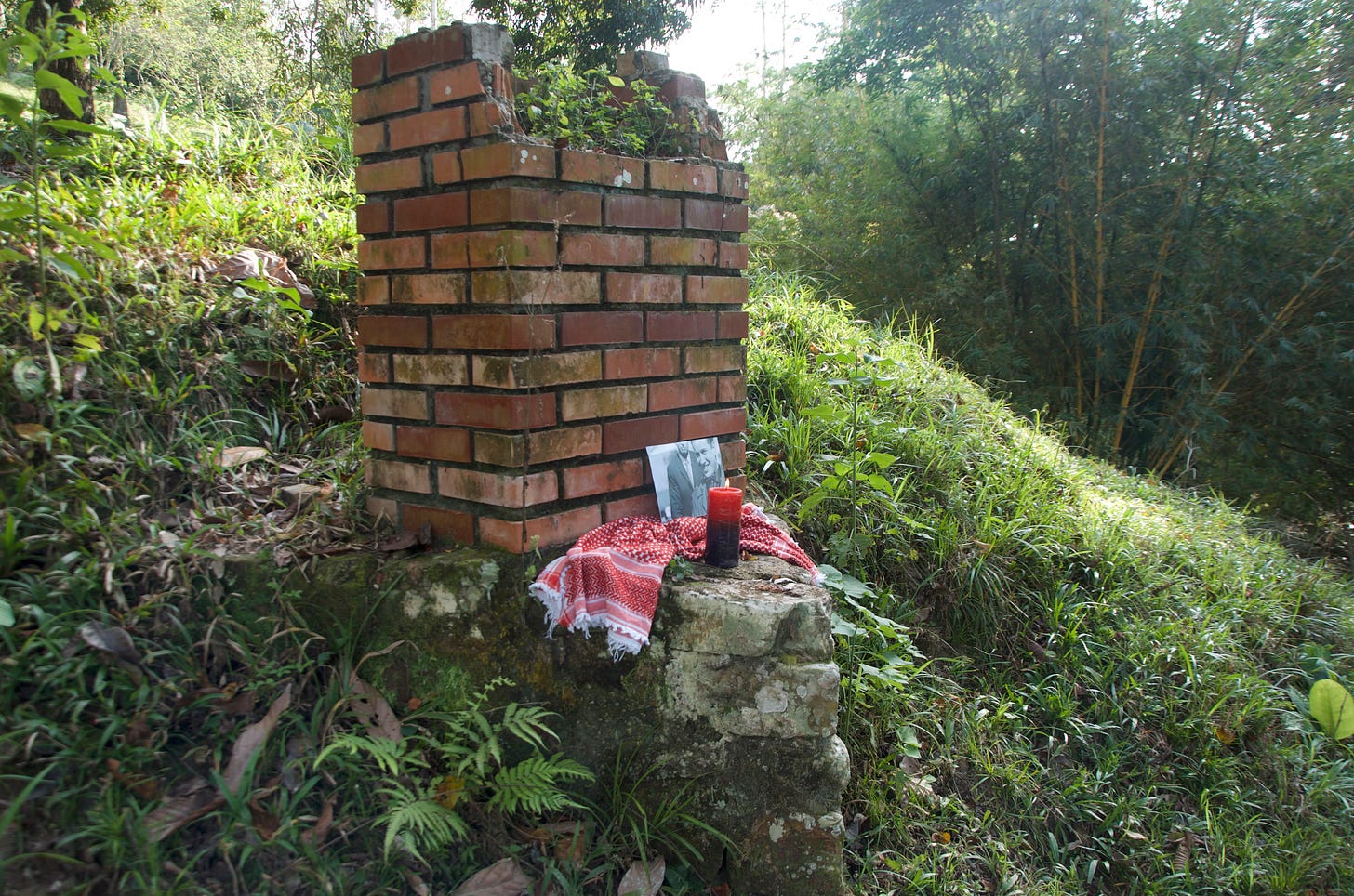
Photo: GOL, a damaged monument marking
the spot where Camilo fell in combat.
When Camilo joined the ELN he was convinced that there was no democratic and peaceful solution to the country’s problems. Poverty was rampant and an agrarian reform was urgently needed. The country was dominated by an oligarchy that concentrated power and the wealth of the nation in a small number of hands from a small number of families. The US military directly interfered in the country and moreover played a key role in the bombings of peasants and the setting up of paramilitary groups.

Any similarity to the current moment is not coincidental, though there are clear differences between the two periods.

Of course, as has happened the world over, poverty has decreased or at least the most abhorrent manifestations of it have. Social indicators have improved. But there continues to be a lot of poverty in Colombia and the gap between the poorest and the richest is still problematic. The Gini is situated in 54.8[5]with the richest 1% of the population having 17.9% of income and the poorest 40% getting just 10.3% of income.[6]

As for land, it is accepted by one and all that the concentration of land ownership is today greater than it was in the 1960s. In 2017, Oxfam published a report on the concentration of land. According to the study, 1% of the UPA (Agricultural Production Units) amass 73,78% of the productive land of the country.[7] This figure does not include indigenous lands. If we look at the UPAs over 2,000 hectares in size, we find that they “represent 0.1 percent of the total (2,362 holdings); on average they are 17,195 hectares in size and occupy almost 60 percent of the total area included in the census (40.6 million hectares, or 58.72 percent).”[8]

In Camilo’s day access to health was precarious due to a lack of coverage and today it is precarious because it is a private business dominated by foreign capital, mainly Spanish, such as the Keralty Group. It is worth pointing out that Petro’s reform is not about imposing free state medical care but rather about reforming the private medicine that the state finances.

Regarding US military interference, the situation today is worse than in the 1960s. The US has control of seven military bases in Colombia and mercenary companies are contractors with the state and their operations enjoy complete impunity within the country. Now after Petro’s prostration before Trump, the future looks dark. No sooner had the meeting finished, to keep Trump happy, the bombardments of Catatumbo and Nariño began.

Lastly, there is the question of democracy in Colombia. You can vote in Colombia as you could in Camilo’s time, though the elections change little and votes are still bought with money or at gun point. The “democracy” can be seen in the murders of social leaders and also of demobilised guerrillas. According to the NGO, Indepaz, in 2025 187 social leaders were murdered and in 2024 another 173, whilst 39 demobilised members of the FARC were murdered in 2025 and 31 in 2024.[9] So much democracy!

Not even the right to protest exists. The social explosion of 2021 was violently repressed with the police murdering more than 80 people, imprisoning the youths of the Frontline (Primera Línea) who responded to the state violence suffering all types of abuse, including sexual abuse and many ended up in jail where they languished whilst the champagne socialists discussed the year and variety of their wines, bought through their high salaries and more than one theft of public funds. This movement which was not pacific, answered the state’s bullets with rocks, the gases with masks, the batons with shields and made Petro’s election possible, who once in power betrayed them.

In such a situation what would a reincarnated Camilo do? Camilo was above all a fighter, I don’t know whether he would fight in the mountains or in the social movements, whether he would be in the ELN or in social movements. In life he did both. He was a social leader and he rose up in arms against the state. What I think can be said is that he would be part of the struggle. He wouldn’t join the champagne socialists in their coffee houses and bars in sterile debates and to borrow Broderick’s phrase he would be horrified by… the poverty, US interference, the lack of democracy, the corruption in Petro’s government, the nepotism, the lukewarm measures that don’t change anything and in no way would he see Petro purring on Trump’s lap in Washington as the culmination of his dreams and hopes for the Colombian people.

References

[1] El Espectador.

[2] Giraldo J. (2024) La delincuencia paramilitar.

[3] El Espectador.

[4] Verdad Abierta (22/07/2019) “El Eln, con la guerra a las espaldas”: Carlos Medina Gallego.

[5] Gini measures inequality with 0 representing absolute equality in income and 100 absolute inequality.

[6] World Bank (2026) Human Development Report 2025. World Bank. p.285

[7] All figures are taken from Oxfam (2017) A Snapshot Of Inequality What The Latest Agricultural Census Reveals About Land Distribution In Colombia, Oxfam.

[8] Ibíd. P. 15

[9] See.

⏩ Gearóid Ó Loingsigh is a political and human rights activist with extensive experience in Latin America.

In Defence Of Camilo Torres, The Guerrilla Priest

Gearóid Ó Loingsigh ☭ writing in Substack on 12-February-2026.
Camilo Torres addressing a public meeting
After 60 years it was announced that they had finally found the remains of the revolutionary priest Camilo Torres, fallen in combat on February 15th 1966 in the ranks of the guerrilla group, the ELN. The state disappeared his body and the strange aspect of it all is that it was the ELN itself that announced it and not the state that disappeared him.

The discovery gave some impetus to the debate on the ELN’s actions, the political and moral positions of Camilo Torres and whether the priest would agree with the today’s ELN or not and whether he would be a militant of an ELN of this nature or in opposition to the said group. This last point seems to be what most excites the social democrats, ex-members of the ELN currently given over to the liberalism of the former right-wing president Juan Manuel Santos and other “pretty” expressions of the Colombian bourgeoise. But this is the least important point. However, it falls to me to deal with it, even if only to dismiss it as a relevant debate.

Joe Broderick has a footnote in the history of Colombia as the author of the great biography of Camilo, an historic book due to its content and the time in which it was written. It is an excellent book, but being a good writer does not make Broderick a political analyst of the reality of Colombia and yet that is what they have turned him into, partly because his current positions coincide with the Zeitgeist. He coincides with Petro’s positions, those of his party the Historic Pact, and of more than one ex-militant of the ELN who live off the tale of their former armed militancy and the current opposition to the ELN. Of course, they have the right to change their opinion and even to criticise all that they see wrong with armed organisations and no doubt there will be issues on which we will say they are right, as a stopped watch tells the right time twice a day and even the greatest drunkard eventually hits the bullseye after numerous attempts.

Broderick, in addition to placing in doubt that the remains found are those of Camilo stated in his interview with El Espectador that the guerrilla movement in Colombia was a failure,[1] and he has a point in the sense that no guerrilla group took power or came even close. This is down to many factors such as the political and military errors of the insurgencies as well as the repression of the mass movement and the bloodbath from the right-wing paramilitary groups. We should never forget that many of the current champagne socialists used to describe the paramilitaries as the state’s loose cannon and they even published reports that argued that. We are where we are not only because of the insurgencies’ mistakes but also due to the murderous strategies of all of Colombia’s presidents, without exceptions. There is not a single president since the founding of the ELN that does not have innocent blood on his hands and I include Petro in that. And as much as the champagne socialists might wish to think so, the paramilitaries did not go away. They are still around. As the priest Javier Giraldo s.j. explains:

The impunity of the most horrendous crimes such as massacres, executions, disappearances and others of such severity is solved today though the strategy of ANONYMINITY, but the daily paramilitary crimes have found another widespread solution for their impunity, which is the INSTITUTIONAL AND PR ADJUSTMENT TO THEIR MODUS OPERANDI.[2]

If they tell you that it doesn’t exist, or is something else, well then that’s the way it is. When it comes to discussing what Camilo would have done or what way forward now, the champagne socialists describe a country that seems more like Switzerland than Colombia.

Broderick also states that both Camilo and the Cura Pérez, the first commander of the ELN for many years would be horrified in the face of what the ELN is now and said that what must be done is to hunt them down and finish them off and we have to wage war.[3] Of course, Broderick is not offering up either of his two sons nor grandchildren for this war. The war is easier in his study room in Bogotá, but not so much in the countryside nor the working-class neighbourhoods where the insurgencies had some influence in other times. And this is the central point of the attempts by intellectuals to differentiate between the ELN of Camilo’s time (and the Cura Pérez in the strange case of Broderick) and the ELN today. It is not about a discussion on the path the left should follow but rather a justification for the path they want the state to go down with the support of those who once upon a time took up arms against the state.

It is nothing new, a number of former ELN militants such as Lucho Celis, Carlos Arturo Velandia amongst others and academics such as Carlos Medina Gallego have pushed for non-negotiated solution with the ELN. In the case of Medina Gallego, he was ahead of Broderick and in 2019 asked for the escalation of the war against the ELN.[4] It would seem that the experts on the ELN want to get their pension over the bodies and bones of the ELN. Both neither he nor the other ELN experts are particularly innovative in that. In fact, they got there quite late. Before them, various leaders of the M-19 guerrillas backed a war not only against the guerrillas but even against their own demobilised comrades from M-19. Rosemberg Pabón, the commander of the storming of the Dominican Embassy and the taking of multiple hostages and Everth Bustamante joined the ranks of the extreme right and were members of Uribe’s Democratic Centre, the party of the false positives, of the drug traffickers and the handover of the country to foreign capital. A pretty path awaits our experts on the ELN.

But going back to the issue of Camilo, both Broderick as much as Medina Gallego are right, as is also Antonio García the first commander of the ELN. They will all find something in life to back their position. Historic figures lend themselves to be interpreted or re-signified. Though the ELN has something in their favour, other than the clumsiness of the others: Camilo was not a pacificist. Whether Camilo would be in the ELN or not, is pure speculation as many guerrillas have renounced their past, whilst others from that period have reaffirmed it. But Camilo fell in combat and we can’t know with full certainty what he would have done. But we know what he did: he was a social leader and furthermore he rose up in arms against the state. It is worth asking why he did it, what was the country like back then and what is it like now. There are various factors and I don’t aim to come up with an exhaustive list, at the end of the day I am not writing a doctoral thesis, I will leave that to the well-financed favoured “children” of the Colombian bourgeoise such as Medina Gallego and Alejo Vargas.

Photo: GOL, a damaged monument marking
the spot where Camilo fell in combat.
When Camilo joined the ELN he was convinced that there was no democratic and peaceful solution to the country’s problems. Poverty was rampant and an agrarian reform was urgently needed. The country was dominated by an oligarchy that concentrated power and the wealth of the nation in a small number of hands from a small number of families. The US military directly interfered in the country and moreover played a key role in the bombings of peasants and the setting up of paramilitary groups.

Any similarity to the current moment is not coincidental, though there are clear differences between the two periods.

Of course, as has happened the world over, poverty has decreased or at least the most abhorrent manifestations of it have. Social indicators have improved. But there continues to be a lot of poverty in Colombia and the gap between the poorest and the richest is still problematic. The Gini is situated in 54.8[5]with the richest 1% of the population having 17.9% of income and the poorest 40% getting just 10.3% of income.[6]

As for land, it is accepted by one and all that the concentration of land ownership is today greater than it was in the 1960s. In 2017, Oxfam published a report on the concentration of land. According to the study, 1% of the UPA (Agricultural Production Units) amass 73,78% of the productive land of the country.[7] This figure does not include indigenous lands. If we look at the UPAs over 2,000 hectares in size, we find that they “represent 0.1 percent of the total (2,362 holdings); on average they are 17,195 hectares in size and occupy almost 60 percent of the total area included in the census (40.6 million hectares, or 58.72 percent).”[8]

In Camilo’s day access to health was precarious due to a lack of coverage and today it is precarious because it is a private business dominated by foreign capital, mainly Spanish, such as the Keralty Group. It is worth pointing out that Petro’s reform is not about imposing free state medical care but rather about reforming the private medicine that the state finances.

Regarding US military interference, the situation today is worse than in the 1960s. The US has control of seven military bases in Colombia and mercenary companies are contractors with the state and their operations enjoy complete impunity within the country. Now after Petro’s prostration before Trump, the future looks dark. No sooner had the meeting finished, to keep Trump happy, the bombardments of Catatumbo and Nariño began.

Lastly, there is the question of democracy in Colombia. You can vote in Colombia as you could in Camilo’s time, though the elections change little and votes are still bought with money or at gun point. The “democracy” can be seen in the murders of social leaders and also of demobilised guerrillas. According to the NGO, Indepaz, in 2025 187 social leaders were murdered and in 2024 another 173, whilst 39 demobilised members of the FARC were murdered in 2025 and 31 in 2024.[9] So much democracy!

Not even the right to protest exists. The social explosion of 2021 was violently repressed with the police murdering more than 80 people, imprisoning the youths of the Frontline (Primera Línea) who responded to the state violence suffering all types of abuse, including sexual abuse and many ended up in jail where they languished whilst the champagne socialists discussed the year and variety of their wines, bought through their high salaries and more than one theft of public funds. This movement which was not pacific, answered the state’s bullets with rocks, the gases with masks, the batons with shields and made Petro’s election possible, who once in power betrayed them.

In such a situation what would a reincarnated Camilo do? Camilo was above all a fighter, I don’t know whether he would fight in the mountains or in the social movements, whether he would be in the ELN or in social movements. In life he did both. He was a social leader and he rose up in arms against the state. What I think can be said is that he would be part of the struggle. He wouldn’t join the champagne socialists in their coffee houses and bars in sterile debates and to borrow Broderick’s phrase he would be horrified by… the poverty, US interference, the lack of democracy, the corruption in Petro’s government, the nepotism, the lukewarm measures that don’t change anything and in no way would he see Petro purring on Trump’s lap in Washington as the culmination of his dreams and hopes for the Colombian people.

References

[1] El Espectador.

[2] Giraldo J. (2024) La delincuencia paramilitar.

[3] El Espectador.

[4] Verdad Abierta (22/07/2019) “El Eln, con la guerra a las espaldas”: Carlos Medina Gallego.

[5] Gini measures inequality with 0 representing absolute equality in income and 100 absolute inequality.

[6] World Bank (2026) Human Development Report 2025. World Bank. p.285

[7] All figures are taken from Oxfam (2017) A Snapshot Of Inequality What The Latest Agricultural Census Reveals About Land Distribution In Colombia, Oxfam.

[8] Ibíd. P. 15

[9] See.

⏩ Gearóid Ó Loingsigh is a political and human rights activist with extensive experience in Latin America.

No comments