


 |
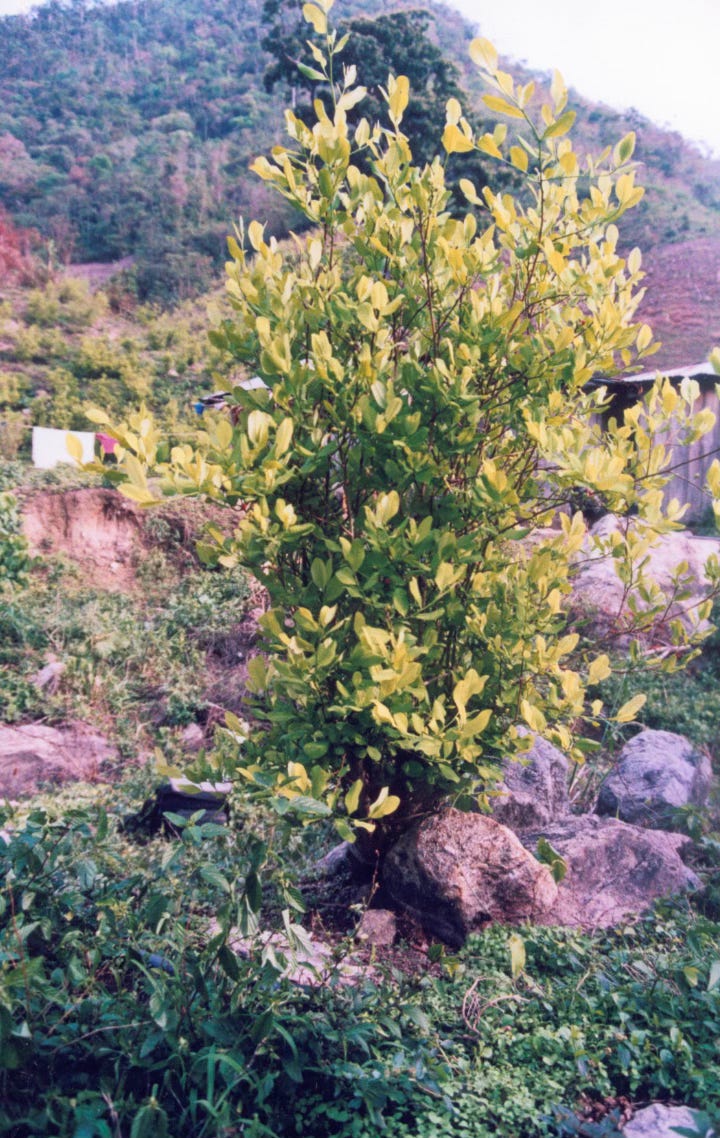
| Foto G.O.L coca plant Sur de Bolívar, Colombia, 2001. |
Petro came out once again with his proposal to eradicate coca. It is not his proposal though, it is an old one and even dates from before Plan Colombia. This plan is not only a state policy but the policy of various international bodies and European governments: crop substitution. Petro in a visit to the south of the country to inaugurate the Community Groups in Support of the Eradication of Illicit Use Crops spoke of the need to eradicate them and also to build the necessary infrastructure, blaming his government’s functionaries for the lack of progress on this last point.[1]
Under Petro’s government when something is not done, or is done badly, he blames the functionaries, but is he not the president? What are all the friends, lovers, children of lovers and the rest that he appointed to his government doing? They are also functionaries. If they are not up to the task they should return to the NGOs from whence they came, if there are any vacancies. There they can waste money and half do their jobs without any great concern.
On the substitution itself he said in his Twitter account that:
It seems to contradict his own strategy on illicit crops that talked of, in principle, broader initiatives on topics such as poverty and infrastructure etc.[3] Though if one looks at previous government strategies they all talked of infrastructure and other matters. For all of them the key was crop substitution. Through that they aimed to say that the peasant grows coca because it is more profitable than other crops and that the peasants made a mistake in choosing their original crops (food stuffs) and that with a change they might rise out of poverty. This completely ignores the concentration of production in the modern Colombian countryside where just six crops account for 70% of tilled land.
Coffee and cocoa are integral crops to all substitution proposals and predate Plan Colombia. They were part of Samper’s proposal known as Plante. Another lead crop, as they say is African Palm which is to be found everywhere. According to the FAO in 2000, 675,342 hectares of coffee were harvested compared to 841,354 in 2023. Something similar can be seen with cocoa which increased from 81,138 ha. to 190,800 ha harvested. In the case of coconuts the increase was smaller going from 14,076 ha. to 17,328 ha. But in the case of African palm a dramatic increase can be seen rising from 134, 772 to 502,624 with another 100,000 hectares planted that have yet to come into production. And despite this in the same period the coca in the country rose from 163,000 hectares to 252,000 in 2023.
These are not new proposals, as under Uribe Vélez’s government they talked of the Forest Protection Programme. But the forest protectors, protected cocoa crops whilst the chain saw destroyed the jungle. Uribe was enthusiastic about the monocultures. His minister for agriculture the corrupt convict Felipe Arias drew up the document Exporting Stake where they defined the items of the agricultural economy that they wanted to promote as cash crops. It should surprise no one that the first item were the slow growth crops such as palm, cocoa, rubber and some nuts and they proposed quadrupling the area planted with these crops between 2006 and 2020.[4]
Love of these monocultures is not the exclusive domain of Uribe, Arias nor Petro. All governments have promoted these crops, even the FARC agreed in their peace agreement to promote agribusiness.
Petro began his presidency with grandiose statements announcing changes in the paradigm on mining, agriculture and many more policies, including his anti-drugs policy. He gave a speech at the United Nations where he said they had to change the prohibitionist paradigm. He ends his government repeating the same old policies and finishes off with his minister for justice Andrés Idárraga announcing the recommencement of the fumigation of coca crops through aerial spraying with glyphosate in the Department of Cauca.
If fumigation works, then it should work everywhere. The fact they are limiting it to Cauca with the excuse that they are combatting the dissidents of the FARC, shows that it is the same discourse from Uribe and also, it is worth saying, Trump. The anti-drugs policy of Petro has been a complete failure. The Colombian countryside’s problem has deep roots, it has to do with the power structure in the countryside, the structure of the Colombian economy, its role in the global economy, the dominance of national and international monopolies. And none of that changes by saying to a peasant, Hey fella, plant cocoa instead of coca.
Under Petro’s government when something is not done, or is done badly, he blames the functionaries, but is he not the president? What are all the friends, lovers, children of lovers and the rest that he appointed to his government doing? They are also functionaries. If they are not up to the task they should return to the NGOs from whence they came, if there are any vacancies. There they can waste money and half do their jobs without any great concern.
On the substitution itself he said in his Twitter account that:
A peasant movement in favour of it, and a budget, seeds to replant the forest, cocoa, coffee and coconuts. We need long term purchase contracts for foodstuffs. That is how we eradicate coca in Colombia.[2]
It seems to contradict his own strategy on illicit crops that talked of, in principle, broader initiatives on topics such as poverty and infrastructure etc.[3] Though if one looks at previous government strategies they all talked of infrastructure and other matters. For all of them the key was crop substitution. Through that they aimed to say that the peasant grows coca because it is more profitable than other crops and that the peasants made a mistake in choosing their original crops (food stuffs) and that with a change they might rise out of poverty. This completely ignores the concentration of production in the modern Colombian countryside where just six crops account for 70% of tilled land.
Coffee and cocoa are integral crops to all substitution proposals and predate Plan Colombia. They were part of Samper’s proposal known as Plante. Another lead crop, as they say is African Palm which is to be found everywhere. According to the FAO in 2000, 675,342 hectares of coffee were harvested compared to 841,354 in 2023. Something similar can be seen with cocoa which increased from 81,138 ha. to 190,800 ha harvested. In the case of coconuts the increase was smaller going from 14,076 ha. to 17,328 ha. But in the case of African palm a dramatic increase can be seen rising from 134, 772 to 502,624 with another 100,000 hectares planted that have yet to come into production. And despite this in the same period the coca in the country rose from 163,000 hectares to 252,000 in 2023.
These are not new proposals, as under Uribe Vélez’s government they talked of the Forest Protection Programme. But the forest protectors, protected cocoa crops whilst the chain saw destroyed the jungle. Uribe was enthusiastic about the monocultures. His minister for agriculture the corrupt convict Felipe Arias drew up the document Exporting Stake where they defined the items of the agricultural economy that they wanted to promote as cash crops. It should surprise no one that the first item were the slow growth crops such as palm, cocoa, rubber and some nuts and they proposed quadrupling the area planted with these crops between 2006 and 2020.[4]
Love of these monocultures is not the exclusive domain of Uribe, Arias nor Petro. All governments have promoted these crops, even the FARC agreed in their peace agreement to promote agribusiness.
Comprehensive development of the countryside: the comprehensive development of the countryside depends on the proper balance between the different forms of production in existence – family-based agriculture, agroindustry, tourism, commercial large scale agriculture; on the competitiveness and the need to promote and foment investment in the countryside with an entrepreneurial vision and productive aims as a condition for development…
…the government will foment and promote associative practices, productive chains and alliances between small-scale, medium sized and large producers as well as processors, traders and exporters with the aim a guaranteeing a competitive scale of production.[5]
Petro began his presidency with grandiose statements announcing changes in the paradigm on mining, agriculture and many more policies, including his anti-drugs policy. He gave a speech at the United Nations where he said they had to change the prohibitionist paradigm. He ends his government repeating the same old policies and finishes off with his minister for justice Andrés Idárraga announcing the recommencement of the fumigation of coca crops through aerial spraying with glyphosate in the Department of Cauca.
If fumigation works, then it should work everywhere. The fact they are limiting it to Cauca with the excuse that they are combatting the dissidents of the FARC, shows that it is the same discourse from Uribe and also, it is worth saying, Trump. The anti-drugs policy of Petro has been a complete failure. The Colombian countryside’s problem has deep roots, it has to do with the power structure in the countryside, the structure of the Colombian economy, its role in the global economy, the dominance of national and international monopolies. And none of that changes by saying to a peasant, Hey fella, plant cocoa instead of coca.
References
[1] See
[2] See.
2:08 AM · Dec 21, 2025 · 482K Views
538 Replies · 2.07K Reposts · 5.24K Likes
[3] National Drug Policy 2023-2033. Ministerio de Justicia. Bogotá.
[4] The document is APUESTA EXPORTADORA AGROPECUARIA MINISTER10 DE AGRICULTURA Y DESARROLLO RURAL 2006 – 2020 was taken down from the internet after the scandal surrounding Felipe Arias and the Secure Agricultural Income programme.
[5] ACUERDO FINAL PARA LA TERMINACIÓN DEL CONFLICTO Y LA CONSTRUCCIÓN DE UNA PAZ
ESTABLE Y DURADERA pages 12 & 33.
[1] See
[2] See.
2:08 AM · Dec 21, 2025 · 482K Views
538 Replies · 2.07K Reposts · 5.24K Likes
[3] National Drug Policy 2023-2033. Ministerio de Justicia. Bogotá.
[4] The document is APUESTA EXPORTADORA AGROPECUARIA MINISTER10 DE AGRICULTURA Y DESARROLLO RURAL 2006 – 2020 was taken down from the internet after the scandal surrounding Felipe Arias and the Secure Agricultural Income programme.
[5] ACUERDO FINAL PARA LA TERMINACIÓN DEL CONFLICTO Y LA CONSTRUCCIÓN DE UNA PAZ
ESTABLE Y DURADERA pages 12 & 33.
⏩ Gearóid Ó Loingsigh is a political and human rights activist with extensive experience in Latin America.


No comments