


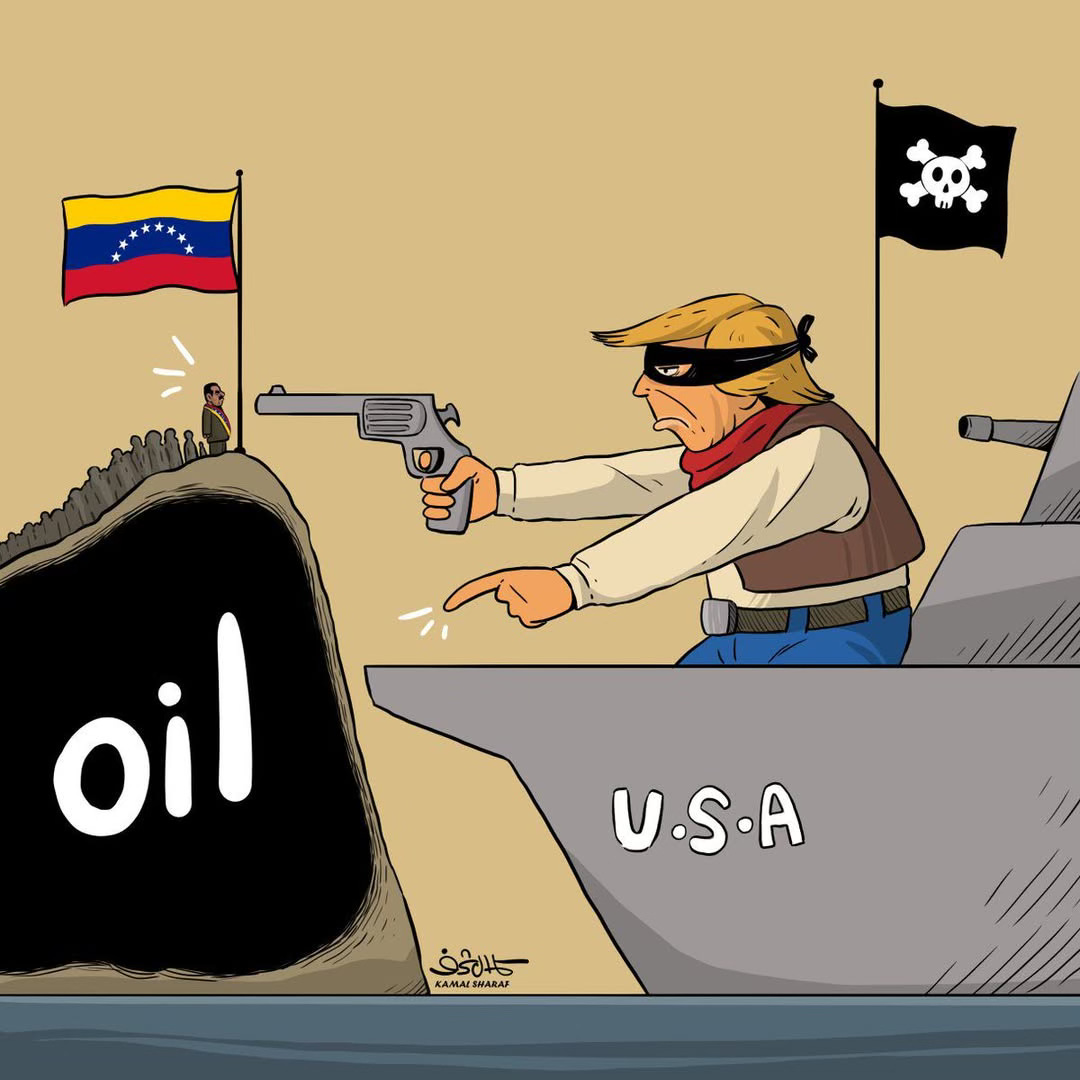
US threats against Venezuela are not new. They have been threatening the country for years, sending mercenaries, financing politicians with a dodgy reputation such as Juan Guaidó and imposing a blockade on the country. Nothing has worked for them and Trump remembered the old wildcard of all US governments from the end of the 19th century: drugs. It is the perfect excuse for all types of interference in the internal affairs of any country, but it is not new. Trump’s antics are not copyrighted - they are plagiarised.
The plagiarism is of previous presidents such as Obama, Clinton and even Theodore Roosevelt (the one who stole Panama from Colombia) under whose mandate the meeting of the Opium Commission was held in Shanghai in 1909. A lot of talk about the evil of drugs and against consumption, but in reality, it was part of a manoeuvre to get into China’s good books to favour their economic interests in exchange for helping them eliminate opium consumption.[1] They were never concerned about consumers’ health. Every attempt and international treaty to limit or prohibit drug consumption always excluded alcohol and tobacco, two drugs produced by large north American and European companies.
Nowadays, despite all the modern campaigns against tobacco consumption, the industry generates mouthwatering profits. Just five companies dominate the world market, the largest being Altria, the owner of companies like Phillip Morris USA. Between 2020 and 2024 this company paid out a total of USD 32 billion in dividends to the shareholders.[2] Something similar happens in the case of alcohol with a global market of more than USD 2,400 billion.[3]
But those drugs, whose markets were not dominated by the USA, were prohibited leaving juicy profits for the Yankee companies with the sale of legal drugs such as tobacco and alcohol. But that does not mean that the illegal drugs don’t generate huge profits for north American and European companies in money laundering and the supply of precursor chemicals to make heroin, cocaine and other illegal drugs.
It is not surprising that the first attempts to militarise the interdiction of narcotics took place under a republican government. It is not that the democrats are better, but that sometimes they leave the dirty work to the republicans, in this case Reagan and Bush Sr. who militarised the war on drugs both internationally and within the country, particularly on the border with Mexico.[4]
At the end of the 1980s, in the midst of debates on overturning the Posse Comitatus Act[5] and allow for a freer use of the military against the civilian population they ended up recognising the military as the lead agency for the detection and monitoring of drug trafficking towards the USA.[6] Both Bush and Obama sent troops to the Mexican border as part of the war on drugs.[7] In Latin America the USA promoted the militarisation of the war on drugs, financing anti-narcotic units within the military, as was the case in Bolivia. And even in the case of Colombia the first anti-narcotics battalion was agreed to in a meeting between US Secretary of Defence William Cohen and the Colombian Minister for Defence Rodrigo Lloreda. The US provided the funds. When we think of the Colombian conflict, it seems implausible that the Colombian military turned down flat an offer of USD 2.8 million to set up military anti-narcotic units.[8]
The first international anti-narcotics operation where US troops publicly took part was Operation Blast Furnace in Bolivia, 1986. Approximately 160 north American troops in Panama were transferred to Bolivia to supposedly help the Bolivian police destroy laboratories and seize cocaine. It was the first of many joint operations. In 1990, the governments of Bolivia, Colombia, Peru and the US agreed that the armed forces of each country can and should take part in the fight against drugs.
But those drugs, whose markets were not dominated by the USA, were prohibited leaving juicy profits for the Yankee companies with the sale of legal drugs such as tobacco and alcohol. But that does not mean that the illegal drugs don’t generate huge profits for north American and European companies in money laundering and the supply of precursor chemicals to make heroin, cocaine and other illegal drugs.
It is not surprising that the first attempts to militarise the interdiction of narcotics took place under a republican government. It is not that the democrats are better, but that sometimes they leave the dirty work to the republicans, in this case Reagan and Bush Sr. who militarised the war on drugs both internationally and within the country, particularly on the border with Mexico.[4]
At the end of the 1980s, in the midst of debates on overturning the Posse Comitatus Act[5] and allow for a freer use of the military against the civilian population they ended up recognising the military as the lead agency for the detection and monitoring of drug trafficking towards the USA.[6] Both Bush and Obama sent troops to the Mexican border as part of the war on drugs.[7] In Latin America the USA promoted the militarisation of the war on drugs, financing anti-narcotic units within the military, as was the case in Bolivia. And even in the case of Colombia the first anti-narcotics battalion was agreed to in a meeting between US Secretary of Defence William Cohen and the Colombian Minister for Defence Rodrigo Lloreda. The US provided the funds. When we think of the Colombian conflict, it seems implausible that the Colombian military turned down flat an offer of USD 2.8 million to set up military anti-narcotic units.[8]
The first international anti-narcotics operation where US troops publicly took part was Operation Blast Furnace in Bolivia, 1986. Approximately 160 north American troops in Panama were transferred to Bolivia to supposedly help the Bolivian police destroy laboratories and seize cocaine. It was the first of many joint operations. In 1990, the governments of Bolivia, Colombia, Peru and the US agreed that the armed forces of each country can and should take part in the fight against drugs.
The control of illegal trafficking in drugs is essentially a law enforcement matter. However, because of its magnitude and the different aspects involved, and in keeping with the sovereign interest of each State and its own judicial system, the armed forces in each of the countries, within their own territory and national jurisdictions, may also participate. The Parties may establish bilateral and multilateral understandings for cooperation in accordance with their interests, needs and priorities.[9]
Amongst the military options was aerial interdiction, that initially consisted of the destruction of runways, but in the 1990s Colombia and Peru began a programme of shooting down aeroplanes in mid-flight. The US was worried about the possibility of lawsuits over those acts and for a while suspended the sharing of intelligence with Peru and Colombia.[10] Clinton however, approved a law protecting US military officers involved in such attacks. Between 1995 and 2001, the US military took part in the downing of 14 small planes in Peru, and the Peruvians on their own a further 24. And it is not known how often the Colombians downed planes.[11] But the programme was suspended for a while following an attack on a small plane that was carrying a US evangelical missionary and her infant who were killed in the attack. Later it was renewed with new rules in place.
So, Trump’s attacks on speed boats and fishing boats are the continuation of a drugs policy developed to its logical conclusion. What he is doing is not new and the same doubts about the legality of such actions have always existed regarding the downing of planes. Of course, there is a difference and it is only that Trump’s actions are unilateral and are not carried out in the context of a previously agreed plan. Although, it worth saying that in the case of Colombia, Petro has not taken any of the measures to hand to put a stop to the military actions. The US still has seven military bases in the country and the military and the police not only continue to cooperate with them but rather Petro even boasts about the participation of US intelligence in the bombarding of FARC dissidents and stated on his Twitter account:
There have been twelve bombardments ordered by me and only by me, respecting to the utmost degree human rights. US intelligence is used but under human rights conditions that I myself have adopted.[12]
It should be pointed out that all presidents say they respect human rights, even Uribe did so. Whether they do or not (and they don’t) is another matter.
So, Trump represents a development and at the same time a continuity regarding drugs and the military. He also represents a continuity with all the other presidents of the USA regarding the real interests behind their discourse on drugs. Trump is not interested in drugs. If he was, he wouldn’t have pardoned the former president of Honduras, Juan Orlando Hernández convicted of importing 400 tons of cocaine. Hernández is not the only drug trafficker to have been pardoned by Trump.[13]
If Obama had been interested in drugs he would have taken stern action against HSBC following the scandal of the laundering of USD 881 million. But he did little. He could have suspended their banking licence, he could also have placed the entire board of directors of the bank on the Clinton List, but he didn’t. Instead, the bank paid a fine of USD 1.8 billion and went on as if nothing. It should be said that it was not the first, nor the last time that bank and others launder the proceeds of the sale of illegal drugs. Amongst the banks fined for money laundering are Credit Suisse USD 536 million in 2009; Barclays USD 298 million in 2010; ING USD 619 million in 2012; Standard Chartered USD 330 million in 2012 and another USD 1.1 billion in 2019; BNP Paribas USD 8.9 billion in 2014 and Deutsche Bank USD 258 million in 2015.[14] Clinton himself freed from a jail a lawyer that had laundered money for the Cali Cartel. If it was really about drugs the board of directors of those banks would be in prison and/or on the Clinton List and Clinton would never have freed Harvey Weinig from prison.
If they wanted to solve the drug problem by military means in the US, they could bomb the headquarters, if not the factories of the major pharmaceutical companies in the US. The opiate crisis in the US began with the abuse of legal pharmaceuticals, amongst them fentanyl. The illegal market began with meeting the needs of that abuse, supplying a cheaper product that was easier to obtain. Even so, 125 million prescriptions for opioids are issued in the country and 96% of those who use illegal opiates consume legal ones at least once a year.[15] The problem is Made in USA.
If they wanted to prevent the fabrication of cocaine they could bomb the German hydrochloric acid factories, an essential precursor chemical for making cocaine. But of course, they are not going to do any of that.
As the title of this article indicates, the drugs issue is a wildcard that can be used at any time to do whatever they want. When they invaded Panama, they said that it was because Noriega was a drug trafficker. He may have been, but he was their drug trafficker. What they want is Venezuela’s oil, as in other moments the stability of Colombia in order to take control of the natural resources. When a Yankee president says that he has to intervene in a country because of drugs, he plays with the truth, he plays poker with the future of millions and his wildcard is drugs. The excuse that convinces many.
References
[1] Bewley-Taylor, D.R, (1999). The United States and International Drug Control. 1909-1997, London: Pinter. P-18 – 19.
[2] See.
[3] See.
[4] See History of Joint Task Force North
[5] A US law that restricted though did not totally prohibit the use of the military against the civilian population in the exercise of a police role. It dates from 1878.
[6] Withers, G. et al (2010) Preach What you Practice: The Separation of Military and Police Roles in the Americas. WOLA. pp. 7-8
[7] Ibíd. p.9
[8] Ibíd. p.17
[9] Declaration of Cartagena.
[10] Huskisson, Major D.C. (2004) The Airbridge Denial Program and the Shootdown of Civil Aircraft Under International Law. Magill University. pp. 10-11 https://apps.dtic.mil/sti/tr/pdf/ADA425906.pdf
[11] Ibíd. p.14
[12] See.
[13] Complex (04/12/2025) Here’s The Drug Dealers Trump Has Pardoned. Joe Price.
[1] Bewley-Taylor, D.R, (1999). The United States and International Drug Control. 1909-1997, London: Pinter. P-18 – 19.
[2] See.
[3] See.
[4] See History of Joint Task Force North
[5] A US law that restricted though did not totally prohibit the use of the military against the civilian population in the exercise of a police role. It dates from 1878.
[6] Withers, G. et al (2010) Preach What you Practice: The Separation of Military and Police Roles in the Americas. WOLA. pp. 7-8
[7] Ibíd. p.9
[8] Ibíd. p.17
[9] Declaration of Cartagena.
[10] Huskisson, Major D.C. (2004) The Airbridge Denial Program and the Shootdown of Civil Aircraft Under International Law. Magill University. pp. 10-11 https://apps.dtic.mil/sti/tr/pdf/ADA425906.pdf
[11] Ibíd. p.14
[12] See.
[13] Complex (04/12/2025) Here’s The Drug Dealers Trump Has Pardoned. Joe Price.
[14] Investopedia (12/10/2025) HSBC Money Laundering Scandal: A Case Study in Compliance Failures. Marc L. Ross.
[15] See.
⏩ Gearóid Ó Loingsigh is a political and human rights activist with extensive experience in Latin America.


No comments